

We asked the review platforms the question you ask. Five of the seven would not answer, and that refusal is the most useful thing we learned.
Your buyer types a vendor name into a review platform, reads three complaints, and closes the tab. That behaviour is not changing.
What is changing is the search around it. In the queries we track, the phrase "rankshift" with "trustradius" appears ten times in different forms.
Those ten queries drew 1,837 impressions over six months with not one click. Our own pages rank for them. We do not answer them.
This post is the honest version of the answer: what we could read, what we could not, and how to run the check yourself in twenty minutes.
The question buyers ask is not the one review sites answer
A review platform is built for a buyer who is already on it. They arrived from a link, they are reading one product, and the page gives them ratings, a filter and a wall of comments.
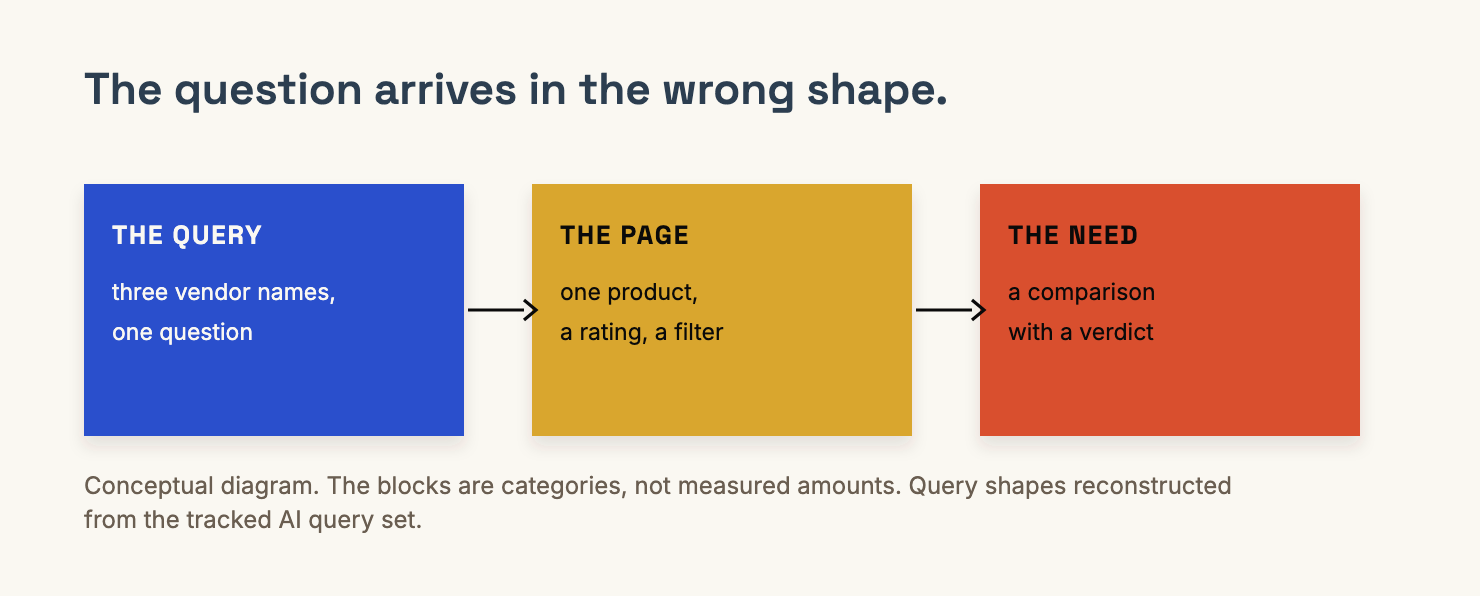
Your buyer is somewhere earlier. They are in a search box, they have typed three vendor names, and they are trying to find the difference between them.
What they want is a comparison. The review platform gives them a single product's page with an unrelated product's page next door.
That mismatch is why the queries sit unanswered on our pages. We publish the comparison they need. They searched for a review, and the comparison is not what the word promised.
Why the review platform is the wrong place to look
There is a structural reason the platforms do not answer comparison questions, and it is worth naming before anyone accuses them of hiding something.
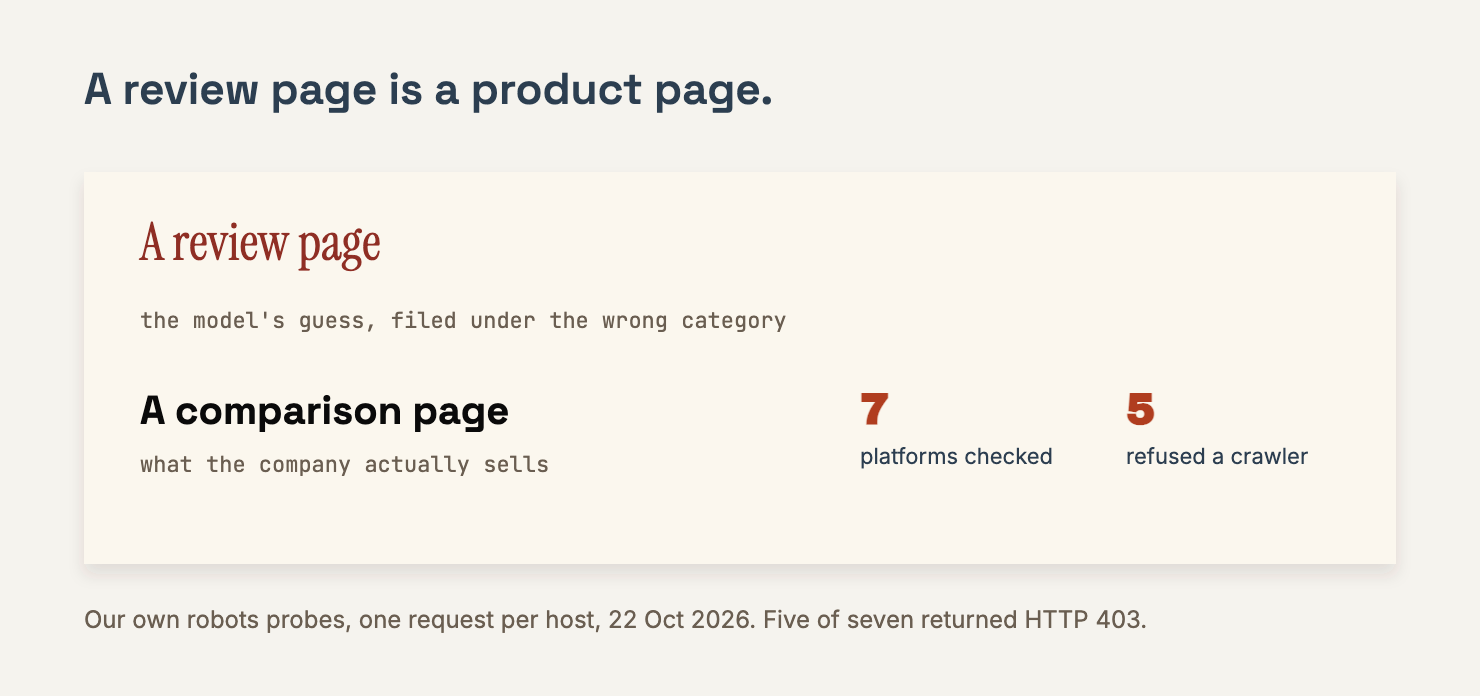
A review page is a product page for a reviewer. It has a rating, a filter, a scroll of comments and a call to action for a trial. It is not a comparison, and it was never built to be one. The page a buyer actually wants, a side-by-side of three vendors, does not exist there in a form anyone can rank.
So the reviews are answering a different question than the one being asked. That is not censorship. It is a mismatch between a product's shape and a buyer's need, and it is why a comparison page can rank for a review query and still not satisfy it.
Which is the uncomfortable part for us. We were ranked for those queries. We did not lose them to the platforms. We lost them to our own snippets.
Five of the seven will not let a crawler read them
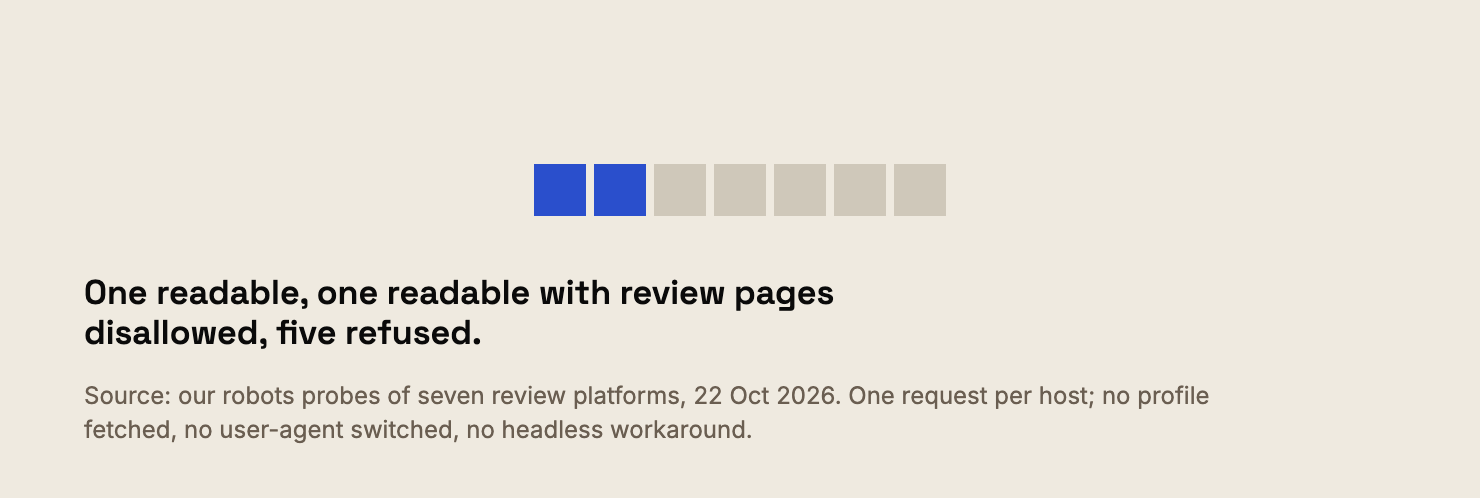
Before writing anything about what reviewers say, we checked what we were permitted to read. One request per host, the robots file first, no profile fetched, no user-agent switched, no headless browser used to get around a refusal.
| Platform | robots.txt | What that means for us |
|---|---|---|
| G2 | 200, 88 rules for `*` | Read paths open. Interaction paths such as lead forms and follow requests are not. |
| Capterra | 403 | Permission unverifiable. Nothing collected. |
| TrustRadius | 403 | Permission unverifiable. Nothing collected. |
| GetApp | 403 | Permission unverifiable. Nothing collected. |
| Product Hunt | 403 | Permission unverifiable. Nothing collected. |
| Software Advice | 403 | Permission unverifiable. Nothing collected. |
| Gartner | 200 | Readable, and review-detail pages and vendor-versus-vendor comparisons are explicitly disallowed. |
That table is the finding. One platform of seven permits a crawler to read a product profile without restriction.
That seven is fourteen now, and the wider read is more open and less usable at the same time. Twelve of the fourteen publish a rules file, eleven of those permit reading a product profile, and only two will serve the file to an automated client at all. That is what the review platform access study measured on 23 October. The consequence for anything written about reviews is blunt: a 403 on a rules file is a wall rather than a policy, and you cannot quote a condition you were never handed.
And the two directories that do publish vendor-versus-vendor comparisons are the two that disallow reading them.
We did not attempt to route around any of this. A 403 is a refusal, and a refusal is the answer to the question we were asking.
What a refusal actually costs you
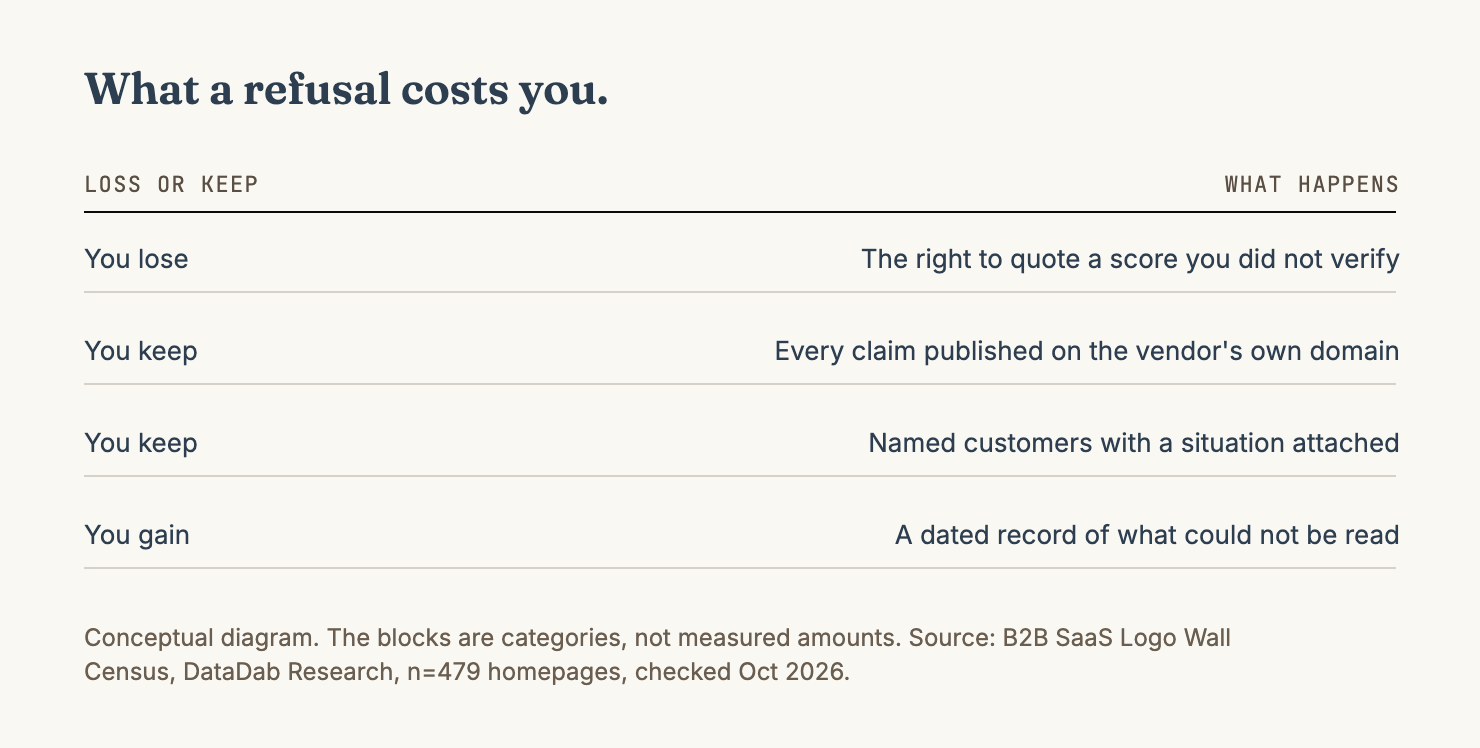
It costs less than the folklore suggests, and more than the optimists claim.
You lose the ability to quote a review score as if you had verified it. That is a real loss, because "4.3 out of 5 on G2" is a sentence buyers repeat, and a number you cannot check is a number you should not publish.
What you keep is everything you can verify from the vendor's own domain. A named customer on a vendor's customer page is a claim the vendor made publicly, and you can check it, date it, and link it. Our logo-wall census found 74.2% of the marks on those walls identifiable, and 21.1% of the 479 homepages we checked carry a wall at all.
The other 25.8% of marks are hashed assets or variants, which is what a logo you cannot read looks like to a crawler.
The practical rule: prefer a named, linked, checkable fact over an unverified score, even when the score sounds more impressive.
The one review signal that is genuinely public
Customer evidence published on the vendor's own site is the closest thing to a review that you can verify, and it is more useful than a star rating for a specific reason: it names the situation.
A rating says a number of people were satisfied. A customer page says a company with 40 staff and a security review moved from a spreadsheet to our platform, and it usually says what made them switch.
That second sentence is the one that helps a buyer like yours, because it describes a fit rather than a feeling.
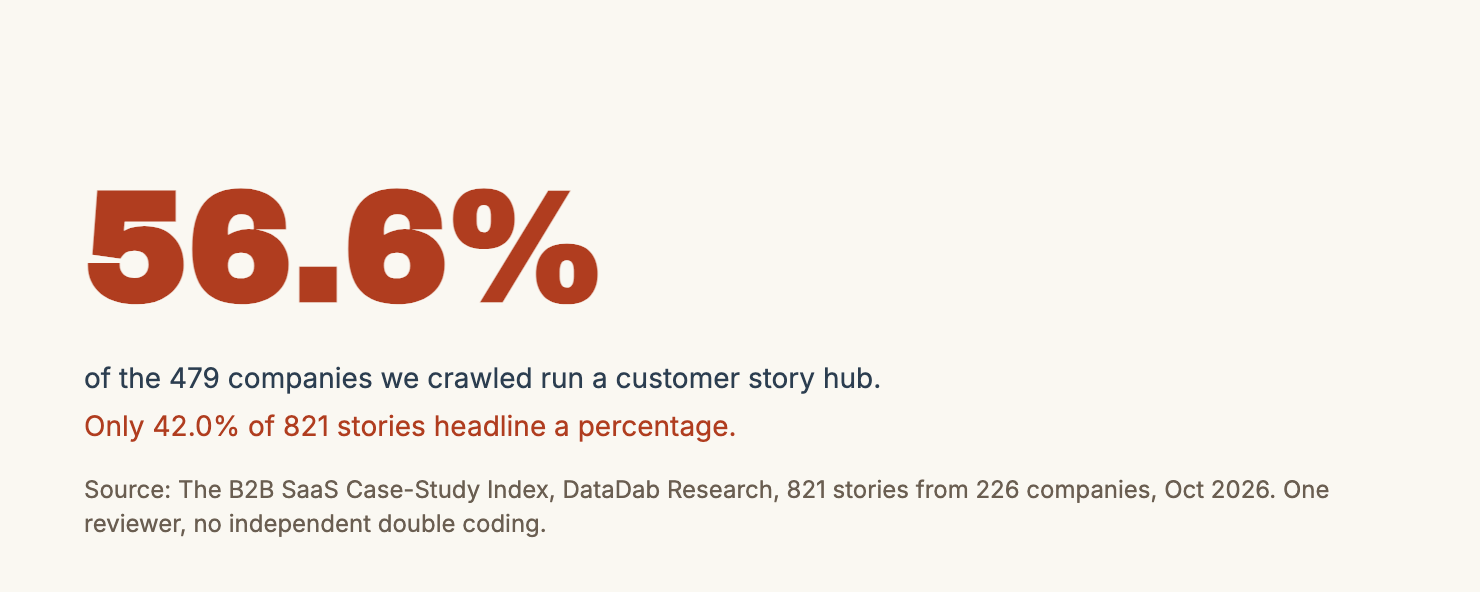
Our case-study index measured 821 published customer stories from 226 B2B software companies. It found 56.6% of companies maintain a story hub, and that only 42.0% of stories headline a percentage.
That is the standard to write to, whether or not you ever touch a review platform. Put the number in the headline, put the customer's situation next to it, and publish it where your buyer will land.
How to run this check yourself in twenty minutes
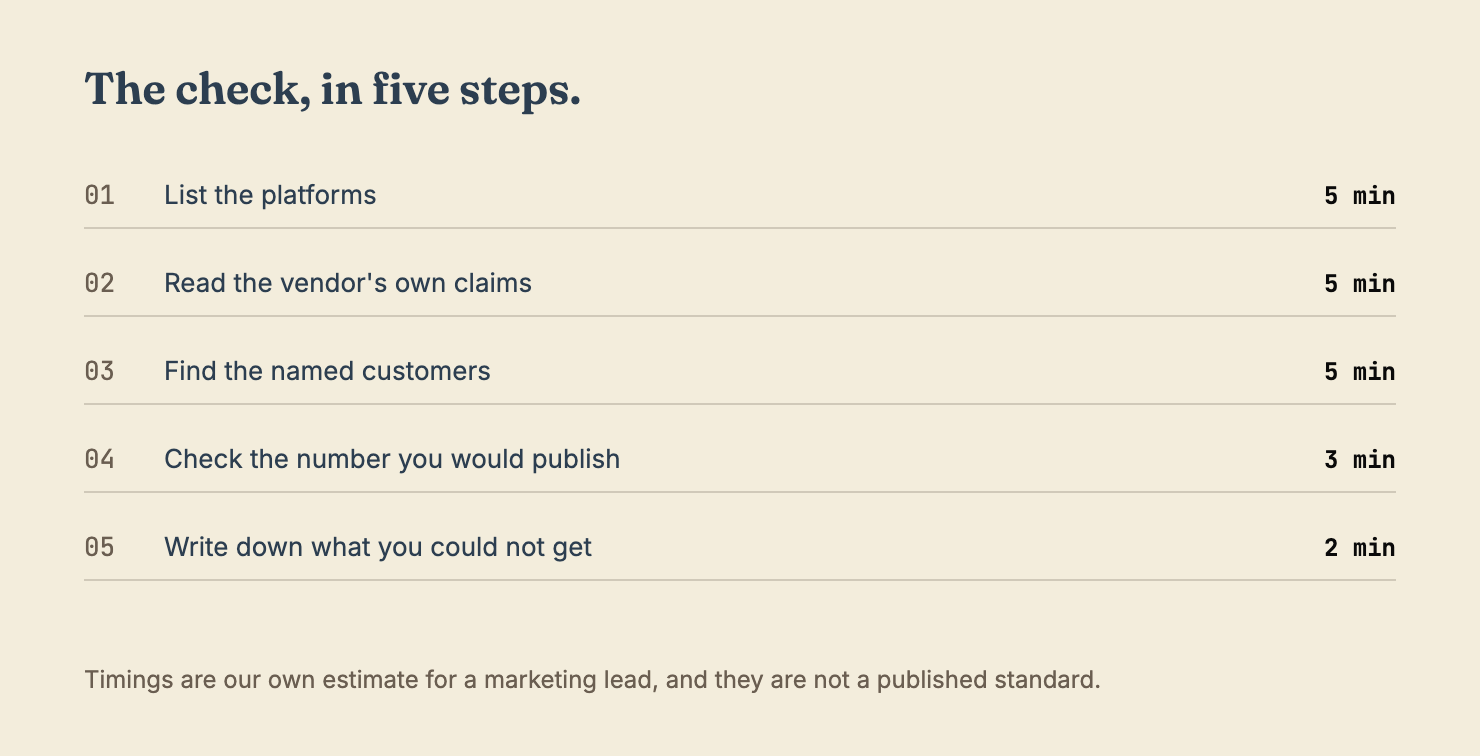
*List the platforms you will cite.* For each, open the robots file and record what it says. Write the answer down, including the refusals. A table of seven rows and a date beats a paragraph of opinion.
*Read what the vendor says about itself.* Every vendor publishes claims somewhere. Capture them with the date and the URL. These are the claims your buyer will meet, and you need to know whether they survive inspection.
*Find the named customers.* Look for real companies with a real situation attached. Check the logo belongs to a customer rather than a partner, because vendors pad walls.
*Check the one number you were going to publish.* If it is a rating, find whether the platform permits the reading. If it does not, drop it or attribute it to the platform's own summary without implying you verified more than you did.
*Write down what you could not get.* A short list of refused sources, with dates, is a defensible record, and it is the honest footnote for any page that quotes the category.
What we will not do
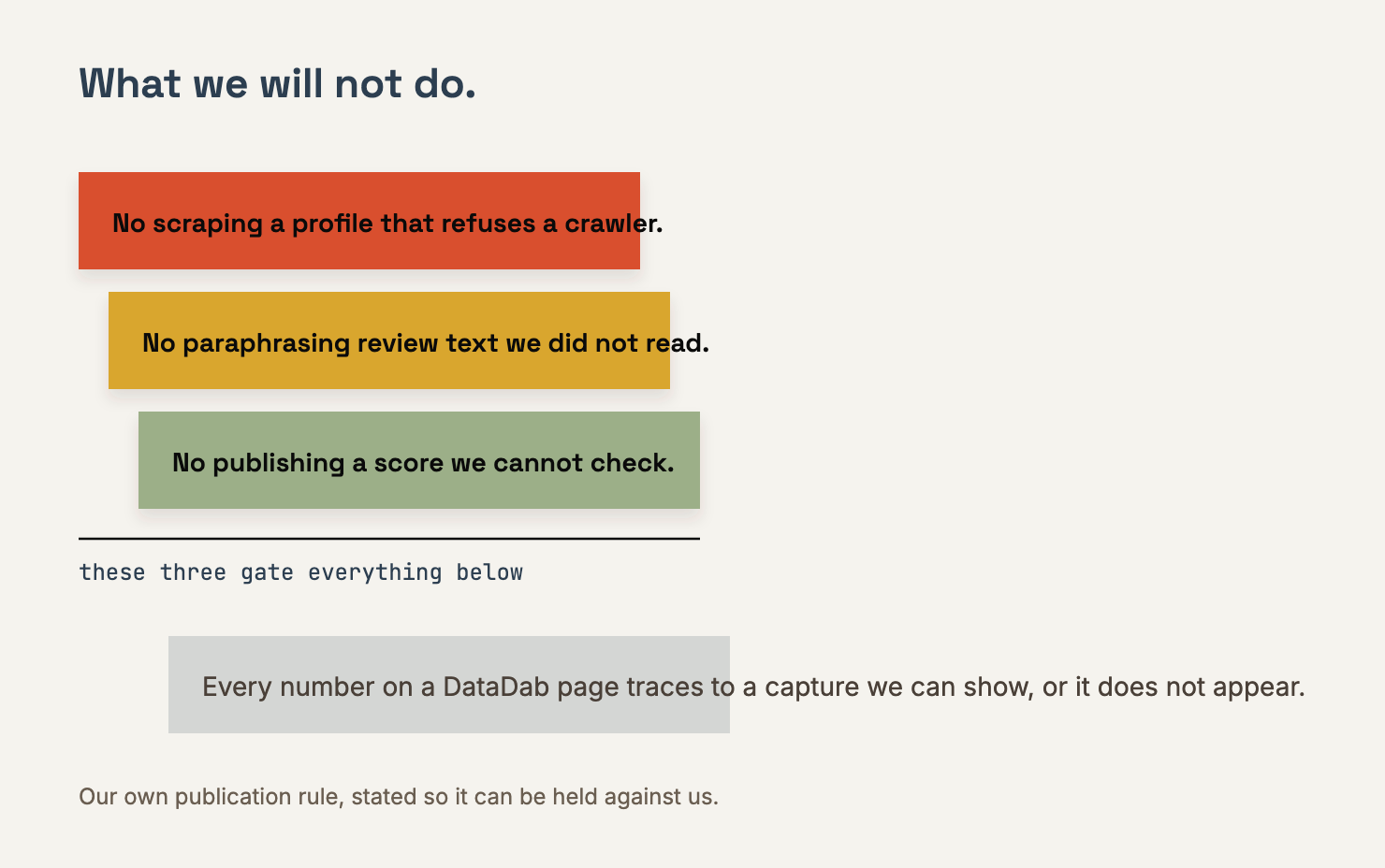
We will not scrape a profile that refuses a crawler, and we will not paraphrase review text we did not read. We will not publish a score we cannot check, and we will not present a vendor's own claim as though it were independent evidence.
This is not squeamishness. If you quote a review score and the platform's terms forbid the quotation, the claim is a liability, and the buyer who checks it finds out about your process rather than about the product.
The rule we apply to ourselves is simple. Every number on a DataDab page traces to a capture we can show, or it does not appear.
What we would publish instead, and how to check it
Here is the version of the answer we would put on our own comparison page, written the way we would want to read it.
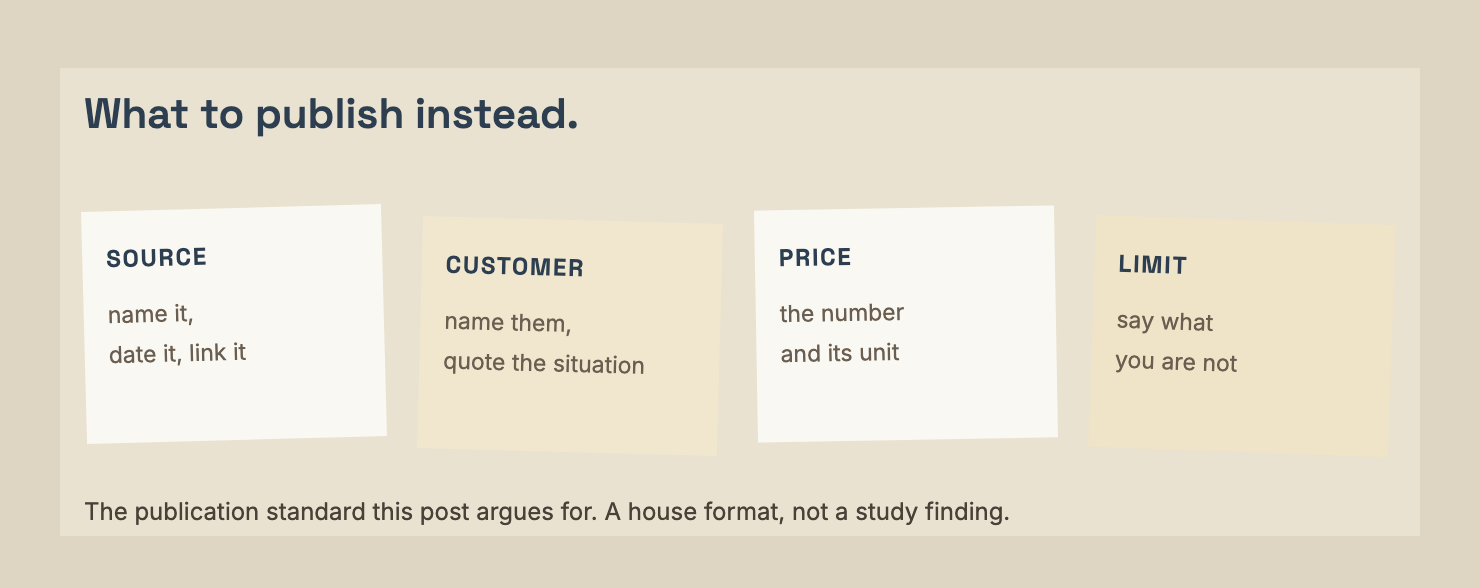
For each vendor, we name the source of every claim, with the date we read it. Where the vendor publishes a price, we quote it with its billing unit. Where it publishes a customer, we name them and link the page. Where a claim cannot be verified, we write that, in the same table, in the same type size as the rest.
That is a less exciting page than a scoreboard. It is also the one a buyer can use, because every line of it can be checked in a minute.
The test we apply: if a competitor challenged a line on our page, could we produce the capture? If not, the line does not ship. It is a low bar, and almost every published comparison fails it.
Who this is for
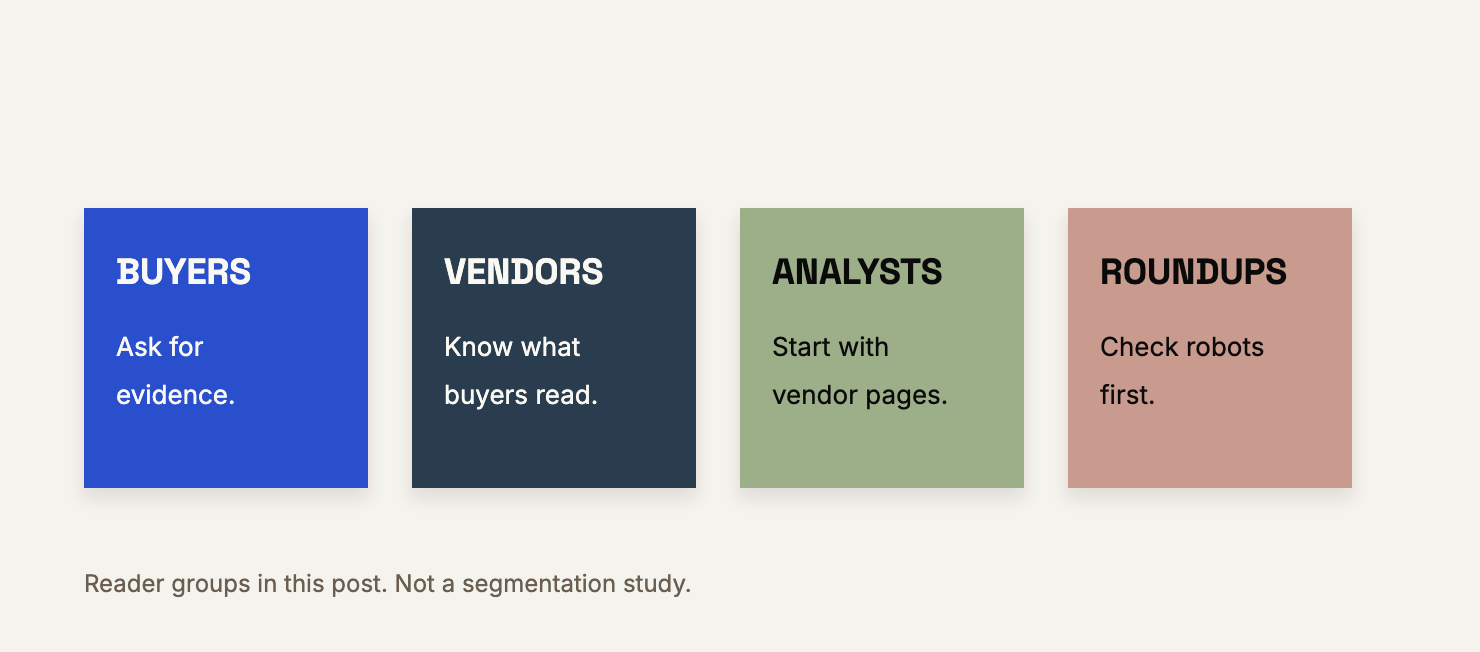
*Buyers comparing tools in this category.* Use the table above as a starting point, and ask each vendor for evidence you can open. A vendor that cannot name a checkable customer fact is telling you something.
*Vendors being compared.* Your review profile is part of your shortlist surface. Know what a buyer can read about you there, because for five of seven platforms it is nothing.
*Analysts writing the comparison.* The best sources here are not review platforms. They are vendor pages, case studies and captured pricing. Start there, and treat reviews as the thing you could not get rather than the thing you built on.
*Teams about to publish a roundup.* Check the robots files first. Ten minutes, and it decides whether your roundup is a synthesis or a liability.
How confident we are
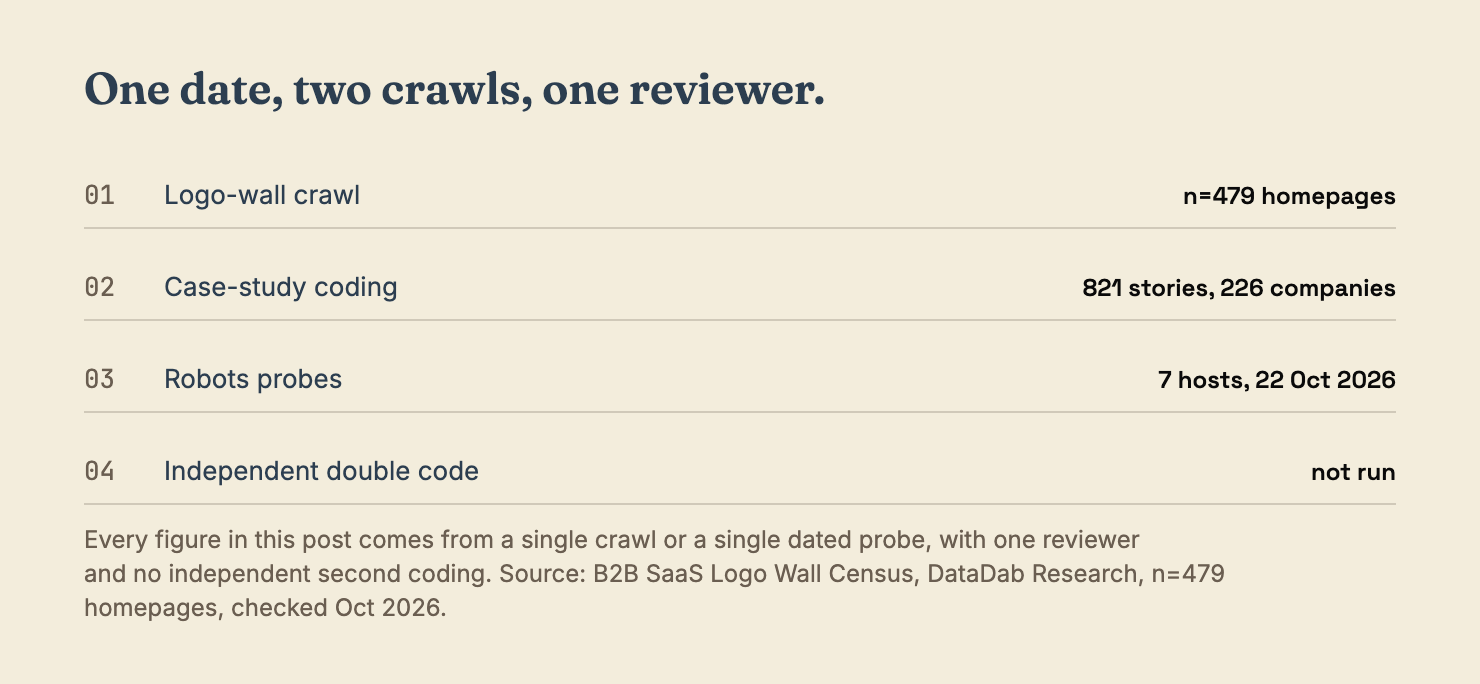
The robots results are one request per host on a single date, and platform policies change without notice. A 403 says the request was refused; it does not say why, and it does not say what a browser would have seen.
The 74.2% identifiable-marks and 21.1% wall-presence figures come from a crawl of 479 homepages with one reviewer and no independent second coding. The 42.0% and 56.6% figures come from 821 hand-coded stories, also with one reviewer.
We read no review profile in preparing this post, so we are not going to characterise what reviewers say about any vendor in it. We describe what we could and could not read, which is the part a buyer can act on.
Wrap-up
Your buyer asked what users say. We asked the platforms, and five of them declined, which told us where the useful evidence actually lives.
So look at what you can verify: a named customer with a situation attached, a claim on the vendor's own page, a price that carries its unit.
Our case-study index measured what the strongest companies publish, and the pattern is a number in the headline next to a real situation.
Publish that, cite what you checked, and write down what you could not reach. That is a shortlist a buyer can act on, worth more than a rating you cannot verify.