

A domain that sold revenue forecasting now redirects to a demo form. A different one, unrelated, now sells jewellery.
While checking whether the vendor list for this piece was stable, one of the domains we probed resolved to a jewellery retailer.
That was not even the interesting finding.
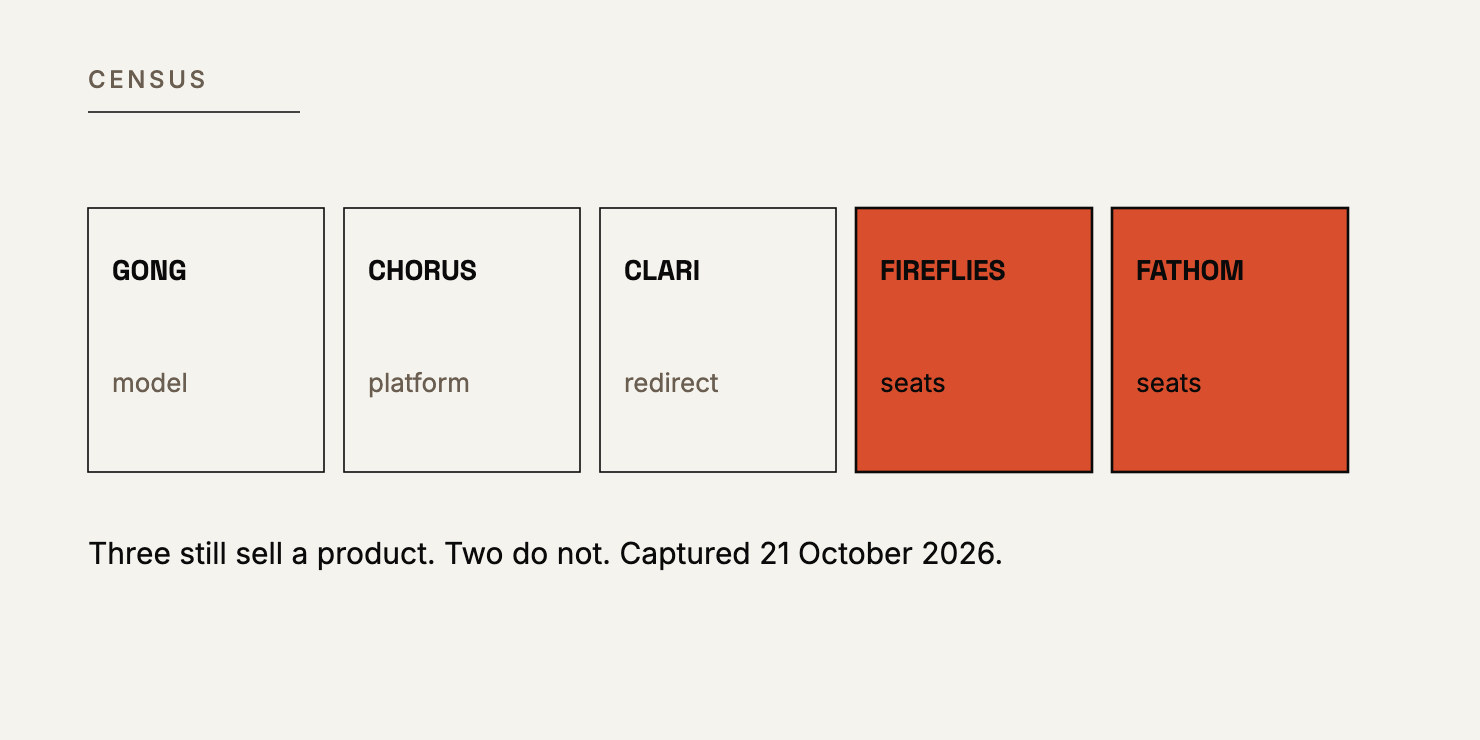
The interesting finding is that two of the five names on a 2025 conversation-intelligence shortlist are no longer products anyone can buy, and a third publishes a pricing model instead of a price.
I wrote the capture up as a census of the category, DNS probes and redirect chains included.
This is what it looks like when a market rearranges itself faster than a procurement process.
Chorus is a redirect now
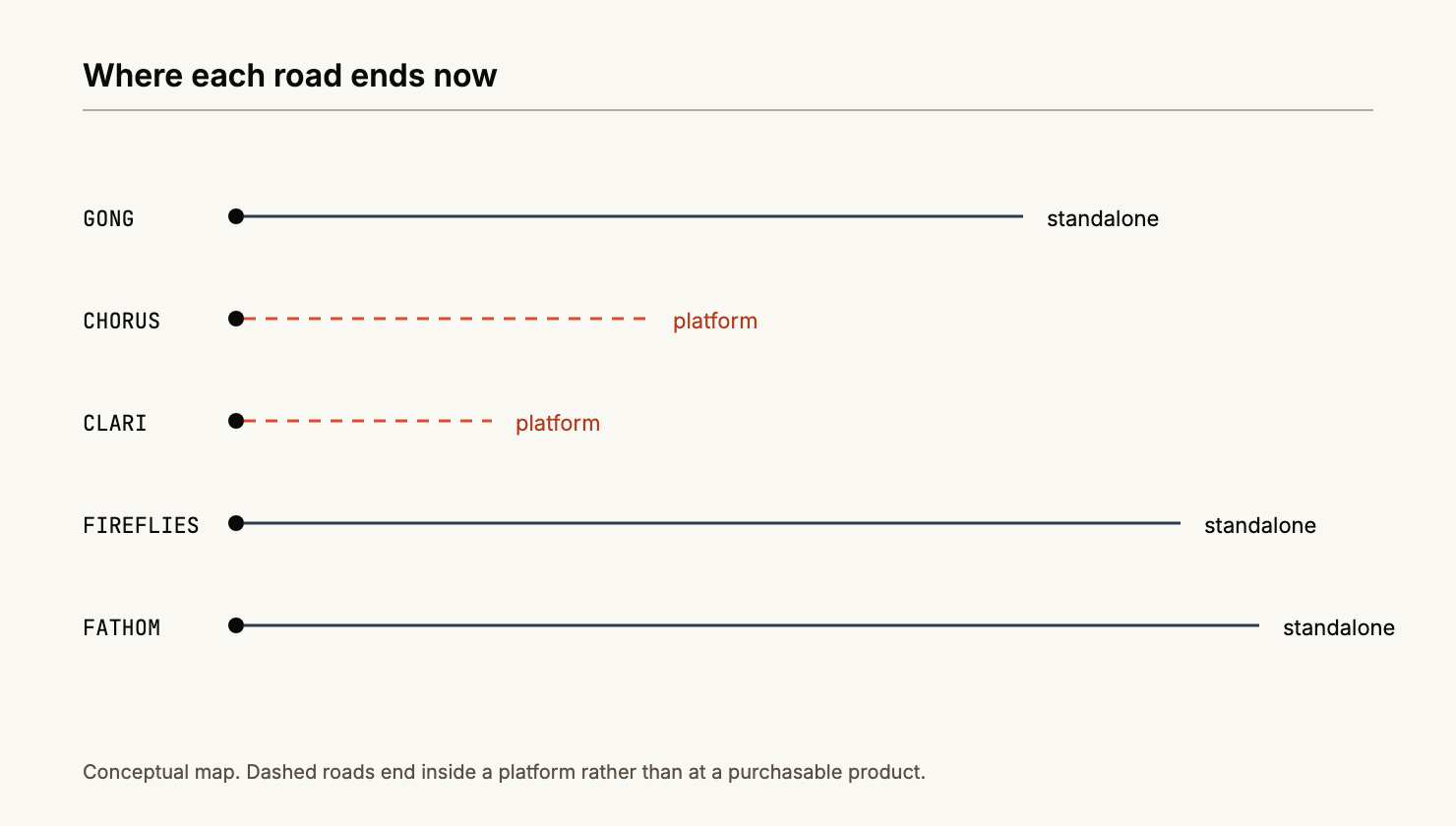
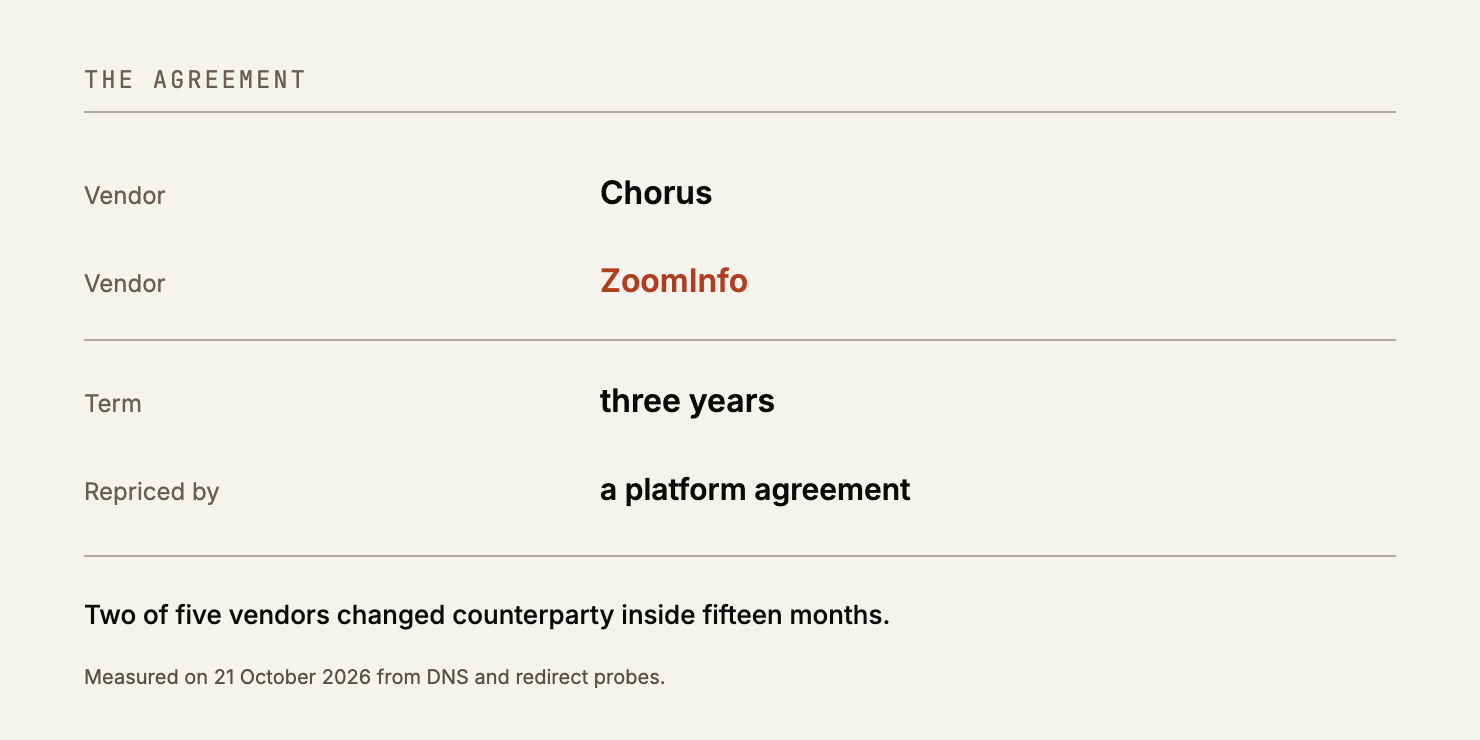
The old chorus.ai domain returns a document of 21 characters whose entire content is a redirect to the ZoomInfo Chorus product page. Its robots file answered 403 when we asked.
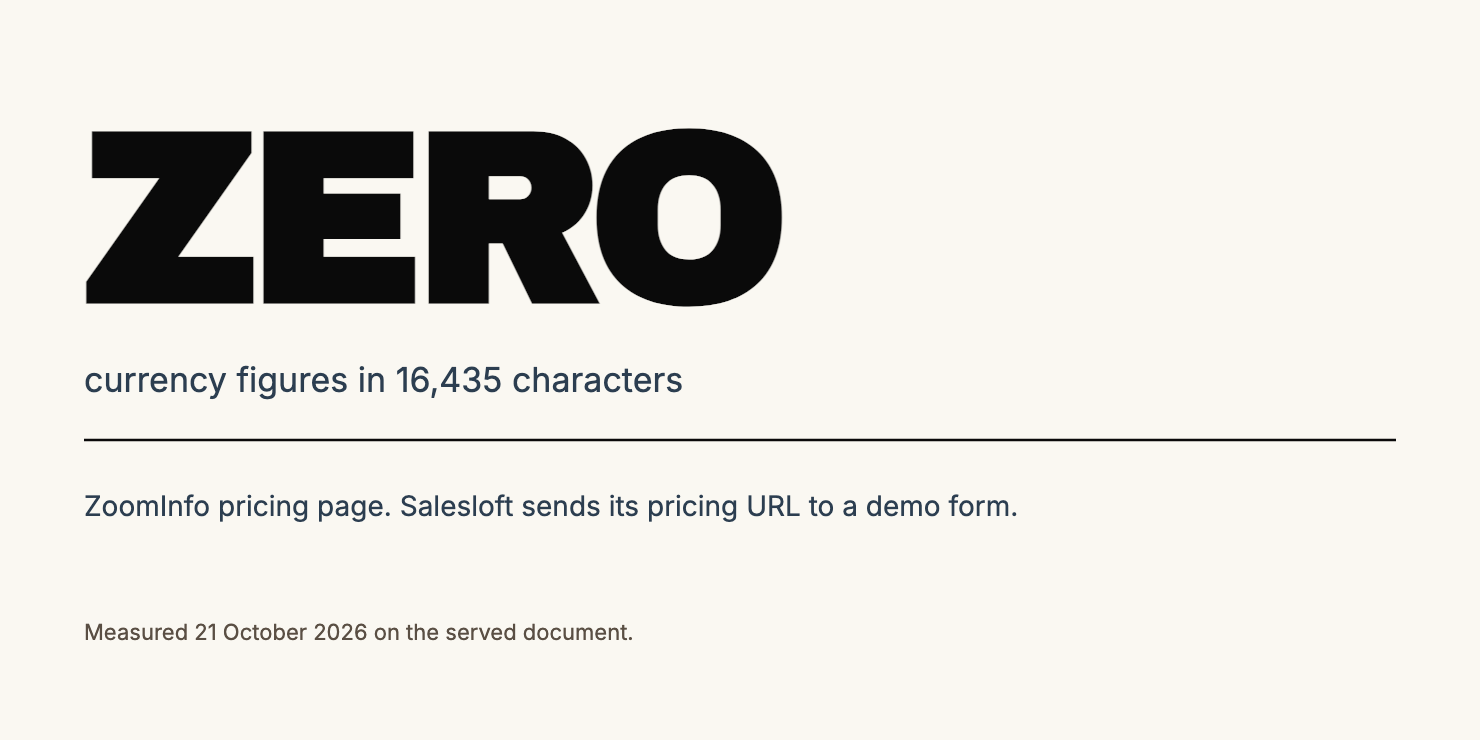
ZoomInfo sells Chorus as a line inside its platform, and the company's own pricing page carries zero currency figures across 16,435 characters of served text. Two ways to reach Chorus, and neither one ends at a price. If your evaluation table has a Chorus column, the vendor's own site cannot fill it.
Clari is a login option
clari.ai still resolves, and on the capture date the TLS handshake failed.
clari.com lands on salesloft.com, where the page labels its products Salesloft and leaves Clari Forecast as a thing you can log in to.
The pricing URL is the part I keep turning over. Requesting salesloft.com/pricing redirects to a page called see-it-live, which is a demo form carrying zero currency figures on arrival.
A product with its own name, its own domain and its own pricing page now has a login button inside somebody else's site.
That is a normal outcome in this market, and it took well under two years.
Both absorbed vendors went the same way, and it is the counter-intuitive one. Joining a platform did not make them more transparent.
It made them less priceable, because the platform behind them publishes nothing either.
You cannot comparison-shop a feature.
There is no seat count to quote and no tier to argue about, so the conversation becomes a scoping exercise with a solutions engineer, billed by the hour whether or not anyone writes a number down.
If the plan was to put Chorus beside Gong on a grid, the grid has one cell and it stays empty.
Gong publishes the shape of the bill and not the amount
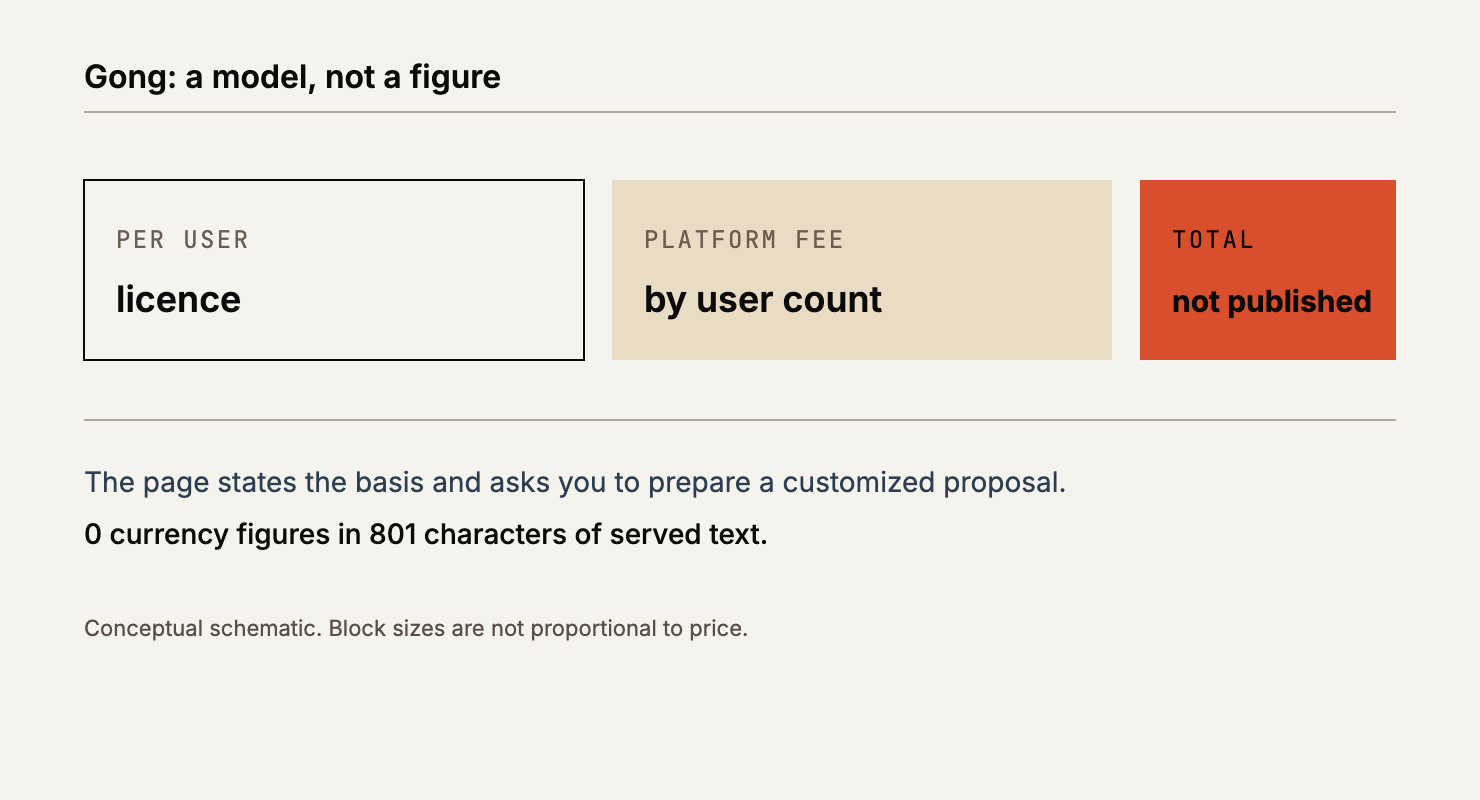
Gong is still independent, still the reference product, and it publishes a model.
Licences are priced per user, plus a platform fee based on the number of users supported, and the page asks you to prepare a customized proposal.
The form sorts teams into 1 to 50, 51 to 1,000, 1,001 to 9,999 and 10,000 or more.
In the 801 characters of text the server sends there are zero currency figures.
That is not nothing. It tells you a 20-person team and a 400-person team are not in the same conversation, which saves a week of email.
It does not put a number in a budget, and the distance between those two things is where procurement time goes to die.
The two that still sell seats
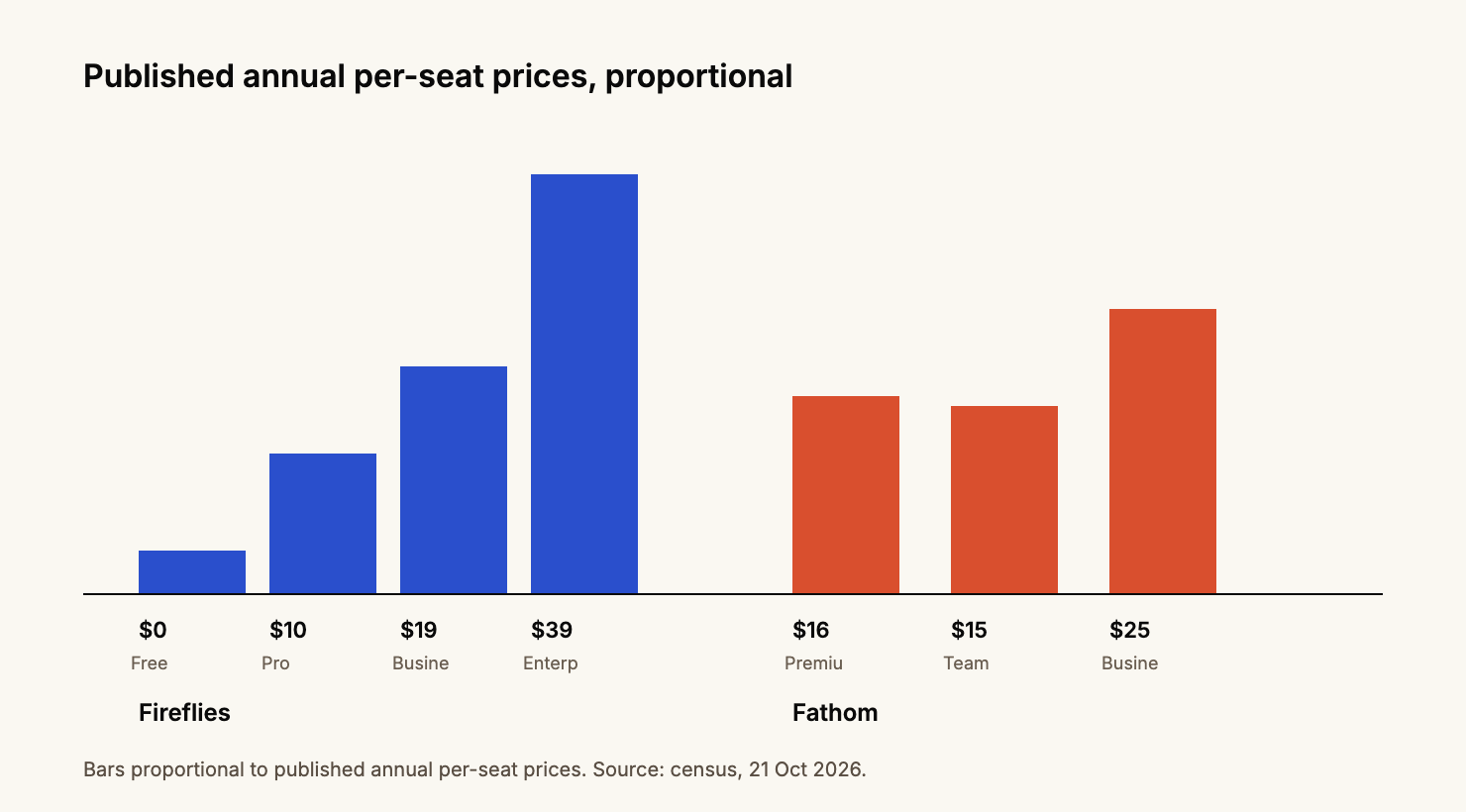
Fireflies publishes a clean ladder.
Free forever at $0, Pro at $10 per seat per month, Business at $19 and Enterprise at $39, all billed annually, with Business listed at $29 a seat if you pay monthly.
Fathom publishes the most structured data in the group.
Team runs $19 per user monthly or $15 annually, Premium $20 against $16, and the billing basis is declared in machine-readable form as per user per month with a two-user minimum.
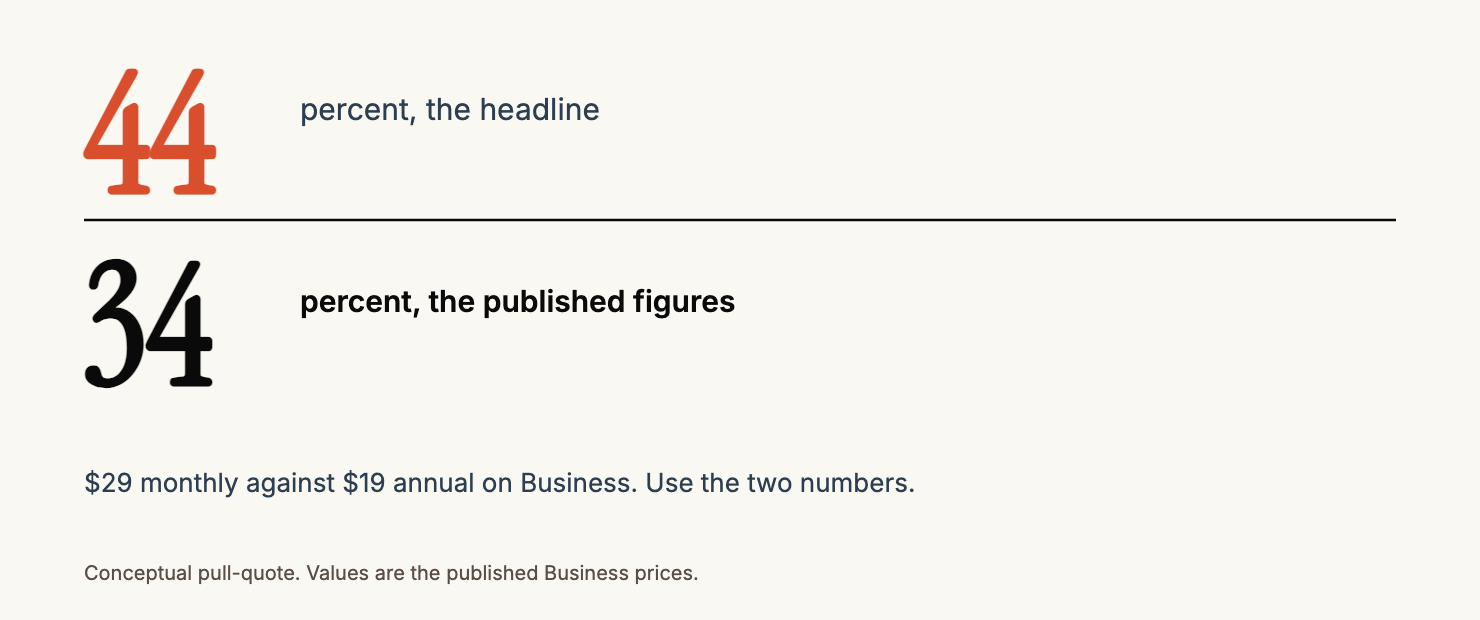
Fireflies also prints a headline claiming you can save up to 44 percent on annual billing. Its own Business figures are $29 and $19, which differ by 34 percent.
The headline may describe something we did not capture, but it is larger than the difference in the numbers sitting underneath it.
I do not think that is dishonesty.
I think it is marketing allowed to sit on a pricing page, which is a different problem and one you solve by reading the two prices instead of the sentence.
These are two purchases wearing one label
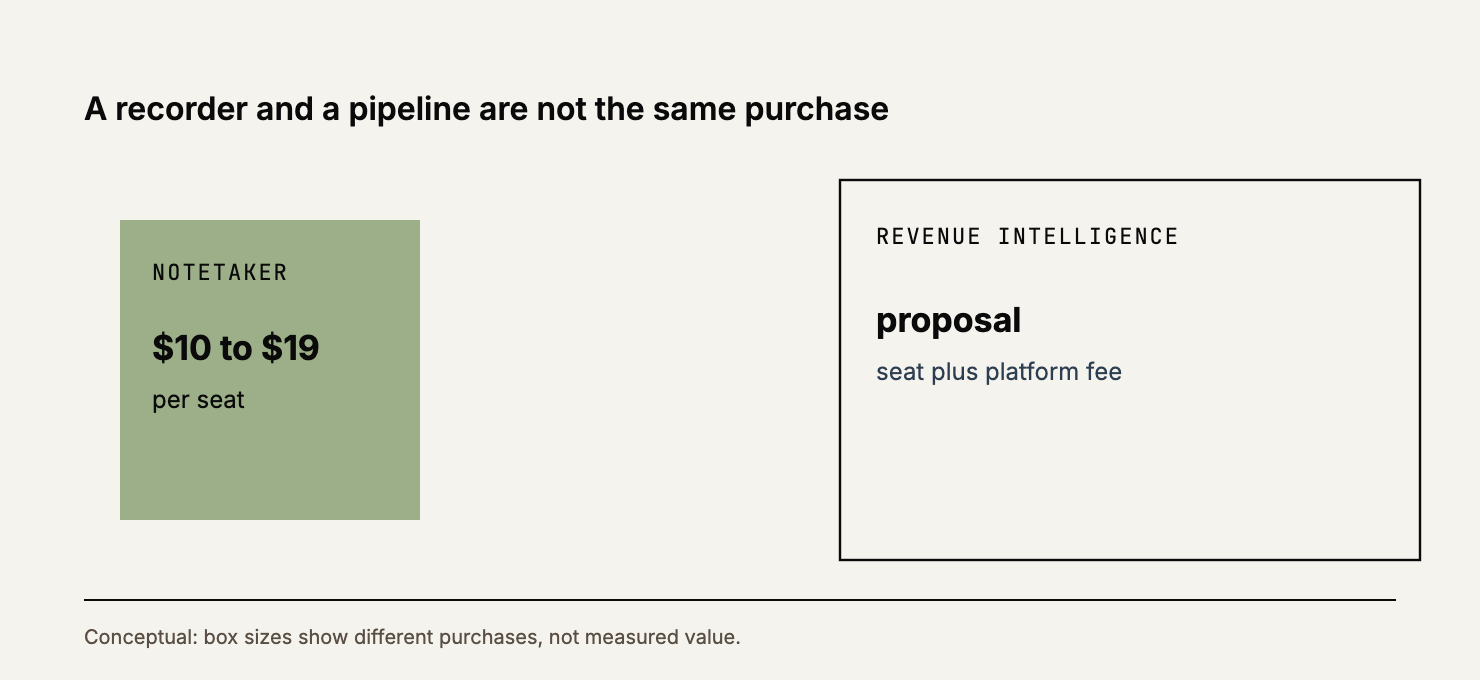
A per-seat notetaker at $10 to $19 records the meeting, transcribes it, summarises it and makes it searchable. That is a real job and it is not a small one.
A revenue intelligence platform analyses calls across a pipeline, feeds the CRM and supports forecasting and coaching.
That is a different job, done by a different person, usually paid for out of a different budget.
The price gap is not the interesting difference.
A recording tool will not tell you whether the quarter lands, and a forecasting platform will not, on its own, remember what the procurement director said on the 14th.
Notetakers publish prices because they expect to be compared. Platform vendors quote because the comparison is a scoping exercise, and scoping exercises get billed by the hour.
Twenty seats, three answers
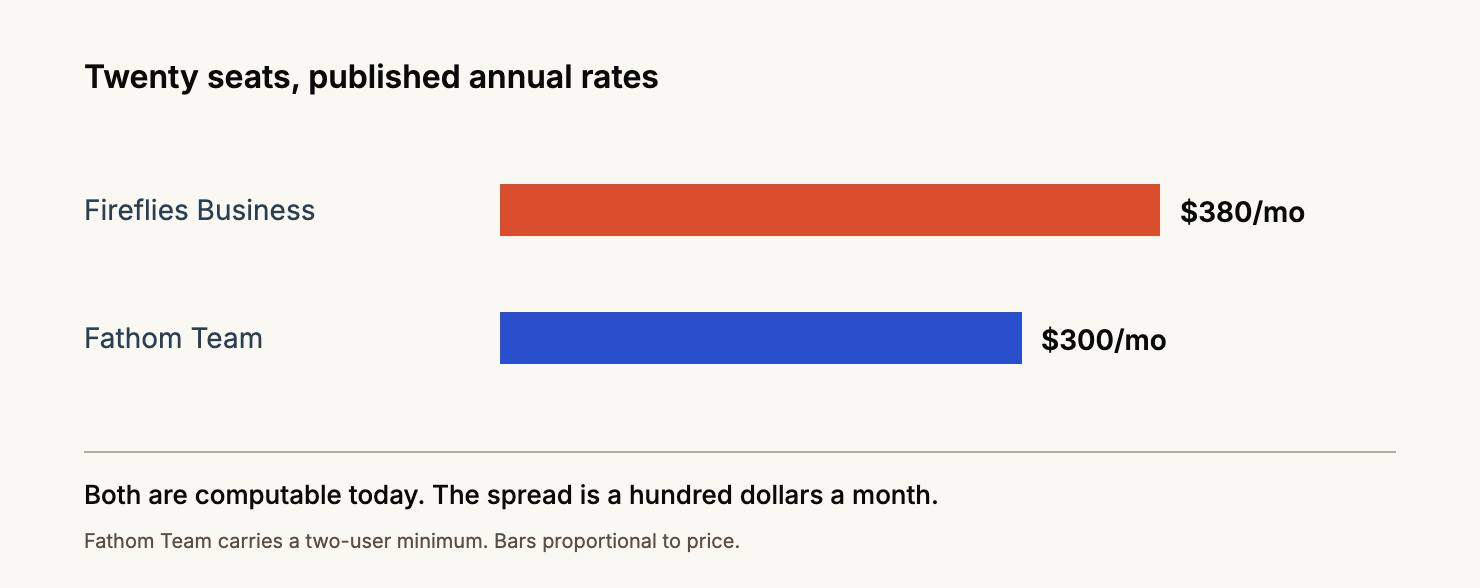
Twenty is the size most mid-market buyers actually quote for, and it is where the published ladders meet.
Fireflies Business at annual rates is $380 a month for twenty seats. Fathom Team is $300, and $380 if you pay monthly at $19 a user.
Fireflies Pro, at the published per-seat rate, is $200.
Two vendors, same lane, same team size, within a hundred dollars of each other. Which tells you the decision that matters is not which notetaker.
It is whether you were ever in that lane to begin with.
Put the same twenty seats through a revenue intelligence vendor and you get a proposal rather than a figure.
Compare that proposal against the notetaker bill and you are finally comparing two purchases instead of two prices.
What a three-year contract is betting on
Two of five vendors here stopped being independently purchasable products inside fifteen months, which is faster than a standard contract term.
That does not mean avoid platforms. Consolidation is normal, and a platform is often a safer home for a product than a startup with eighteen months of runway. It means reading the agreement as a bet on a counterparty. If the tool becomes a feature, your renewal conversation changes hands, and the price you negotiated may not survive the merge.
Ask what the assignment clause says, and ask before the legal review rather than during it.
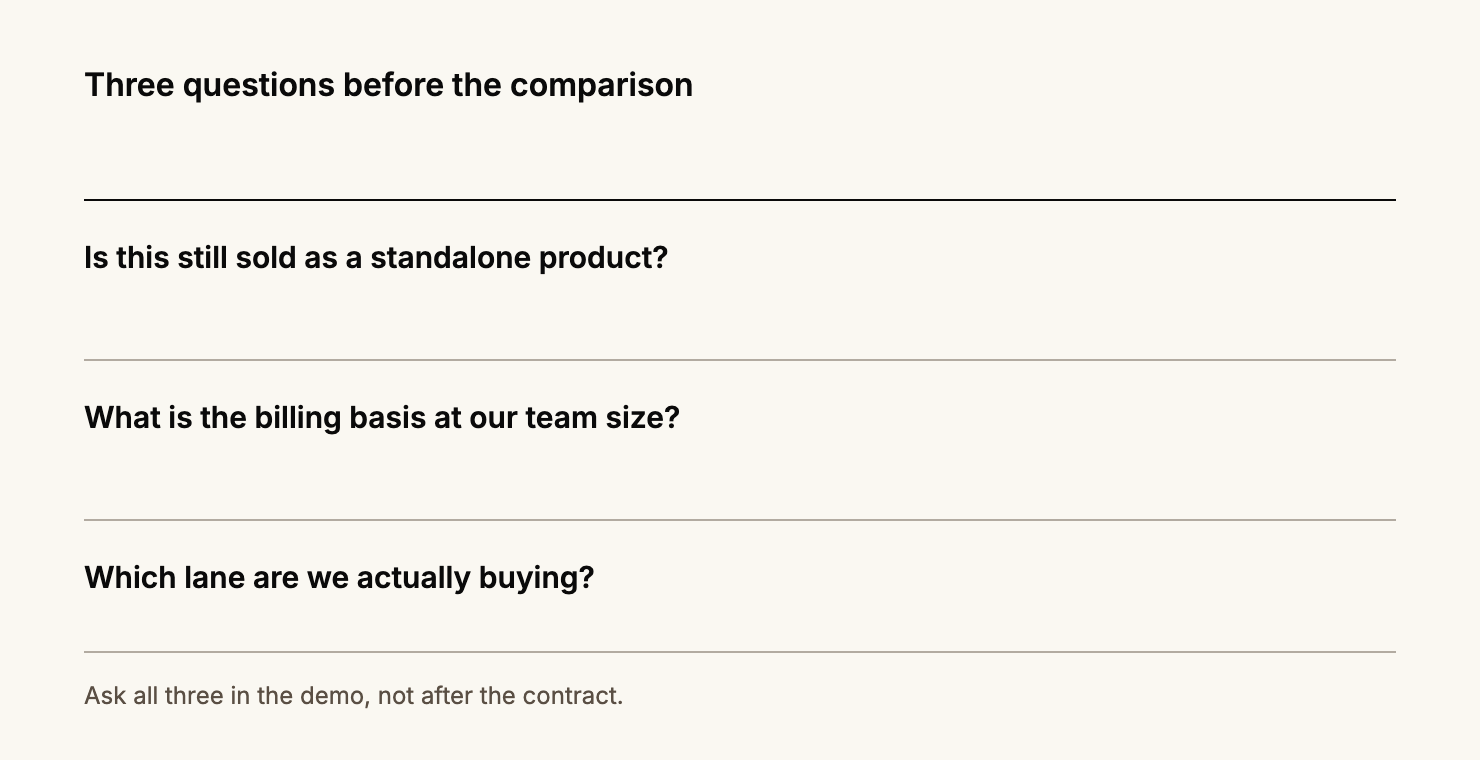
Three questions, none of which is about price
Is this still sold as a standalone product, and what happens to the price if it stops being one?
Both answers are available in a demo and neither appears in a comparison table.
What is the billing basis at our team size, stated in writing? For Fathom that is per user per month with a two-user minimum.
For Gong it is per user plus a platform fee, and the platform fee is the part that decides the total.
Which lane are we buying? If that produces silence in the room, the shortlist is wrong and no negotiation fixes it.
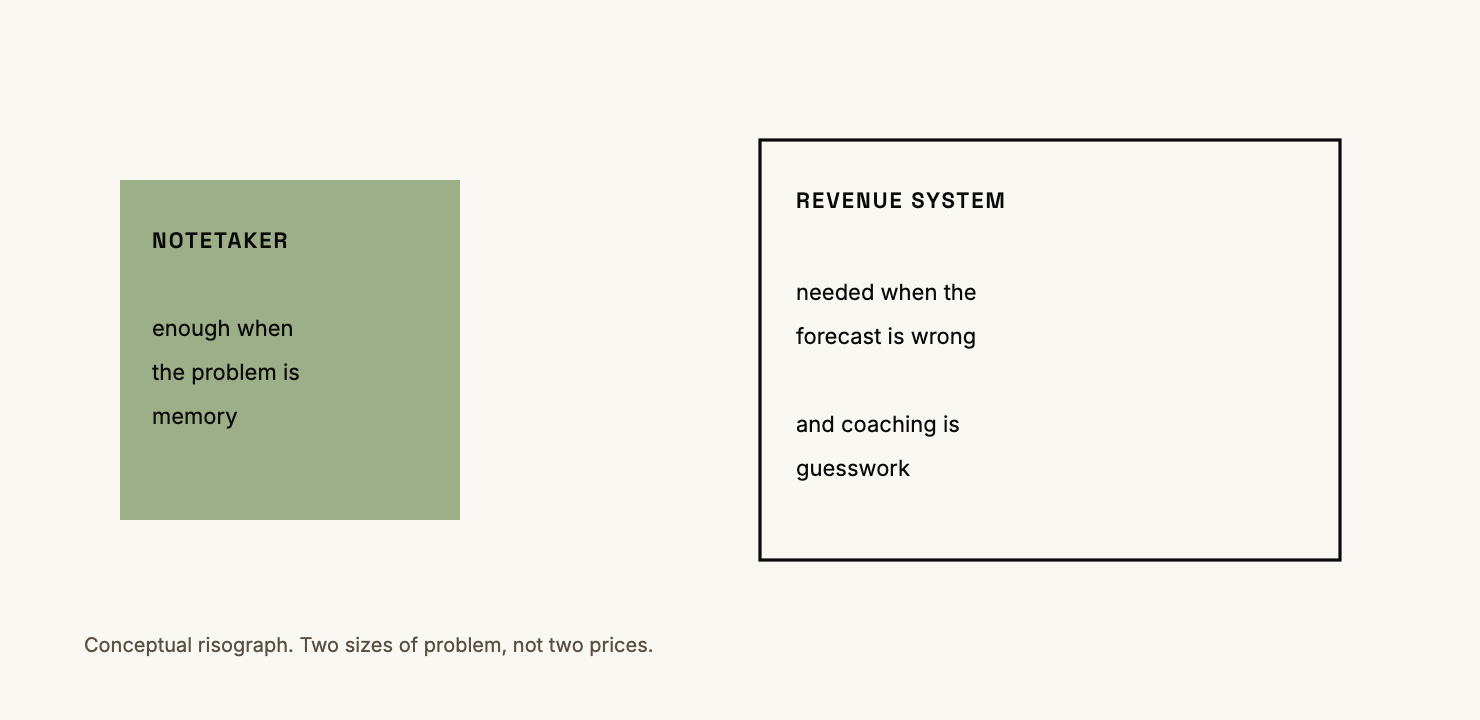
When a notetaker is genuinely enough
If the problem is that your team cannot remember what was said, a notetaker solves it for under $40 a seat and you can start on a free plan this week.
Fireflies is free forever and Fathom publishes a free plan with unlimited recordings, neither of them a countdown clock.
If the problem is that forecasts are wrong and coaching is guesswork, you are buying analysis across a pipeline and no notetaker will produce it.
Most teams who ask us to compare these five are solving the first problem while budgeting for the second.
That mismatch is expensive, and naming the problem out loud before anyone books a demo is free.
What the free plans are actually for
Both published free tiers are plans rather than trials, which changes what an evaluation can look like before anybody signs.
A team can record a fortnight of calls, read the summaries back, and find out whether the habit sticks.
That is the cheapest test available in this category, and most teams skip it.
The shapes differ. Fireflies sits its free tier below a $10 seat, which reads as a way to qualify an individual rather than serve a team.
Fathom's unlimited recordings are the more generous shape for a group testing whether anybody will actually open the summary.
Write down what would force the upgrade before you start.
On a seat-priced tool it is the next person who wants access, which is a headcount decision, and headcount decisions are easier to defend than usage ones.
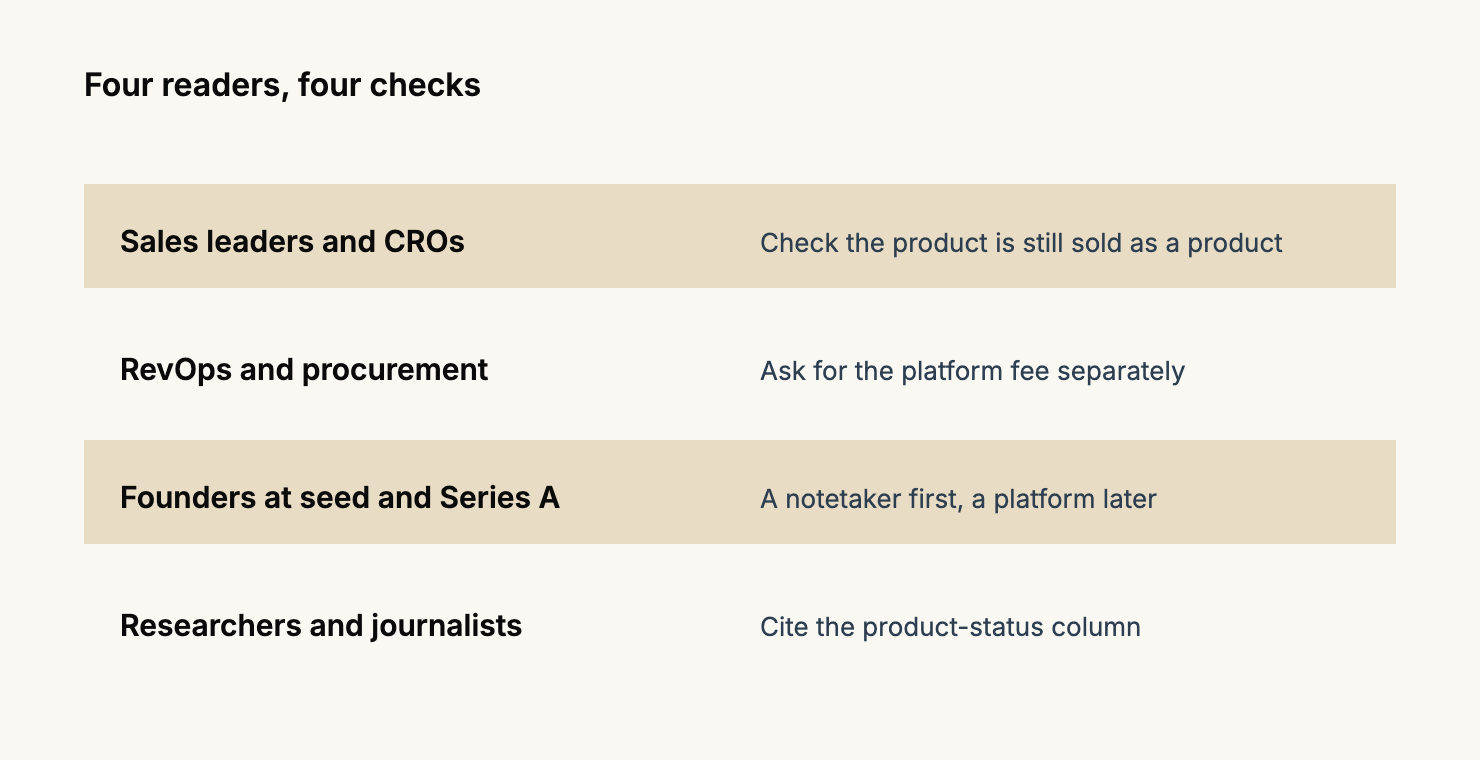
Four readers, four things to take
A sales leader or CRO should check whether the product on the shortlist is still sold as a product.
Two of five here are not, and that changes what the renewal conversation looks like more than any feature difference.
RevOps and procurement should ask for the billing basis and the platform fee as separate line items.
A per-user figure without the platform component is not a price, it is half of one.
A founder at seed or Series A should treat a notetaker at $15 to $19 a seat as a defensible first purchase, and a revenue platform as a later one, taken once the pipeline is large enough for the analysis to say something the pipeline review did not already surface.
A researcher or a journalist should take the product-status column rather than the pricing column.
That is the part of this census no other page in the category publishes, and it will still be true in a quarter.
How confident I am about this
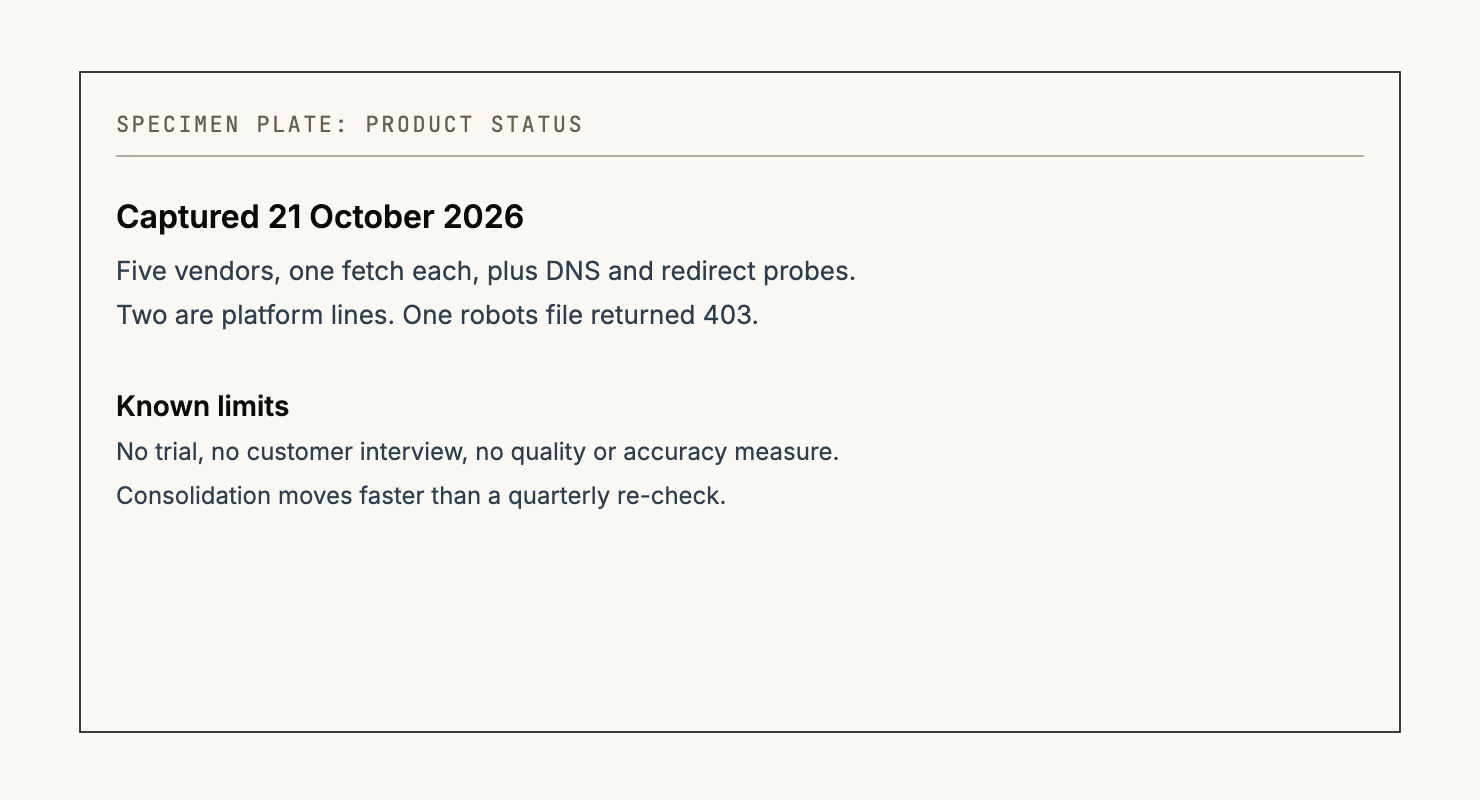
One capture per vendor on 21 October 2026, plus DNS and redirect probes for the legacy domains, and the study is re-checked quarterly.
I read what the server sent rather than what a browser assembles, so a price that only appears after JavaScript runs is recorded as absent.
For chorus.ai and clari.ai we touched nothing beyond the document a browser would have received, and the 403 on Chorus's robots file is recorded as a refusal rather than worked around.
No customer was interviewed, no trial was run and no forecast was tested.
Nothing here measures accuracy, transcription quality or retention, and consolidation in this market moves faster than a quarterly re-check can follow.
Wrap-up
Five names, three products, two platform features and one redirect.
Price the ones that are still products, ask the others whether they are still purchasable, and stop putting a notetaker next to a revenue platform as though the comparison meant something.
The graveyard is the finding. The price list is just where you notice it.
If you want to see which of your own source pages a buyer can actually read, run the scanner over the one that matters.