Turn your content into the evidence buyers and AI systems use to shortlist vendors.
Informational traffic is getting eaten by AI answers. The pages that still move pipeline are different. Comparison pages. Alternatives. Proof. Justification. Built so a human can trust them and an answer engine can cite them.
Book the call if this is happening.
The strongest fit is a team with traffic, category demand, and unclear decision-stage influence.
- Competitors show up in ChatGPT or Perplexity category answers. You do not.
- Sales keeps hearing “how are you different from X?” late in the process.
- Organic traffic still exists, but its pipeline contribution is flat or falling.
- Your CEO wants to know what content budget is still worth defending.
Invisible to referenced in one engagement.
Rankings looked fine. But when buyers asked AI systems which platform to pick, they saw two bigger competitors cited instead. Not us. We rebuilt the decision-stage system around comparison pages, alternative guides, and proof you can actually cite. No fluff.
| Metric | Before | After | Signal |
|---|---|---|---|
| ChatGPT category-response citation rate | 0% | 8 of 10 responses | CITED |
| Sales cycle length | 90 days | 52 days | −42% |
| Comparison-query visibility | 0% | 73% | TRACKED |
“We had traffic. Rankings looked fine. But when we asked ChatGPT ‘what’s the best platform for X?’ — crickets. Or worse, it named our competitor,” says the VP Marketing. “That was the gut punch. That’s when we called DataDab.”
She still has the screenshot. Says she looks at it when the CEO asks about blog traffic.
Copy-ready AI workflows. Paste, get a deliverable, copy it.
Cold emails, SOPs, job descriptions, meeting agendas, pricing-page copy, landing-page fix-lists and 20 more, each one generates a usable deliverable in seconds and copies in one click.
Copy in one click · Free, no sign-up, no email
Buyers changed where they decide. Most content did not.
The old playbook still creates pages. It just does not create the evidence buyers use when they compare, defend, and choose software.
Old playbook
Publish more top-of-funnel posts, report traffic, and hope the right visitors eventually convert.
New buyer behavior
Ask AI engines, read comparison pages, check peers, and arrive already leaning toward two or three vendors.
Where we intervene
We rebuild the pages that shape shortlists: category answers, alternatives, tradeoffs, proof, and internal justification.
Source pages, not blog posts.
We structure your most important pages as decision evidence: easy to retrieve, quote, compare, and defend.
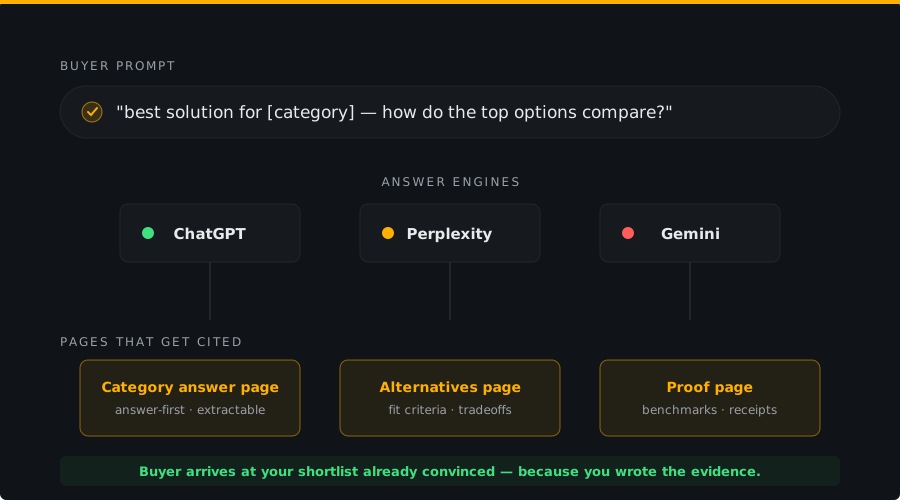
Get cited when buyers ask the category question.
- Answer-first category pages
- Passage-level extractability: definitions, tradeoffs, and schema that answer engines can lift directly
Make the shortlist easier to defend.
- Comparison and alternatives pages
- Fit / not-fit criteria
- Use-case and constraint mapping
Help champions sell the decision internally.
- ROI and business-case framing
- Security and risk responses
- Procurement-ready proof points
A five-month rebuild of your decision-stage content system.
Scoped to your situation, focused on the pages and prompts most likely to affect pipeline.
We diagnose where your content fails to register as a decision signal, rebuild the highest-use source pages, then hand your team a measurement and operating system.
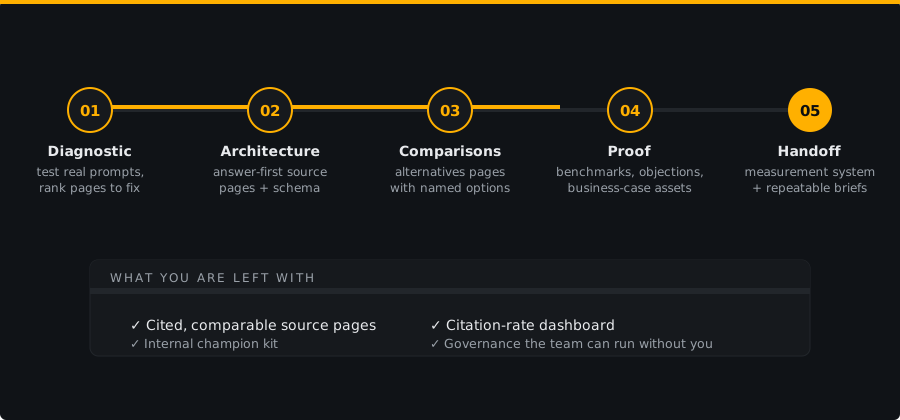
Decision visibility diagnostic
- Test real category prompts across AI systems and competitor pages.
- Prioritize pages to rebuild, consolidate, or leave alone.
Source-page architecture
- Restructure category pages with answer-first, citation-ready passages.
- Add comparison tables, fit criteria, schema, and internal links.
Comparison and alternatives build-out
- Build the pages buyers use to compare you against named options.
- Make tradeoffs, constraints, and differentiation explicit.
Proof and justification
- Turn claims into receipts: benchmarks, examples, objections, and business-case language.
- Equip champions with content they can reuse internally.
Measurement and handoff
- Track AI citation rate, comparison visibility, and sales feedback.
- Leave your team with repeatable briefs and governance.
Proof behind the method.
We study how AI systems cite B2B SaaS pages, then use those findings in client work.
The SaaS AI Citation Index
50 B2B SaaS companies, 1,500 AI queries, and a benchmark for which brands surface when answer engines shape shortlists.
What ChatGPT Actually Cites
A reverse-engineering study of citation patterns across real B2B buyer prompts and the structures answer engines prefer.
How SaaS Companies Get Cited
An eight-cause diagnostic for why B2B SaaS brands are or are not cited inside ChatGPT, Perplexity, Gemini, and Claude.
When DataDab is - and is not - the right fit.
Most buyers compare us against hiring, agencies, freelancers, or SEO retainers. Here is the practical split.
Hire in-house
Choose in-house if: you need full-time embedded production management.
Choose DataDab if: you need senior decision-stage strategy, architecture, and measurement before adding more writers.
Generic content agency
Choose an agency if: your main constraint is volume.
Choose DataDab if: your constraint is that existing content does not influence shortlists, comparisons, or sales confidence.
Freelancer or fractional CMO
Choose them if: you already know what to build and need execution or high-level direction.
Choose DataDab if: the problem is diagnosing which pages, prompts, and proof points actually change buyer decisions.
SEO optimization retainer
Choose SEO if: rankings and technical hygiene are the bottleneck.
Choose DataDab if: you rank but still lose the comparison, AI answer, or internal business case.
Products we ship. Tools you can use right now.
EchoFlow and WriteAmp are live test beds for the same source-page discipline we build for clients. Not ready to talk? Run a fast diagnostic first — free, no sign-up.
What marketing leaders ask first.
The common objections before a diagnostic call.
Does AI visibility actually drive revenue?
It influences shortlists, validates choices, and reduces decision friction before a prospect reaches sales. We measure citation rate, branded/direct lift, comparison visibility, and sales feedback.
How is this different from SEO?
SEO asks whether a page can rank. We ask whether a page can become evidence an answer engine, buyer, or internal champion can quote when a decision is being made.
What do you actually build?
Category source pages, alternatives pages, comparison pages, proof assets, internal justification content, and the measurement system that tells you whether they are working.
What happens on the diagnostic call?
We map your category, current content, likely competitor set, and decision-stage gaps. You leave with a clear view of what is worth fixing and what should not distract the team.
Find out where your content stops influencing the shortlist.
Book a 40-minute diagnostic where we map your content's impact on AI answers, buyer comparisons, and internal decision confidence.
Book Diagnostic