

Price is the column buyers argue about. Time is the one they discover in month three, and almost no vendor publishes it.
Ask a buyer comparing AI visibility platforms what the decision hinges on, and they will talk about price, because price has a number attached.
Ask them what they found after the trial, and the conversation turns to something else entirely.
How long it took to get a report they trusted. How many prompts had to be written before the numbers stopped looking wrong.
Whether anyone was ever going to look at the dashboard on a Tuesday morning.
We went looking for that information in the places it should live, which is the vendors' own documentation. Here is what we found, and it is not what we expected.

We looked for a number and found a silence
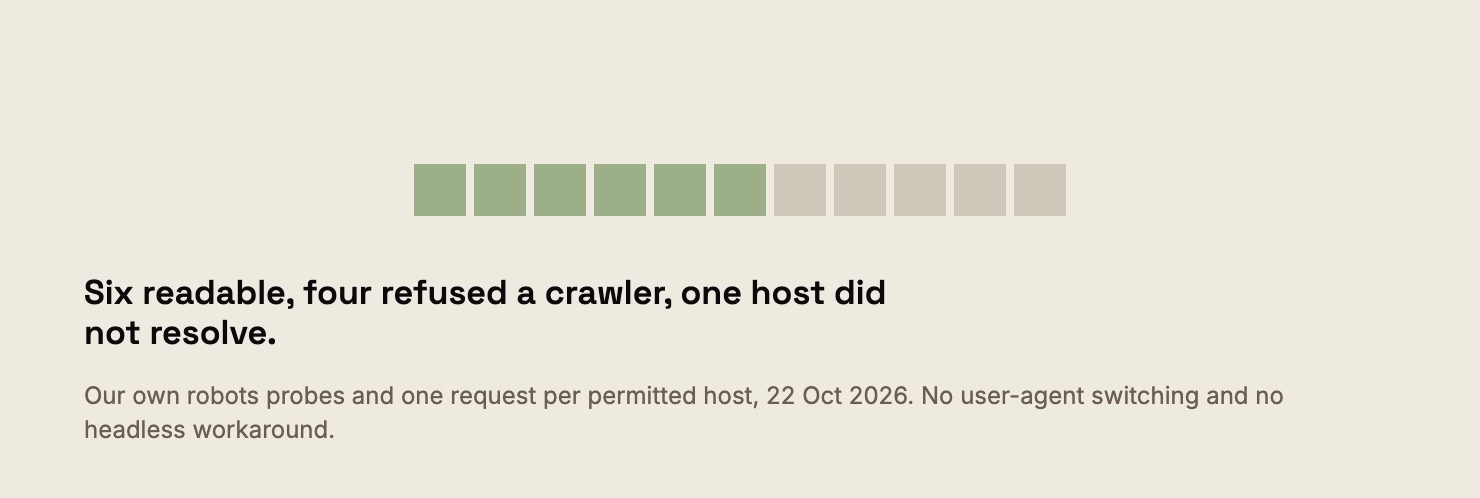
The method matters, so let us state it first. We took the eleven tools already in our AI visibility comparison, checked the robots file of each documentation host, then made one request per permitted host.
No crawling, no user-agent switching, no pretending to be a browser.
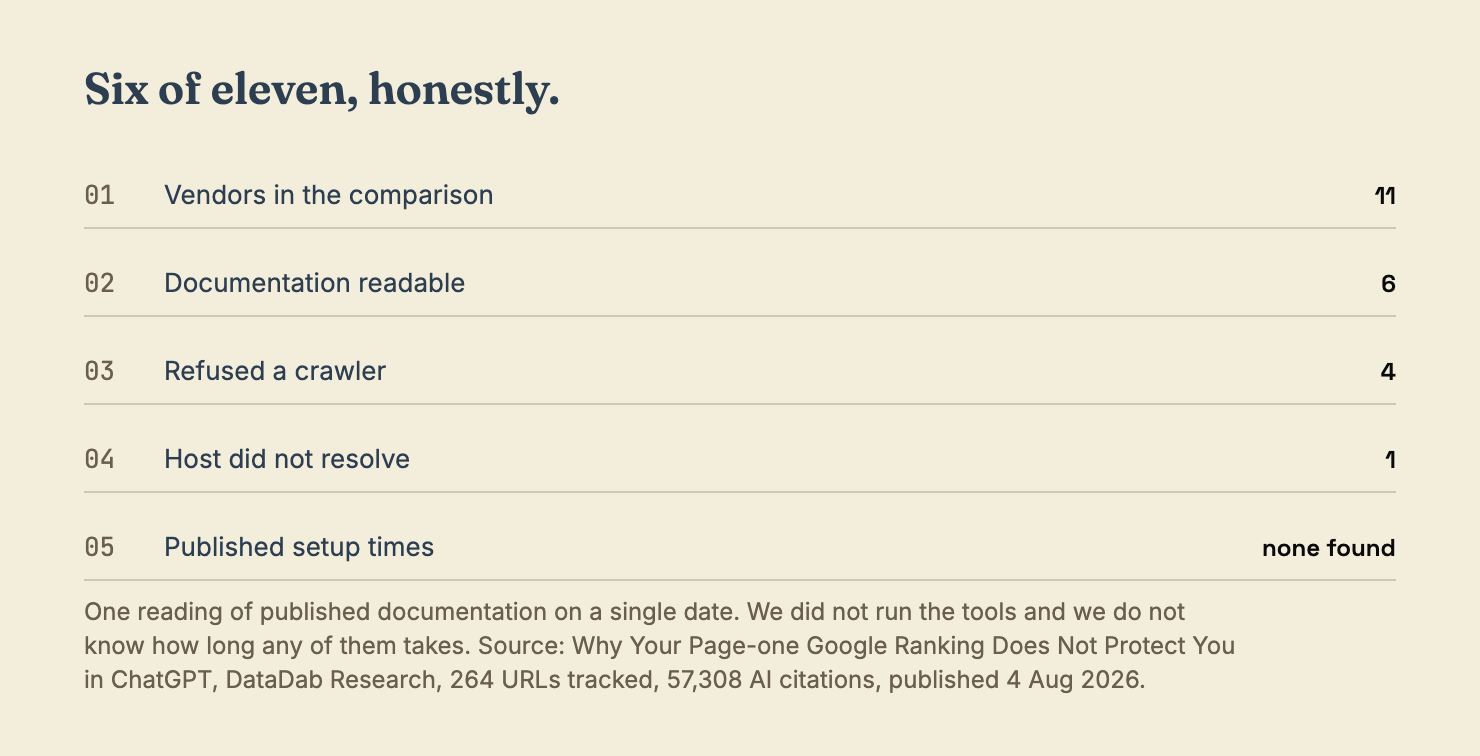
Six of the eleven document their setup in some form. Five do not let us read it, and one of those is the largest vendor in the category by search volume.
| Outcome | Tools | What it means |
|---|---|---|
| Docs readable | 6 | We could read what they publish about setup |
| Refused a crawler | 4 | Nothing collected, no workaround attempted |
| Host did not resolve | 1 | Nothing collected |
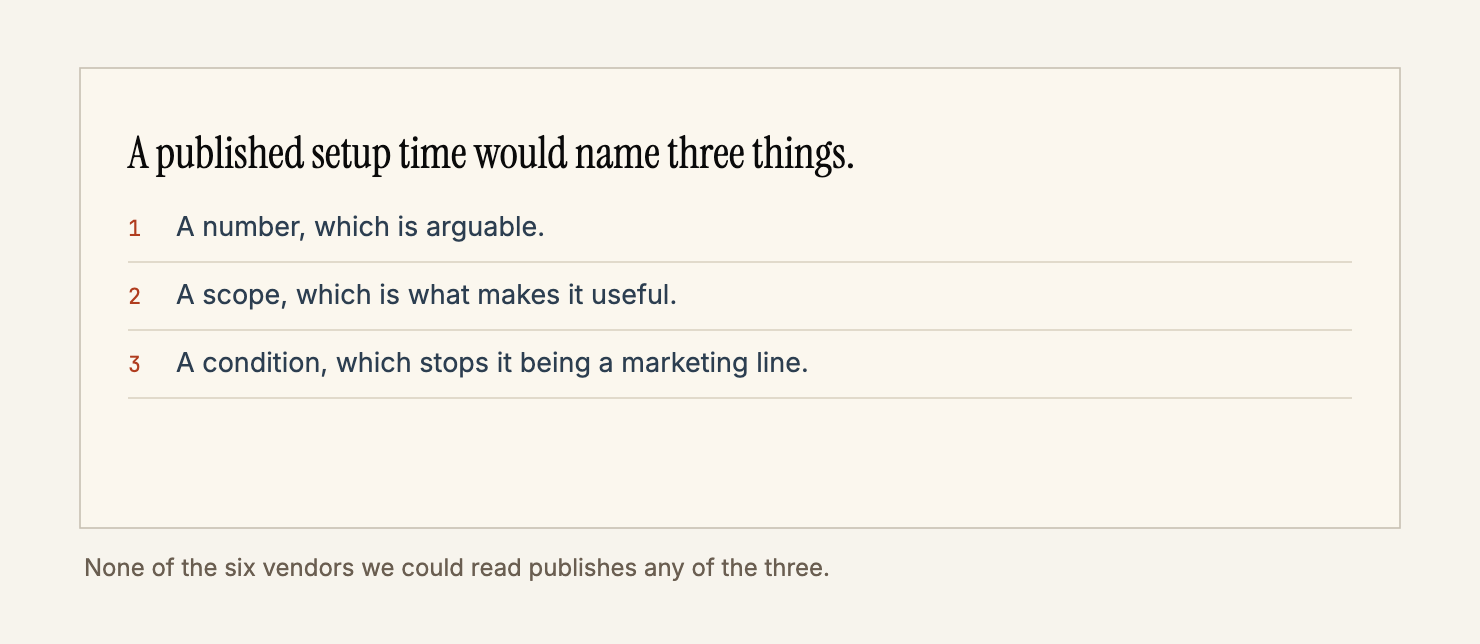
Not one of the six publishes a time-to-first-report figure. Not one of them says "you will have data in N days".
What they publish is a list of features and a screenshot of a populated dashboard, which is the part a buyer cannot check.
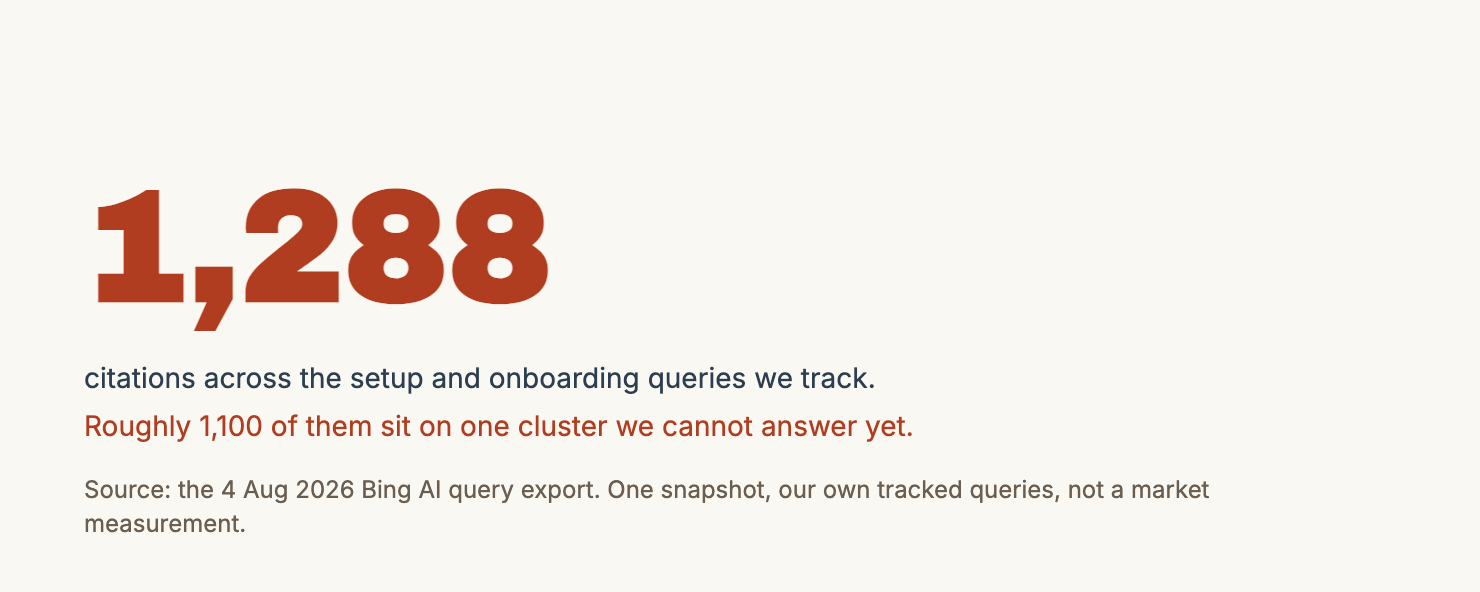
The reading above comes from the AI visibility setup census, which covers eleven vendors rather than the six whose hosts answered. Nine of the eleven publish a machine-readable index of their own documentation, 817 pages between them, and none of those nine states a time to first report. The split inside those indexes is the part worth putting in front of a vendor in a demo: 438 of the listed pages are interface reference and 379 are product documentation, so on several sites the guide a buyer needs to set the product up is a minority of what is published.
The documentation tells you what you must do, not how long it takes
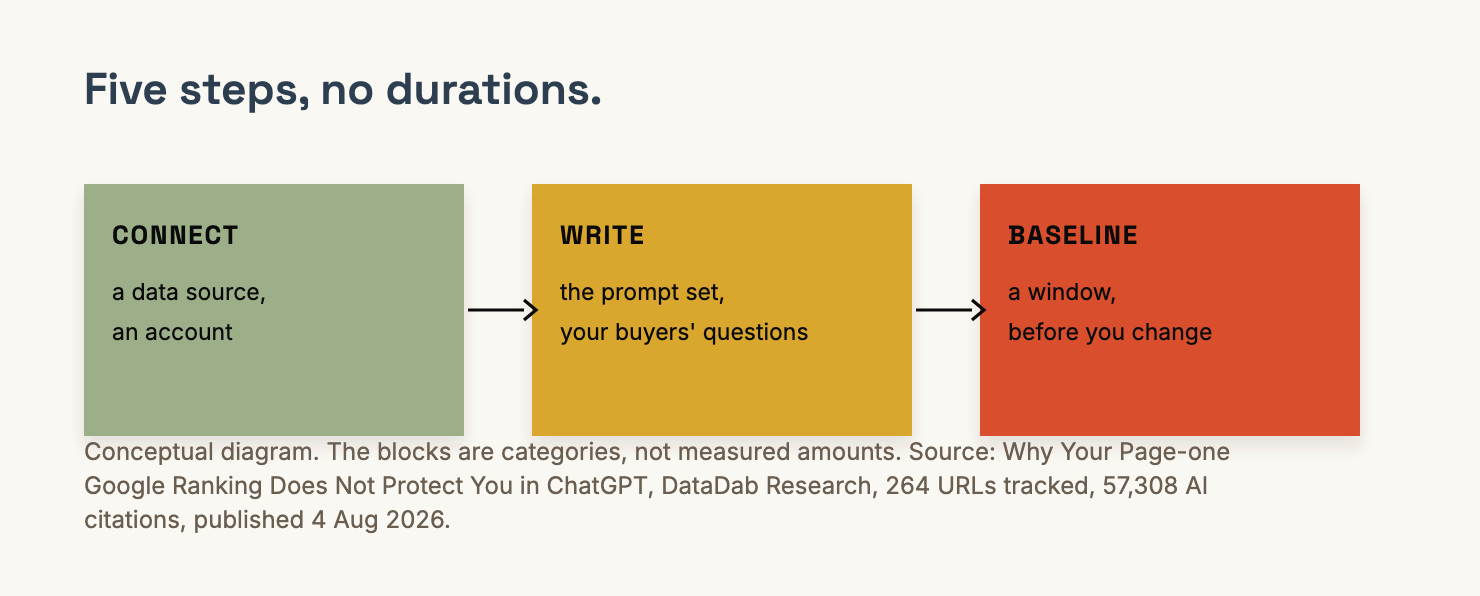
Reading six vendors' setup material, the same structure appears every time. Connect a data source. Write your prompt set. Choose the engines.
Set a baseline window. Read the report.
Each step is described. None is given a duration, and the step that consumes your week is the one no vendor times.
Writing the prompt set is the work. A prompt set is the questions you want your buyers asking, written out and agreed, and it is what makes a report useful or noise.
Two hundred prompts across five engines is a fortnight of somebody's attention. If the vendor does not include that, the trial will feel slower than it is.
The baseline window is the second. You cannot tell whether visibility improved until you have a before, which means you start measuring before you change anything.
The setup period you budget for is really the measurement period you should have started months ago.
What a published setup time would look like if it existed
It is worth being precise about what we did not find, because the absence is the finding.
A published setup time would name a number, a scope and a condition. Something like: with a connected data source, a prompt set of up to two hundred, and three engines, a first report takes five working days.
The number is arguable, the scope is what makes it useful, and the condition is what stops it being a marketing line.
What the six vendors publish instead is the shape of the work without its size. Connect, write, select, baseline, read. Every step is clear.
None has a duration, and the step that decides whether the trial succeeds is the one left open.
That is a deliberate choice, or a workflow that predates the category being sold. Either way the buyer is left to estimate the largest part of the work themselves, using the vendor's demo as the only available sample.
Demos are the best case.
Three cost buckets vendors never separate
Here is the part of setup that gets mispriced, because it is sold as software time.
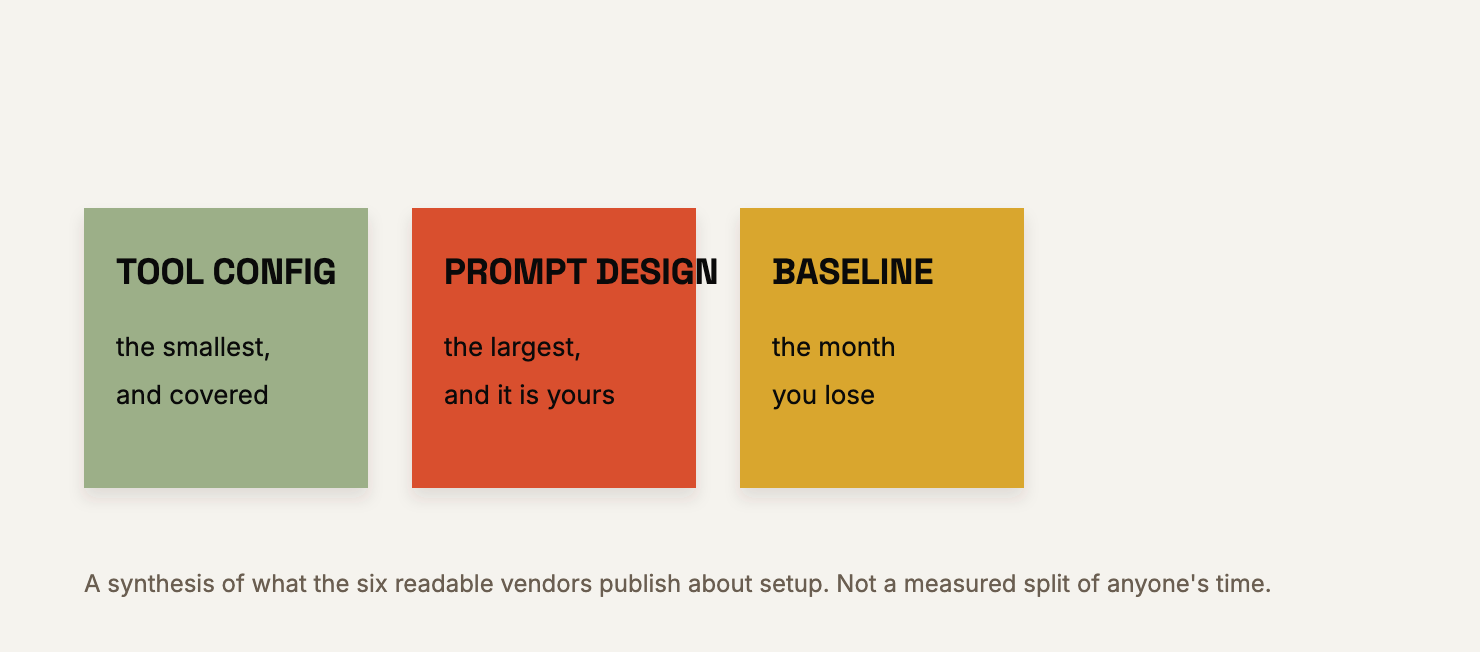
*Tool configuration.* Connecting accounts, choosing engines, setting a report cadence. This is usually the smallest bucket, and it is the one the vendor's onboarding material covers.
*Prompt design.* Deciding what your buyers ask and writing it down. This is the largest bucket in most implementations, and it belongs to you, not the tool. A vendor that ships a template library is telling you the work still exists.
*Baseline and verification.* Getting a report you trust before you act on it. Deciding what counts as a mention, checking false positives, and agreeing what a good result looks like. This is where a first implementation quietly loses a month.
Ask any vendor for an onboarding timeline and you will usually get an answer about the first bucket, because that is the part they control.
The four refusals, and what a refusal tells you
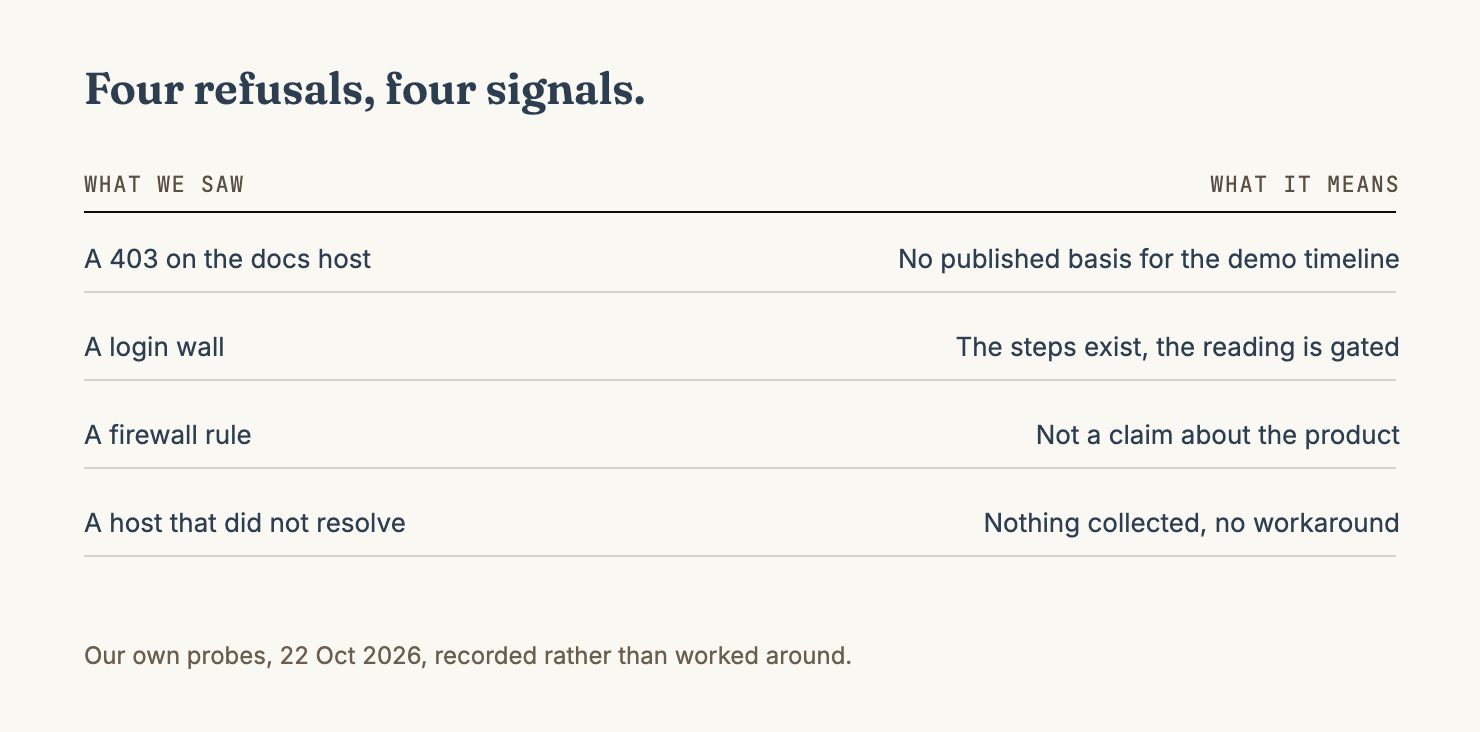
Four of the eleven refused our crawler. We recorded it and moved on, the same protocol we used for the Marketo arm of our marketing automation comparison, where a vendor's domain refused automated access and the page says so.
A refusal is not a red flag about the product. Some documentation sits behind a login, some is written for a human reader, and some is guarded by a firewall rule that treats every automated client as a scraper.
It is a red flag about the evidence you will be given in a sales conversation. If a vendor will not let you read how setup works, the onboarding timeline in the demo is a claim with no published basis, and you should price your plan around doing it yourself.
The honest buyer question is not "how long does onboarding take". It is "show me the setup documentation, and tell me which of these five steps your team does and which ones mine does".
One last thing to check before you buy
Setup time and price are the same decision in two currencies, and only one of them is quoted.
A licence that costs a fifth as much but takes four weeks longer to reach a report you trust is not the cheaper option, and it is worse, because you pay for the month of attention and you still do not have the answer. The vendor will not do that arithmetic for you, because their month is free and yours is not.
What to ask in the demo, in this order
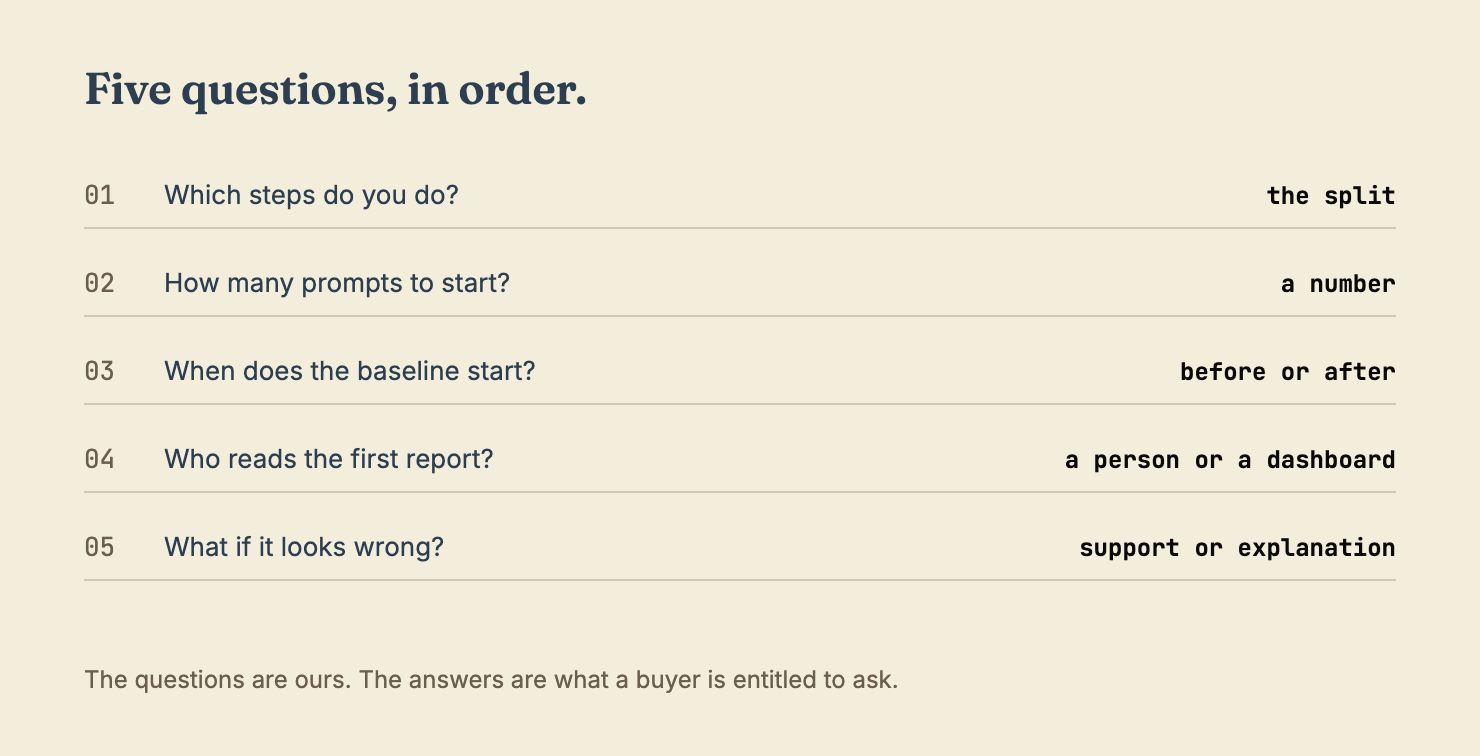
*Which of these five steps do you do?* The list is the same for every vendor, so the answer can be specific. Whoever does most of it is whoever is quoting you the timeline.
*How many prompts does a useful first report need, and who writes them?* A number is a good answer. "Our templates" is an answer too, and it means the work is still yours.
*What is the baseline window, and does the clock start before I connect anything?* If it does not, your first report is measuring a period you did not observe, and the comparison to your later reports is not clean.
*Who reads the first report, and what do they do with it?* This is the question that tells you whether the tool will be used in month three. If the answer is a person with a Tuesday ritual, that is a tool. If the answer is a dashboard, you have bought a report that goes unread.
*What happens when a report looks wrong?* Every first report does. What the vendor says here tells you whether you get support or an explanation.
A 30-day plan that does not depend on the vendor
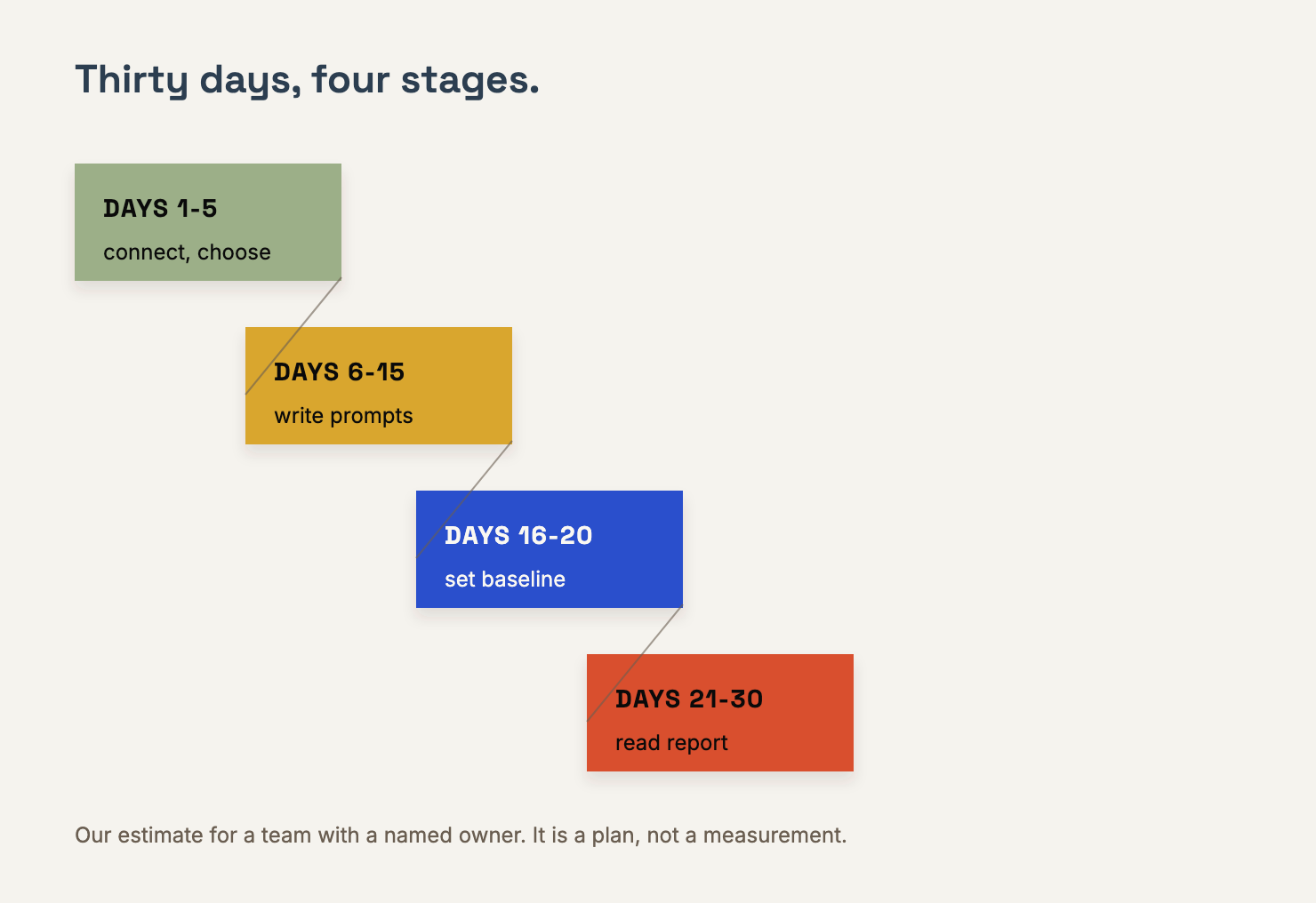
Day one to five: connect the accounts and decide the engines. Days six to fifteen: write the prompt set, using the questions your buyers ask, not the ones that flatter the product.
Days sixteen to twenty: set the baseline and let it run. Days twenty-one to thirty: read one report, check the false positives, decide what you would change.
Thirty days is our estimate for a mid-market team with a named owner, and it is an estimate. It is not a vendor commitment.
It excludes the writing time if the prompt set is built from scratch, and it assumes you do not also change pricing pages in the same month.
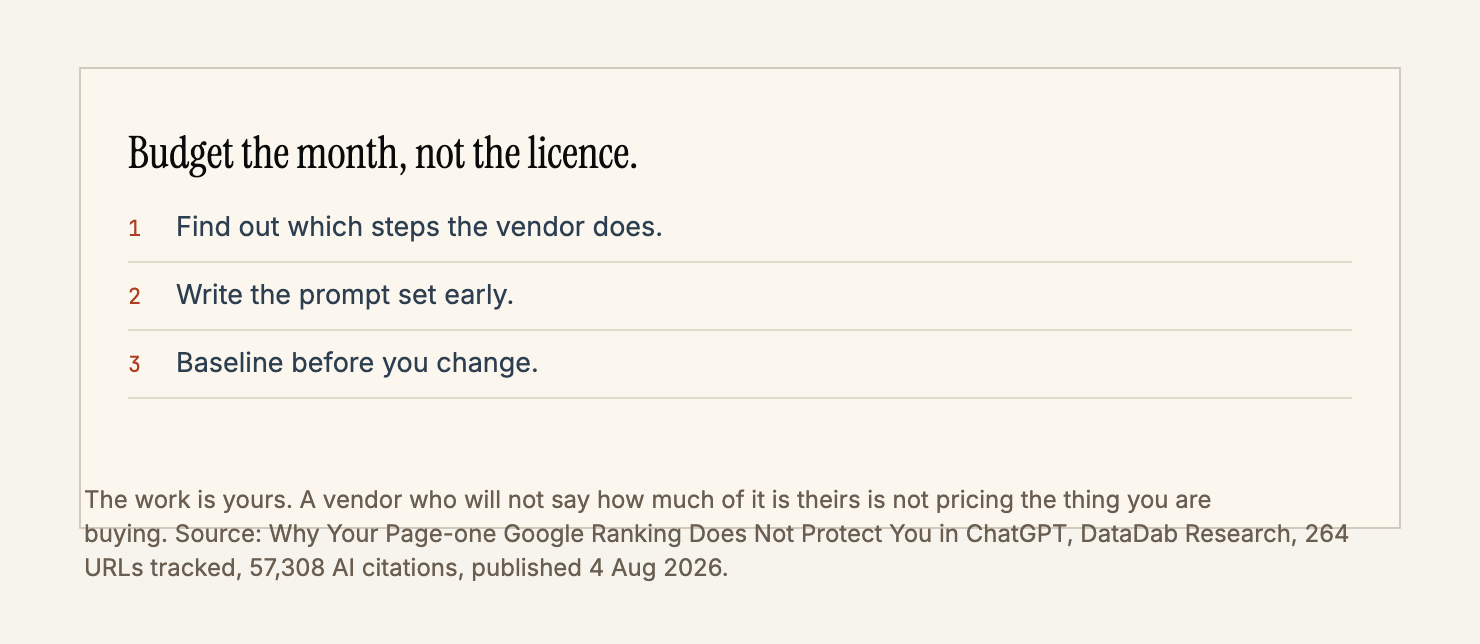
The point of the plan is not the number. It is that the work is yours, and a vendor who will not tell you how much of it is theirs is not pricing the thing you are buying.
Who this is for
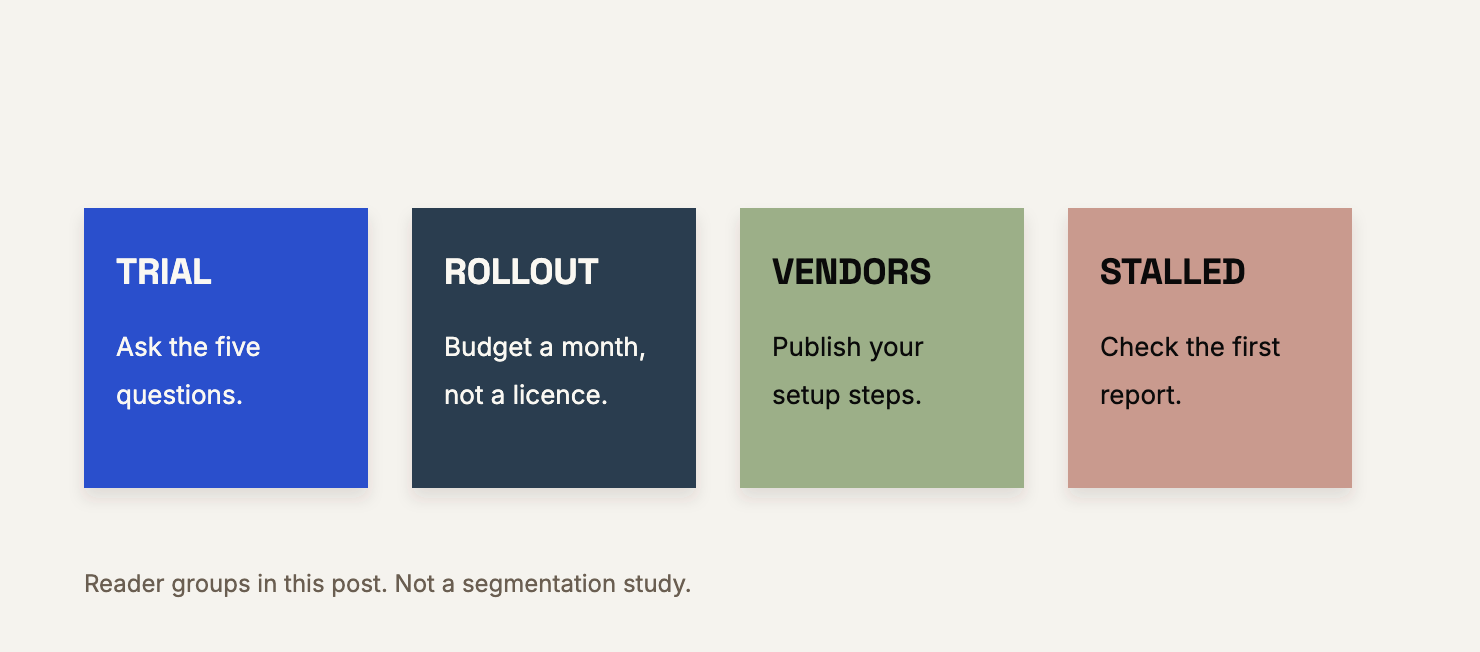
*Buyers running a trial.* Ask the five questions above in the demo. The answers on prompt count and baseline window decide your real start date.
*Heads of marketing who own the rollout.* You are budgeting a month of somebody's attention, not a licence. Price it that way, or the renewal conversation gets harder.
*Vendors selling onboarding.* Publishing your setup steps, and saying plainly which ones you cover, is the cheapest credibility in this category. Six competitors already do it.
*Teams already paying and not reading the dashboard.* Start with the false-positive check. If the first report needed a week of interpretation, the setup is not finished, and month two will not fix it.
How confident we are
This is a read of published vendor documentation as it stood on 22 October 2026, not an audit of eleven onboarding experiences.
We did not run the tools, we did not talk to their customers, and we do not know how long any of them actually takes.
The coverage is partial: six of eleven vendors, with four refusals and one unresolvable host, recorded rather than worked around. The five-step structure we describe is our reading of what the six publish, which is a synthesis, not a vendor specification.
The thirty-day plan is our own estimate for a team with a named owner and no competing work in the same month.
It is a plan, not a measurement, and we would rather you treat it as one.
Wrap-up
No vendor in this category publishes how long setup takes, and the six whose documentation we could read all describe the same five steps without a duration attached.
So work out the split instead. Which steps does the vendor do, and which do you? The prompt set and the baseline are yours, and they are the two that decide whether the tool is running in month three.
Ask the five questions, then run the thirty days, and read the first report carefully. If the onboarding timeline was the thing you were choosing on, you now know it was never a published fact.