

The fix for most B2B libraries is not another post. It is five page jobs, a named owner, and a review trigger attached to each.
A founder sent me her content calendar last quarter. Nineteen planned posts, four of them "thought leadership", none of them answering a question a buyer had actually asked.
I do not mean that as a scold. It is what a keyword-driven plan produces when the constraint is volume rather than a blocked decision.
Our own reference for this is the decision-stage content guide, and its opening claim is the one worth arguing with: you probably have enough content already.
There is no shortage of material in a typical B2B library. There are category explainers, trend pieces, webinar recaps and a heroic number of posts beginning with the word "Why".
Very few of them help when someone has to choose between two plans before Friday's budget meeting.

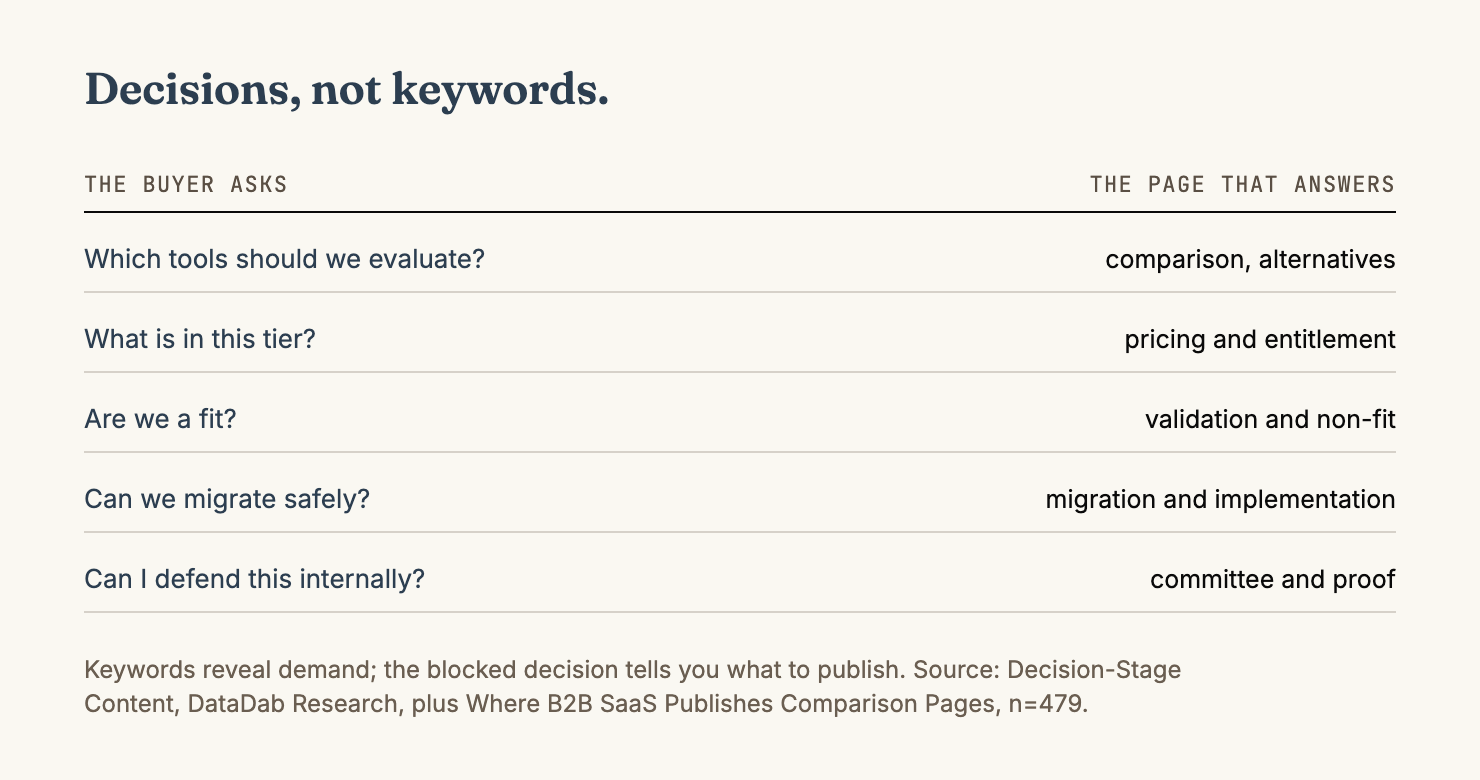
Start from the blocked decision, not the keyword
Real buying decisions arrive in plainer language than a marketing calendar admits. Which tools should we evaluate? What is included at this tier and what sits behind a sales call?
Are we a fit, or are we forcing the product into the wrong job? Can the team migrate without an operational headache?
Can I show procurement, security, finance and my manager enough evidence to move this forward?
Those five questions are a content plan. Keywords reveal demand, and demand is not the same as the thing standing in the way of a purchase.
The inventory that helps is a list of decisions with the page that resolves each one beside it. When a decision has no page, that is the brief.
When a decision has four pages that disagree, that is a different brief, and it is cheaper.
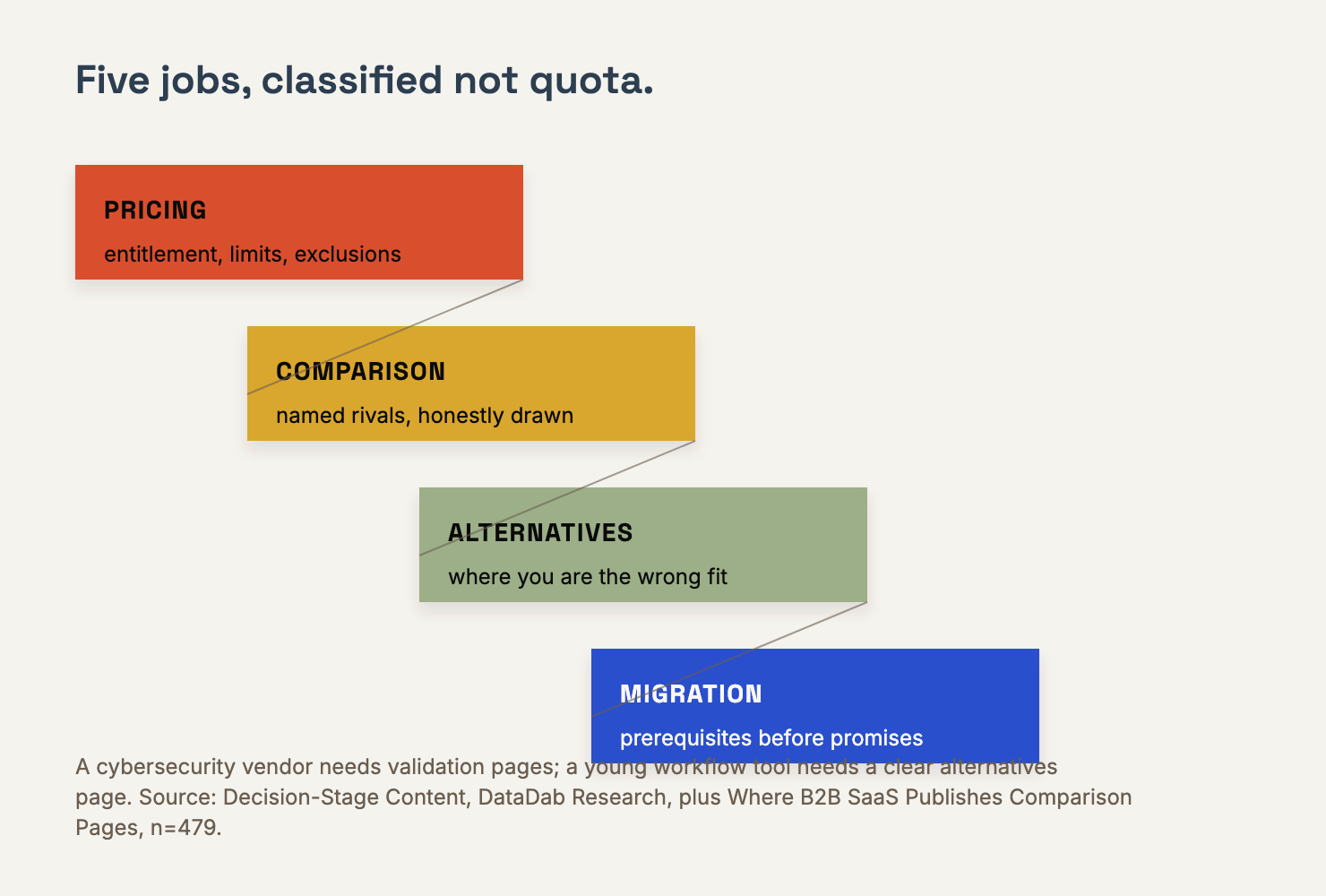
Five jobs a page can be doing
The guide sorts source pages into five jobs, and it is a classification rather than a quota. A cybersecurity vendor with a cautious enterprise buyer may need several validation pages and one comparison.
A young workflow tool may need transparent pricing and a brutally clear alternatives page.
*Pricing and entitlement.* Visible price plus what the tier actually includes: access, usage, services, limits, exclusions. A lead wondering whether they need three seats or an enterprise contract is not helped by "contact sales" in a larger font.
*Comparison.* Named alternatives, honestly described. Products are rarely interchangeable in the ways that matter, and competitors should not be cast as dim straw men. Buyers notice, and they have other tabs open.
*Alternatives and constraint.* Where you are not the right choice, and what to look at instead.
*Migration and implementation.* Prerequisites, data, permissions, downtime, rollback, who does the work. Explain the conditions before promising serenity.
*Validation, ROI and committee.* The page your champion sends to the person who was not in the room. Clear trade-offs, proof boundaries, implementation detail, a shareable summary.
Weak systems send all five of those readers to a generic features page or an opaque form, and then wonder why the funnel looks mysterious.
Where the decision disappears
Three moments, and each needs a different page.
At *AI discovery*, the buyer is building a credible shortlist or understanding a category. They need an answer-first source page with scope and evidence.
A weak system publishes broad commentary that never names the choice.
At *human evaluation*, the buyer is comparing against requirements, constraints and cost. They need comparison, pricing, alternatives, feature-validation or migration content. A weak system sends them to a features page.
At *committee justification*, the buyer is explaining the choice to people who never did the research. They need trade-offs, proof boundaries and a summary they can forward.
A weak system leaves the champion to rebuild the case in a slide deck, badly, at eleven at night.
Most libraries are strong at the first moment and thin at the third. That is where deals stall, and it is invisible in analytics because the stalled deal never visits anything.
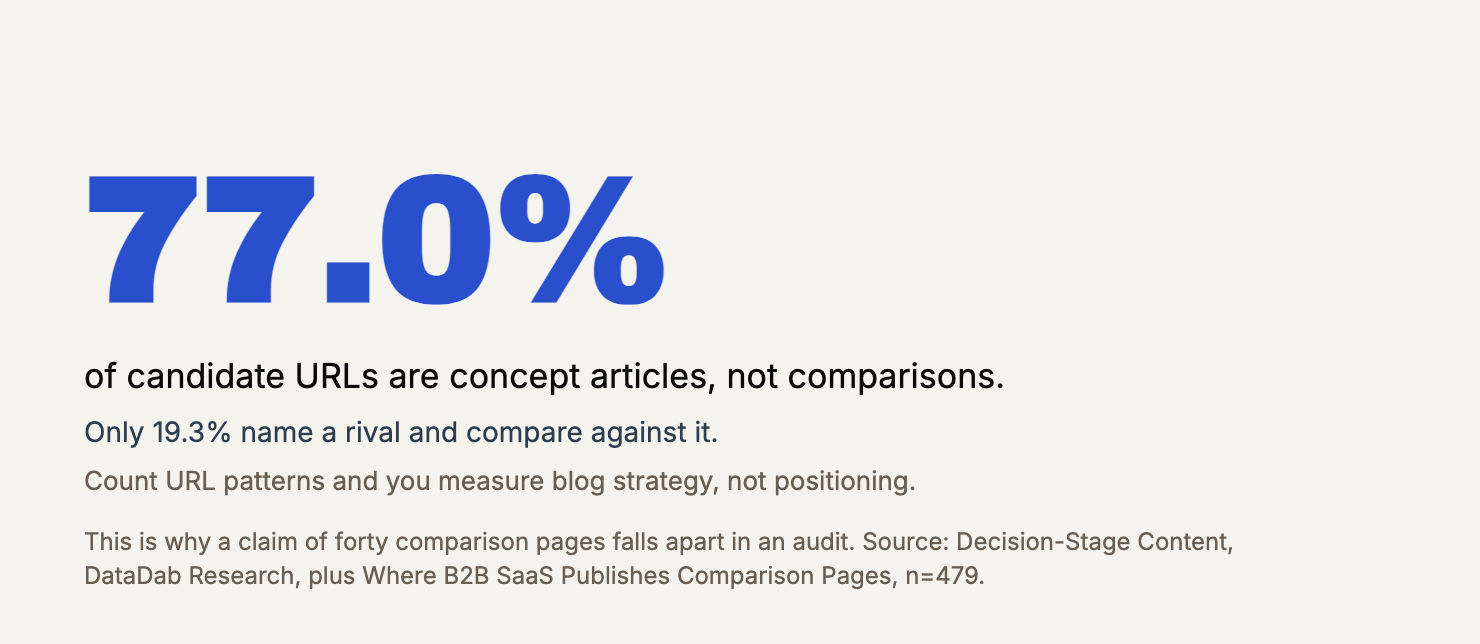
Most pages that look like comparisons are not comparisons
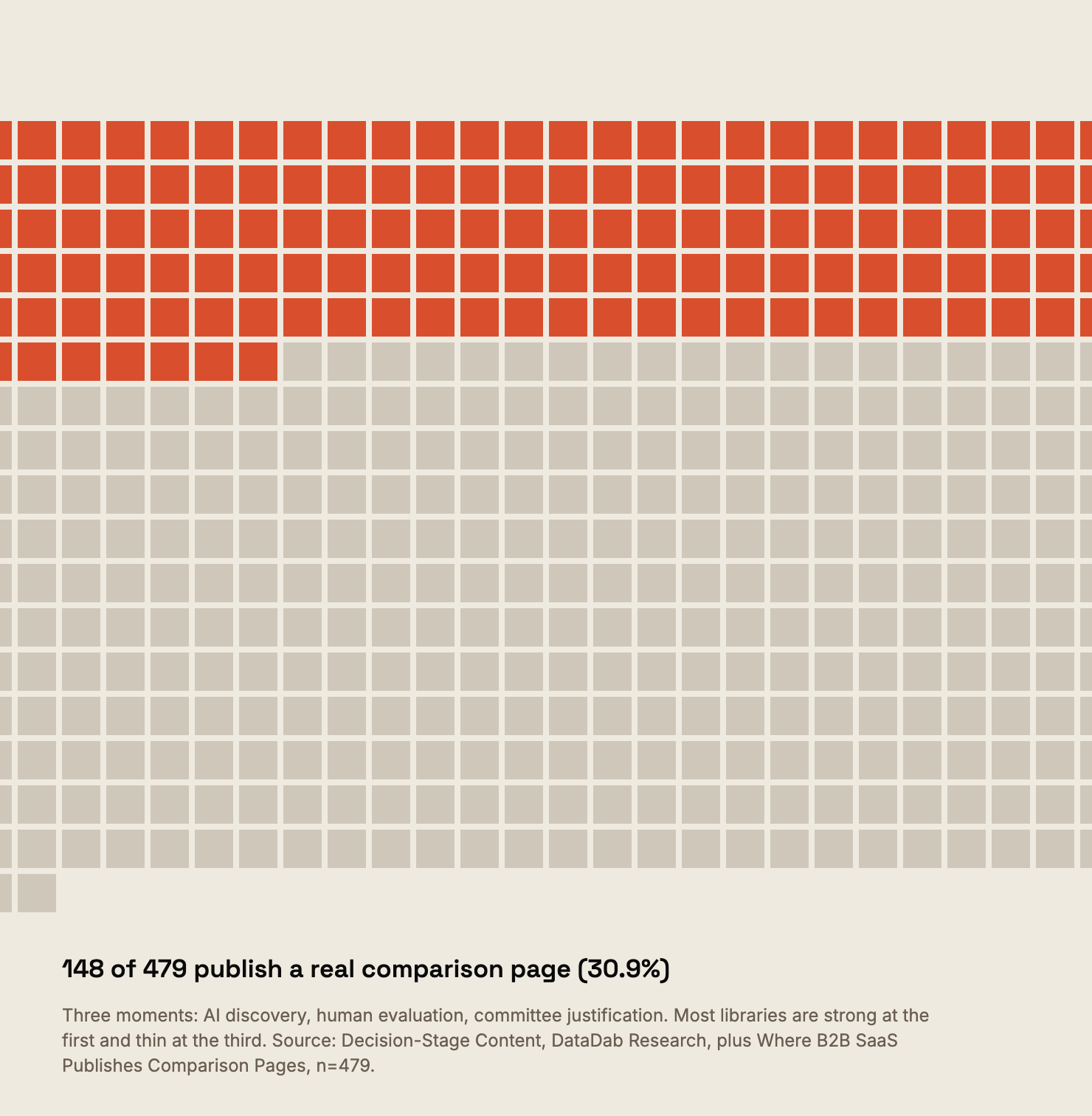
We coded comparison publishing across 479 B2B software companies, and the measurement lesson is the sharpest finding in it.
Of every candidate URL containing "vs" or "alternatives", 77.0% were concept articles. "Lead vs prospect", not "you vs Salesforce". Only 19.3% were vendor-versus-vendor pages.
Count URL patterns and you measure blog strategy, not competitive positioning, which explains why so many "we have 40 comparison pages" claims fall apart in the audit.
148 of 479 companies (30.9%, 95% CI 26.9-35.2%) publish at least one real comparison page. 331 publish none.
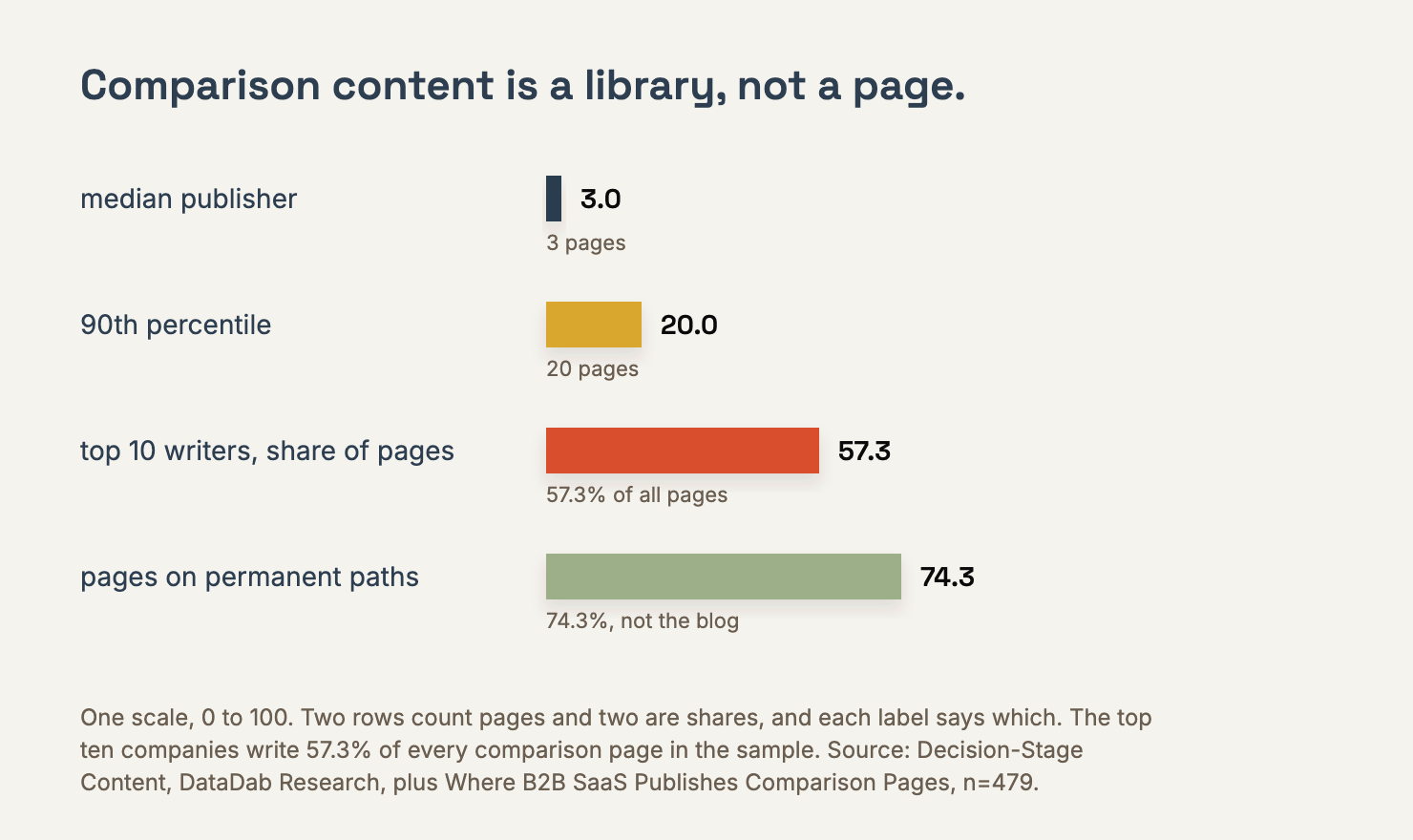
Comparison content is a library, not a page
Among the companies that do publish, the median runs three pages and the 90th percentile runs twenty.
Four companies publish more than a hundred each, and the top ten write 57.3% of every comparison page in the sample.
The rivalry itself is spread out. 213 distinct vendors are named across 1,854 target mentions, the top ten absorb only 29.5% of them, and 216 of 496 vendor pairs, 43.5%, are contested by two or more companies.
And they are built as assets rather than articles. 74.3% of real comparison pages live on permanent paths like /compare/, /alternatives/ or /vs/, against 25.7% (432 pages) sitting in the blog. 1,103 of 1,683 pages, 65.5%, put the publisher's own product in the frame.
Read those together and the strategic claim is straightforward: comparing yourself to rivals is something companies start doing as they scale into a category fight, and the ones doing it treat it as a maintained library.
That is the shape we took with the four category comparisons we published in October 2026: product analytics, marketing automation, conversation intelligence and product feedback. Each names its vendors, quotes only prices the vendor publishes, carries a verification date, and is re-checked quarterly.
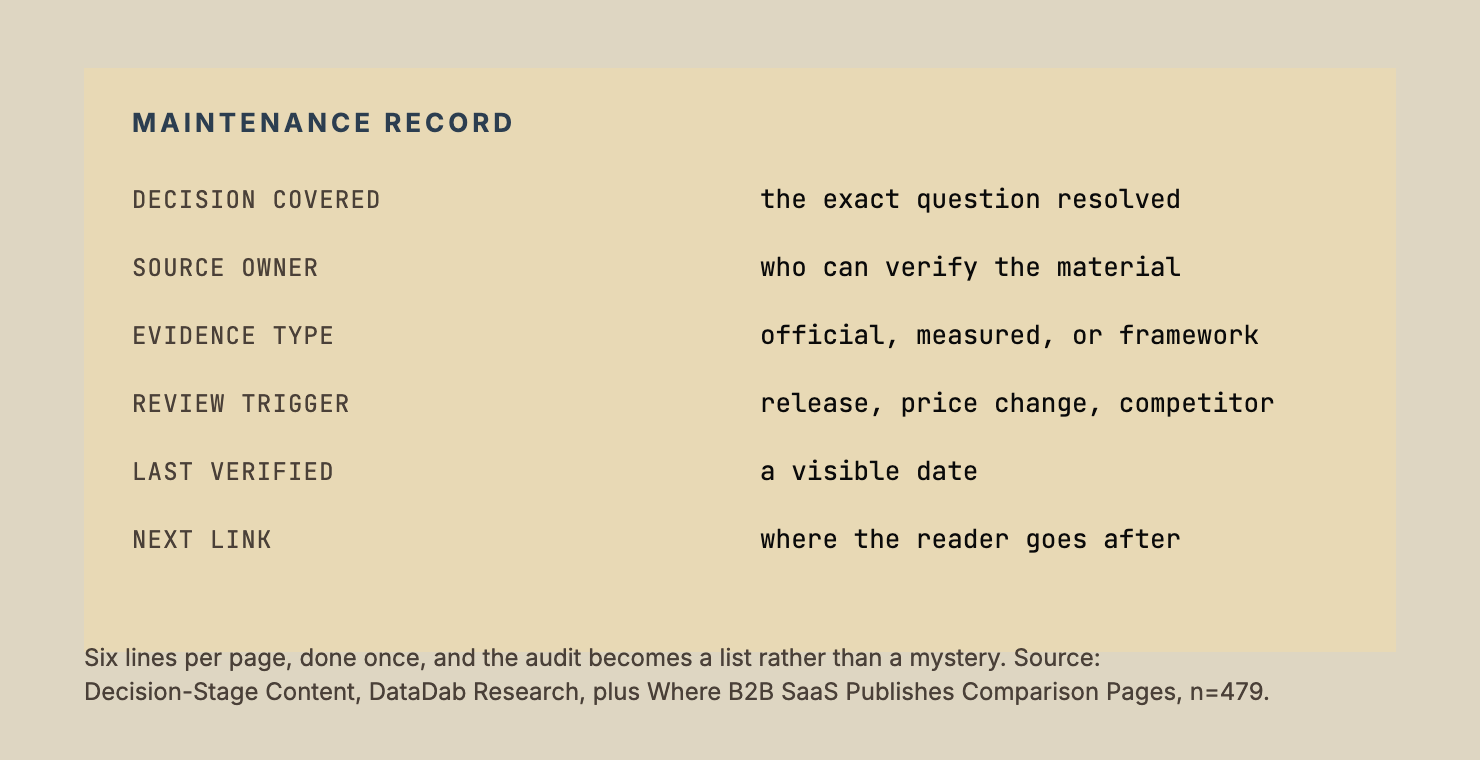
Maintenance is editorial work, and it needs a record
A source page is an operational asset. If it covers pricing, capability, vendor coverage, a measured result or a named alternative, give it an owner and a review trigger.
Otherwise it ages into something that looks current and is quietly wrong, and that is more dangerous than an obviously old blog post because someone will use it in a real buying decision.
The record we use is short:
- *Decision covered:* the exact question the page resolves - *Source owner:* the product, commercial, marketing or research person who can verify the material - *Evidence type:* official source, preserved measurement, or practitioner framework - *Review trigger:* product release, pricing change, competitor update, or a scheduled editorial check - *Last verified:* a visible date for any claim that can change - *Next link:* where the reader goes after this page answers
Six lines per page, done once, and the audit becomes a list rather than a mystery.
Change a price without a trigger attached and you have a page that confidently misinforms buyers for a quarter.
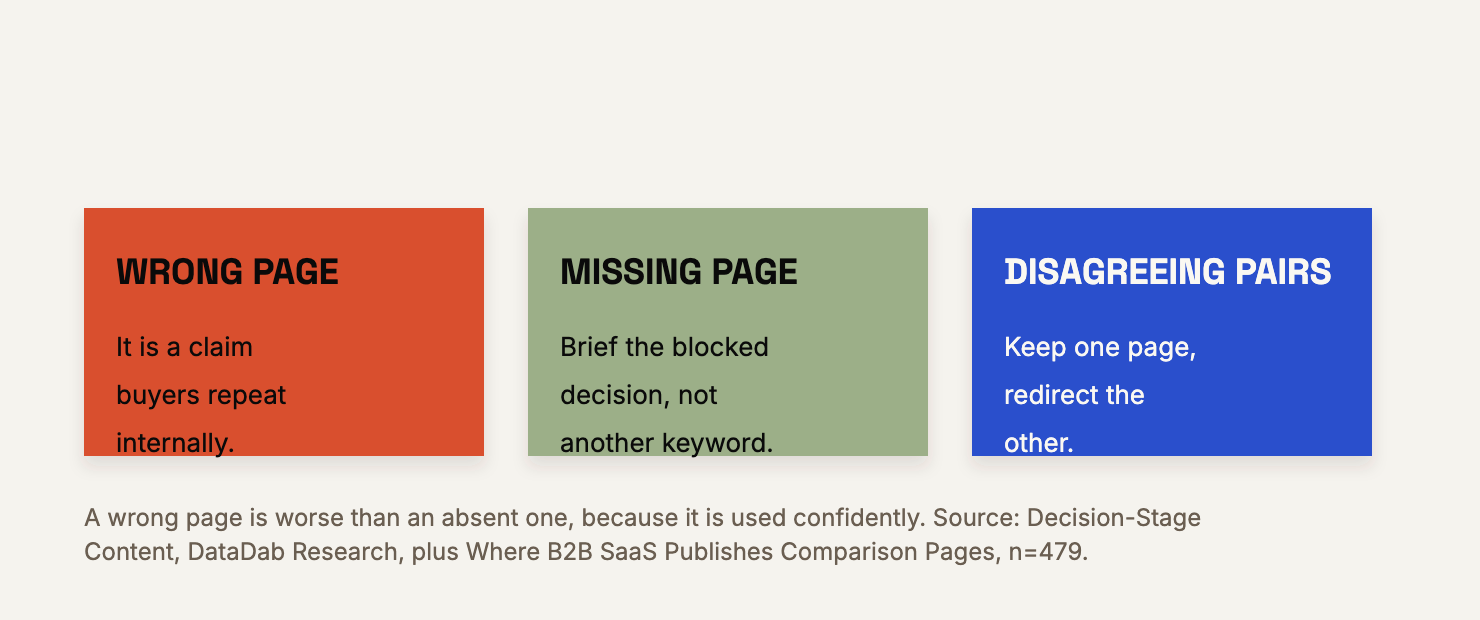
What to fix first
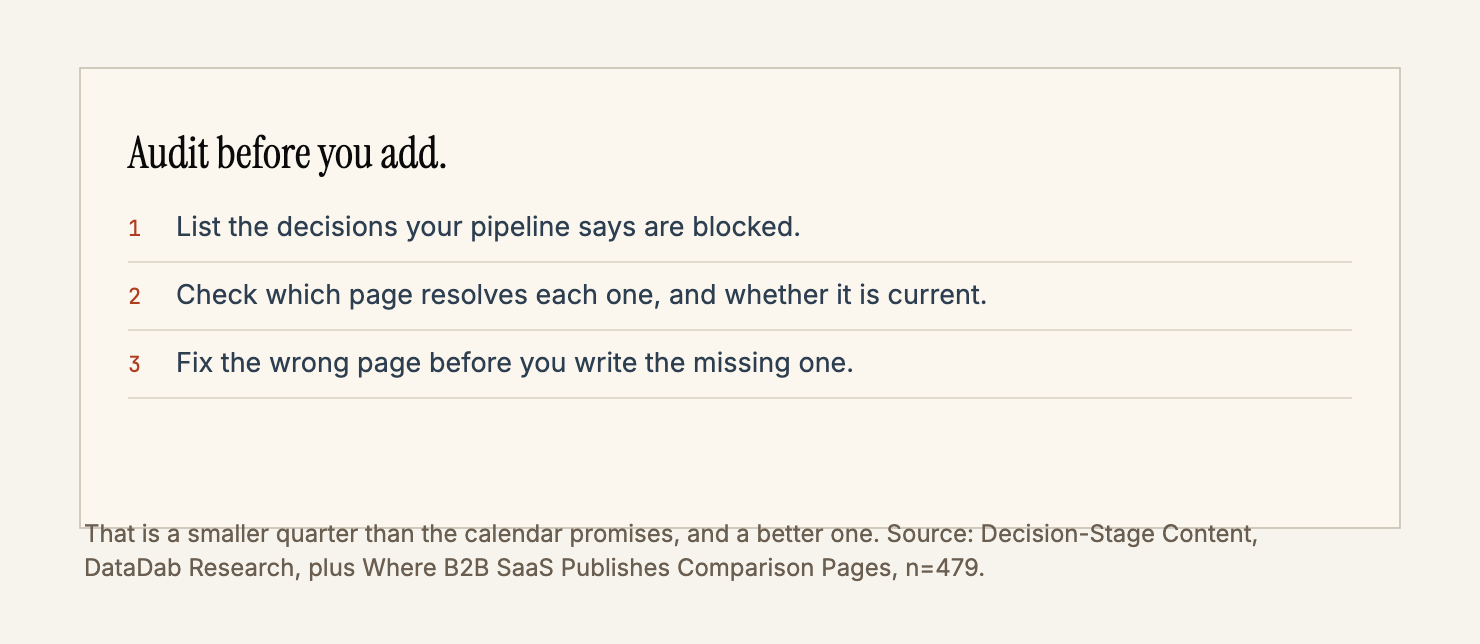
Take the decisions that are actually blocked, in your pipeline rather than in theory. Then look at what your own pages say about each one.
Fix the page that is wrong before you write the one that is missing, because a wrong page is worse than nothing: it is a claim buyers repeat internally.
If you have nineteen planned posts and no owner for the pricing page, the honest plan is: three posts, six months of maintenance, and an inventory of decisions.
That is a smaller quarter than the calendar promises and a better one.
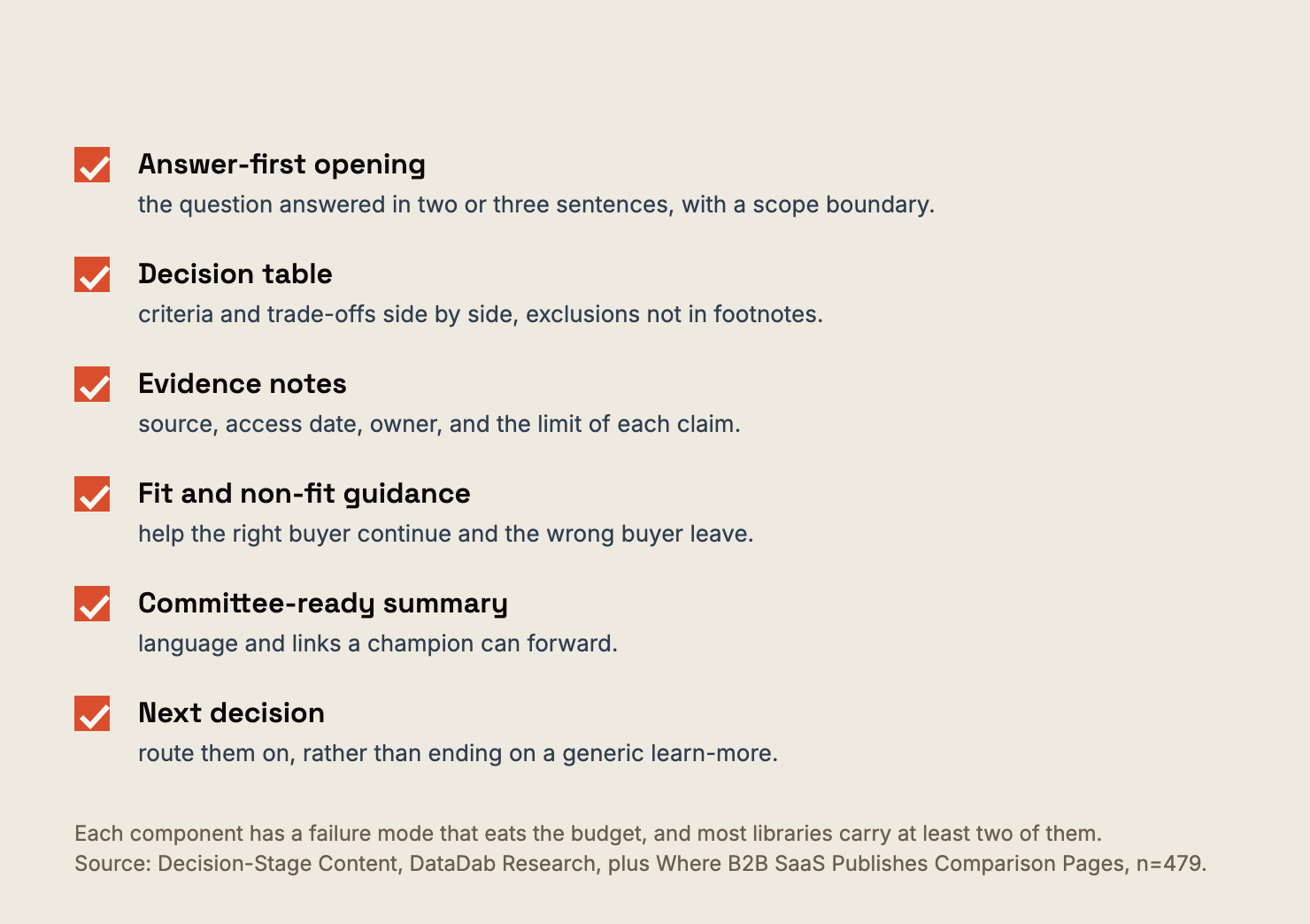
What a useful source page contains
A sensible topic is not enough. The guide gives six components a decision-resolving page needs, each with the failure mode that eats the budget.
*Answer-first opening.* The question answered in the first two or three sentences, with a scope boundary. The failure is category history, brand theatre, or an intro that could open anything.
*Decision table.* Criteria and trade-offs side by side. The failure is a feature grid that hides material exclusions in footnotes.
*Evidence notes.* Source, access date, owner and the limit of each important claim. The failure is treating vendor copy or an old sales deck as independent proof.
*Fit and non-fit guidance.* Help the right buyer continue and the wrong buyer leave. The failure is calling every reader an ideal customer.
*Committee-ready summary.* Language and links a champion can forward. The failure is assuming the person reading controls the approval.
*Next decision.* Route the reader to the most useful follow-on page, tool or conversation. The failure is ending on a generic "learn more" button.
Six components, and a page either has them or it is a post with a buying-shaped title.
The one-line test for each page
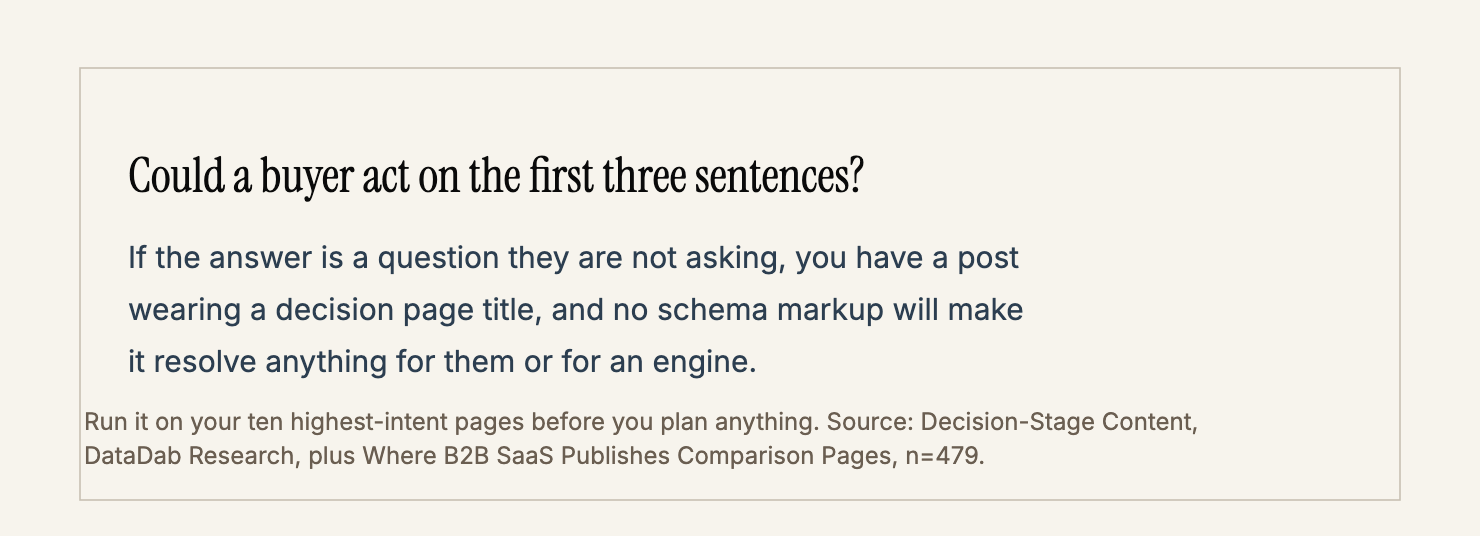
Open the page, read the first three sentences, and ask whether a buyer could act on them without scrolling. If the answer is a question the buyer is not asking, you have a post wearing a decision page's title, and no amount of schema will make it resolve anything.
Who this is for
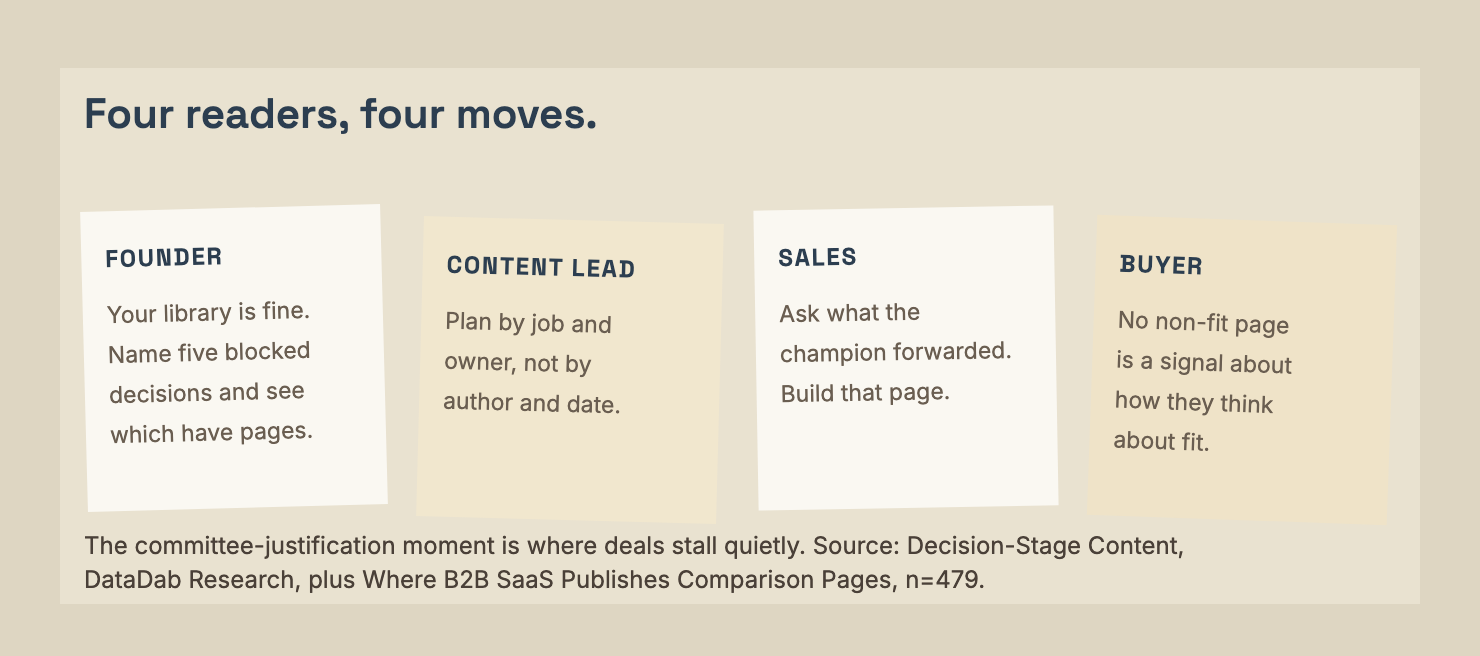
*Founders with a blog and no conversions from it:* your library is probably fine. Your decision coverage is not. Name five blocked decisions and see which page resolves each.
*Content leads:* the five jobs are a planning grid that survives a reorg. Assign owners and triggers rather than authors and dates.
*Sales leaders:* the committee-justification moment is where your deals die quietly. Ask reps what the champion forwarded, and build that page.
*Buyers:* if you cannot find a vendor's non-fit page, that is a signal about the vendor, and it is not about their honesty. It is about whether they have thought about who they are wrong for.
A note on how confident we are
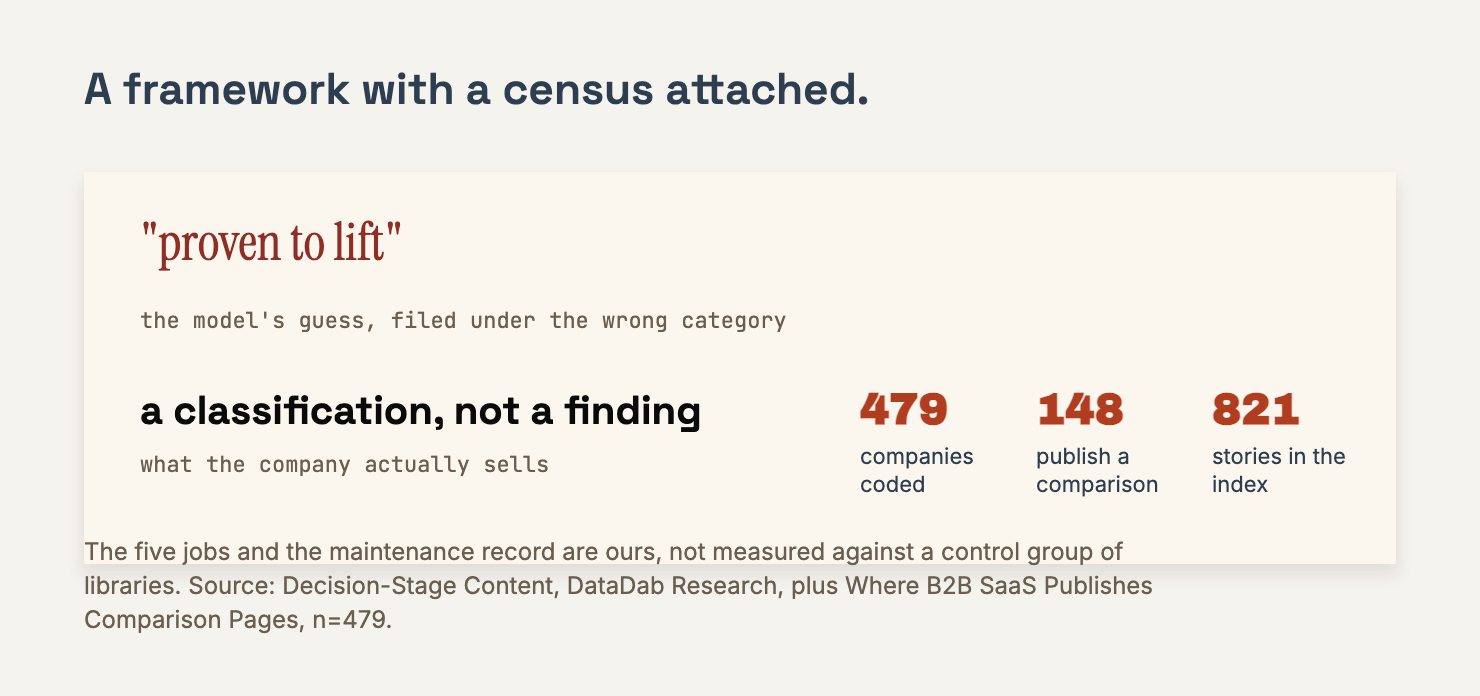
The five jobs and the maintenance record are a practitioner framework published on our own reference page, not a measured finding.
They have not been tested against a control group of libraries, and I would not present them as more than a working classification.
The comparison-page numbers are a real census with a real bias: 479 YC-backed B2B software companies, so venture-backed and developer-heavy, and the study measures what a company publishes on its own domain.
A vendor running comparison content on a partner site or behind a gated PDF is not in these counts.
The "you have enough content" claim is a position, taken deliberately, and it is wrong for a company in a genuinely unaddressed category.
If the comparison has not been written because the category does not exist yet, write it and own the definition.
Wrap-up
Five jobs: pricing and entitlement, comparison, alternatives and constraint, migration, validation and committee. Three moments where the decision disappears. One maintenance record per page.
Audit before you add. Then scan the page a buyer is most likely to get stuck on.


