

A brand absent from AI answers usually has three to five of these running at once. The order matters more than the count, and almost everybody starts in the wrong place.
A marketing director sent me her action list last month. New comparison page, refreshed statistics, FAQ schema, an outreach push for reviews. Four good ideas.
She had not checked whether an AI crawler could fetch her pricing page, which was sitting behind a bot-protection rule.
Every item on her list was downstream of a block she did not know about.
Our diagnostic page for this is how SaaS companies get cited, and it names eight causes in the order they turn up: crawl access, corpus indexation, passage retrievability, extractable structure, entity clarity, competitive displacement, freshness decay, query-intent mismatch.
Run it properly and you find three to five active at once. Causes one through five have to be fixed before causes six through eight do anything.
Cause one is causal in the literal sense
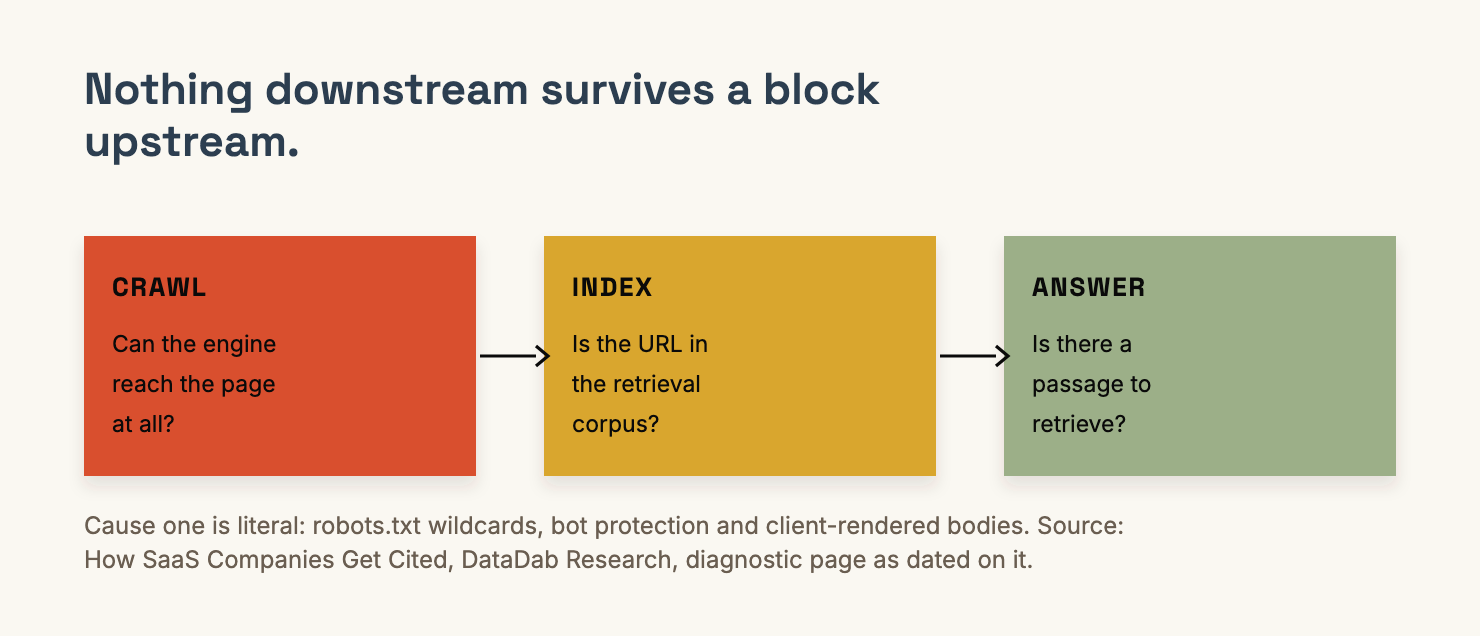
Crawl access means whether an AI crawler can reach and render your page.
The common failures are a robots.txt wildcard that disallows GPTBot, ClaudeBot or PerplexityBot, bot protection that blocks unknown agents, and client-rendered JavaScript that hides the body from anything that is not a full browser.
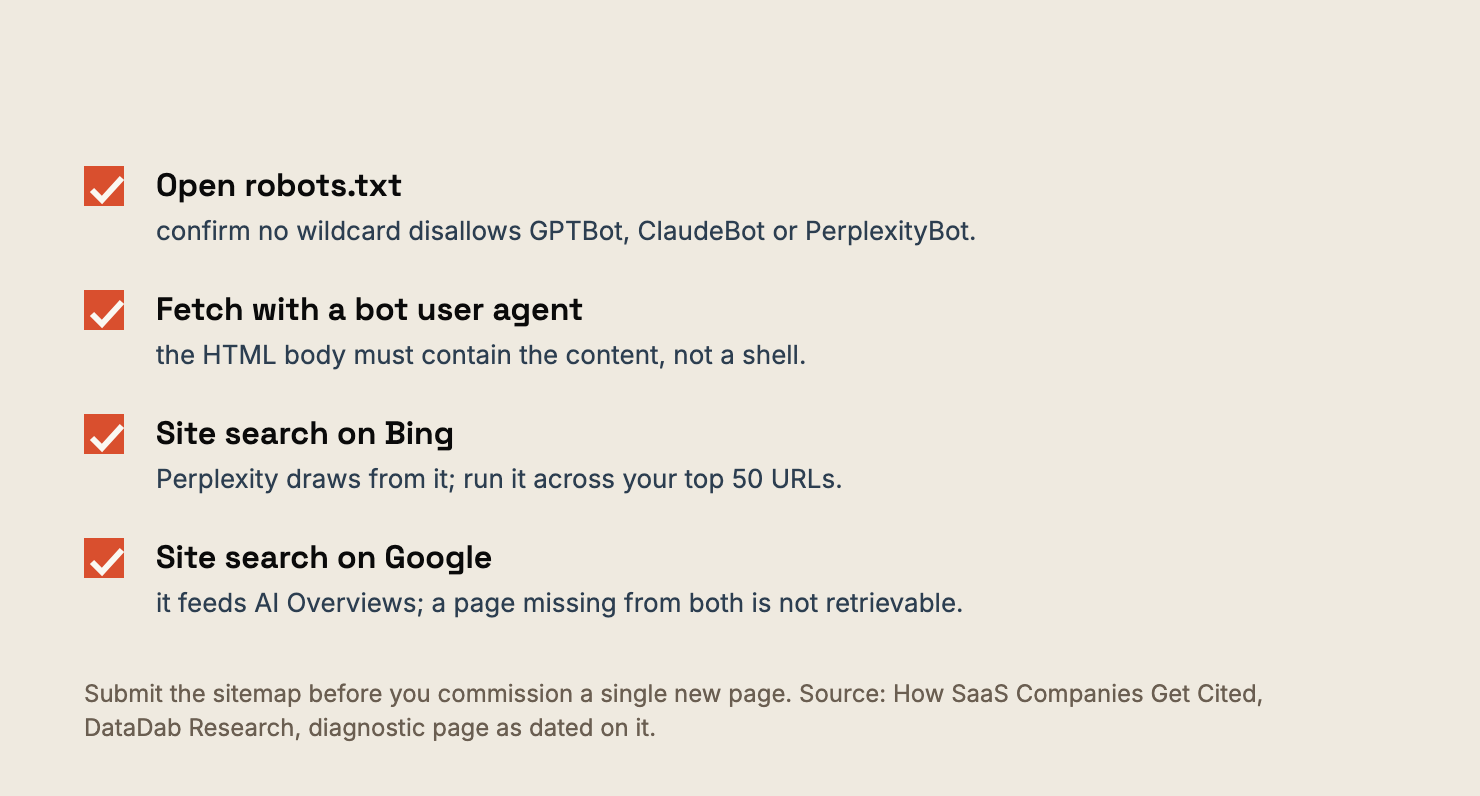
The self-test takes five minutes. Open your live robots.txt and confirm there is no wildcard disallow covering those bots.
Then fetch your best page with a GPTBot user agent and check the returned HTML contains the actual content rather than a shell.
No citation work matters if the engine cannot reach the page.
That is why it sits first, and it is why teams with a busy roadmap keep failing it: it costs nothing to check and produces no deliverable to show.
Cause two: being on the web is not being in the index
Corpus indexation asks whether your domain sits in the indexer that retrieval engines draw from. A page can exist, rank, and be unreachable in an answer.
The test is ten minutes across your top 50 URLs. Run a site search against Bing, which is Perplexity's primary indexer, and against Google, which feeds AI Overviews.
Pages missing from both are not on the retrieval surface at all.
Fix direction is unglamorous: submit the sitemap to Bing Webmaster Tools and Google, then confirm the URLs you care about are actually present.
Most teams have a Bing account for the first time in this conversation.
Cause three: the passage, not the page
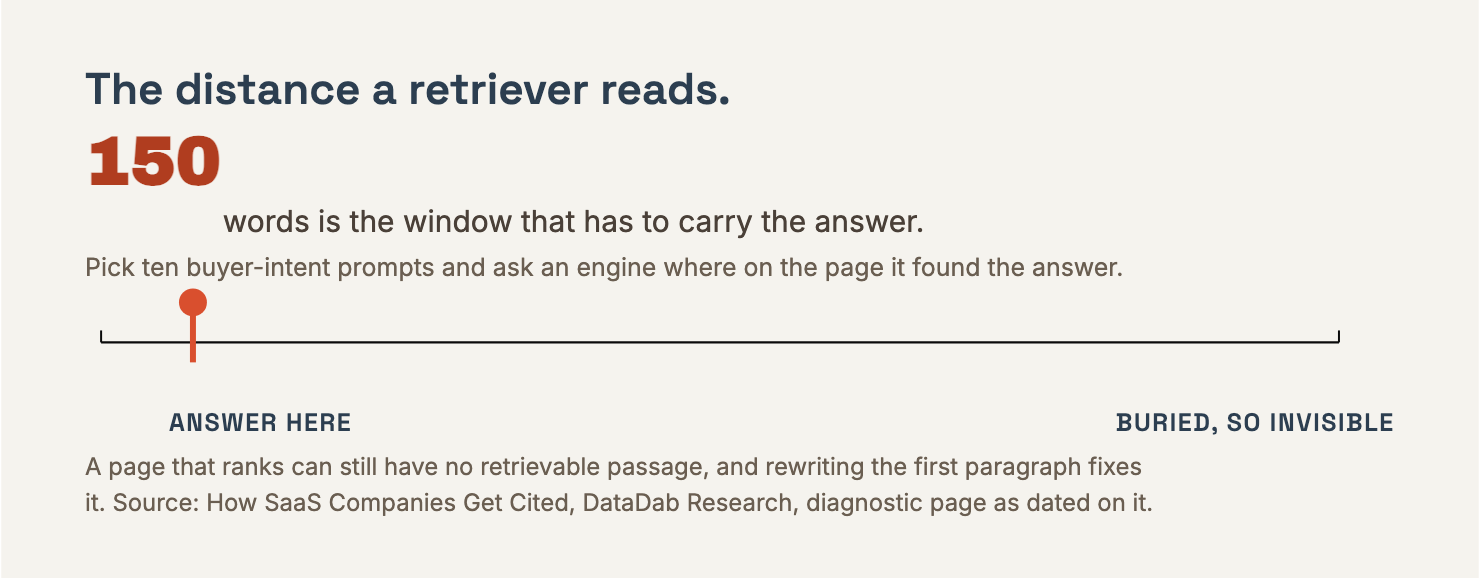
Passage retrievability asks whether the specific 100-300 word window that answers a buyer query exists on your page in an extractable form. Buried conclusions and prose-only pages fail it. Answer-first pages pass it.
Give yourself thirty minutes and the top 10 buyer-intent prompts in your category. For each, ask an engine where on the page the answer comes from.
If it cannot find a precise passage, neither can a buyer skimming your page on a call.
The fix rewrites the first paragraph of every important page to state the answer, then earn the rest of the word count.
It is the largest win available without publishing anything new, and it is the one most teams skip because it feels like editing rather than creating.
Cause four: structure earns the citation, not the prose
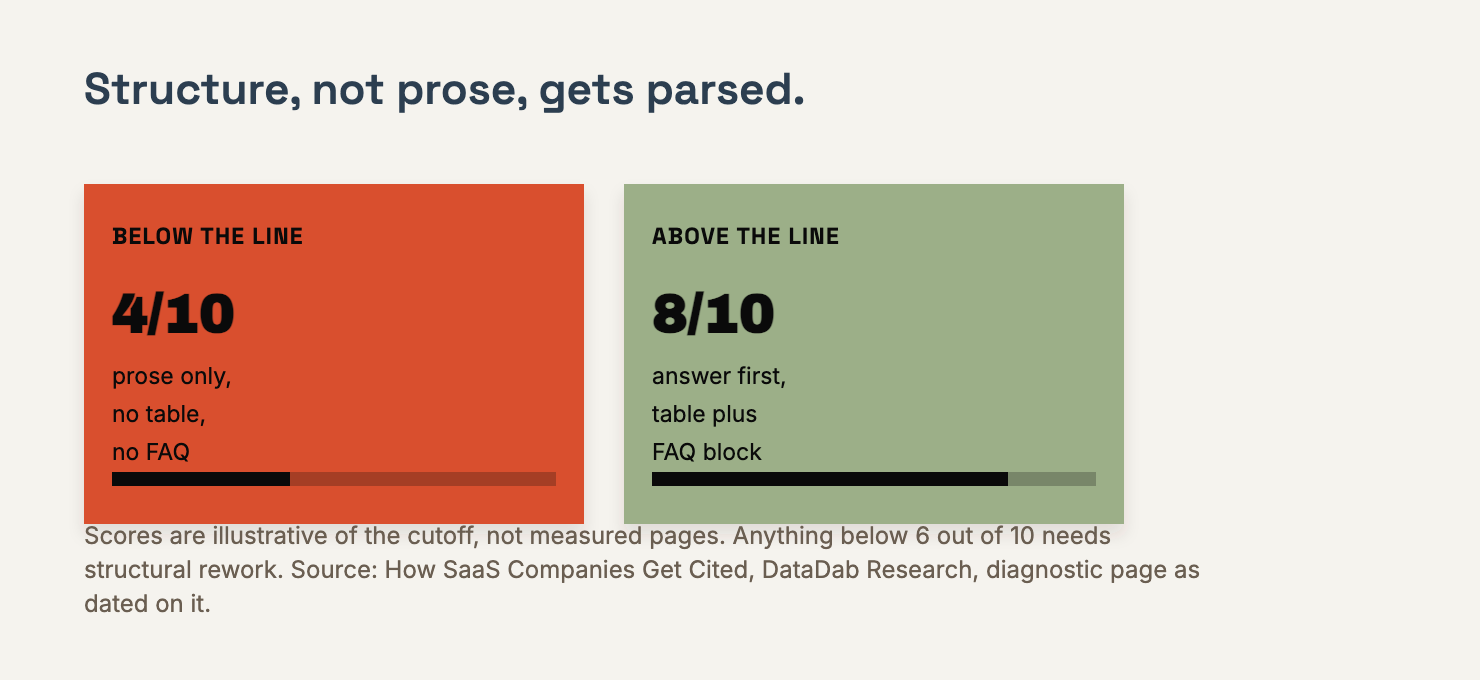
Extractable structure means the shapes answer engines parse reliably: comparison tables, FAQ blocks, ranked lists, and schema markup.
Prose-only pages earn fewer citations than structure-rich pages, even when the prose is identical. I have watched the same argument perform differently purely because one version had a table in it.
Run our AI Extractability Audit across your top 10 pages and cross-check with a free audit from a vendor, so you are not arguing with one number.
Anything scoring below 6 out of 10 needs structural rework.
Then add Organization, Article, FAQPage and BreadcrumbList markup to the pages that are cited or should be, and add at least one table and one FAQ block to every buyer-intent page.
Cause five: entities have to be reconciled, not mentioned
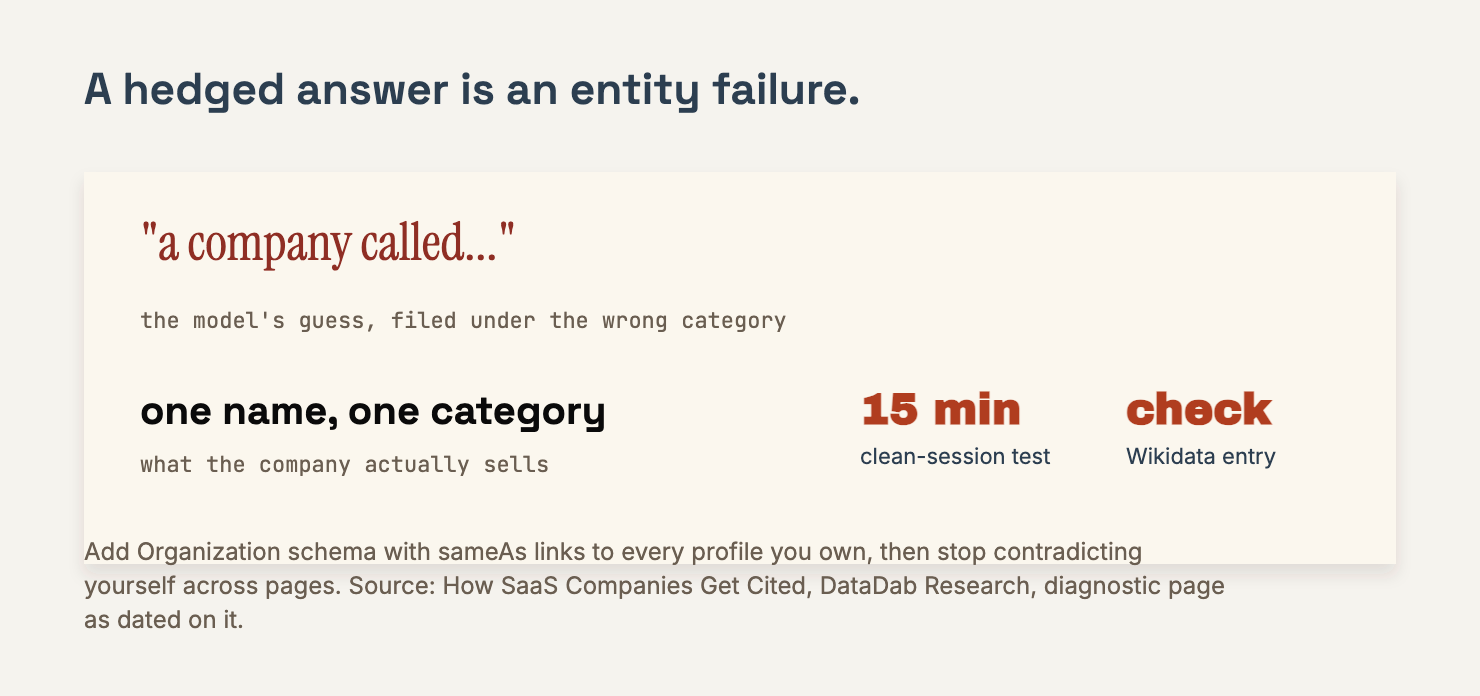
Entity clarity asks whether an engine has reconciled your brand across the web as a single, named, well-described thing. Strong entities get cited confidently.
Weak ones produce hedged answers, the "a company called..." phrasing that tells you the model is guessing.
Fifteen minutes. Ask ChatGPT what your brand is, in a clean session. If it hedges, qualifies, or puts you in the wrong category, your entity is unclear.
Then check whether you have a Wikidata entry, because that is where reconciliation gets cheap help.
The fix is consistency work: Organization schema with links to every profile you own, the same category description on every page, and one canonical description of what you do that your site never contradicts.
Causes six to eight are real, and they are wasted until five is done
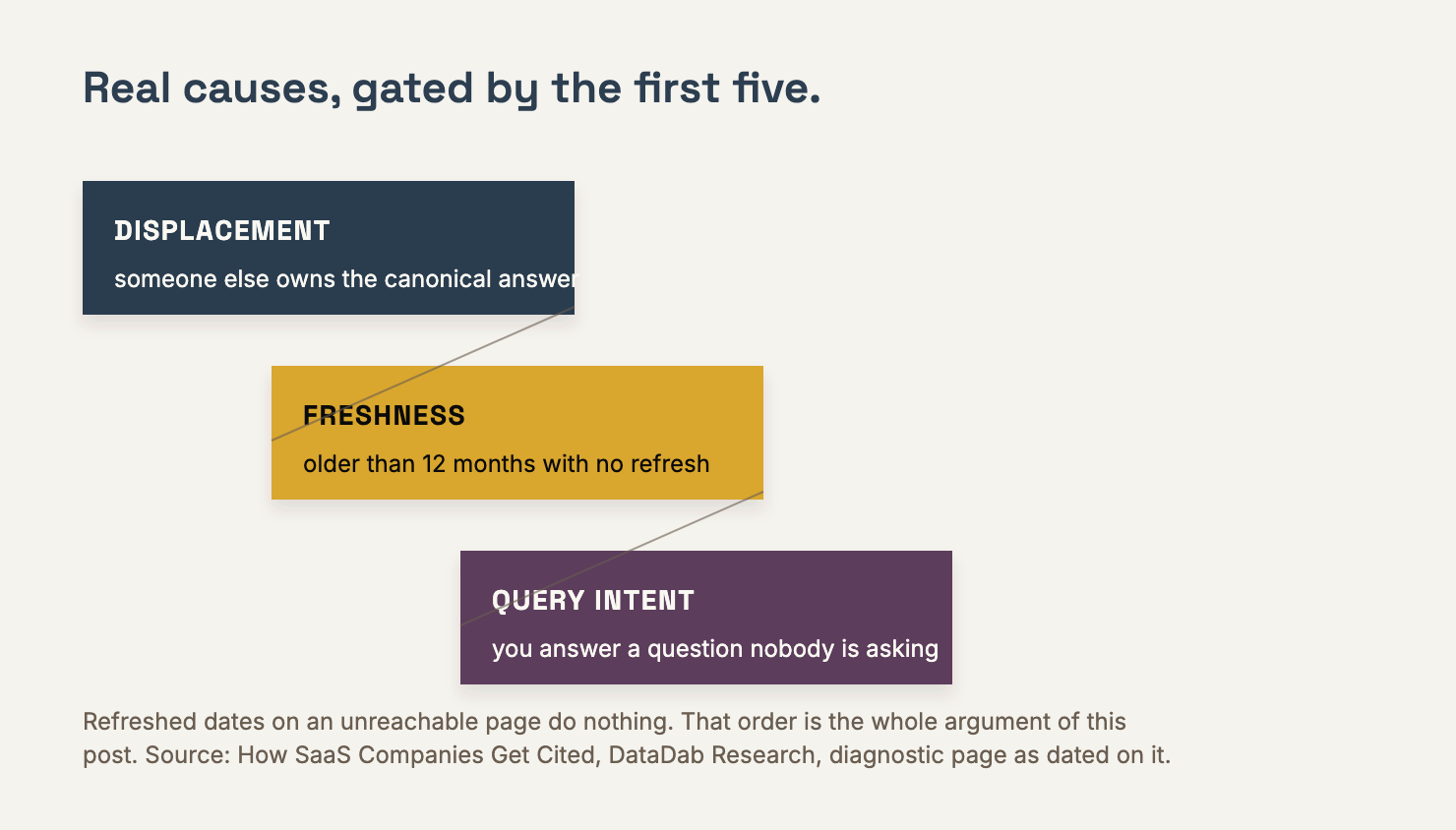
Competitive displacement is the honest one: if a competitor owns the canonical answer to "best [category] for [use case]", your pages get cited second or not at all, however good they are.
The test is to find the cited source for your top 10 prompts. If it is a competitor, write the displacing page.
If it is Wikipedia or a review site, you have a different problem entirely.
Freshness decay is the one teams can see. Check publication and last-modified dates on your top 20 cited pages.
Anything older than 12 months with no data refresh is flagged, and retrieval-first engines down-weight it. Add a visible last-updated stamp, refresh dated statistics quarterly, and publish a short note about what changed.
Query-intent mismatch sits last because it is the least fixable by editing: your page answers a question the buying stage is not asking. That is a positioning problem wearing a content symptom.
Now the ordering rule. If your passage retrievability is broken, refreshing dates does nothing an engine can use. If crawl access is broken, all seven other causes are decoration.
The count of your problems is not the useful number. Which one is upstream is.
What four conditions actually have to hold
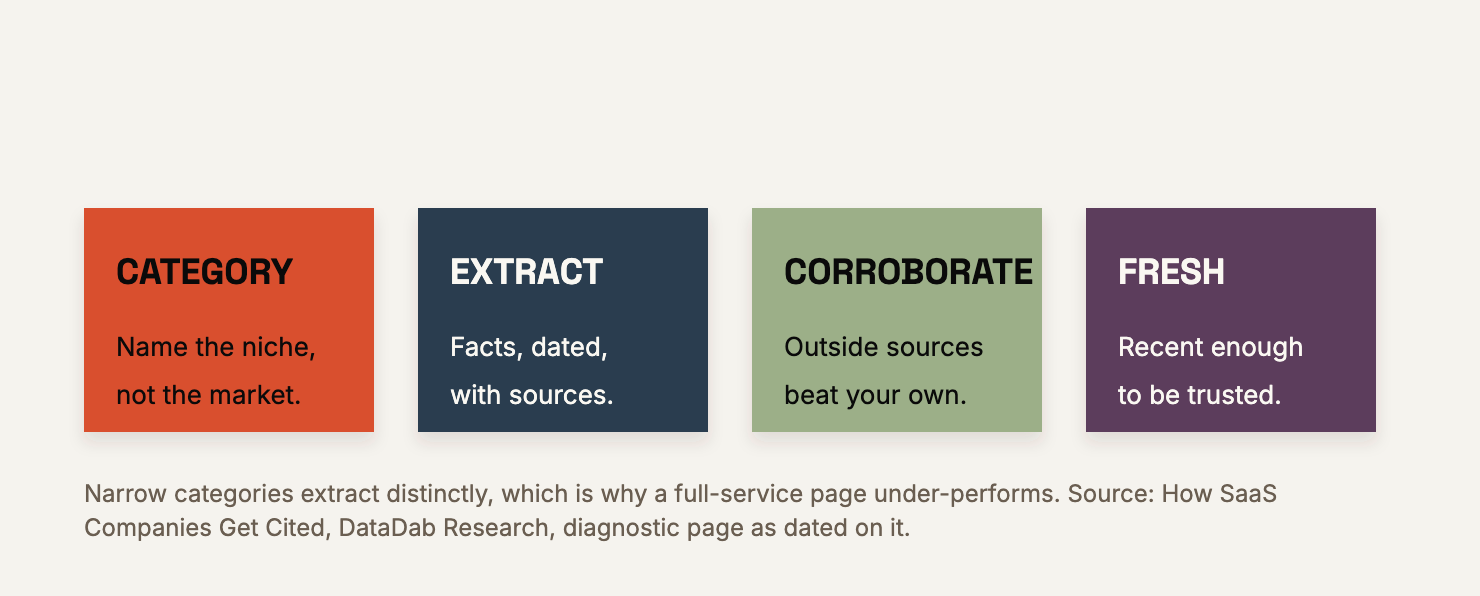
Underneath the eight causes there are four conditions a cited page tends to satisfy. It defines a specific category or sub-niche. It presents facts an answer engine can extract cleanly.
It is corroborated across third-party review and editorial platforms. It is fresh enough that the model trusts the source.
Narrow beats broad on the first one every time: naming your ICP and your use case outperforms a full-service description, because the narrower page extracts as a distinct thing.
The third condition is where most mid-market vendors have no plan, and it is the slow one: corroboration is earned outside your domain.
The fourth is why a page that worked last year goes quiet without anyone changing it.
The nine steps, in the order you use them
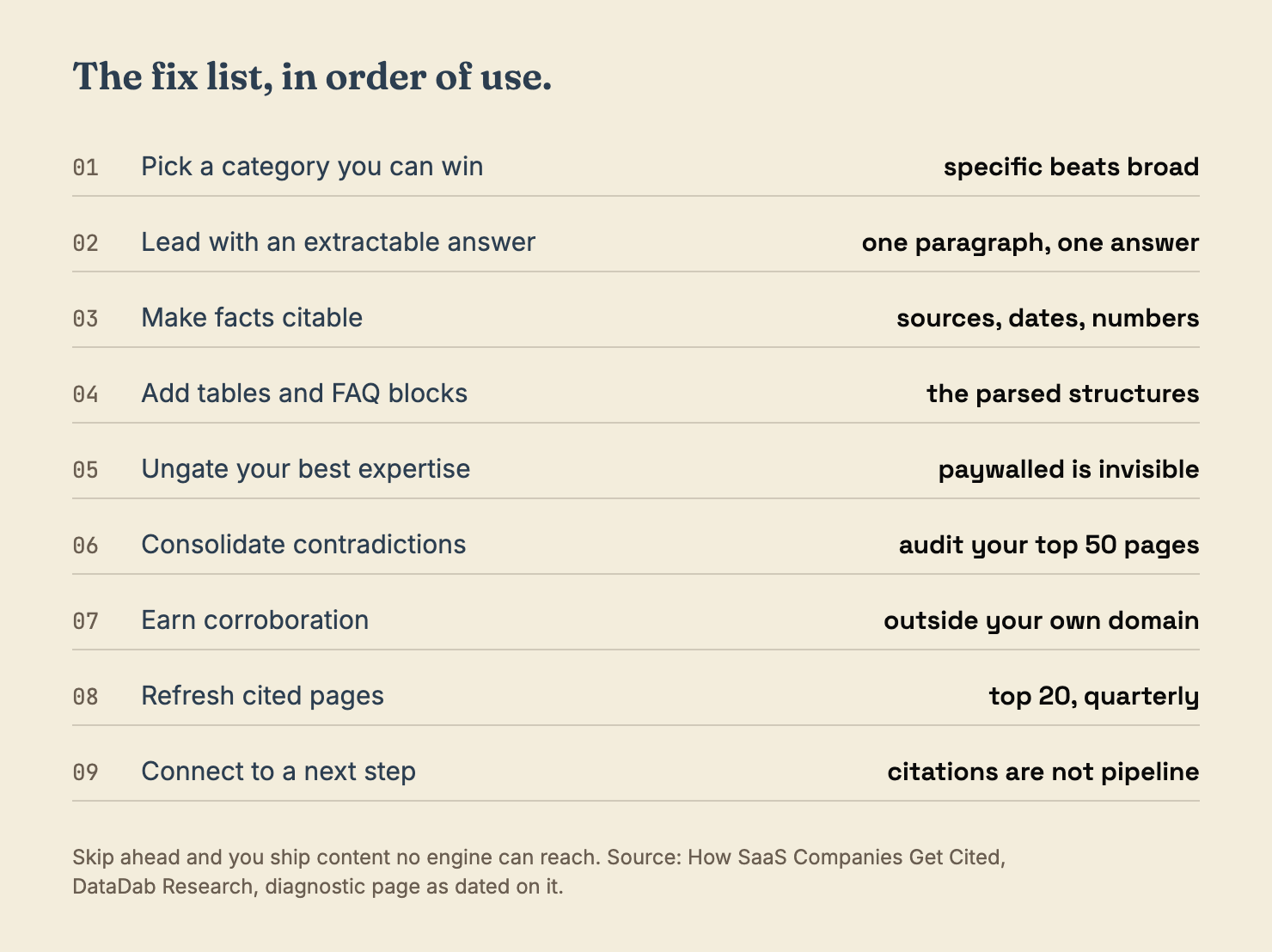
Once the causes are cleared, the fix list is short and specific. Run it in this order, because skipping ahead ships content no engine can reach.
1. Pick a category you can win. Specific beats broad, and naming your ICP and use case out-cites a full-service description every time.
2. Lead each cited page with an extractable answer. One paragraph, one answer, no preamble, phrased the way a buyer would accept it.
3. Make facts citable. Named sources, dated claims, primary research. Hedging is a citation tax.
4. Add comparison tables and FAQ blocks, with three to seven real follow-up questions answered.
5. Ungate your best expertise. A PDF behind a form is invisible to retrieval, and paywalled knowledge does not get cited.
6. Consolidate contradictory pages. Audit your top 50 and, where two disagree about the same offering, keep the better one and redirect the other.
7. Earn third-party corroboration. One canonical claim backed by three independent sources is cited more reliably than three self-published claims.
8. Refresh cited pages. Quarterly date-modified updates on your top 20 cited pages compound, and a re-publication date moves the citation layer more than an original one.
9. Connect the research to a next step, because citations that lead nowhere are a metric and not a pipeline.
Nothing on this list requires a new page. That is the uncomfortable part: the eight causes are mostly cleared with checks, one paragraph rewrite and a schema pass, and then a decision about who owns the page afterwards.
Who this is for
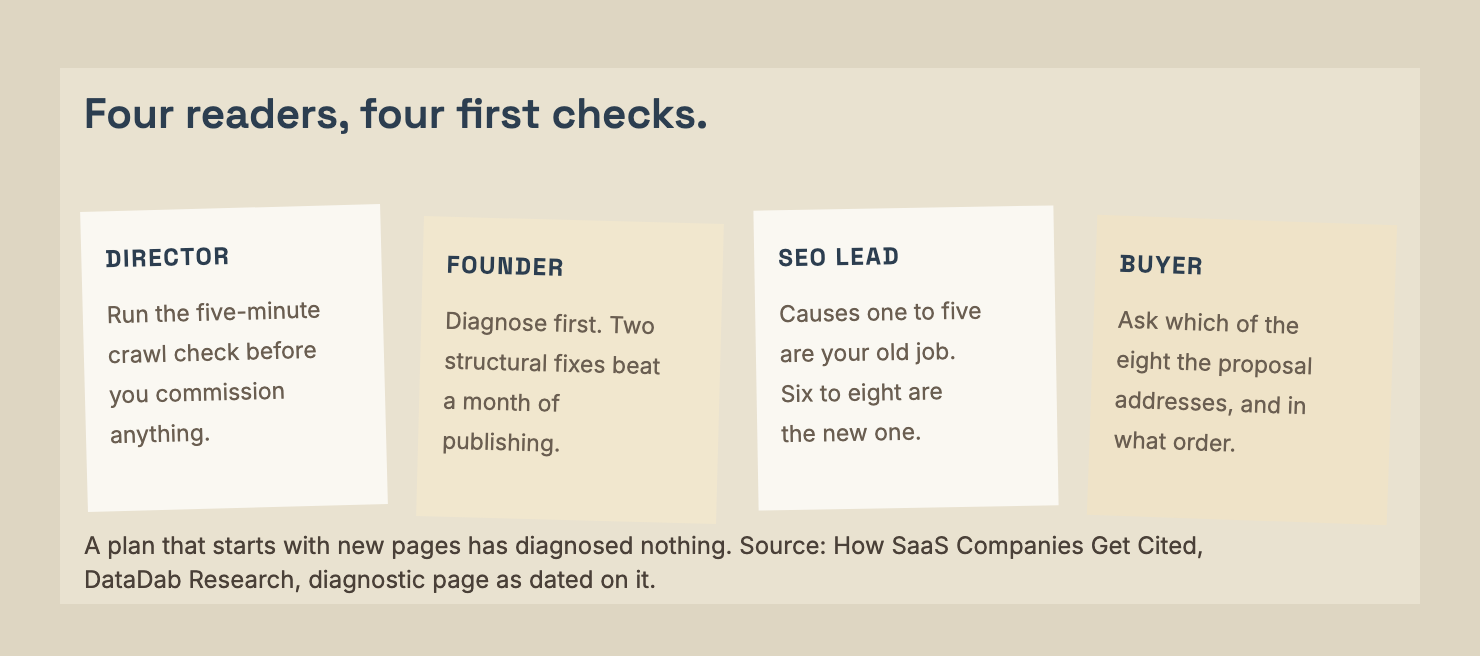
*Marketing directors with a content plan:* run the five-minute crawl check before you commission anything. It is the only cause on the list that can invalidate the entire plan.
*Founders told they need more content:* probably not. Diagnose first, in order, and you will find that two structural fixes beat a month of publishing.
*SEO leads moving into AI visibility:* causes one to five are your existing job with new names. Six to eight are the ones where your old instincts mislead you, because displacement is not a ranking problem.
*Buyers of this kind of service:* ask which of the eight the proposal addresses, in what order, and how each is tested. A plan that starts with new pages has not diagnosed anything.
A note on how confident we are
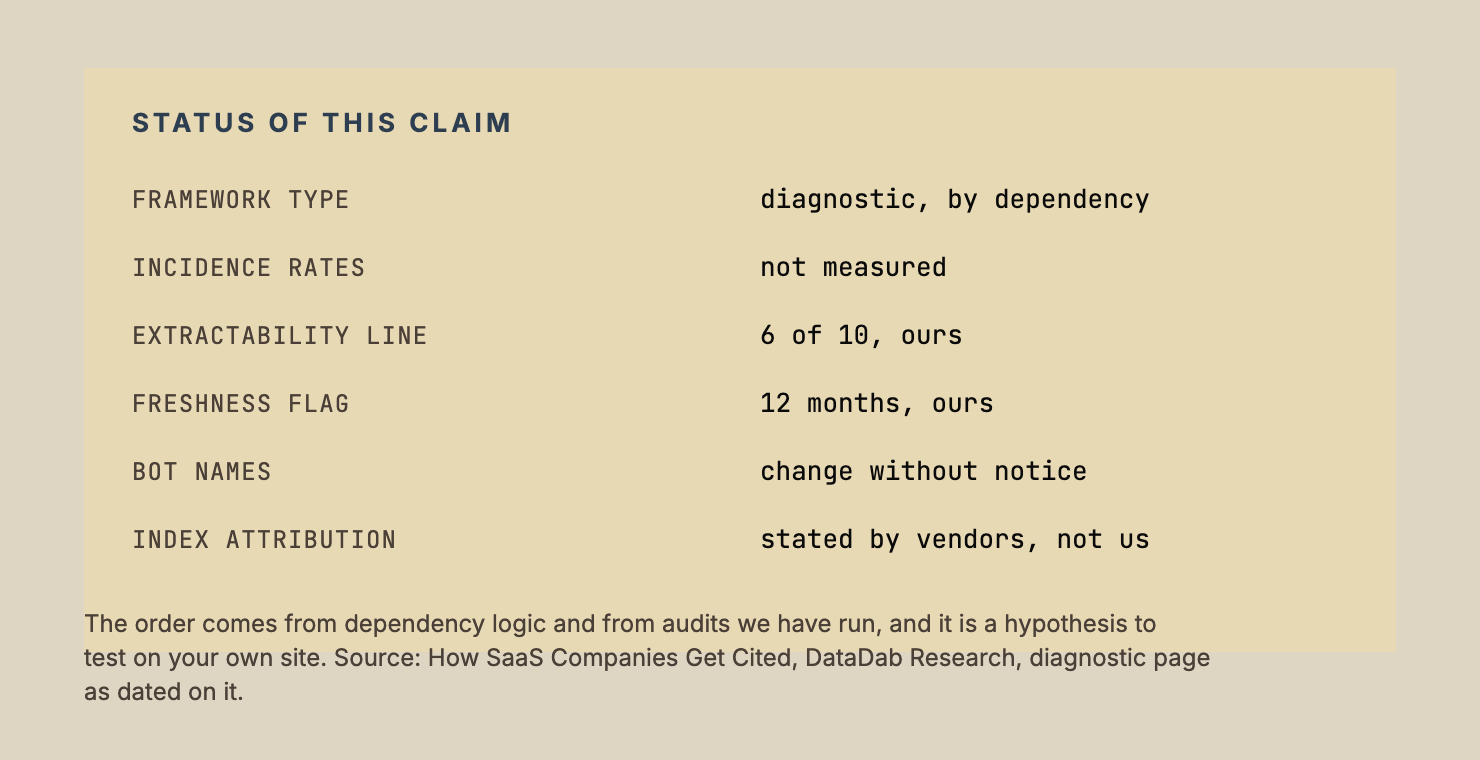
This is a diagnostic framework, not a measured incidence rate.
We have not coded a sample of brands against the eight causes, so I cannot tell you how often each one is the real blocker.
The order comes from dependency logic and from what we see in audits, and it is a hypothesis to test rather than a finding.
The tests have a shelf life.
Bot names, indexer behaviour, schema handling and engine answers all change; the ones above describe what was true when the study page was written and verified, and each needs re-running on your own site.
Some thresholds are ours, not the industry's.
The 6 out of 10 extractability line and the 12-month freshness flag are our working cutoffs on our own audit, stated as such, and a defensible argument exists for both being tighter or looser depending on your category.
One thing I deliberately left out: this post makes no claim about where any brand ranks in a scored index.
Grades from our Citation Index work require a validated response panel that does not exist yet, so those numbers stay off the page until they do.
Wrap-up
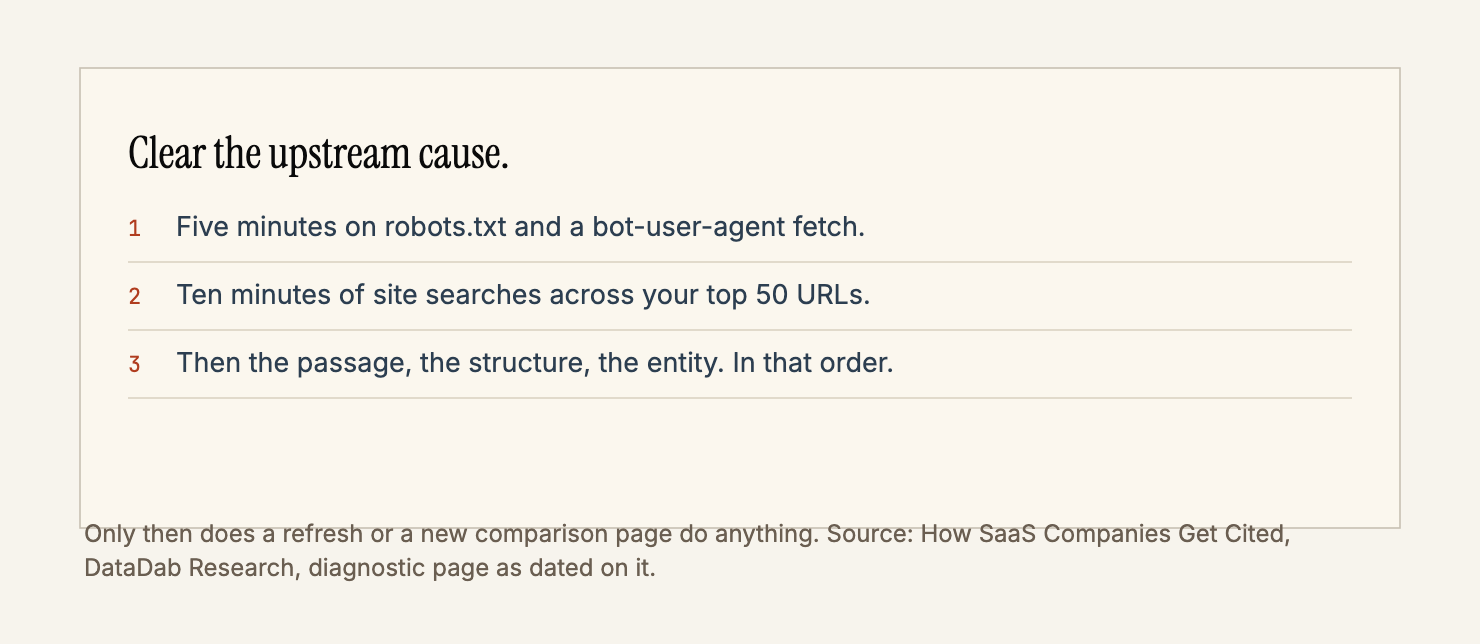
Reach, index, passage, structure, entity. Then displacement, freshness and intent. Three to five causes run at once, and the upstream one decides whether the rest of your list does anything.
Start with the five-minute fetch and the ten minutes of site searches. Then map the buyer questions your pages do not answer at all.