

An agents product closes the distance between a report and a draft. It does not close the distance between a draft and a page that earns the citation.
Most teams buy measurement, receive a list of gaps, and then discover the gap between the list and the work. That distance is where budgets quietly die.
It is also why every serious measurement vendor now has a drafting layer.
Profound has the most visible one. We keep running into it because buyers name it: in our own grounding-query export, the most-asked single-product question is not what Profound costs.
It is how to set an agents product up so it converts top-of-funnel traffic.
That is a setup question, and this piece does not answer it. What follows is the buying question underneath it: what the drafting layer consumes, what it costs, and where it stops.
Here is the honest version, from three studies: our AI visibility tools comparison, our AI marketing software pricing analysis, and the bolt-on versus specialist bake-off.

The agents lane exists because reports annoyed people who had to write
A measurement tool answers a question. Someone then has to turn that answer into a page, a rewrite, a schema block, an outreach note.
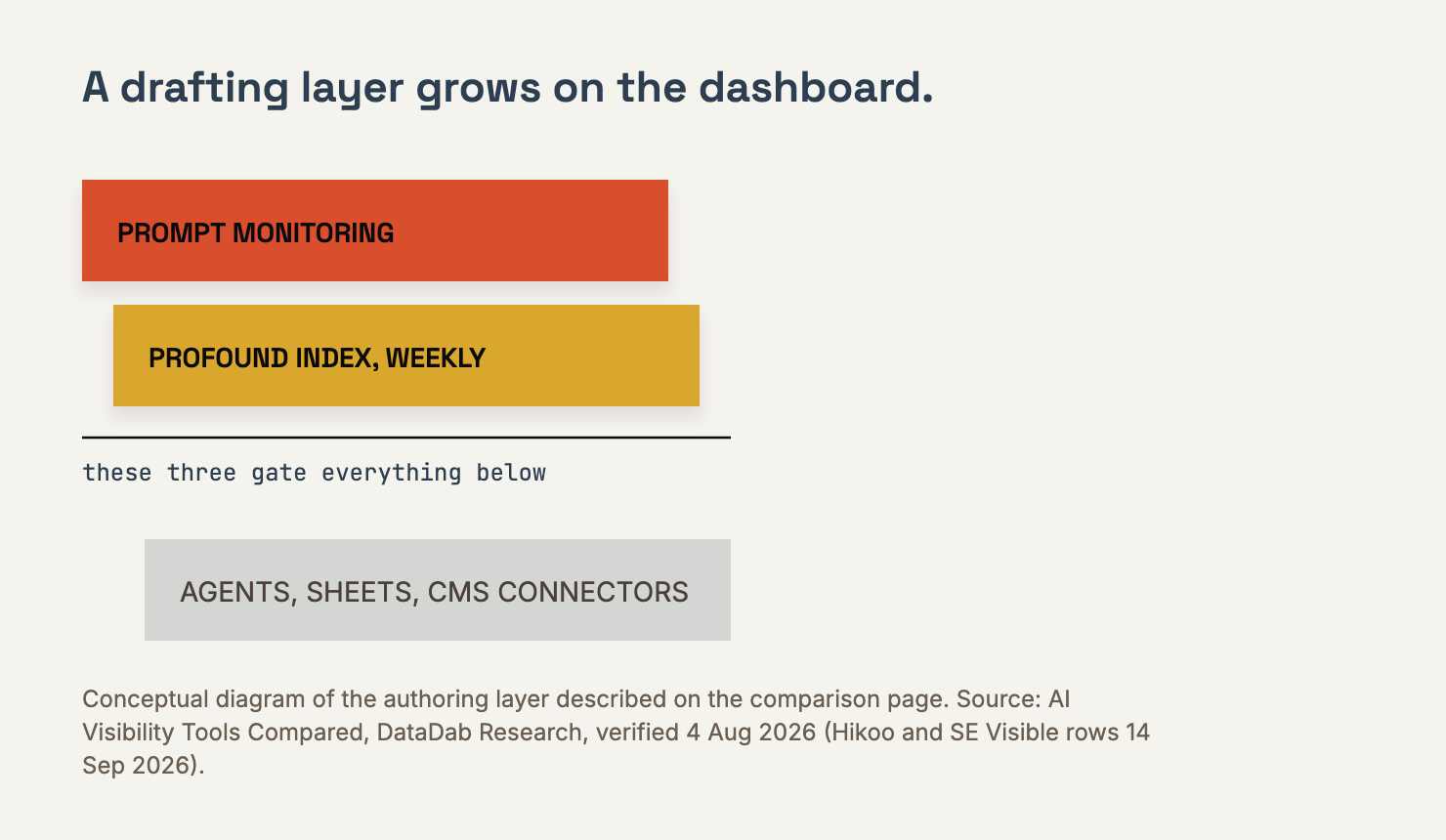
Profound's answer was an authoring layer inside the product. Agents, Sheets, CMS connectors.
The comparison describes the funded measurement player as prompt monitoring across engines, a free weekly Profound Index leaderboard, and that authoring layer on top.
The bolt-on vendors went the other way. As the bake-off puts it, Profound pushes into content while Ahrefs Brand Radar and Semrush sit closer to reporting.
That is a real difference and it is worth buying. It is also not unique. AthenaHQ has actions, Rankshift has a writer, so the lane exists rather than being one vendor's invention.
Agent credits are not query credits, and that is the whole procurement question
Here is the sentence I wish more buyers caught before signing.
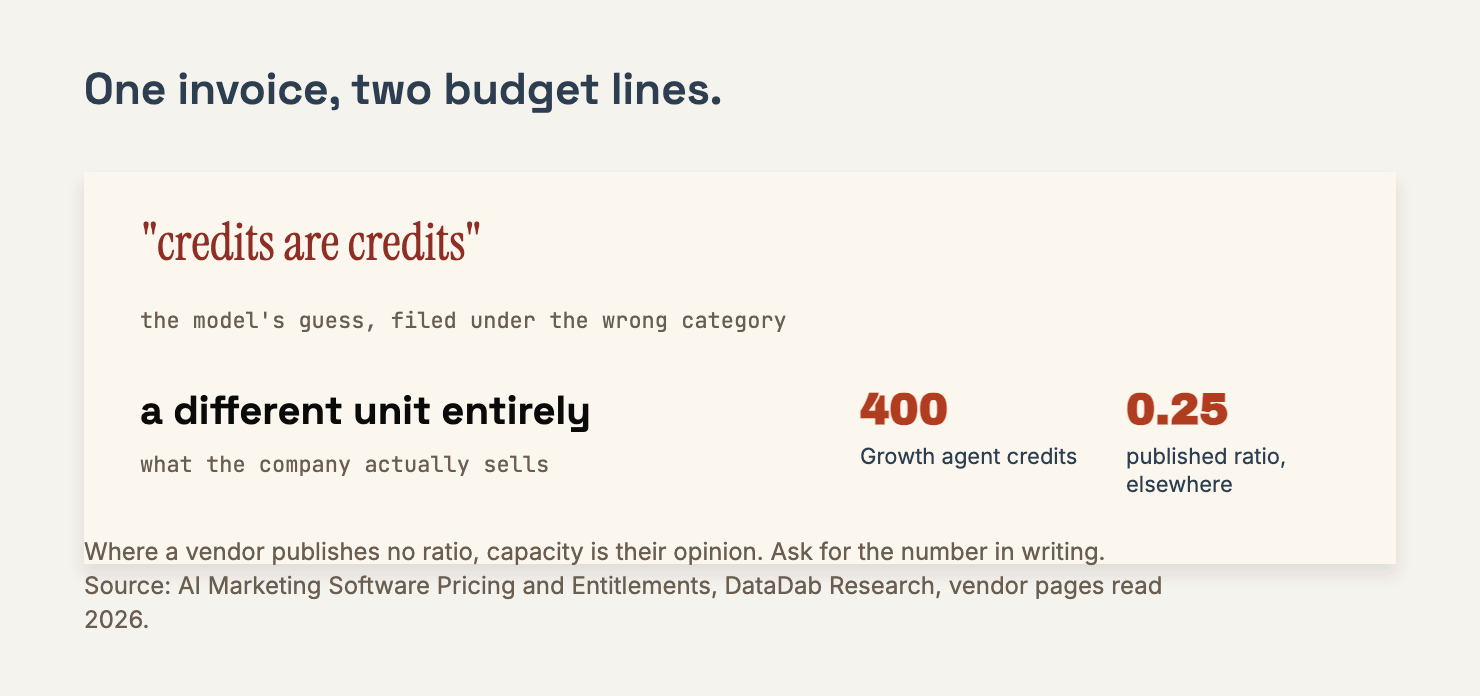
Profound's agent credits are consumption credits for content generation. They are not monitoring queries.
The pricing study says it flatly: the unit is different in kind, and the two cannot be added, compared, or divided into a cost per answer.
So your procurement sheet has two budget lines hiding inside one invoice.
Monitoring consumes prompts and engine-queries. Generation consumes agent credits.
A plan that sounds generous on the first can be thin on the second, and the sales conversation will not tell you which one you are buying.
The trap generalises beyond this vendor. Rankscale publishes its credit-to-query ratio at 0.25 credits per engine query.
Rankshift and Profound do not publish one, so we estimate from stated credit and prompt counts and label it an estimate.
When you cannot see the ratio, you cannot compute the cost of the work you plan to do. Ask for the number in writing.
What $399 a month actually buys
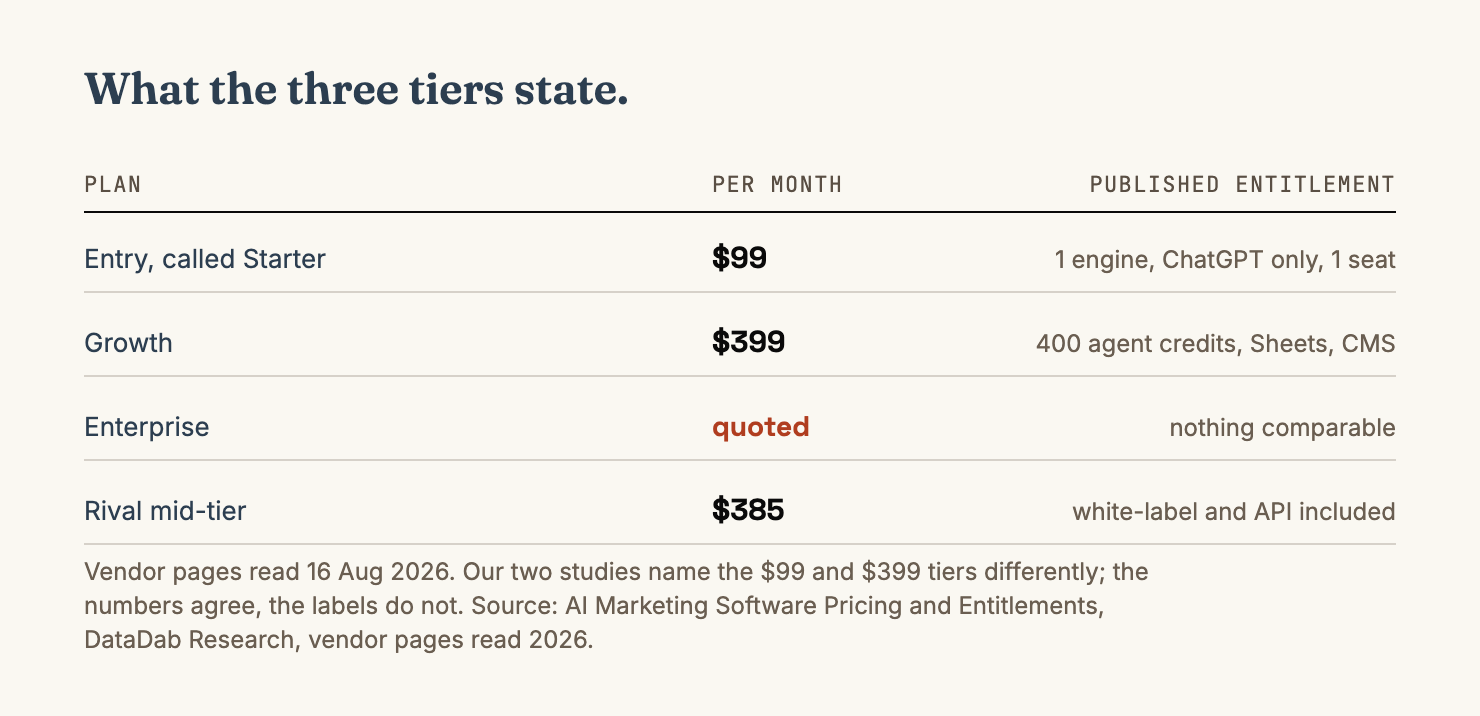
The published ladder, read from vendor pages on 16 August 2026.
| Plan | Price | What is actually published |
|---|---|---|
| Entry, called Starter in one of our studies | $99/mo | prompts plus agent credits, 1 engine (ChatGPT only), 1 seat |
| Growth | $399/mo | 400 agent credits, Sheets and CMS connectors, no API, fewer seats |
| Enterprise | quoted | nothing comparable, so ask in writing before you budget |
Entry at $99 a month buys prompts plus agent credits, with Starter limited to 1 engine and 1 seat.
Growth at $399 a month is where the 400 agent credits, CMS connectors and Sheets live. Enterprise is quoted.
One naming caution, because our own pages disagree. The pricing study calls $99 the Starter entry and $399 Growth. The bolt-on bake-off labels $99 as Growth and $399 as the growing tier, billed yearly.
The two numbers are stable; the tier names are not, and vendors rename plans without renaming what you bought. Confirm which tier you are quoted, not which name appears in the email.
Two consequences worth sitting with.
The entry plan sees ChatGPT only. If your buyers research on Perplexity and Gemini, the cheap sticker cannot answer the question you are asking it.
The engine surcharge arrives as an upgrade rather than as a choice you made.
And the rival mid-tier comparison is unflattering in one specific way.
The pricing study says Profound Growth costs more than Rankscale Growth at $385 a month while including fewer seats and no API, and calls Rankscale Growth the cheapest published option with white-label and API.
If your team needs API access and several seats, the sticker order reverses. That is packaging, not quality.
It only shows up when you line plans against your own constraints instead of against each other.
Where an agents product genuinely beats the bolt-on
Two places, in the order they matter.
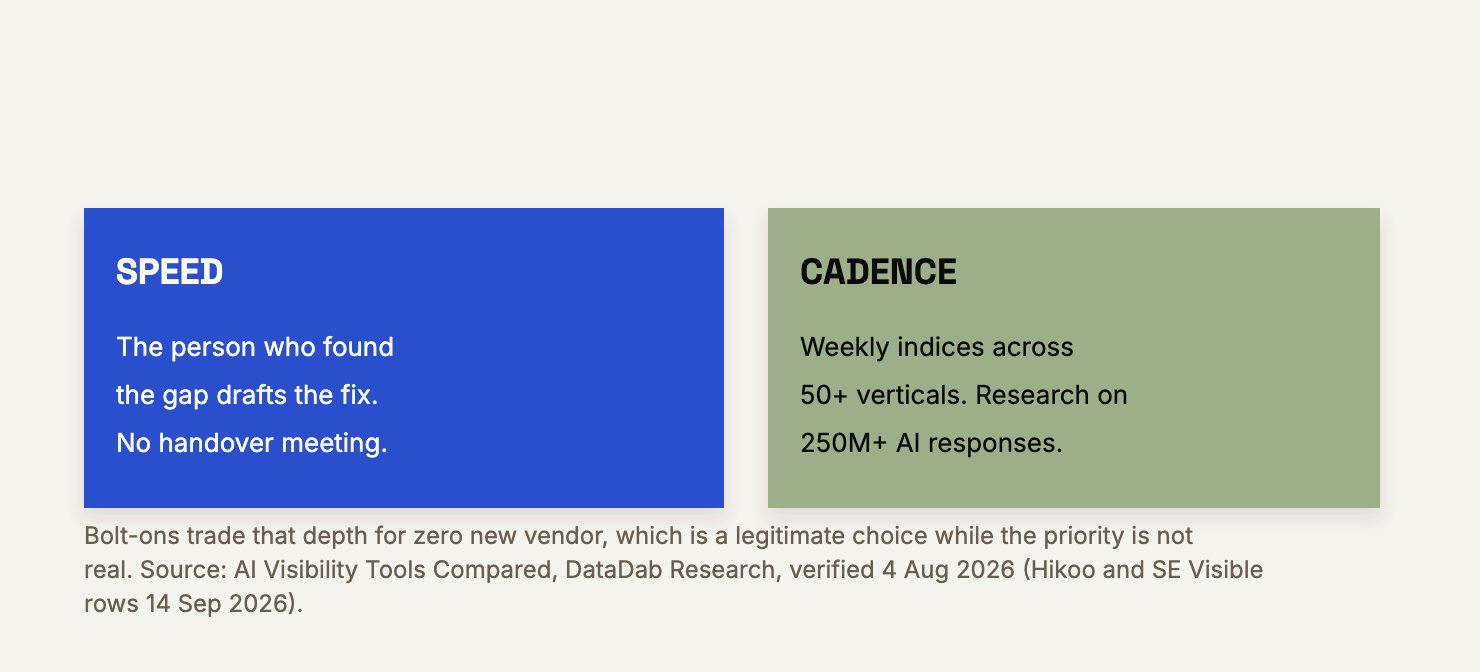
Speed between insight and asset. The person who found the gap is the person who drafts the fix, with no handover meeting.
On a team where one person owns both halves, that is the whole value.
Cadence you cannot otherwise fund, plus a metric you can defend. Profound's indices refresh weekly across 50+ verticals, and its primary research runs on samples of 250M+ AI responses.
No agency and no in-house team matches that observation rate.
Drafting sits next to that signal, so suggestions arrive while they are still current.
The bake-off makes the budget argument: if AI visibility is a funded, reported-on goal, the specialist that owns the citation metric gives you a cleaner number to defend it with.
Bolt-ons trade that depth for zero new vendor. That is a legitimate preference while the priority is not yet real.
Where the drafting stops and the shipping starts
We are the vendors in the third lane, so discount my tone and read the structure.
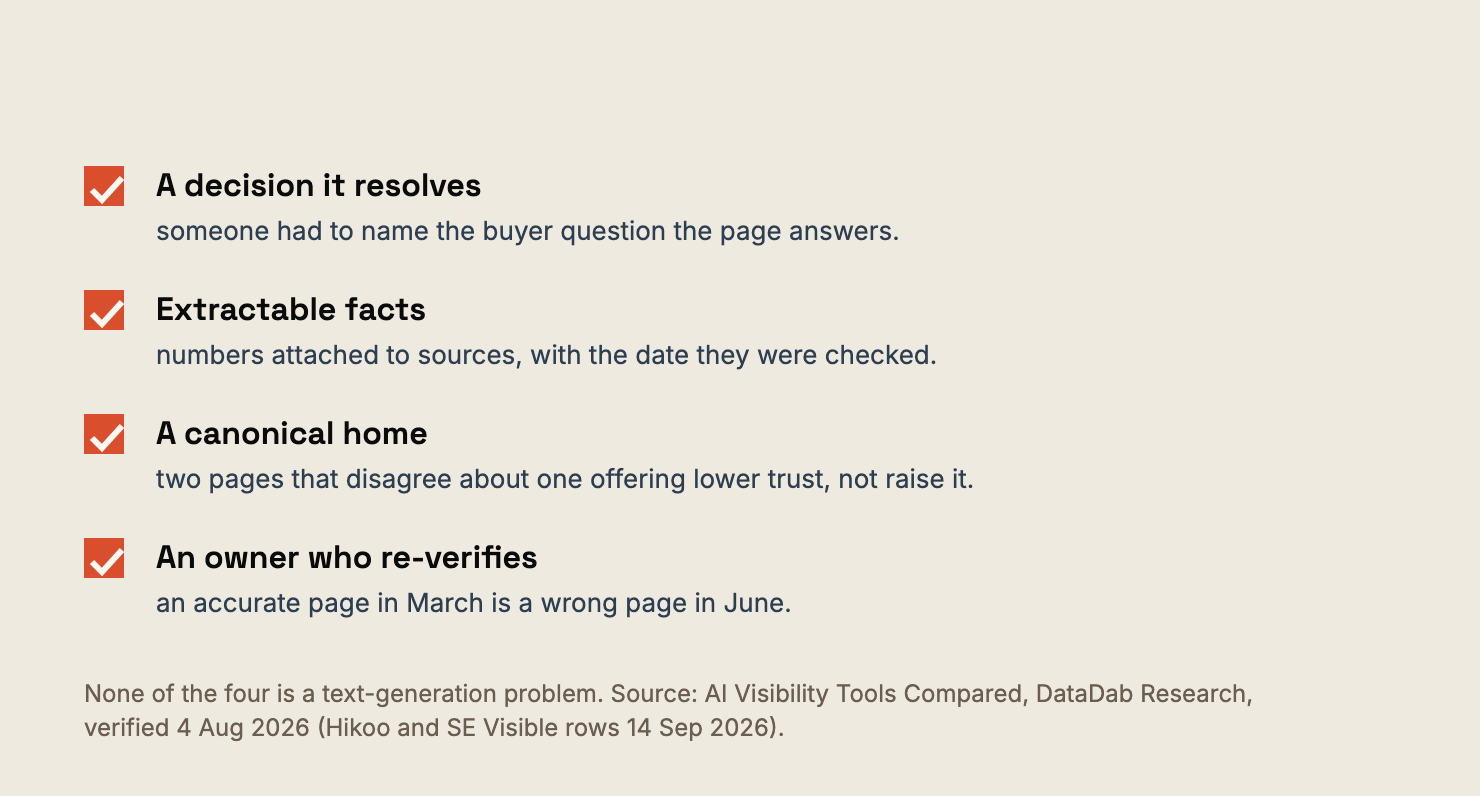
A generated draft needs four things before it earns a citation. None of them live in a dashboard.
It needs a decision it actually resolves, which means someone named the buyer's question. It needs facts a machine can extract, with numbers attached to sources and dates.
It needs a canonical home. Two pages that disagree about the same offering reduce trust rather than raising coverage.
And it needs an owner who re-verifies it when pricing changes. An accurate page in March is a wrong page in June.
None of those are text problems. They are editorial decisions with a maintenance obligation attached. A drafting feature will happily produce ten confident pages carrying none of them.
The pattern we see at $3M-$50M ARR
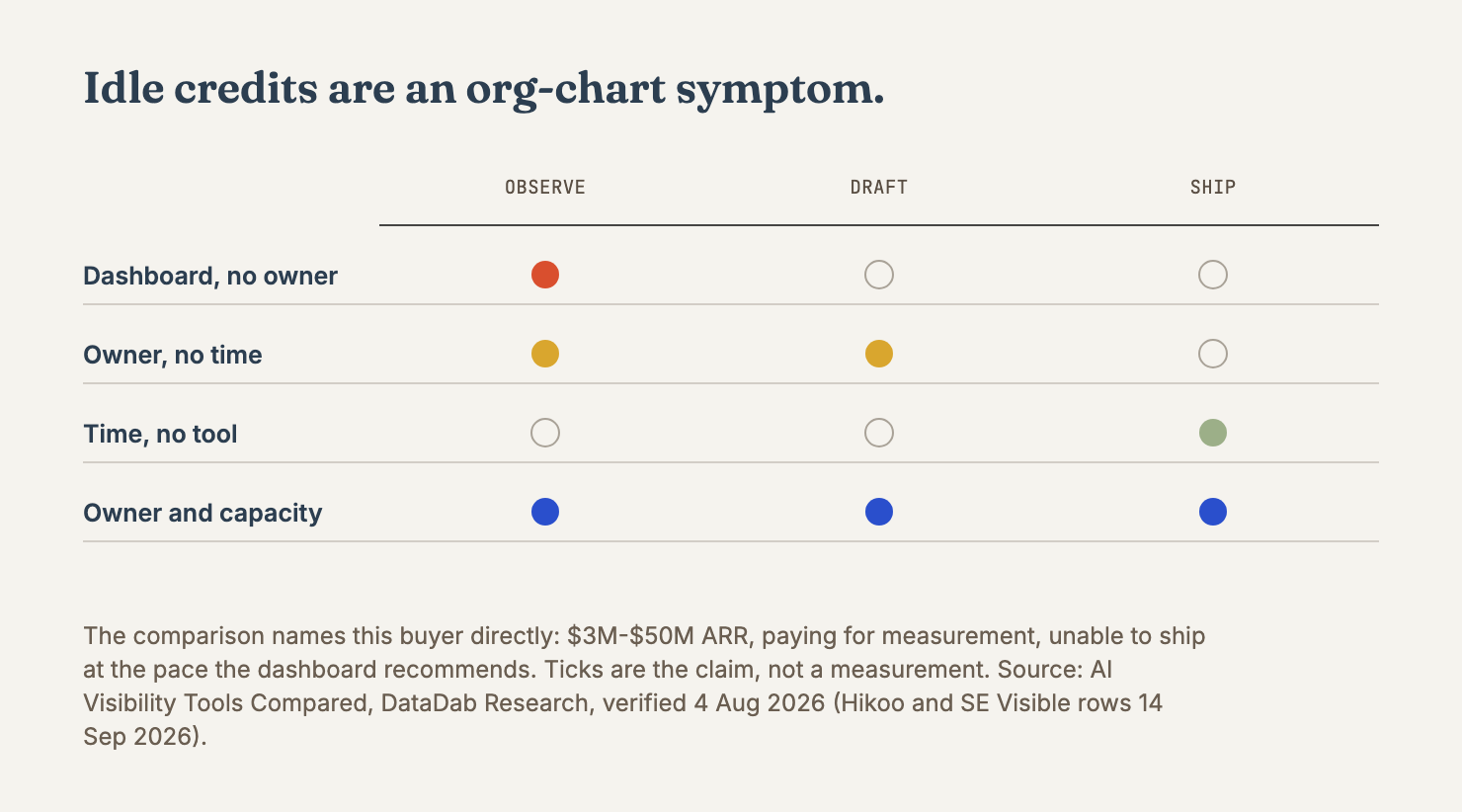
The comparison page names it directly: a B2B SaaS in the $3M-$50M ARR band, paying for Profound, unable to ship content at the pace the dashboard recommends.
Buying the drafting layer did not create capacity. It made the shortfall visible in a new unit.
The same pattern explains why the tool keeps selling. The measurement is genuine, the gaps are real, and the recommendations are honest about what a page should do.
The failure is an org-chart failure wearing a software costume.
If that is your situation, the order that works is boring. Buy observation. Find the two or three pages a buyer actually reads. Ship them, by hand if the credits are sitting idle. Re-measure.
Then decide whether generation volume is the constraint you still have.
What we do that the tools do not
Full disclosure, because it is the reason I have a position.
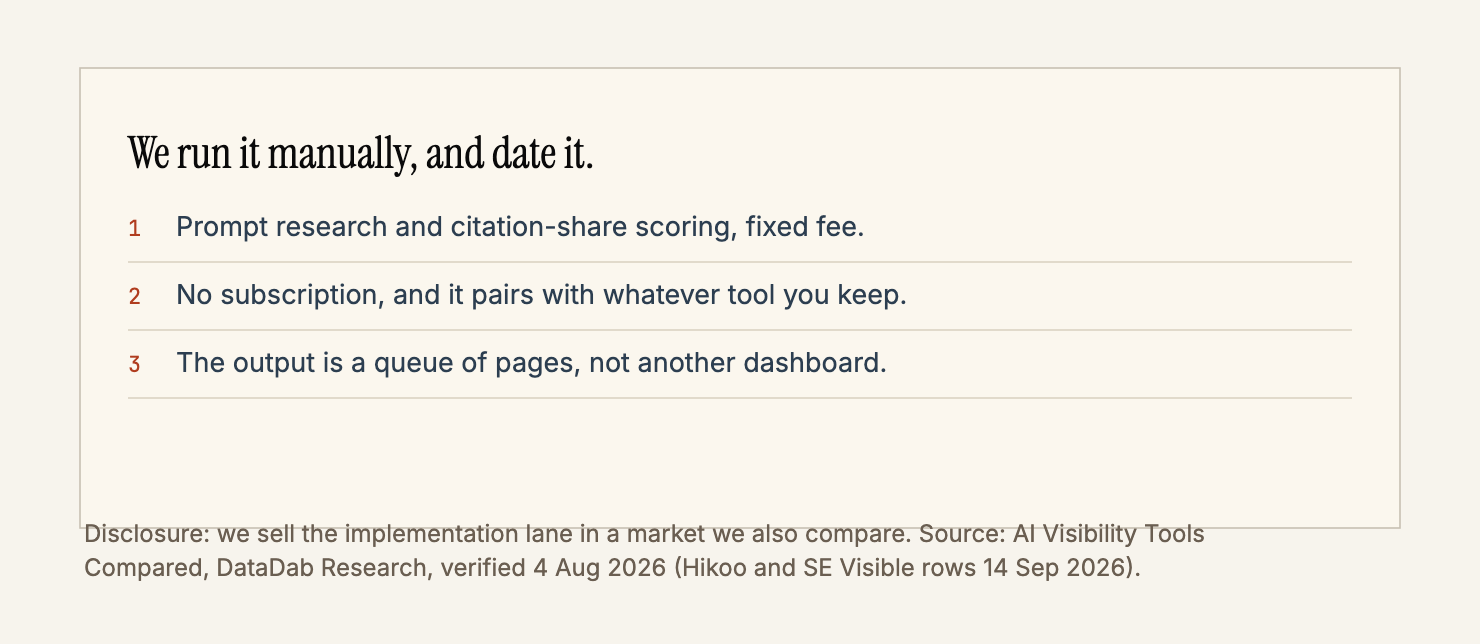
We run the same prompt-research and citation-share scoring that Profound, AthenaHQ and Otterly automate, as a fixed-fee AI Extractability Audit. Manual, dated, on your actual pages, without a subscription.
The study says the pairing plainly: buy Profound or AthenaHQ and treat DataDab as the implementation arm. The tool keeps measuring. We ship the pages and own the maintenance record.
A page like that is an operational asset, not a publication. If it covers pricing, capability, vendor coverage or a measured result, it needs an owner and a review date.
Otherwise it ages into something that looks current and is quietly wrong, and a buyer will use it in a real decision.
Suite or specialist, the one question that decides it
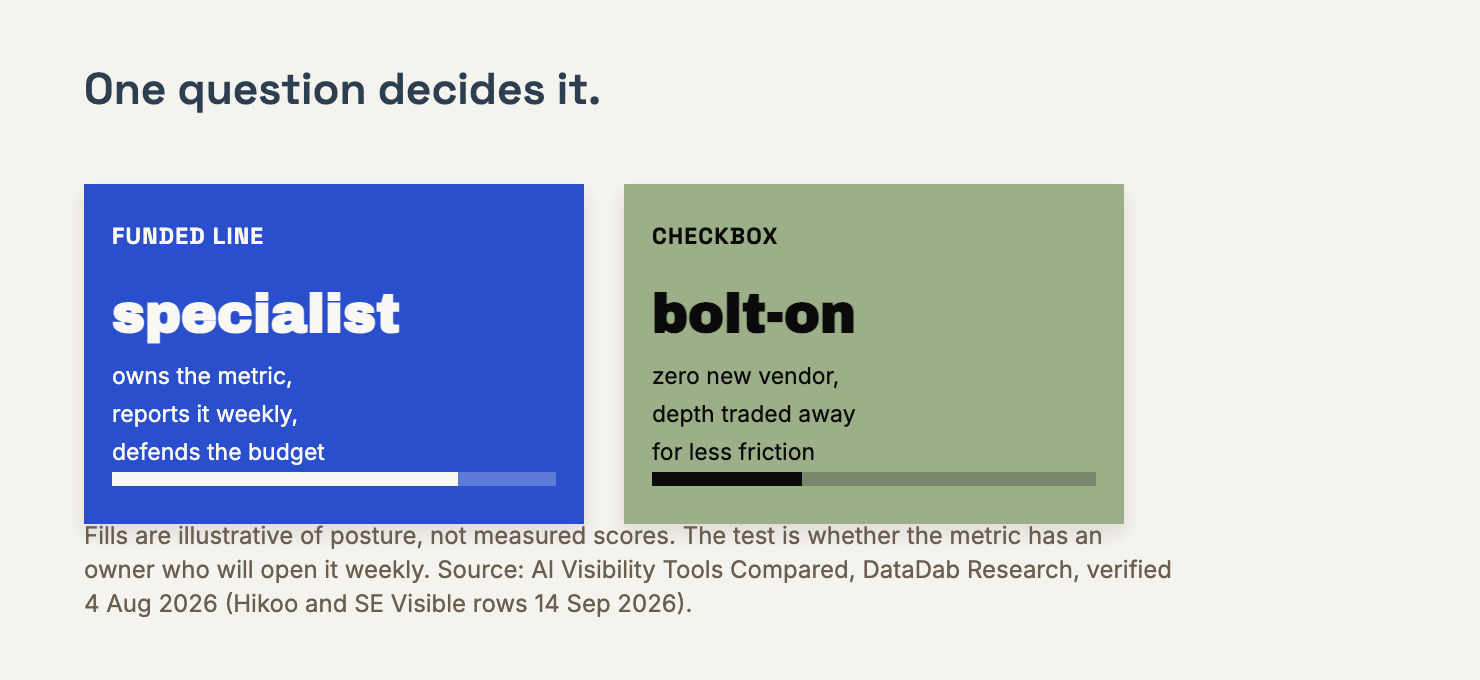
The bake-off reduces it to a single test, and I have not found a better one.
If AI visibility is a standalone priority with dedicated budget, the specialist wins on price transparency and on owning the citation metric with its own research.
If a content or GEO lead owns that metric as a KPI, the research-backed posture is the stronger fit.
If it is neither, and you mostly want the question answered inside tools you already pay for, the bolt-on is the honest choice. It trades depth and a transparent price for zero new vendor.
Do not buy the specialist for its drafting layer while the metric has no owner. That is how credits go idle and the renewal becomes a conversation you lose.
Who this is for
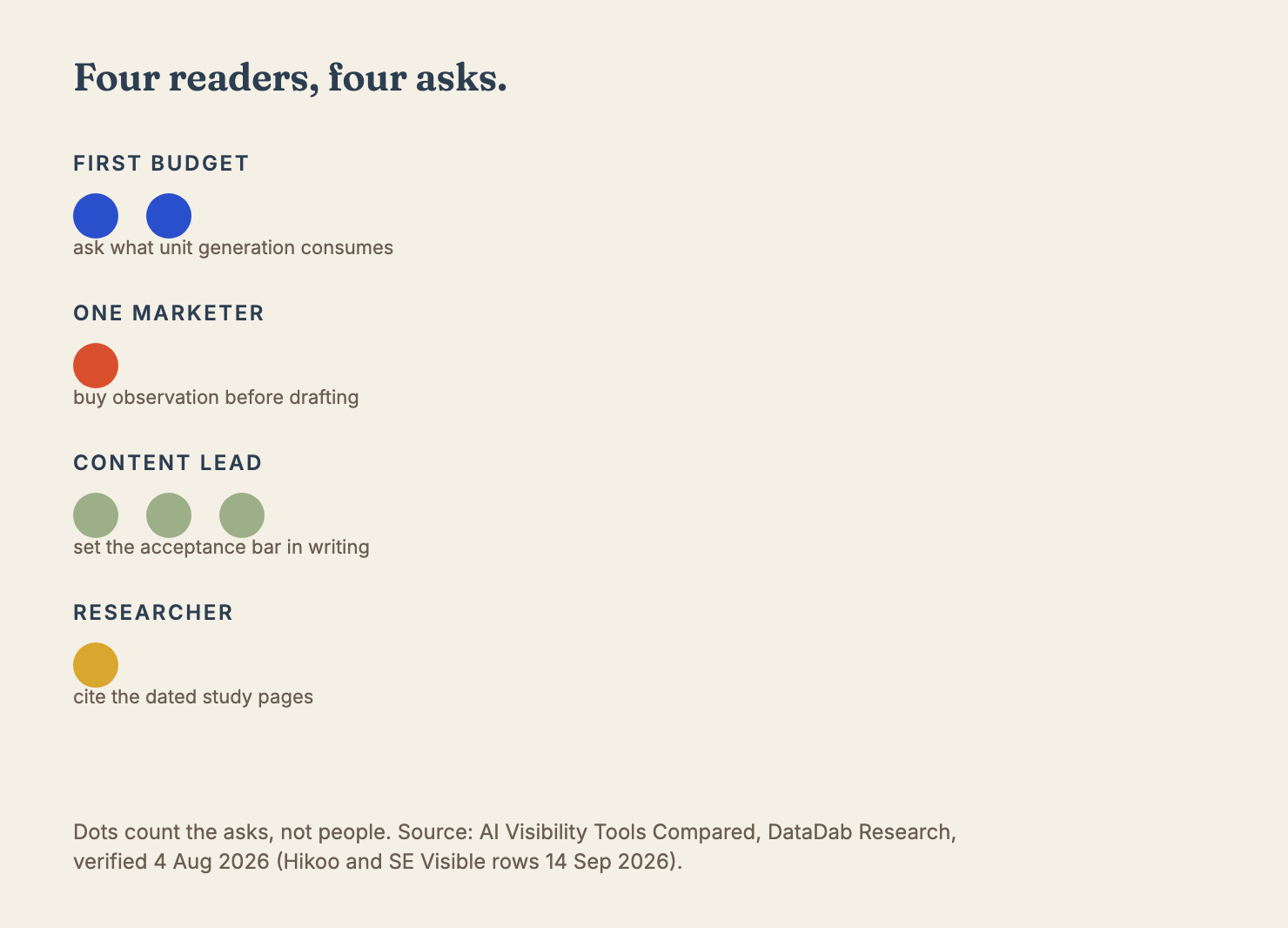
*Marketing leads buying a first AI visibility budget:* ask two questions in the demo. What unit does generation consume, and how many units does one page cost? Write the answers down. That is your renewal case.
*Founders at $3M-$50M ARR with one marketer:* an entry plan watching one engine is usually the wrong start. Buy observation, and put the difference into the three pages a buyer actually reads.
*Content and SEO leads:* you will be handed generated drafts. Set the acceptance bar in writing before the purchase. Decision resolved, sourced numbers, canonical home, named owner.
*Researchers and competitor analysts:* the vendor-by-vendor pricing and entitlement detail lives in the studies, with verification dates. Cite those rather than this argument.
A note on how confident we are
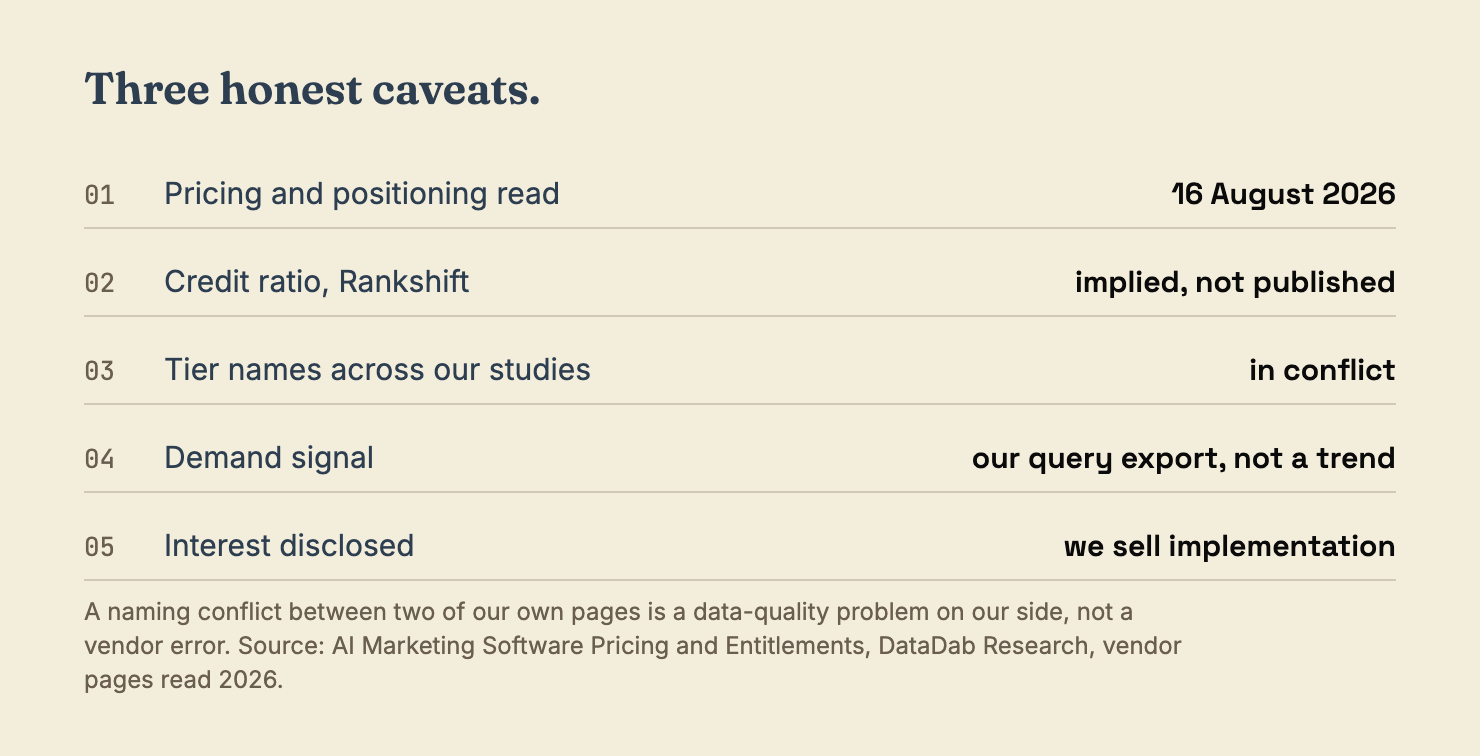
Published pricing and positioning were read from vendor sites on 16 August 2026, and this category changes monthly.
Every number here needs re-checking against the vendor's own page before you commit budget, which is what the studies state about themselves.
The credit estimate is not measured. Where a vendor publishes no credit-to-query ratio we infer one from stated counts, and the study labels that inference.
Treat it as a question for the vendor, not a finding.
Tier naming conflicts between our own two studies, as noted above.
That is a data-quality issue on our side rather than a vendor error, and the honest fix is to re-read the vendor's pricing page with you in the room before you sign.
The demand claim is directional. It comes from our own grounding-query export, which attributes queries to citations but not to specific URLs, and it is a snapshot rather than a trend.
I also have a commercial interest. We sell implementation in a market where one compared vendor is a measurement provider and another layer is an agent.
The bake-off reaches a fair conclusion for the bolt-on case, and I would rather argue against it in public than pretend to have no position.
Wrap-up
An agents product shortens the path from a report to a draft.
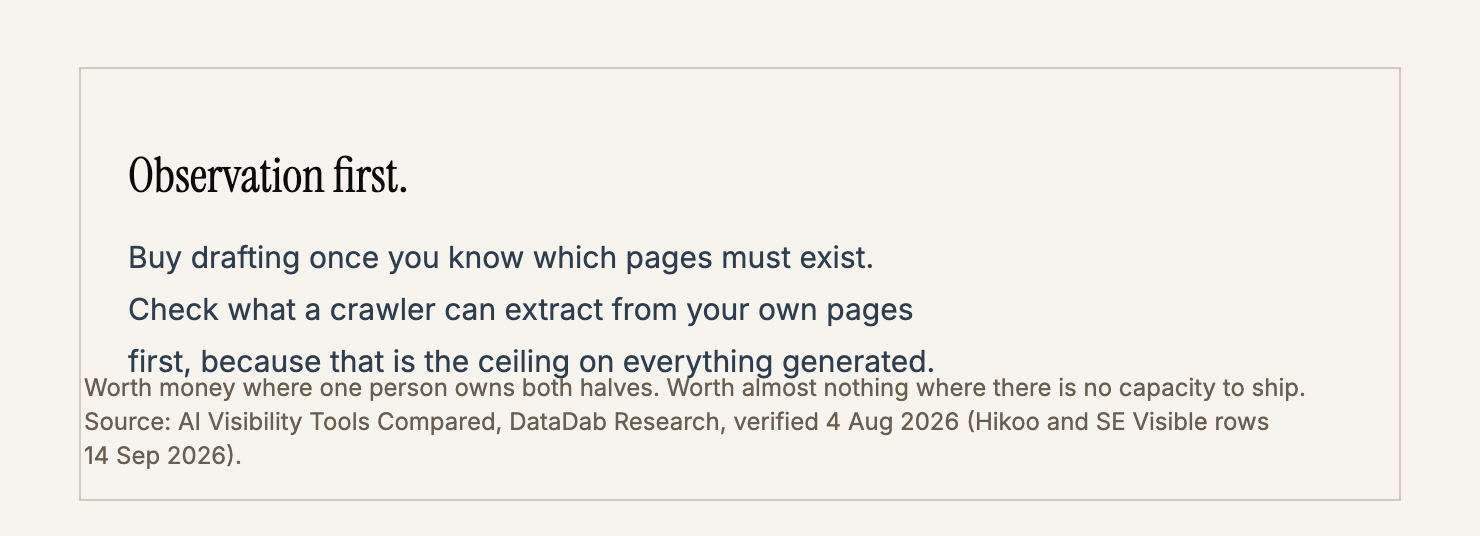
That is worth money where one person owns both halves, and almost nothing where there is no capacity to ship what it drafts.
Buy observation first if you do not know where you stand. Buy drafting second, once you know which pages need to exist.
Before either, check what a crawler can actually extract from your own pages, because that is the ceiling on everything generated from them.