

The category sold as one product is really three, and teams buy the wrong one first because the demo looked decisive.
A marketing lead sent me a vendor deck last week. Eleven pages, a dashboard screenshot, a price at the bottom. She asked which tool I would pick.
I asked what her team is stuck on. She did not know.
That is the answer, and it is why these subscriptions die at renewal.
We spend our days in the other lane, shipping pages a dashboard tells you to fix.
So we built a comparison of the AI visibility tools market as three lanes rather than a leaderboard, and I will argue here what we argue there.
The decision is not tool versus no tool. It is which of three jobs you need done first.
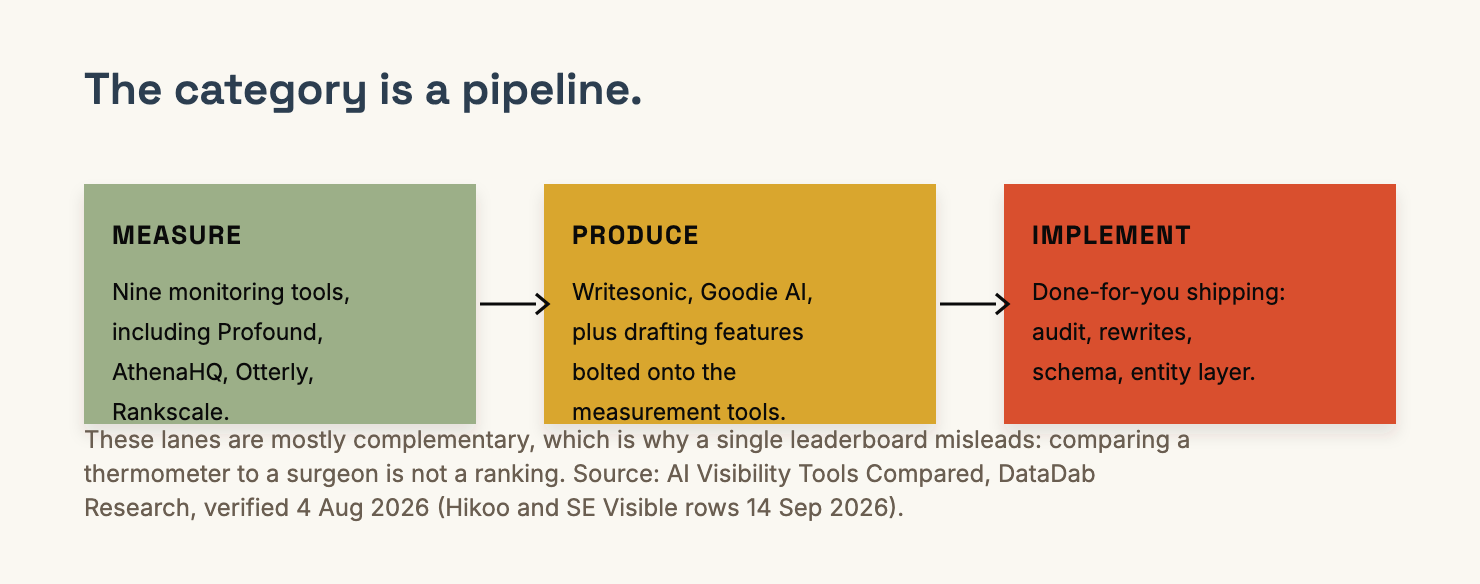
The category is three lanes, not a leaderboard
*Measure.* Monitoring and diagnostics: Profound, AthenaHQ, Otterly AI, Peec AI, SE Visible, Hikoo, Ahrefs Brand Radar, Rankscale, Rankshift. These tell you where you appear, where you do not, and what the answer said about you.
*Produce.* Content and workflow tooling. Writesonic and Goodie AI sit here.
*Implement.* Done-for-you shipping. The audit, the rewrites, the schema, the entity work. That is where we sell.
These lanes are mostly complementary, which is exactly why leaderboards mislead. A ranking invites you to compare vendors that solve different problems.
It is like ranking a thermometer against a surgeon against a hospital. Name the job and the shortlist collapses on its own.
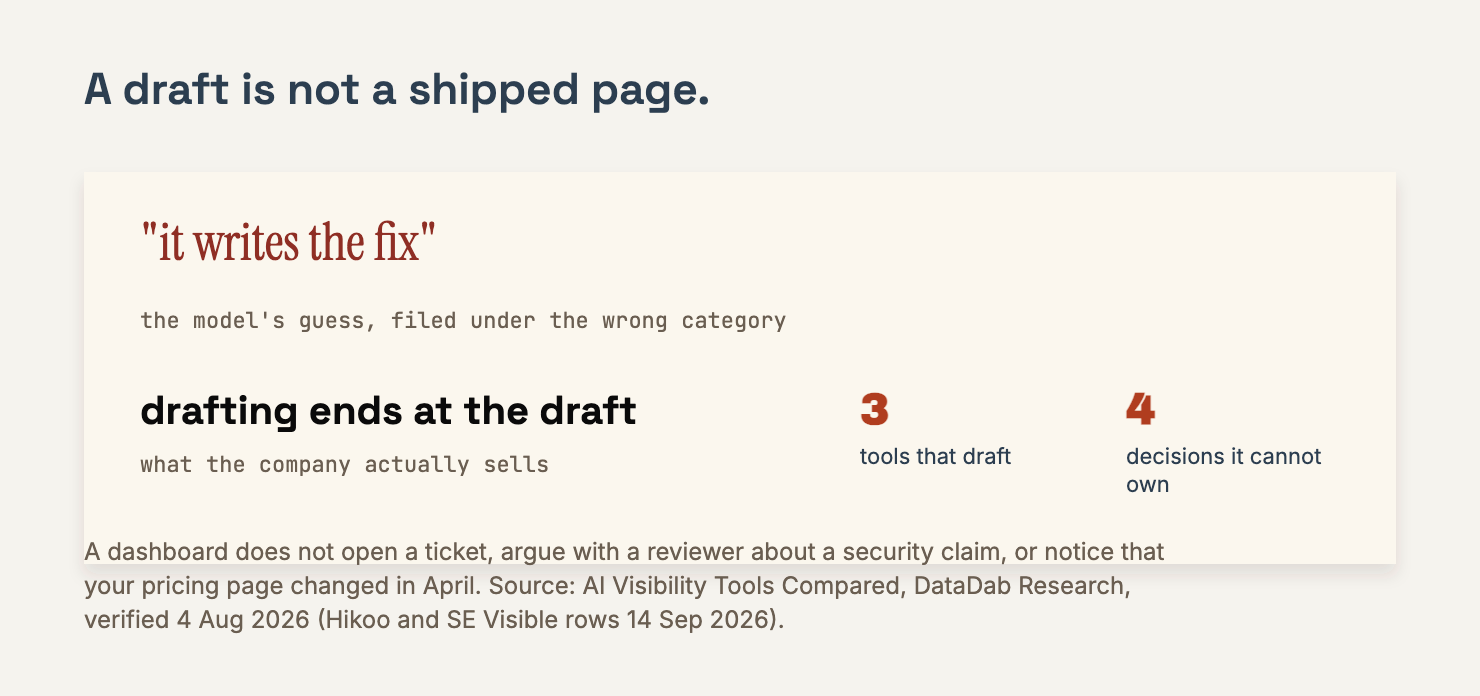
Most measurement tools now draft, and drafting is not shipping
The lanes blur on purpose, because blending them is good business. You buy measurement, and the product offers to write the fix.
Every serious measurement vendor has grown a drafting layer. Profound Agents, AthenaHQ actions, Rankshift's writer. The feature list reads like a production studio.
That offer is honest and it is incomplete, and the gap matters at renewal.
Drafting a page is one step.
Deciding which page a buyer actually reads, what evidence it lacks, who owns the claim, whether the number inside it is current, and whether the rewrite survives the next product change: that is the work.
None of it is a text-generation problem. A dashboard does not open a ticket, argue with a reviewer about a security claim, or notice that your pricing page changed in April.
We keep the distinction explicit on our own page, because we are one of the vendors in the diagram. The polite version is worse for the reader.
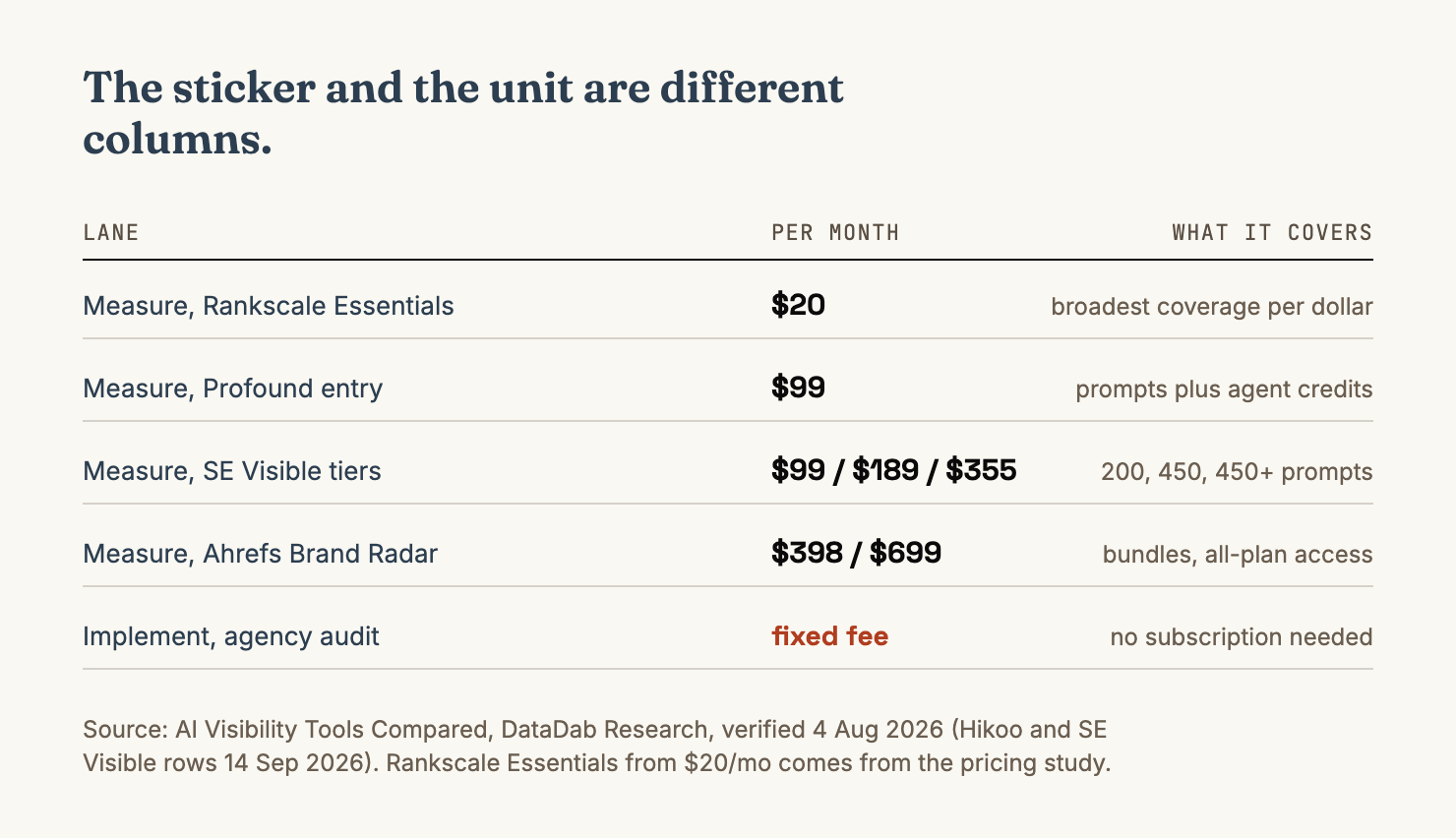
What each lane costs when you read the sticker honestly
Published prices, read from vendor pages on 4 August 2026, with two rows refreshed on 14 September.
| Lane | Published entry | What the number really covers |
|---|---|---|
| Measure | Profound from $99/mo, Ahrefs Brand Radar in $398/$699 bundles, SE Visible at $99/$189/$355 | prompts, not unlimited queries, and extra engines are often add-ons |
| Produce | Writesonic and Goodie AI tiers, from roughly $20/month | drafting volume, not decisions about what to draft |
| Implement | fixed-fee audit, then a scoped programme | the shipping itself |
Enterprise tiers in the measurement lane, Profound and AthenaHQ, are sales-led contracts with annual commitments. So the sticker ends where the mid-market plan ends and the procurement conversation begins.
The measurement lane is where the arithmetic gets interesting. Our AI marketing software pricing analysis is blunt about it.
A plan advertising 25 prompts across 3 engines gives you 75 engine-queries. HubSpot AEO at $50 a month therefore costs about $0.67 per query.
Rankscale Pro at $99 a month carries 1,200 credits at 0.25 credits per query. That is 4,800 engine-queries, or $0.02 each.
Same column on a comparison sheet. Thirty-three times apart in real cost.
Then the engine surcharge. OtterlyAI Lite at $29 covers 4 engines, so needing 6 moves you to a $189 plan. That is 6.5x the price you quoted your boss.
Sticker prices in this category are not comparable. Which makes the tool decision a specification-reading exercise that most buyers skip.
The bottleneck decides the first purchase
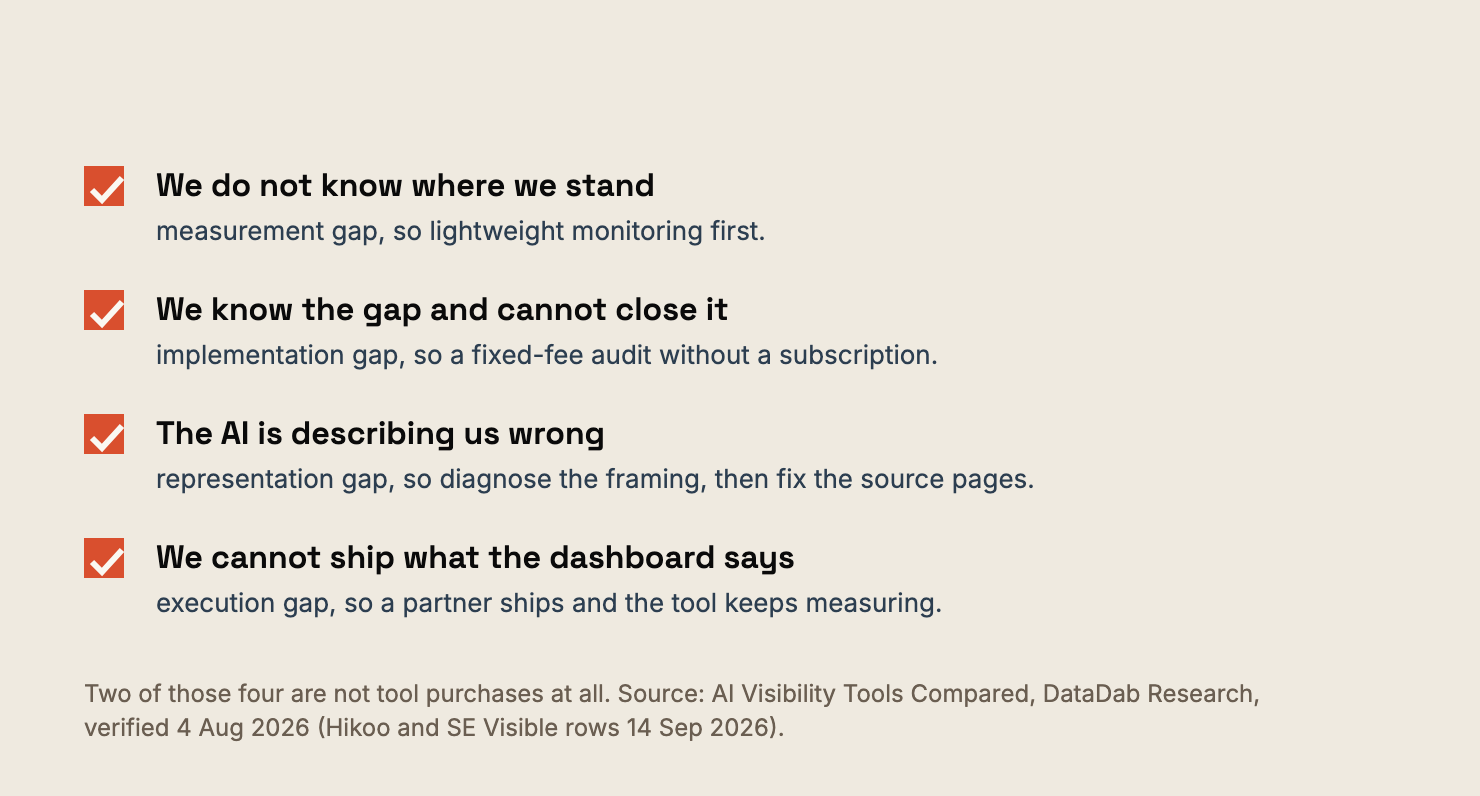
We run this with every team that asks the which-tool question. Name the constraint, and the right first purchase follows from it.
| What you actually said | The gap | Start here |
|---|---|---|
| "We do not know where we stand" | measurement | lightweight monitoring first |
| "We know the gap and cannot close it" | implementation | a fixed-fee audit that runs without a tool subscription |
| "The AI is describing us wrong" | representation | diagnose the framing, then fix the source pages |
| "We cannot ship what the dashboard recommends" | execution | a partner ships, the tool keeps measuring |
Two of those four are not tool purchases at all. That is the finding I want a reader to leave with.
A mid-market team that buys monitoring when the real problem is execution ends up with a weekly report that changes nothing. Then the budget line gets cut in the quarter it disappoints.
The deck she sent me was an implementation-gap problem wearing a measurement-gap uniform.
What an implementation partner will not do
Fairness first, in both directions.
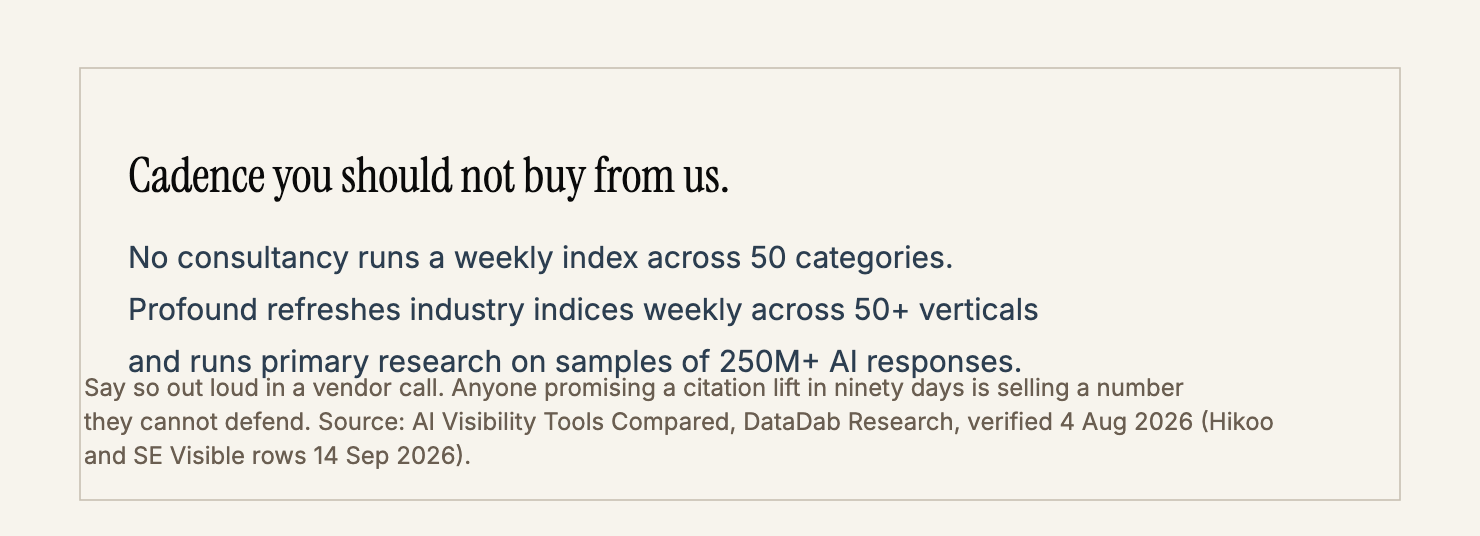
A partner does not run a weekly index across 50 categories the way Profound does, and it should not pretend to. Profound's cadence is real: weekly-refreshed industry indices across 50+ verticals.
Its primary research runs on samples of 250M+ AI responses.
No consultancy matches that observation rate. If one claims to, ask how it was measured rather than opening another deck.
What an agency will not do honestly is tell you its fixes caused a citation you cannot attribute. Citations move for reasons that have nothing to do with your page.
Anyone promising a percentage lift inside ninety days is selling a number they cannot defend. Say that out loud in every vendor call you take this quarter.
And a partner who tells you to cancel your monitoring tool is not giving advice. That is a sales technique.
The lanes complement each other, and measurement is how you learn whether the work did anything.
When a tool is enough on its own
Honest version, since we are one of the vendors in the third lane.
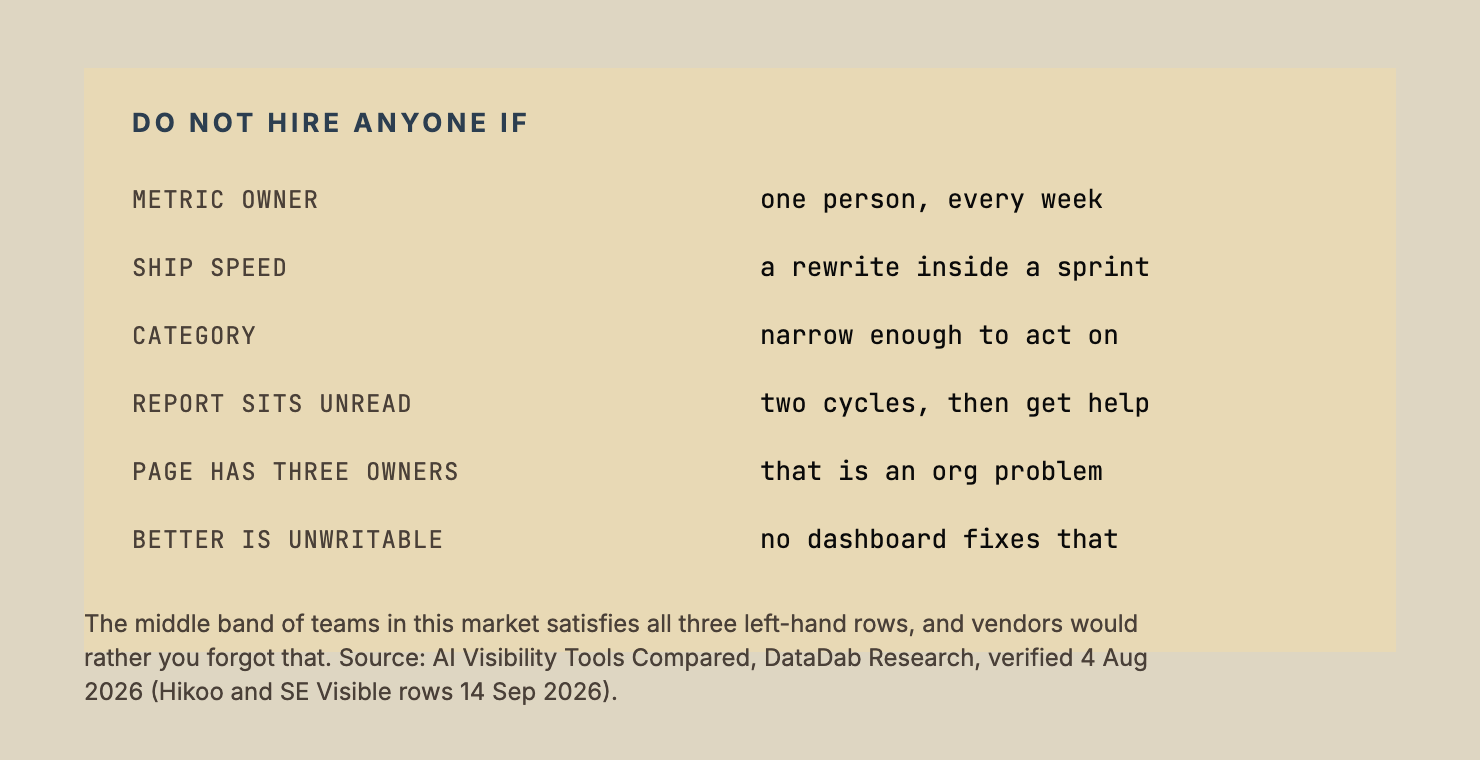
Buy software and keep the work in-house when three things are true. Someone will own the metric weekly. Someone can ship a rewrite inside a sprint.
And your category is narrow enough that a dashboard's suggestions are actionable rather than generic.
That describes more teams than vendors would like to admit, and those teams should not pay us.
You need help when the recommendation sits in a report for two cycles. When the page that needs changing belongs to three teams. Or when you cannot write down what "better" would look like.
That is an execution and ownership problem. No dashboard fixes it.
Which purchase fits which team
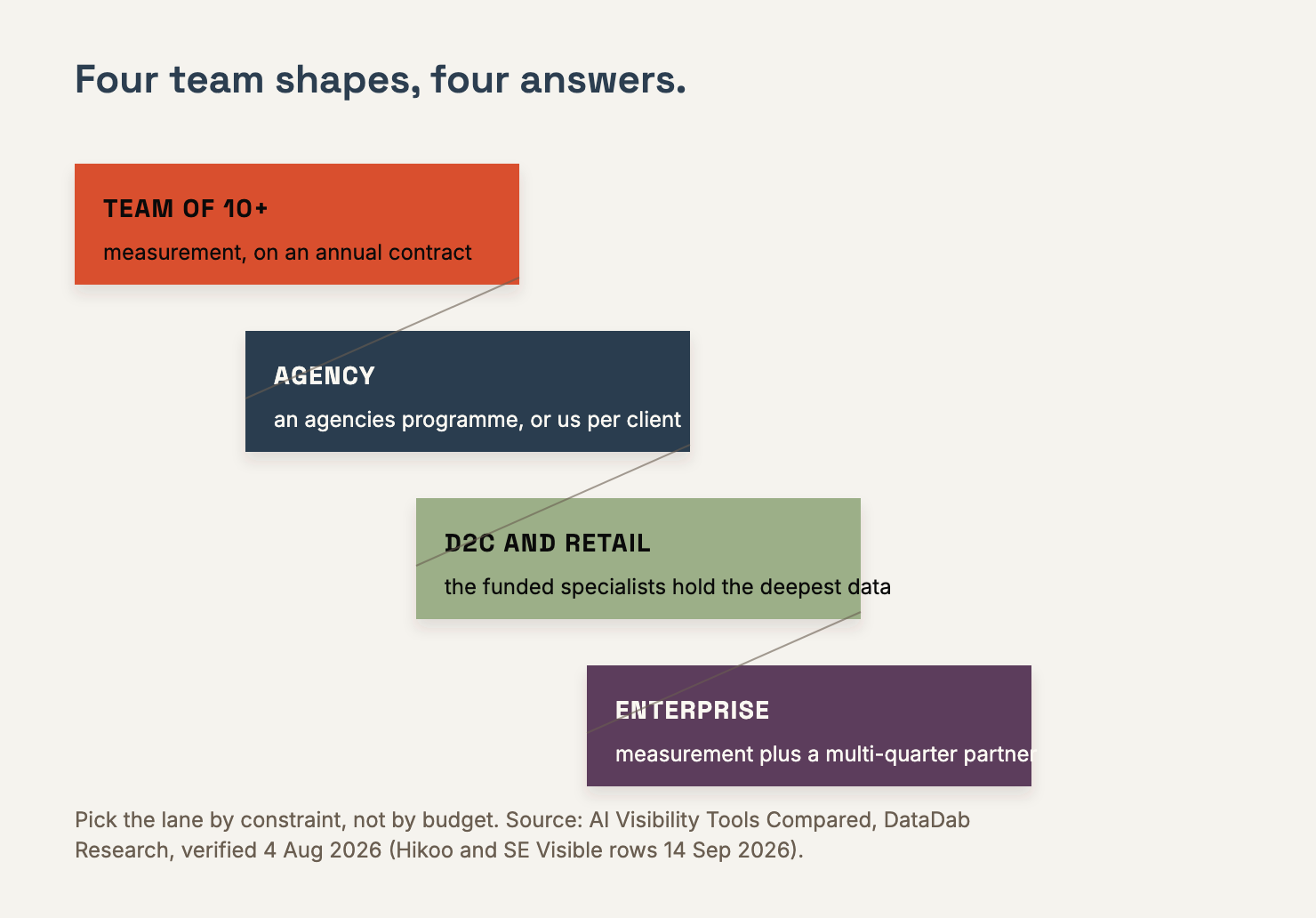
The comparison page already splits this by buyer shape, and it is worth repeating because most teams pick a lane by budget rather than by constraint.
Marketing teams of ten or more running several brand portfolios: Profound or AthenaHQ, and expect an annual contract.
Agencies and in-house teams running AI visibility for multiple B2B SaaS clients: a measurement tool with an agencies programme, or an implementation lane priced per client.
Ecommerce, D2C and retail: the deepest data sits with the funded specialists, with lighter monitoring tools as accessible alternatives.
Enterprise software facing a Fortune 500 buyer committee: measurement plus a multi-quarter partner to act on it.
For most B2B SaaS teams in the $3M-$50M ARR band, published mid-tier plans carry the work. Add the enterprise tier later, when procurement demands it rather than when the deck does.
The one thing that does not change by segment: a benchmark you never act on is a checkbox. If the person who reads the report cannot change a page, buy nothing yet.
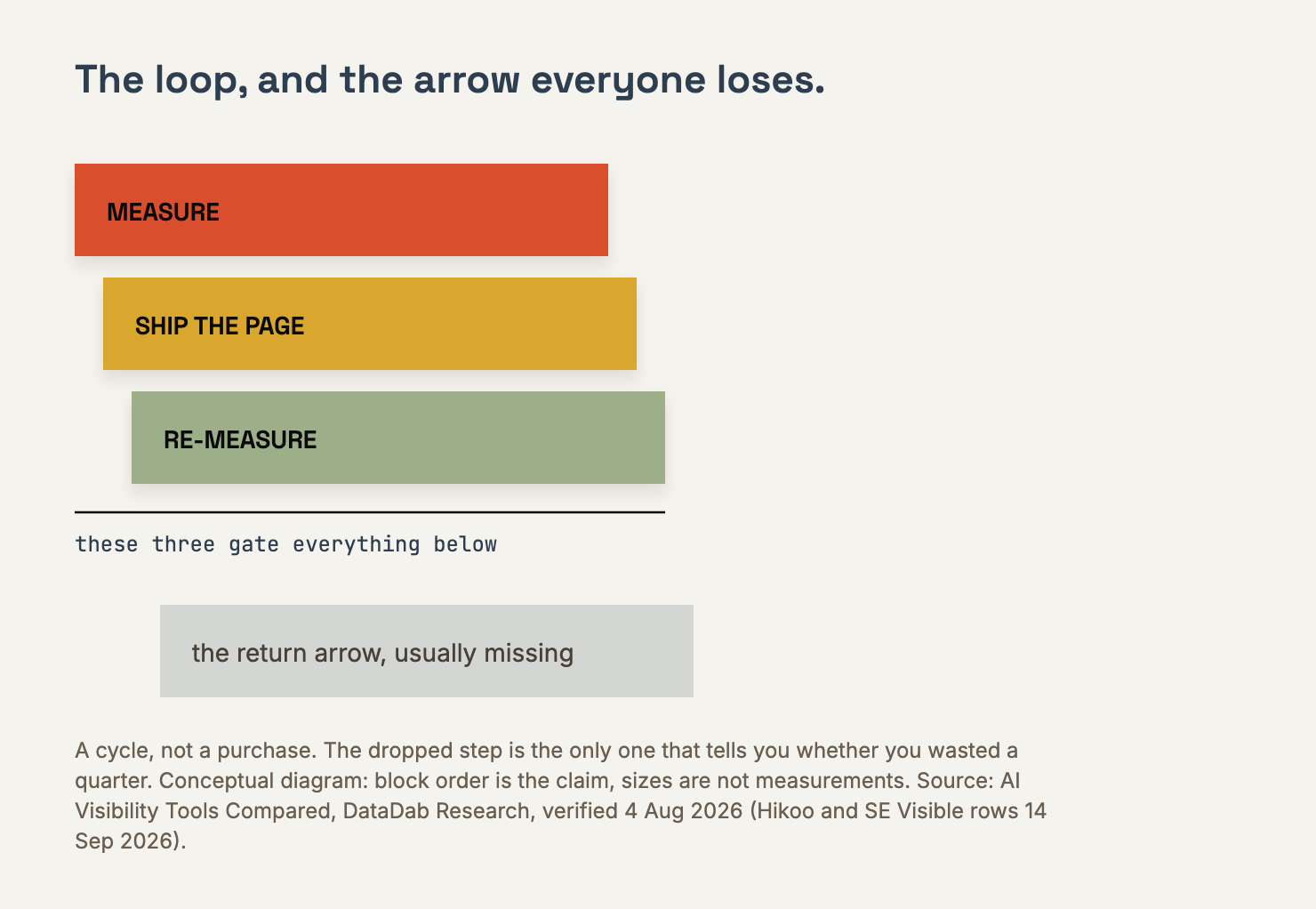
The loop is the deliverable, not the dashboard
Teams treat this as a purchase. It is a cycle. Measure, find the gap, ship the page, re-measure.
The last arrow is the one people drop, and it is the only one that tells you whether you wasted a quarter.
One caution on the measurement leg. A free model-memory check tells you what an open-weight model recalls about you from training. It is not live ChatGPT or Perplexity measurement.
We label our own tool that way, because the temptation to imply more is precisely the temptation that burns trust in this category.
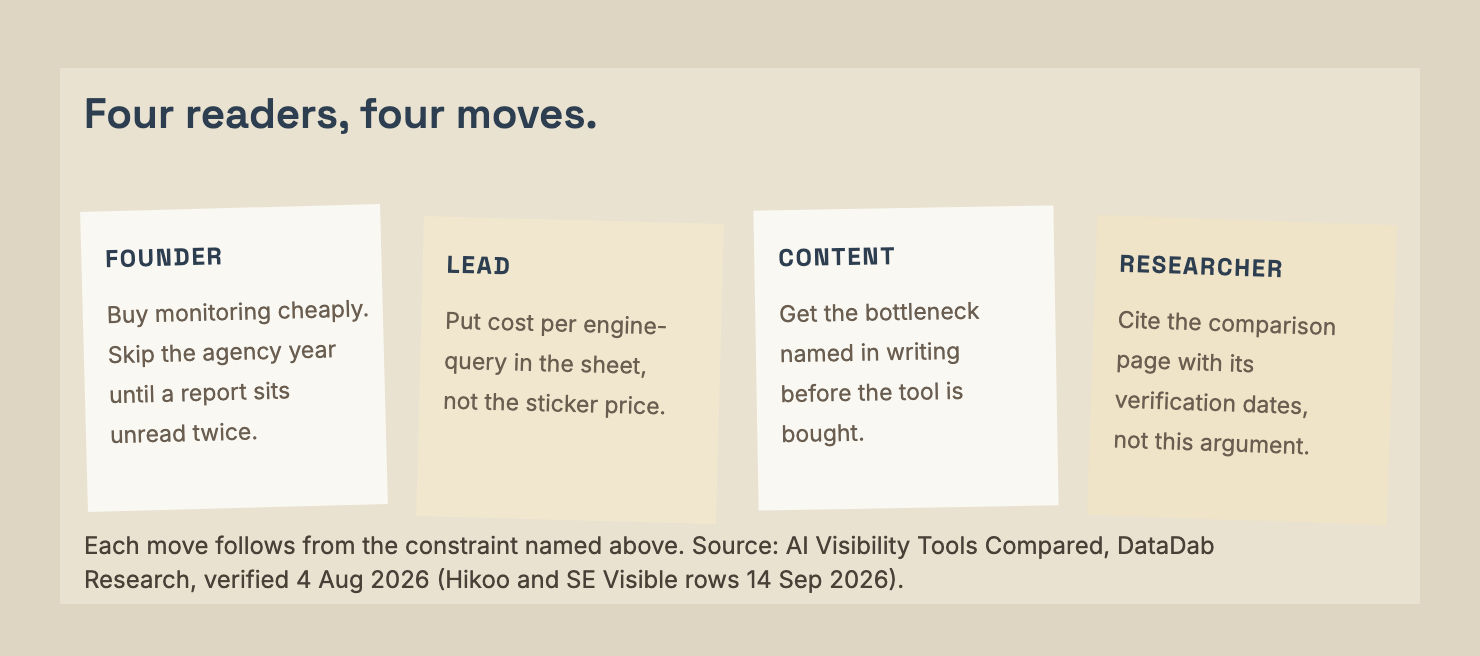
Who this is for
*Founders at $3M-$50M ARR* with one marketing person: buy monitoring cheaply and skip the agency year. Book an audit once the report has sat unread for two cycles.
*Marketing leads defending a budget:* the arithmetic above is your armour. Cost per engine-query, not sticker price, belongs in a procurement sheet. It also shrinks the 12-week evaluation cycle most teams fall into.
*Heads of content:* you are the person asked to ship what the dashboard recommends. Get the bottleneck named before the tool is bought, or you inherit an unowned queue.
*Researchers:* the vendor-by-vendor table, engine coverage and verification dates live on the comparison page. That is what to cite, rather than this argument.
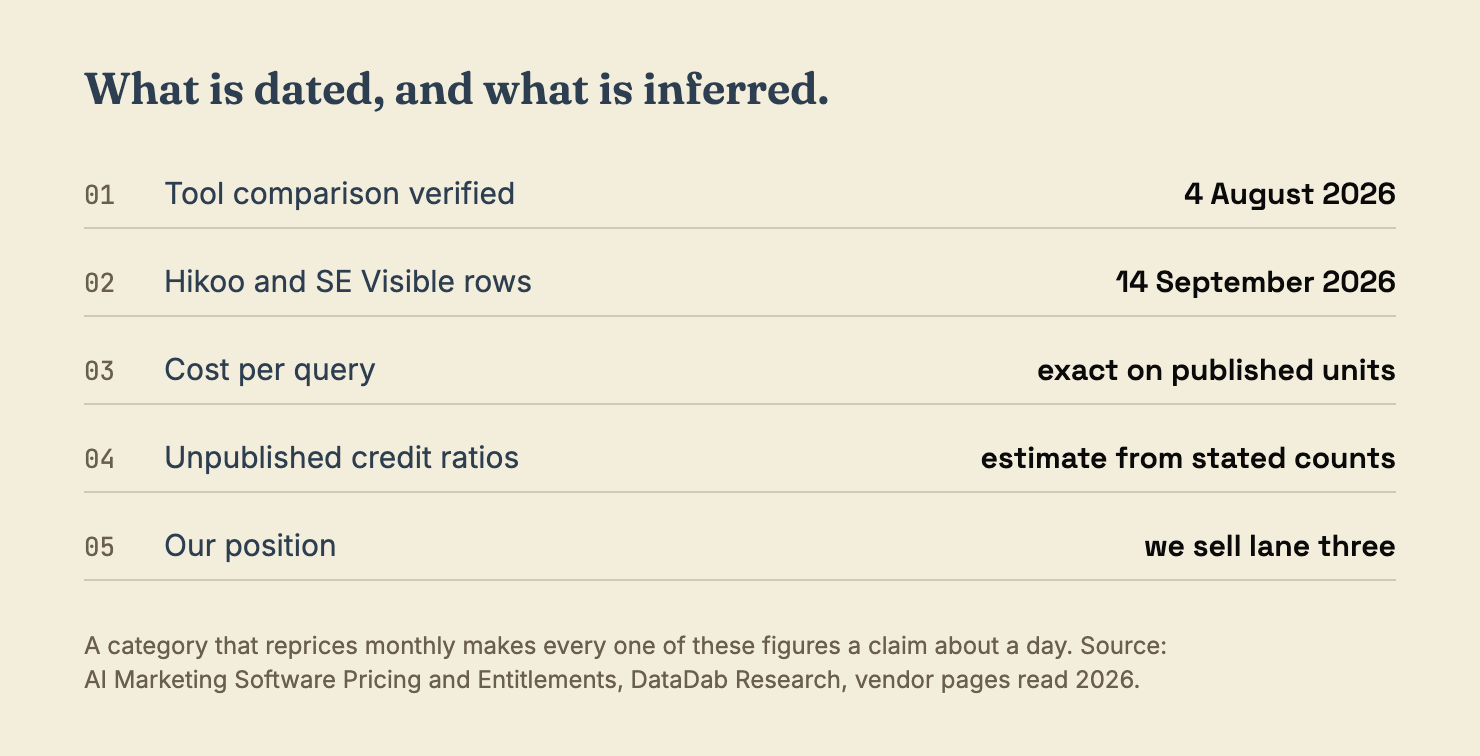
A note on how confident we are
The tool comparison was verified against vendor pages on 4 August 2026, with the Hikoo and SE Visible rows added on 14 September 2026. Both dates are stale in a category that changes monthly.
Every figure here needs re-checking against each vendor's own page before you act on it. The study says so on itself, which is the only reason I am comfortable publishing it.
The cost-per-query arithmetic is exact on published numbers, and it depends entirely on whether a vendor's prompt limit means per query or per engine-query.
Where a ratio is not published we estimate it from stated credit counts and label the estimate.
An estimate about someone else's billing is a question to ask them, not a finding to hand them.
Our position is not neutral. We sell the third lane, and we appear in the comparison we published. Read it as an argument with disclosure rather than an independent review.
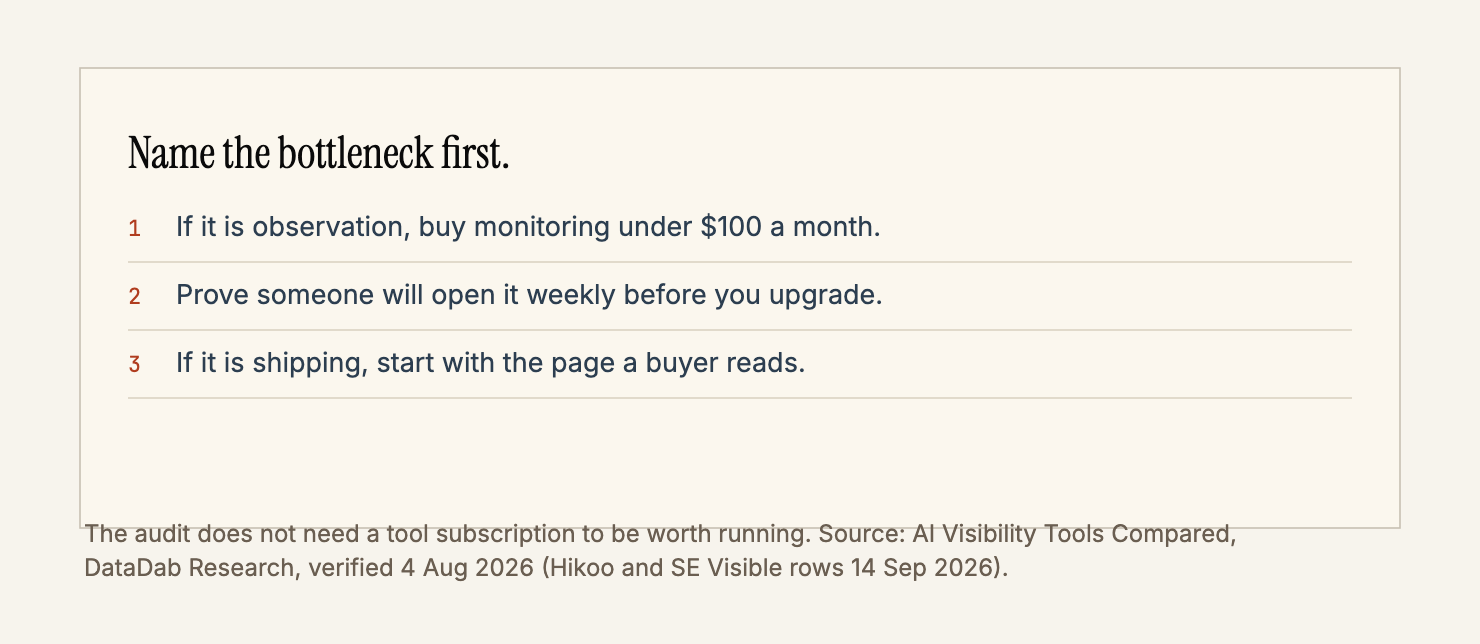
Wrap-up
Three lanes: measure, produce, implement. Name the bottleneck, buy against it, and close the loop with re-measurement.
If the answer is monitoring, spend under $100 a month and prove someone will use it weekly before you upgrade.
If the answer is shipping, the audit comes first, and it does not need a tool subscription to be worth running.
Start with the page a buyer is most likely to read, then check whether a crawler can extract your facts from it.