

We published five guides to the same launch. Together they have almost no traffic. Here is the one that answers the question people are actually asking.
Six months ago we published a guide to launching on Product Hunt. Then another one, and another, and a fourth with a different angle, because each one was about a slightly different thing.
Together, they have been read by hardly anyone. The query "we launched on product hunt" for a SaaS product drew 232 impressions over six months for us, and we rank for it.
We had four pages competing with each other and no single answer.
Here is the consolidated version, and the reasoning about what a launch is for.
What a launch actually does
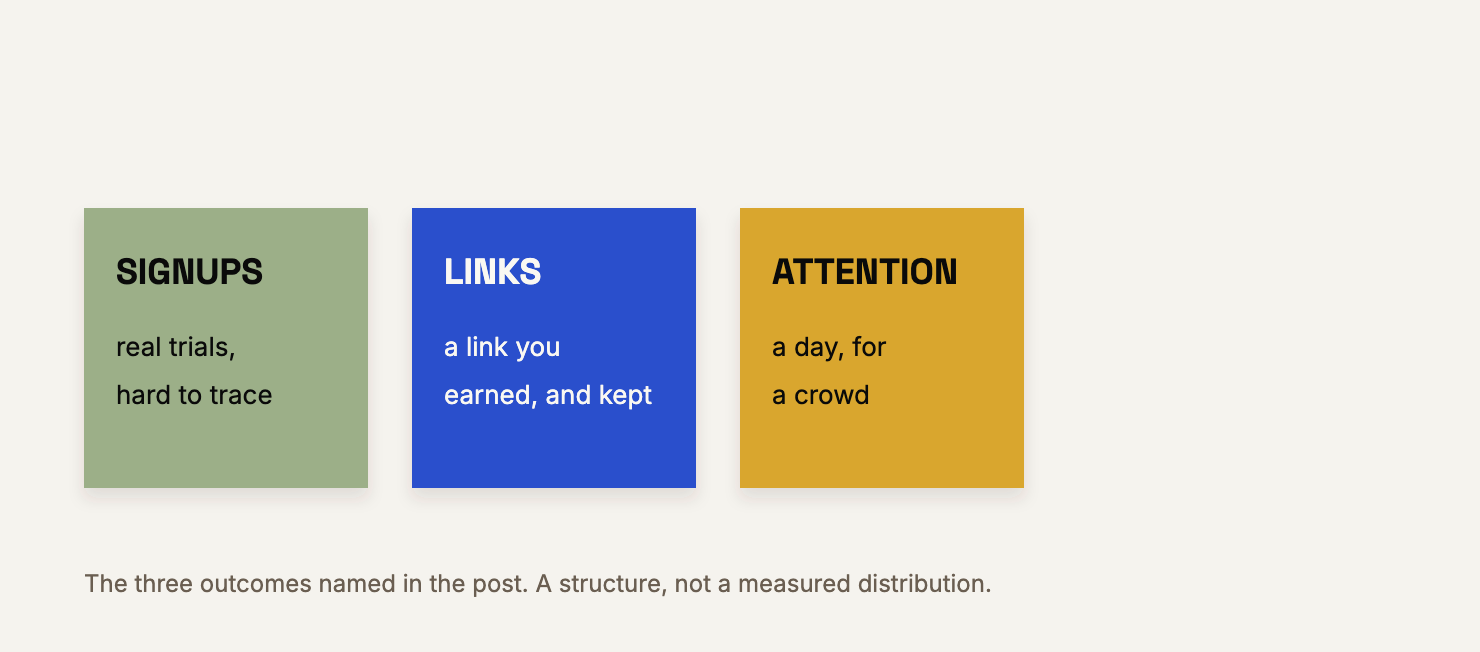
A Product Hunt launch produces one of three things, and it is worth deciding which one before you book the date.
*Some signups.* Real trials, from people who were not looking for you, in a single day. This is the outcome most teams assume and few measure, because it is the hardest to attribute.
*Some links.* A launch post on a domain you own, pointing at a page you own, is a link you earned rather than bought. It is the one durable output.
*Some attention.* A day of visibility among a particular crowd, which is worth something to you if you sell to that crowd and nothing at all if you do not.
Most launches are planned for the first outcome and measured against the third. That is why the launch feels like a disappointment afterwards, and it is usually not the platform's fault.
The 48 hours, honestly
The mechanics are not complicated, and most teams get them roughly right.
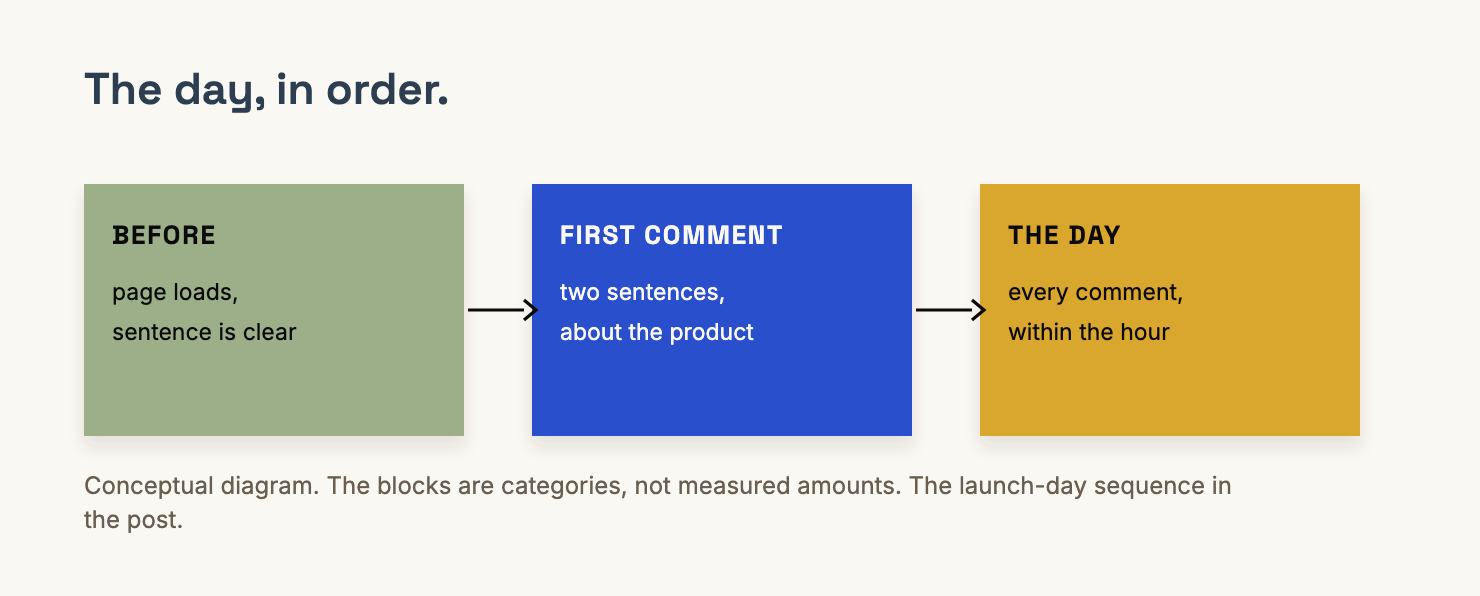
Your page needs a real name, a real screenshot, and a sentence that says what it does for whom. Not a slogan, and not a category claim.
"The CRM for agencies" is a category claim. "Tracks which client invoices were never paid" is a sentence.
Your first comment has to come from you, and it has to be about the product rather than about the launch. People who arrive to vote read the first five comments before they vote, and the ones that read like marketing get ignored.
Then you answer every comment, for the whole day, and you do not go quiet on day two. The ranking depends on early velocity, and velocity comes from people you already know.
That is the whole method. There is no trick in it, and the teams that do well are the ones that understood it a month before the launch.
The comparison, if you have done a launch before
Two of our own pages cover this properly, and the tension between them is the point.
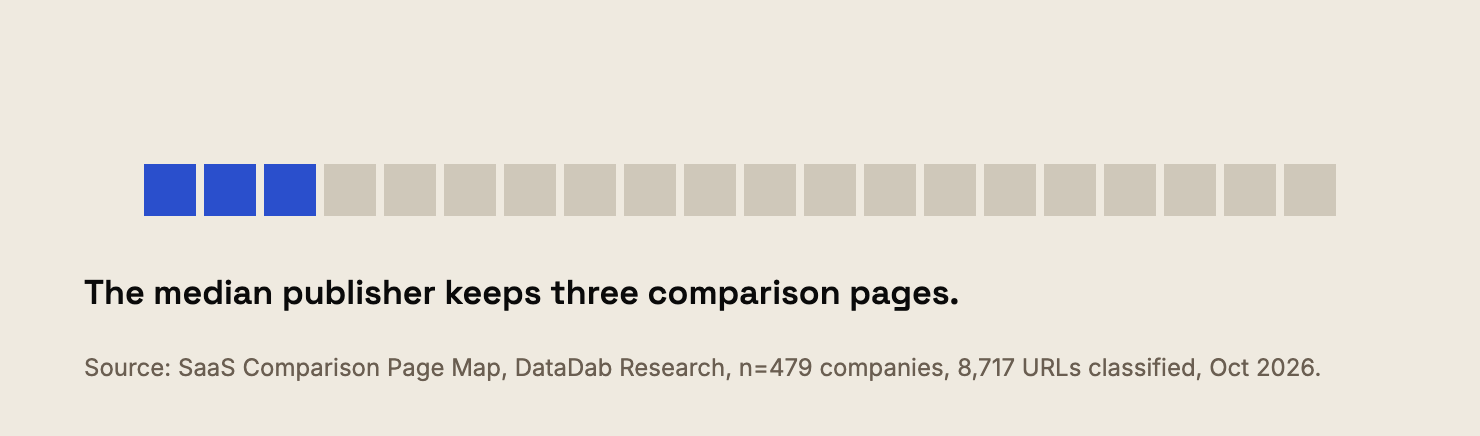
Our comparison-page map found 30.9% of 479 B2B software companies publish a real vendor-versus-vendor comparison, and that the median publisher keeps three.
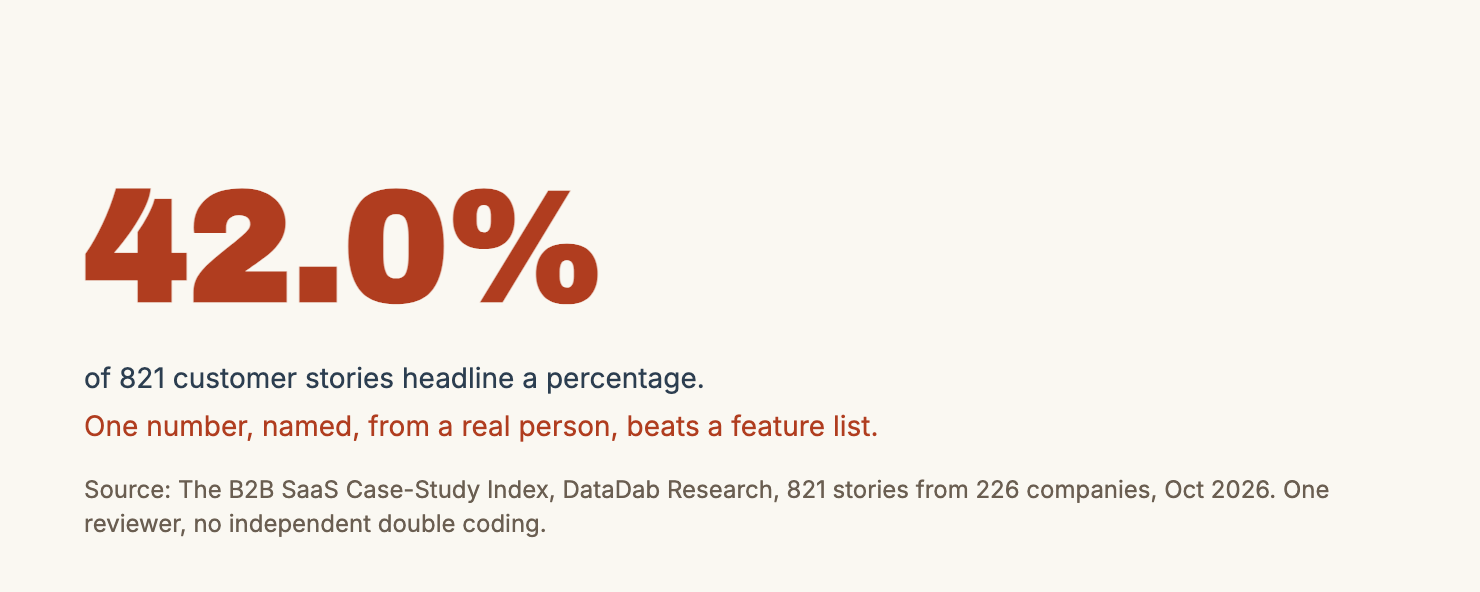
The case-study index found 56.6% of the same frame run a customer story hub, and that only 42.0% of 821 stories headline a percentage.
Both are standing assets. They need an owner and a review date, and they keep working for years.
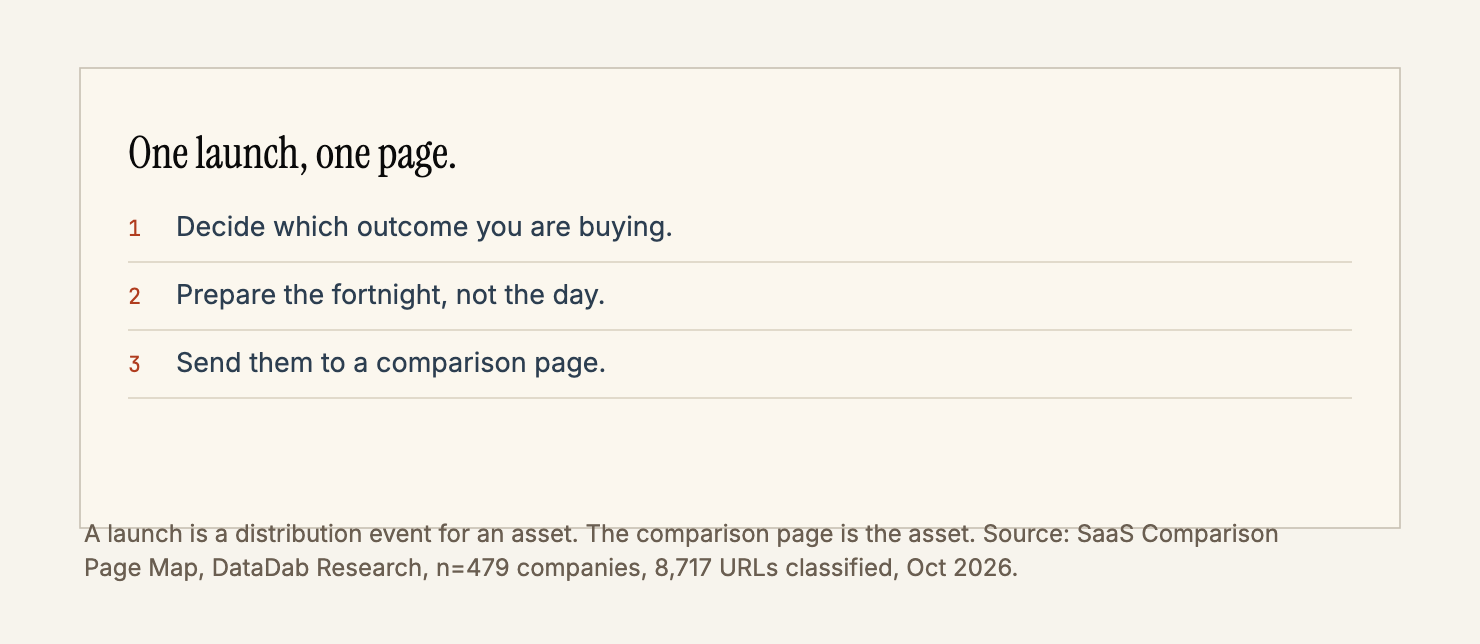
A launch is a distribution event for one of those assets. It is a good day. It is not a strategy, and the teams that treat it as one end up with a good number on one day and nothing the next month.
The comparison is the harder thing to do and the more valuable one, because a buyer who arrives from a launch and reads a page that compares you properly is doing something a launch alone cannot do for them.
The part that happens afterwards
This is where a launch usually goes wrong, and it has nothing to do with the platform.
A launch brings people to a page. If that page does not tell them what happens next, they read it, feel briefly interested, and leave.
Your own follow-up is a list of people who signed up for a trial and never opened the product, and a day of attention that produced a number you cannot attribute.
This is the same problem as every other launch, and the same test applies. What does the reader do next, in the words they would use?
If the answer is a sentence about your category, the page is not ready.
*Activation, not applause.* A launch that produces 200 signups of which 30 activate is worth less than one that produces 40 signups of which 25 activate, and the second one is also cheaper to run.
We have measured how the strongest companies write this kind of proof in our case-study index: of 821 published customer stories, only 42.0% headline a percentage.
The same discipline applies to a launch page. One number, named, from a real person, is worth more than a feature list with a waitlist form.
When not to launch
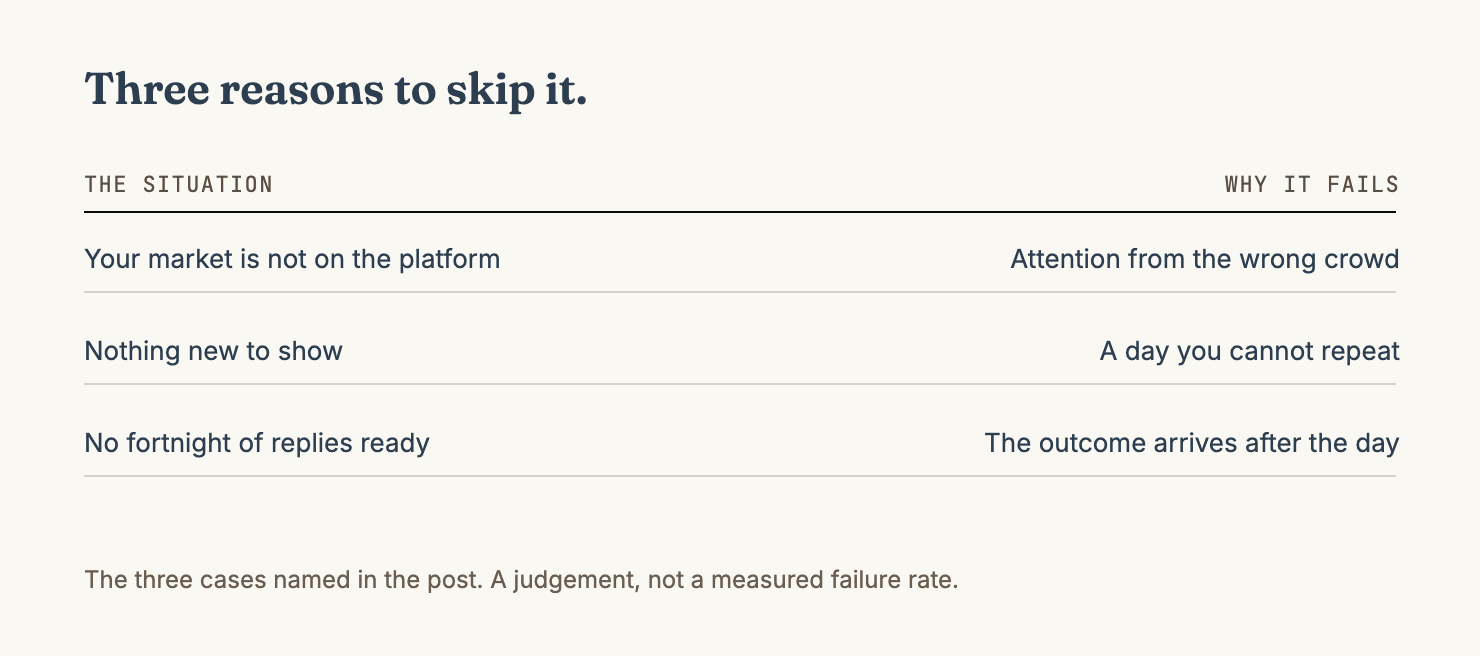
Three situations where a launch is the wrong instrument, and the third one is the most common.
You are selling into a market that is not on the platform. A launch gets you attention from people who like new products, which is not the same as your buyer.
You have nothing new to show. A launch with an existing product and an existing pitch spends a day of attention you cannot repeat.
You do not have the two weeks of follow-up ready. A launch is not a day of work, it is a fortnight of replies, and the fortnight is where the links and the signups actually come from.
If any of those three applies, keep the date and spend the attention on a comparison page instead. Our comparison-page map found that 30.9% of 479 B2B software companies publish a real vendor comparison and the median publisher keeps three.
That is the asset that keeps working, and it is what most launches should have been.
What to do on the day
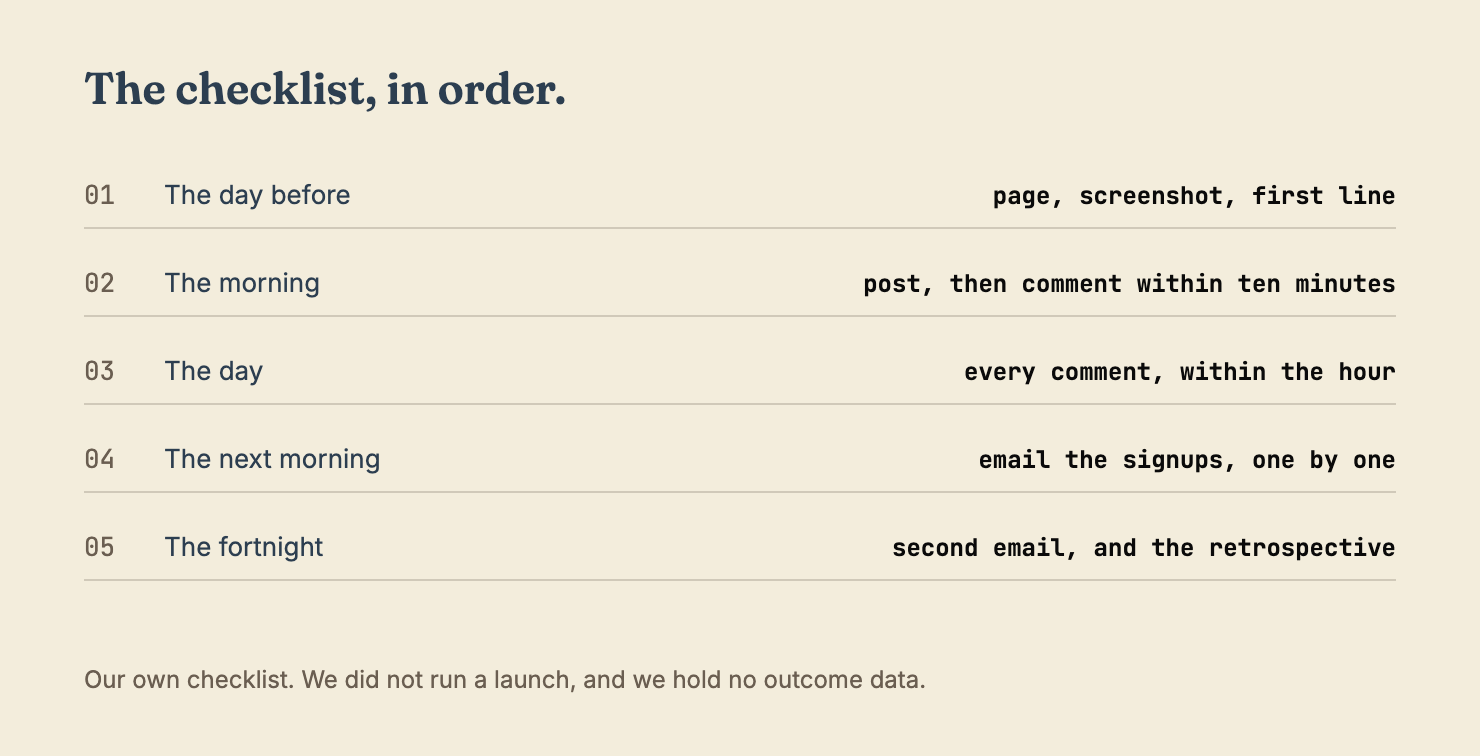
Write it down before the day, because on the day you will not be able to think.
The morning: check the page loads on a phone, and that the screenshot is not a laptop mockup with unreadable text in it.
Post the link.
Write the first comment, which explains what the product does and for whom, in two sentences.
The day: answer every comment within the hour if you can. When somebody asks what problem it solves, answer that rather than with a feature.
Reply to the ones who are being unfair, because everybody is reading. Do not ask for upvotes, and do not offer a discount for them, because both are read as desperate.
The next day: do not post the results on social and call it done. Email the signups, in a personal note, telling them what you noticed about their use.
The fortnight: keep answering comments, and send the second wave of email. The people who came from a launch and did nothing are not a lost cause, they are an audience with a different problem, and the follow-up is where the outcome is decided.
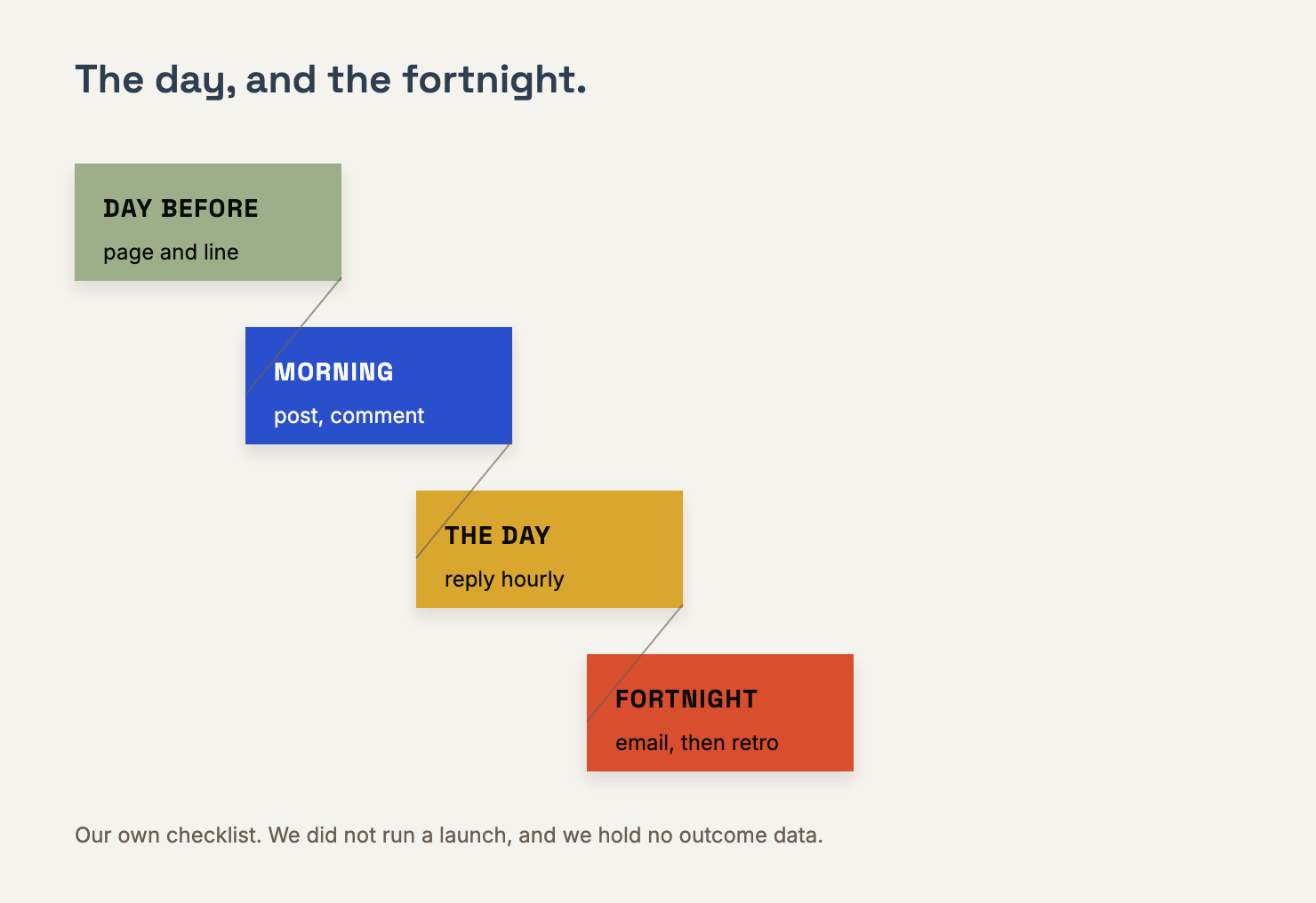
A short checklist to run the launch from
If you read nothing else, read this list. It is the version we would hand to somebody launching on Friday.
The day before: page loads on a phone, screenshot is legible, the first line says what it does for whom, and the next step is obvious to somebody who has never seen the product.
The morning: post the link, then write your first comment within ten minutes, explaining the product in two sentences and saying who it is for.
No launch language, no discount, no request for upvotes.
The day: reply to every comment within the hour. Answer the hard ones plainly. Reply to the unfair ones too, in public, once, without heat.
The next morning: do not declare victory on social. Email the signups, one at a time, with a note about what you noticed about their use.
The fortnight: keep replying, and send a second email to the people who did not sign up. Then write the retrospective while it is still slightly painful, because that is the only moment you will get the honest version of what happened.
Six lines, and most of them are about the fortnight rather than the day. That ratio is the real finding.
Who this is for
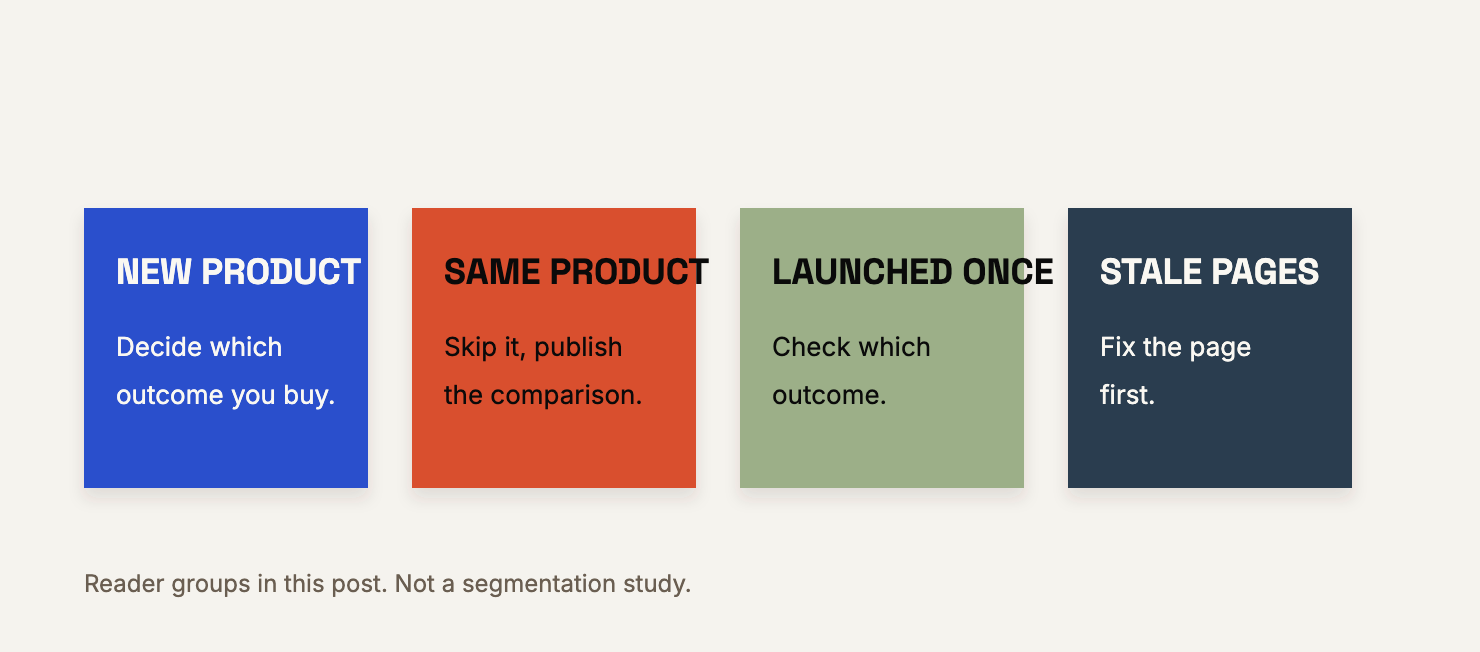
*Teams launching a real product to a crowd that matches their buyer.* Do it properly, and decide in advance which of the three outcomes you are buying.
*Teams considering a launch for a product that has not changed.* Skip it. Publish the comparison page instead, and it will still be working in a year.
*Founders who have done one and count it as a success or a failure.* Check which of the three outcomes you got, because the answer decides whether you should do it again. If you got links, the second launch is worth it. If you got attention, it was worth a day and not worth a campaign.
*Teams whose launch page has not changed since the last one.* That page is the asset. Fix it, and the next launch is a distribution event rather than a rebuild.
How confident we are
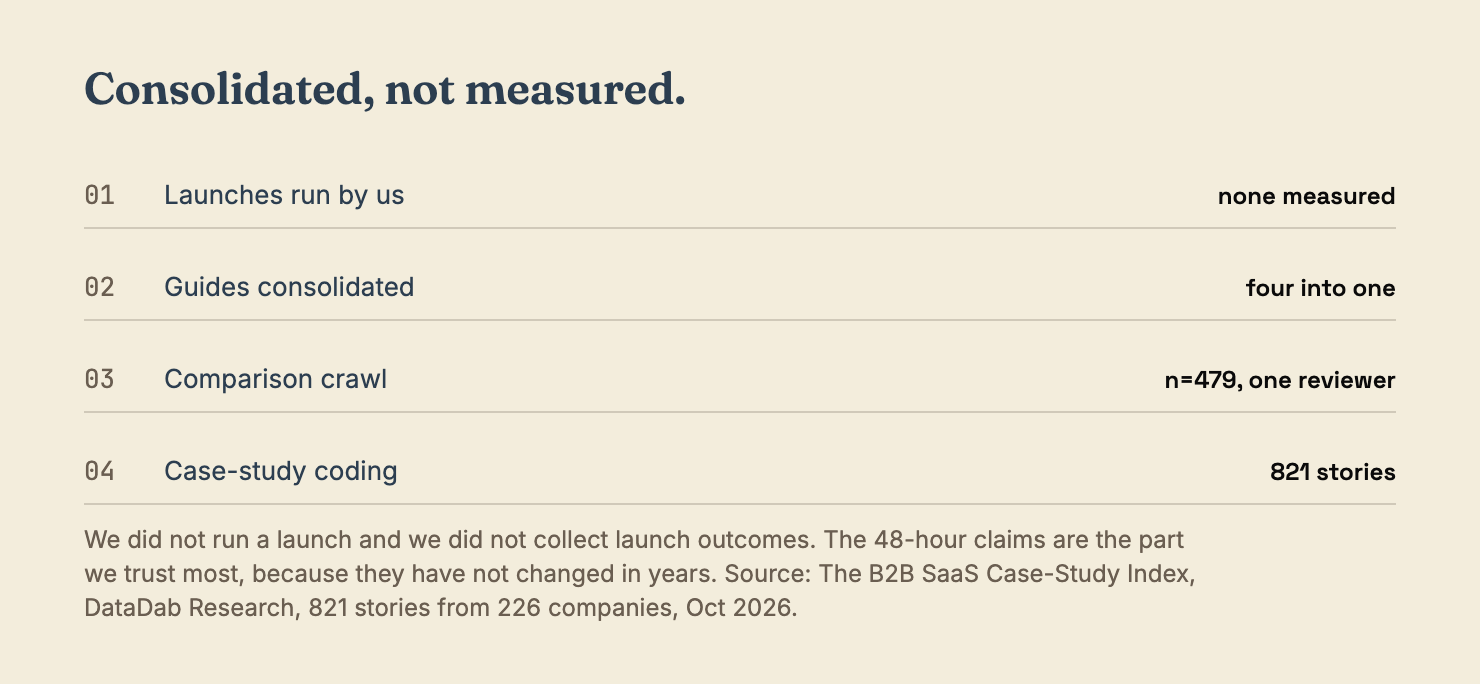
This is our consolidated view of a lot of launches, not a study of them. We did not run a launch, we did not collect launch outcomes, and the 232 impression figure is a search observation from our own data rather than a measurement of how many people search this.
The comparison publishing figures come from a crawl of 479 YC-backed companies with one reviewer and no independent second coding. The case-study figures come from 821 hand-coded stories, also with one reviewer.
The claims about the 48 hours are the part we are most confident in, because they are the part that has not changed in years.
The claims about outcomes are the part we would expect a launch to be judged on, and the part we have least evidence for.
Wrap-up
Five guides became one, because four of them were answering a question that was not being asked. The question is what a launch is for, and the honest answer is three possible outcomes with very different values.
Decide which one you are buying, prepare the fortnight rather than the day, and make the page do the work of telling somebody what to do next.
Then look at your comparison pages, because that is the asset a launch should be feeding, and the one that will still be working when somebody asks in six months.