

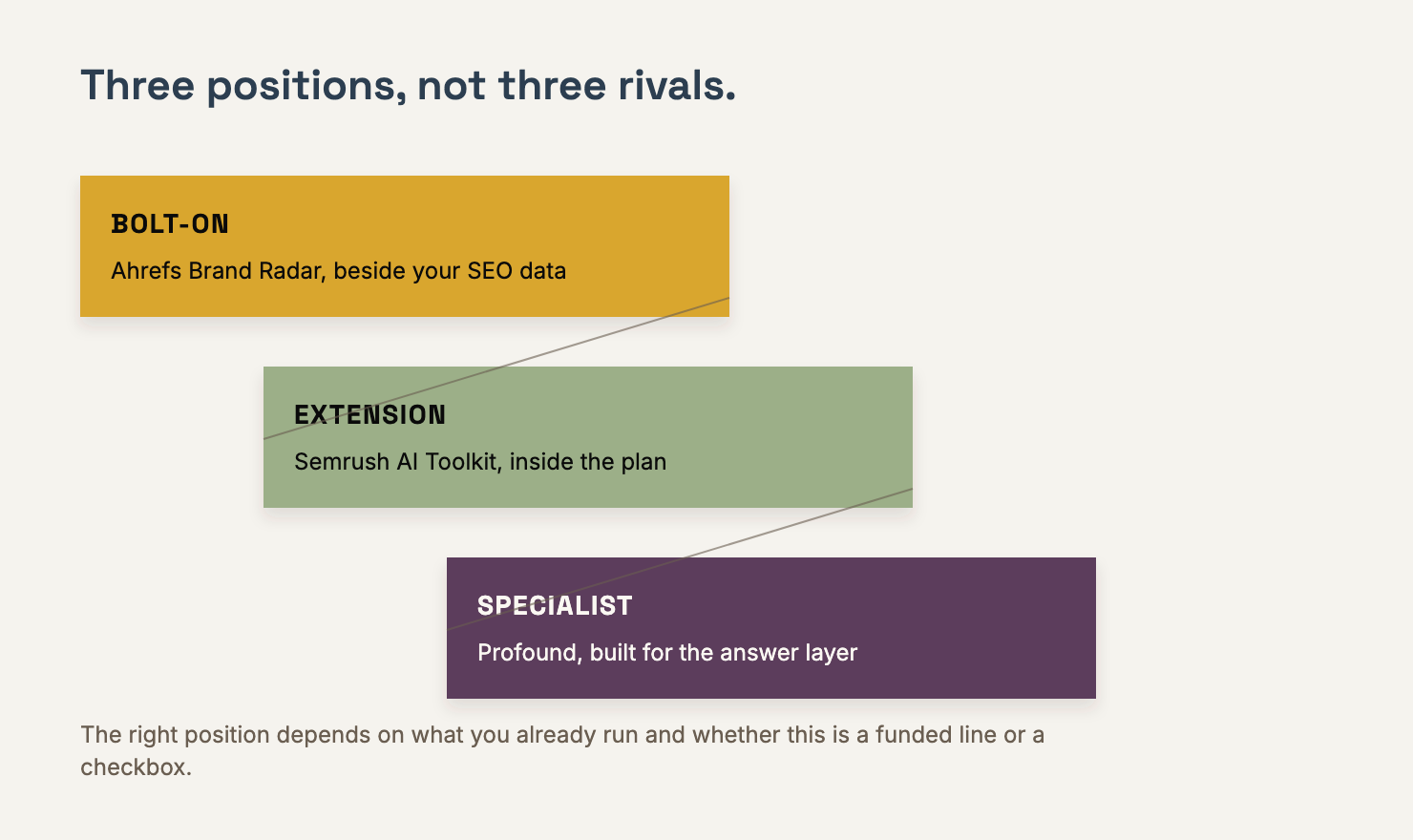
Three tools watch how answer engines describe your brand. They do not compete like equals, because they sit in three different places in your stack.
A marketing lead asked us last week which AI visibility tool to buy. She had forty minutes and three demos booked.
That is the wrong order. The question is not which product is better. The question is where AI visibility lives in your organisation, and that answer decides the shortlist before you see a single dashboard.
We wrote this up as a stack decision in the Ahrefs Brand Radar vs Semrush AI Toolkit vs Profound study, where we checked each vendor's own page rather than trusting a round-up, and read pricing and positioning from all three on 16 August 2026.

Three tools, three different jobs
Ahrefs Brand Radar is an SEO-suite bolt-on. It puts AI-answer visibility beside the search data your team already opens every day.
Semrush AI Toolkit is a platform extension. It adds AI-search monitoring inside Semrush rather than selling you a new product.
Profound is the specialist. It was built for the AI-answer layer, tracks prompts and citations, and publishes its own research on what answer engines do.
None of these is the "best" tool. They answer different procurement questions: what do we already pay for, and is this a line item or a checkbox?
| Tool | Position | Published price | Surface | Own research |
|---|---|---|---|---|
| Ahrefs Brand Radar | SEO-suite bolt-on | From about $398/mo | Answers plus YouTube, TikTok, Reddit | No |
| Semrush AI Toolkit | Platform extension | Bundled in plans | AI search inside the Semrush view | Limited |
| Profound | Specialist | $99/mo or $399/mo, yearly | Answer engines, prompts and citations | Yes, publishes regularly |
Read the last column before the price column. Whether a vendor publishes its own research is the clearest signal of whether it treats AI citation as a product or as a feature added to something else.
Only one of the three gives you a clean price
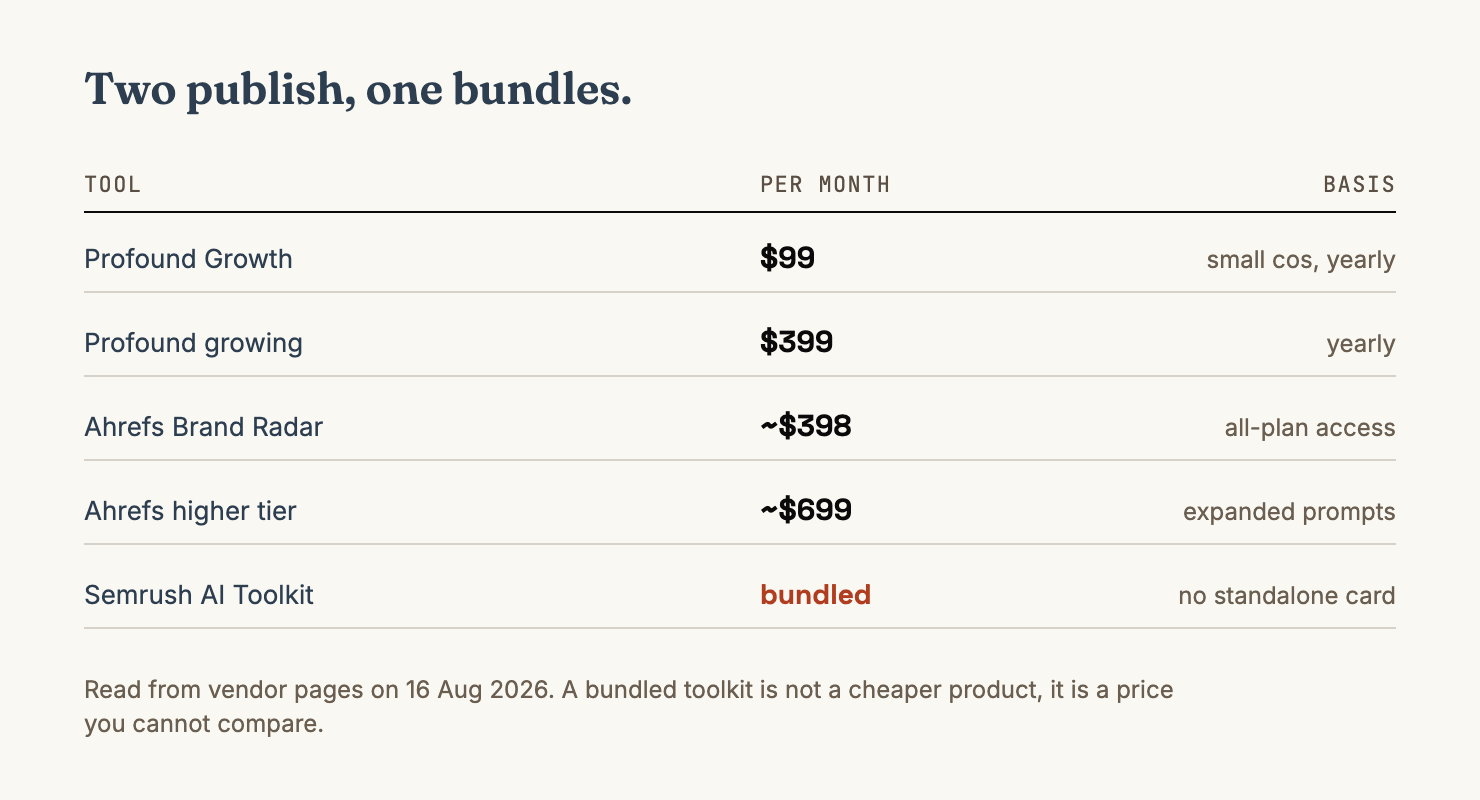
Profound publishes: $99 a month on the Growth plan for small companies, $399 for the growing tier, both billed yearly, with enterprise quoted.
Ahrefs lists all-plan access around $398 a month, with a higher tier near $699 for expanded prompt access. Individual-platform selection is available.
Semrush bundles the AI Toolkit into its plans. There is no standalone rate card, because the toolkit is not an independent product you can buy separately.
That is the practical difference, and it is not about generosity. A transparent price means you can defend a budget line. A bundled one means the decision is already made by whoever signed the platform contract.
Breadth is not the same as depth
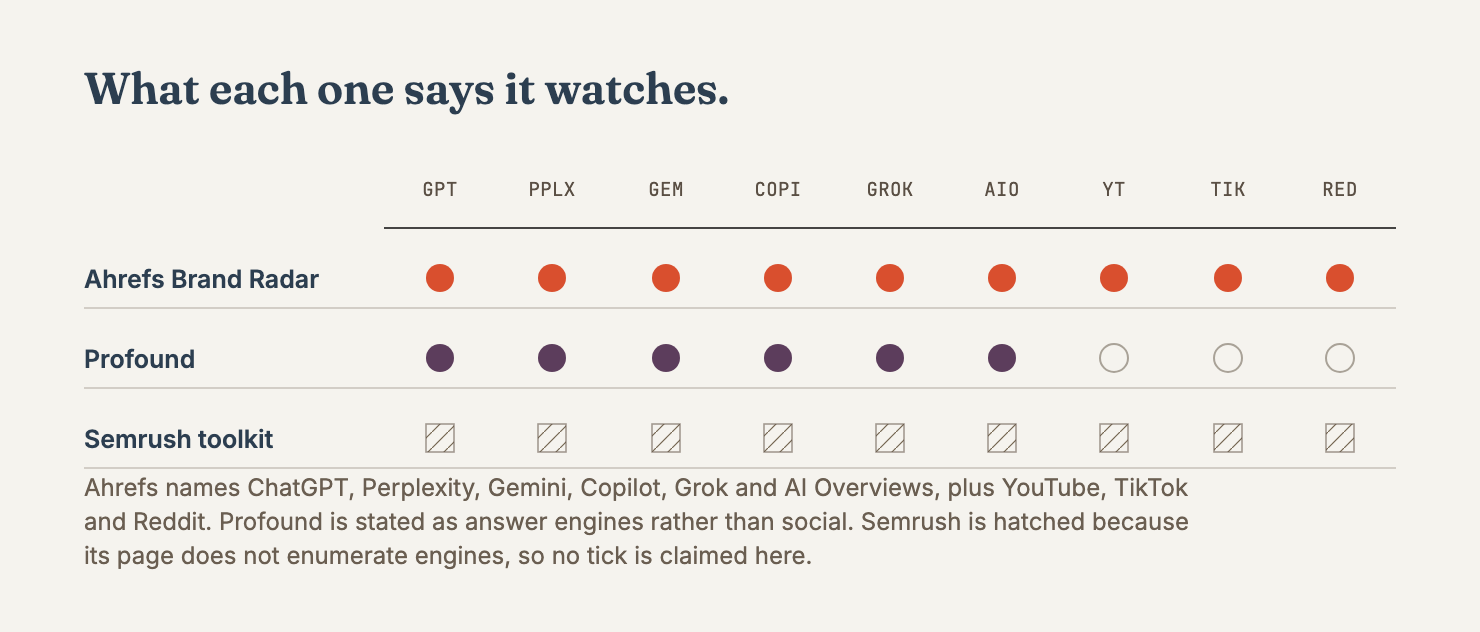
Brand Radar covers the widest surface: ChatGPT, Perplexity, Gemini, Copilot, Grok and AI Overviews, plus YouTube, TikTok and Reddit. It scores presence using a large organic-prompt dataset.
Profound goes deep on answer engines instead: which prompts mention you, which pages get cited, and how your brand presence moves over time.
Semrush covers AI inside its own view of search. Its breadth is tied to what the platform already measures.
If you need social and video visibility measured alongside answers, only one of these does it. If you need to know which passage of which page earned a citation, breadth will not help you.
Brand Radar also lets you select individual AI platforms to track, and monitors brand mentions and competitor updates in real time. Both are genuinely useful. Neither changes the fact that its price assumes you already value what Ahrefs sells.
What each one is weak at
Every vendor here has a limitation that will decide your purchase if you read the page honestly rather than the pitch.
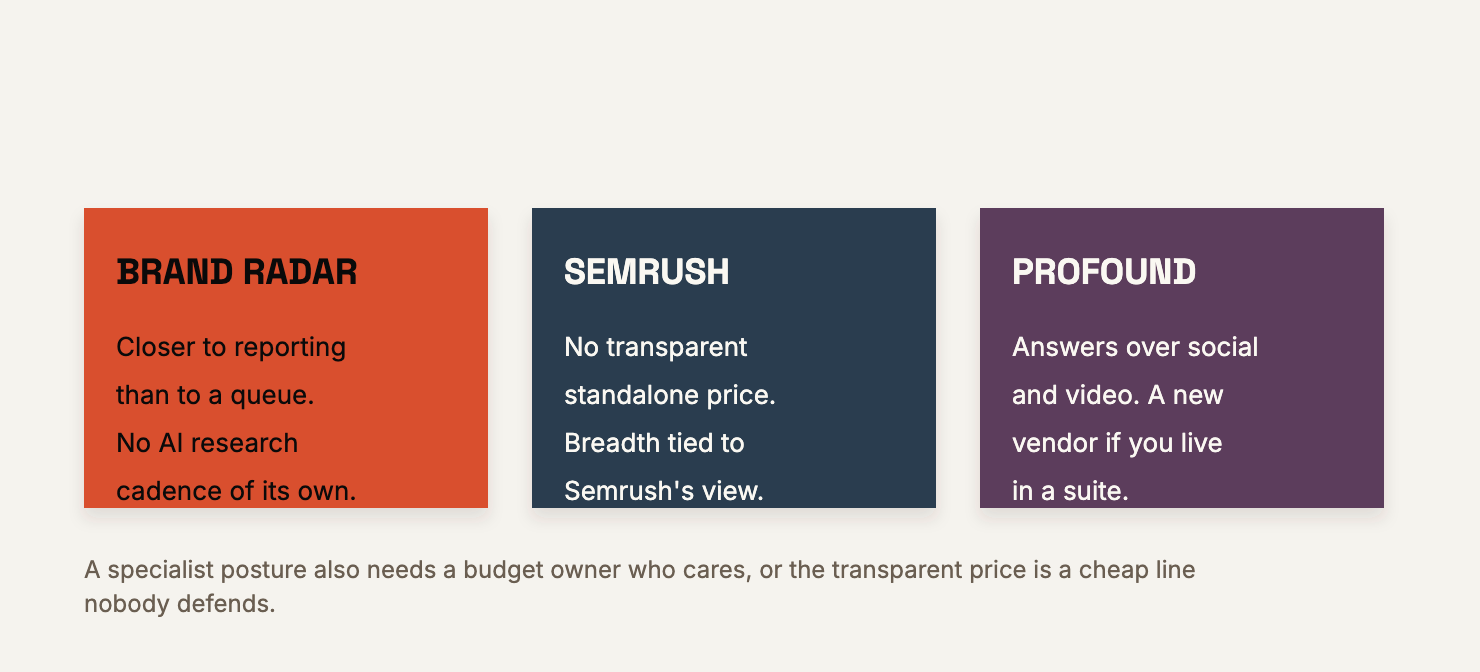
Brand Radar sits closer to reporting than to a content-action layer, and it publishes no research cadence of its own on AI citations. When the category shifts, you are waiting for someone else's methodology.
The Semrush toolkit has no transparent standalone price at all. Its breadth is tied to Semrush's view of search, and its independent AI-citation research is limited. You are extending a platform, not buying a measurement product.
Profound focuses on answer engines more than social or video, and it is a new vendor if your team already lives inside Ahrefs or Semrush. A specialist posture also needs a budget owner who cares. Without one, a transparent price is just a cheap line nobody defends.
For what it is worth, our own position in this market is narrower than any of these. These tools measure. We implement the decision-stage content and entity work that moves the number they report, and we would rather you understood the split than bought a dashboard expecting a fix.
The action layer is the real split
This is where the comparison stops being about dashboards.
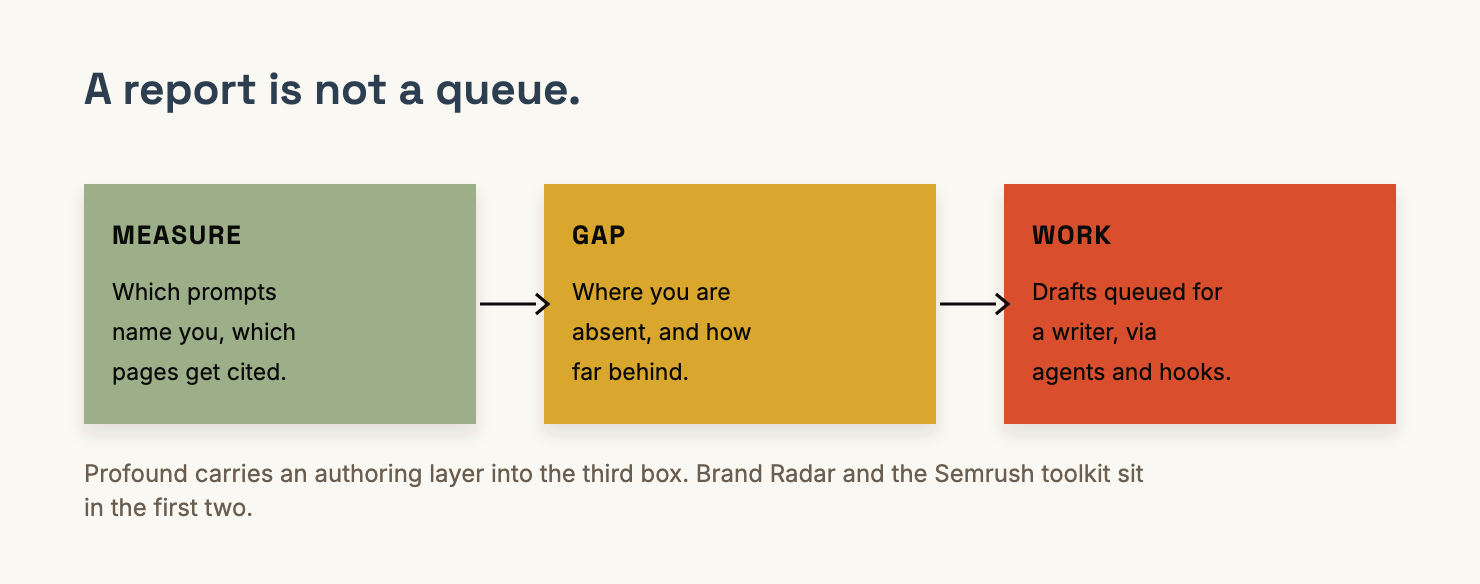
Profound pushes into content. It has an authoring layer of agents and connectors that turns a visibility gap into a draft, plus a free, regularly refreshed index of category visibility.
Brand Radar and the Semrush toolkit sit closer to reporting. They tell you where you stand, next to the data you already trust.
Ask what the output of the tool is. If it is a report, you have bought measurement. If it is work queued for a writer, you have bought measurement and a bit of execution.
Neither is wrong. Buying a report and never funding the fixes is.
The test that decides it
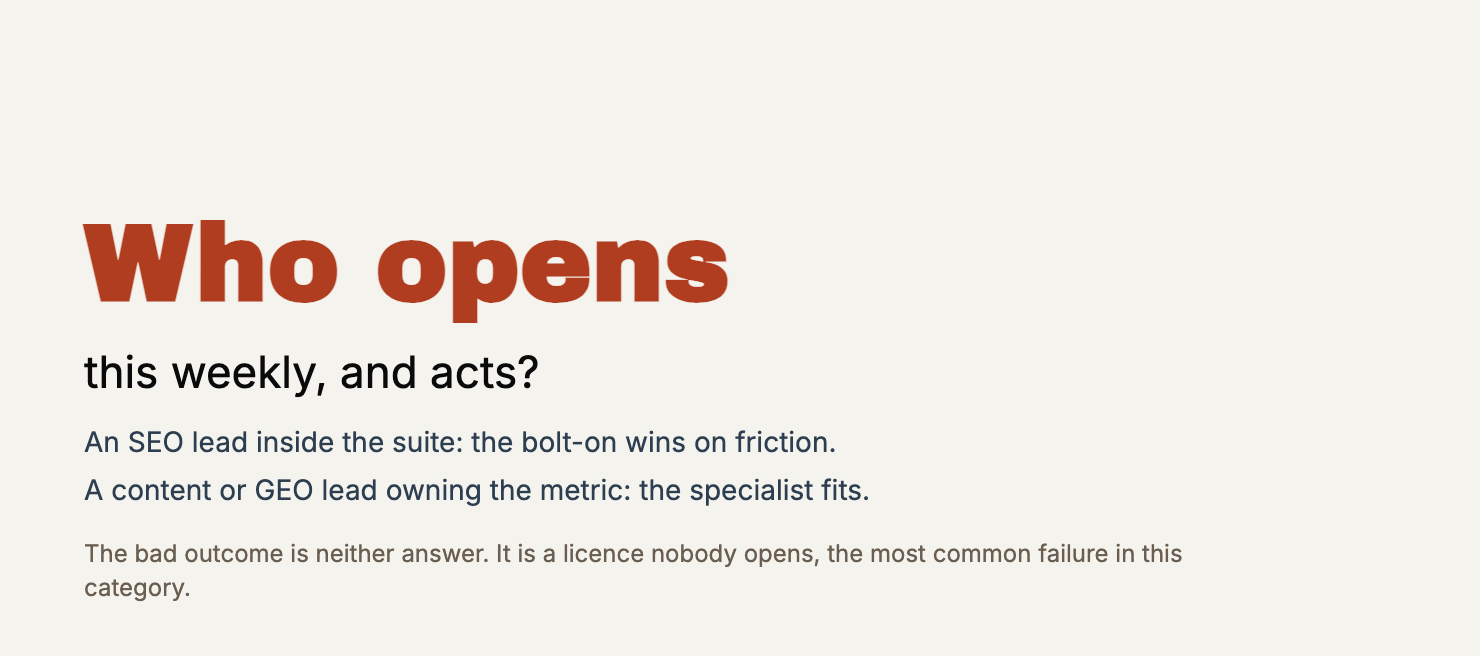
The study puts it in one question: who will open this dashboard weekly and act?
If the SEO lead owns it and works inside Ahrefs or Semrush, the bolt-on wins on friction. You are adding a tab, not a vendor, an invoice, and an onboarding project.
If a content or GEO lead owns the citation metric as a KPI, the specialist's transparent price and research-backed method is the stronger fit. It gives you a number you can defend in a budget meeting.
The bad outcome is neither of these. It is a licence nobody opens, which is the most common failure mode in this category.
If you already pay for Ahrefs, Brand Radar puts AI and social visibility beside the SEO data you trust. If you already pay for Semrush, the toolkit extends the platform you run with no new vendor.
If AI visibility is a funded, reported KPI, the specialist is the fit: transparent price, research behind it, and someone owns the metric. If your content team has to act on citation gaps, the action layer matters more than the surface area.
And if you have no existing suite and a small budget, the $99 entry tier is the only option here that you can evaluate without a sales conversation.
Five questions before you shortlist
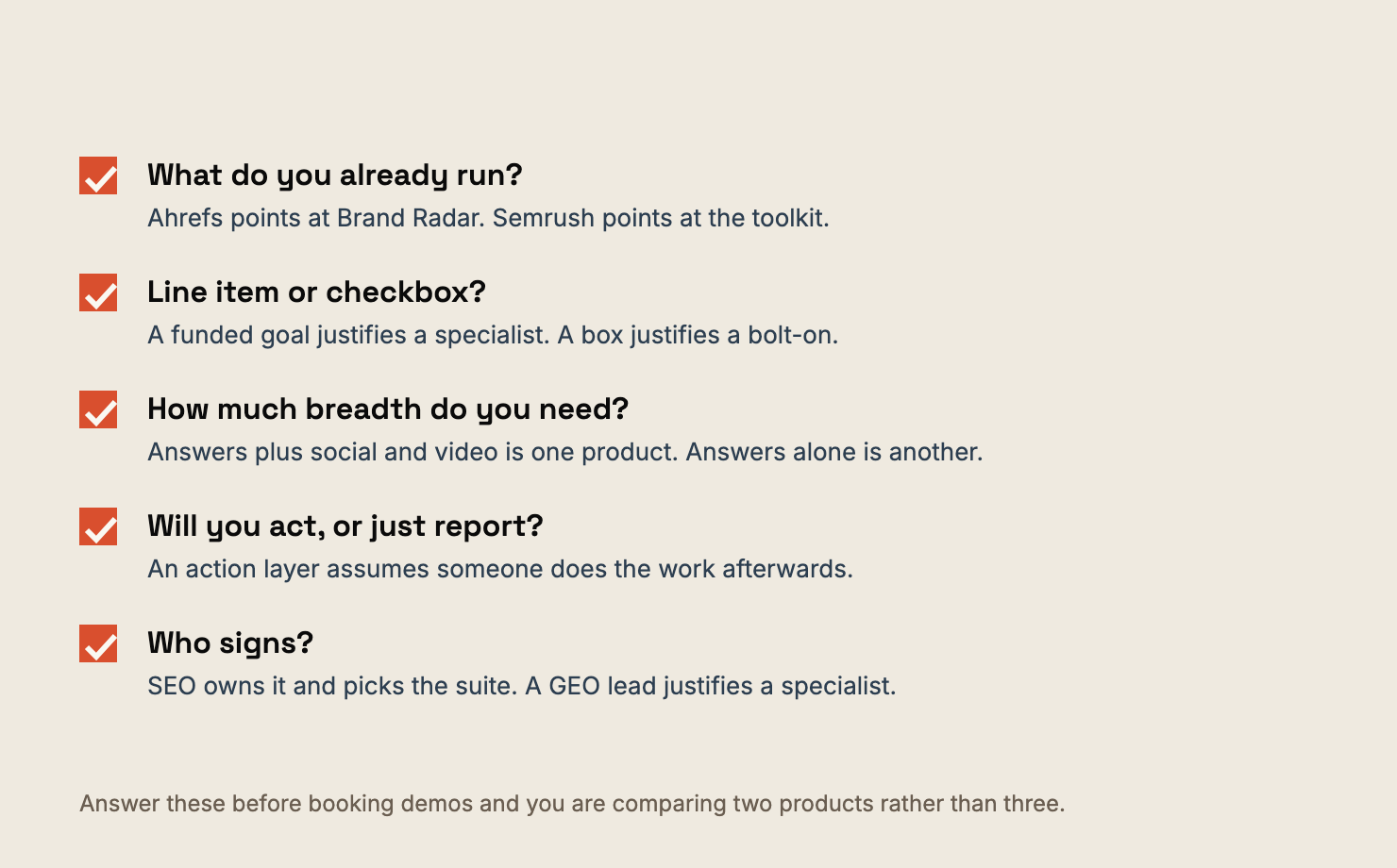
1. *What do you already run?* Ahrefs points at Brand Radar. Semrush points at the toolkit. Neither, with real budget, points at the specialist.
2. *Line item or checkbox?* A funded, reported-on goal justifies a specialist. A box next to SEO justifies a bolt-on.
3. *How much breadth do you need?* Answers plus social and video is one product. Answer engines alone is another.
4. *Will you act or just report?* The tool with an action layer assumes you have someone to do the work.
5. *Who signs?* SEO owns the budget, they pick the suite bolt-on. A separate content or GEO lead owns it, they justify a specialist.
When to buy none of them
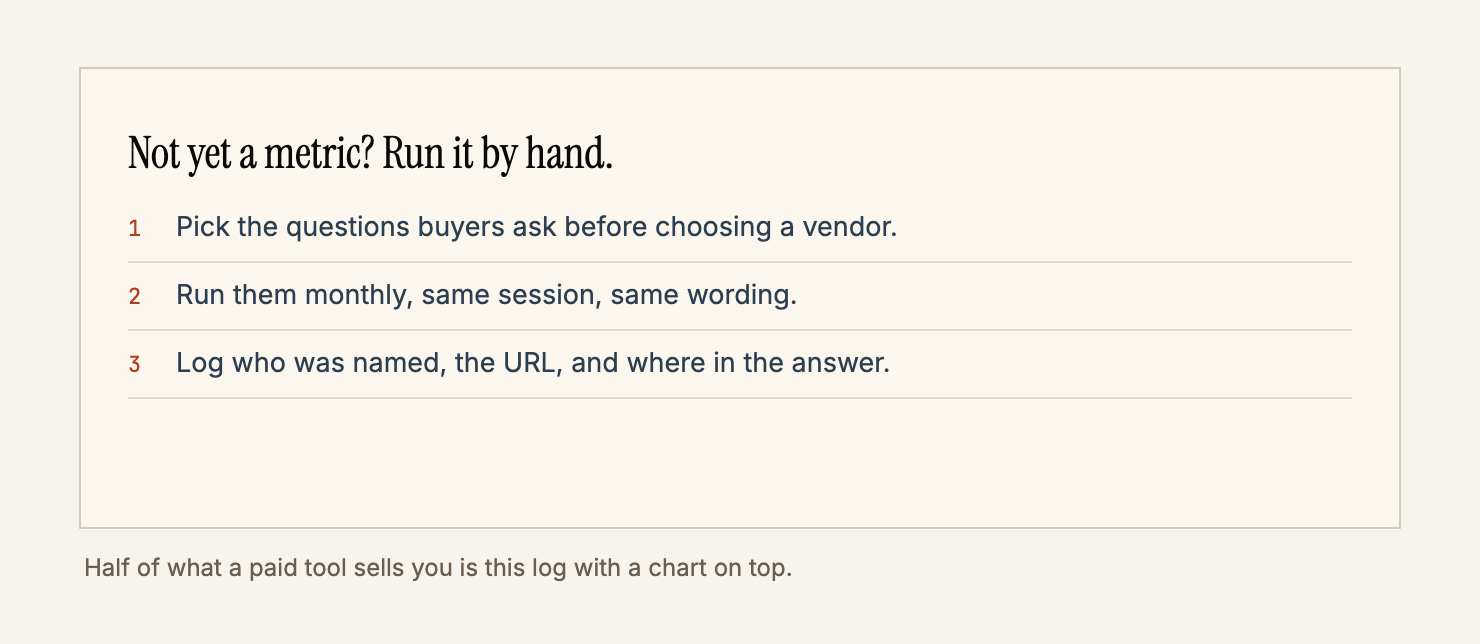
If AI visibility is not yet a monitored metric, and you have no decision-stage pages to act on, a spreadsheet of prompts run monthly by hand beats any of these three.
Add a tool when there is someone who will open it weekly and something worth measuring. Before that you are buying a report about a problem you have not decided to fix.
The manual version is not glamorous, and it works. Pick the questions your buyers ask before choosing a vendor, run them monthly, log who got named and where. Half of what a paid tool sells you is that log with a chart on top.
And note what none of them do. These tools measure the gap. If your pages are not being cited, the fix is content work: answer-first pages, clean extraction, consistent entity data. A dashboard tracks that work. It does not replace it.
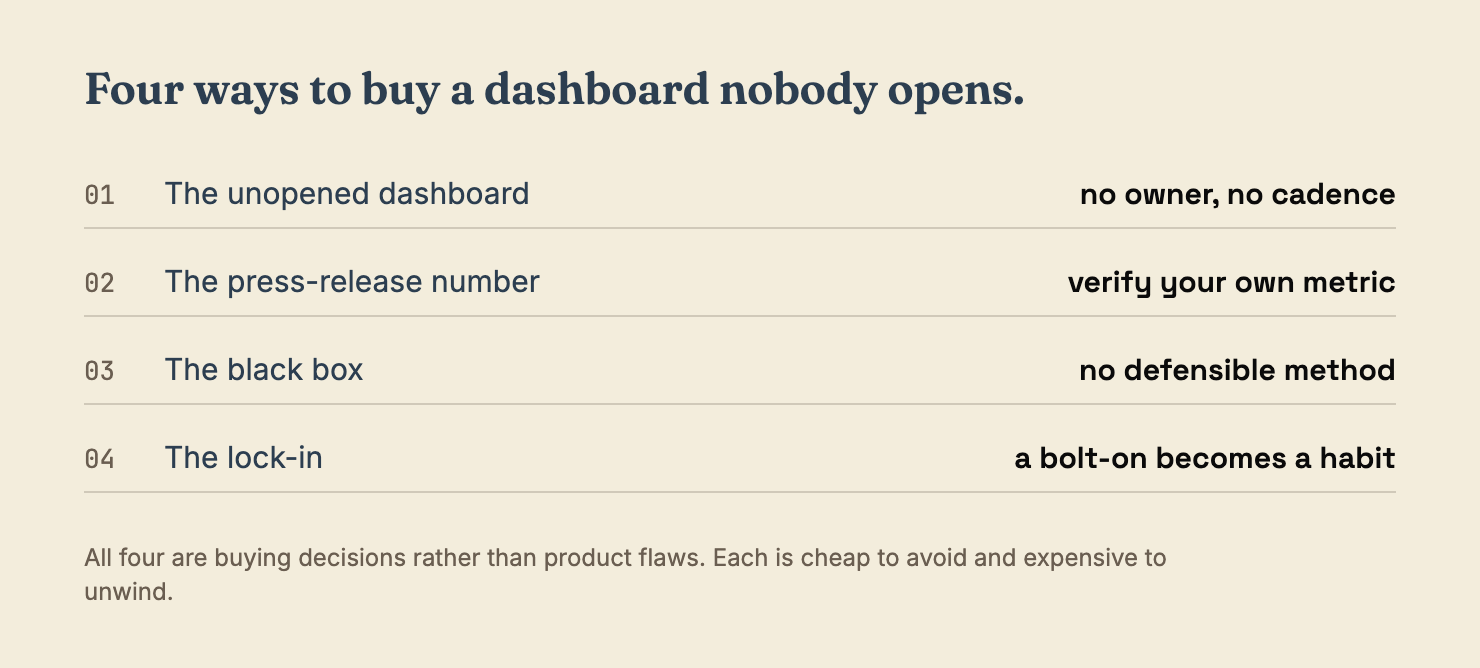
Four traps that cost a licence fee
*The unopened dashboard.* Assign an owner and a cadence before purchase, not after. This is the failure the whole category shares.
*The press-release number.* Both suites and specialists lean on impressive prompt counts. Verify the metric you will actually track, not the one in the headline.
*The black box.* If a tool cannot explain how it decides what counts as a citation, its score is not defensible. Prefer the one whose method you can describe to your CFO.
*The lock-in.* A bolt-on decision today gets harder to leave later. Choose by stack, but be honest that it is a commitment rather than a trial.
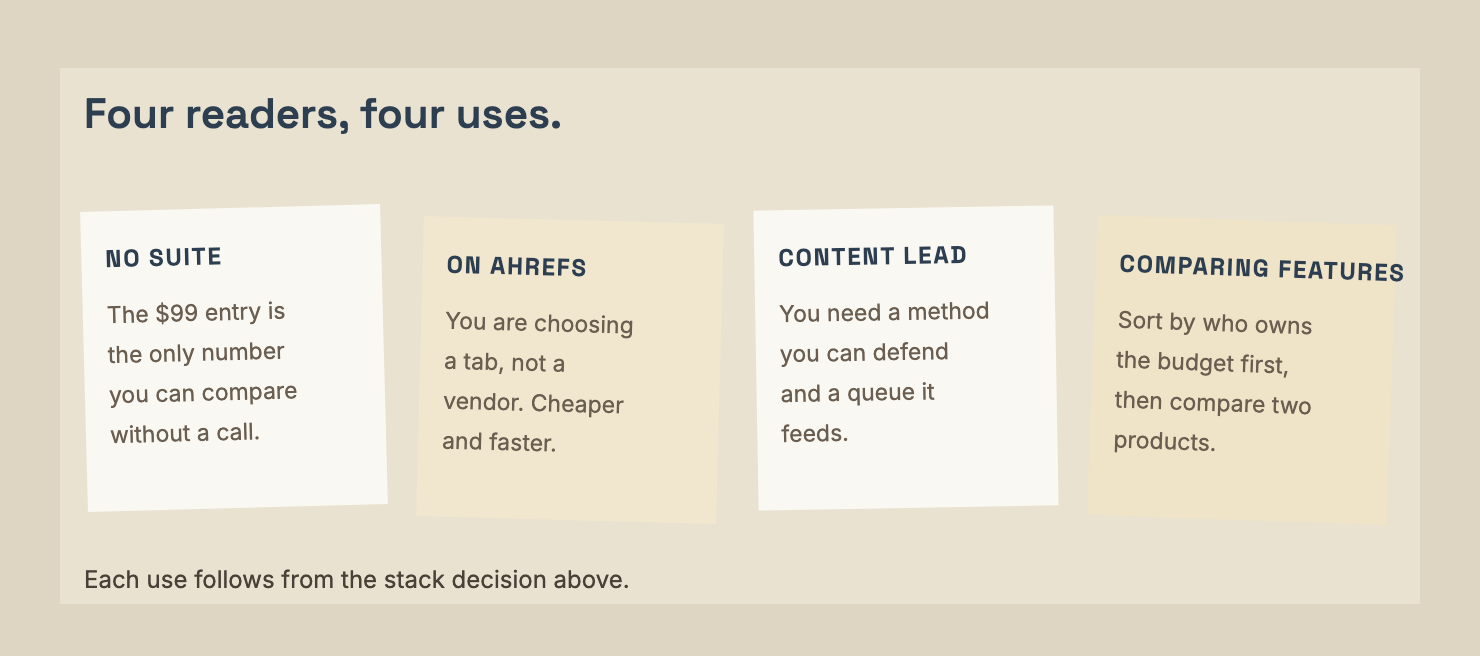
Who this is for
*Marketing leads with budget but no stack.* The specialist's published $99 entry is the only number here you can compare without a sales call.
*SEO teams already paying for Ahrefs or Semrush.* You are probably deciding between two tabs you already own. That is a cheaper, faster answer than a new vendor.
*Content leads measured on citations.* You need the tool that explains its method and feeds your queue, not the one with the widest surface.
*Anyone evaluating all three on features.* Stop. Sort by who owns the budget and who opens the dashboard, then compare two products rather than three.
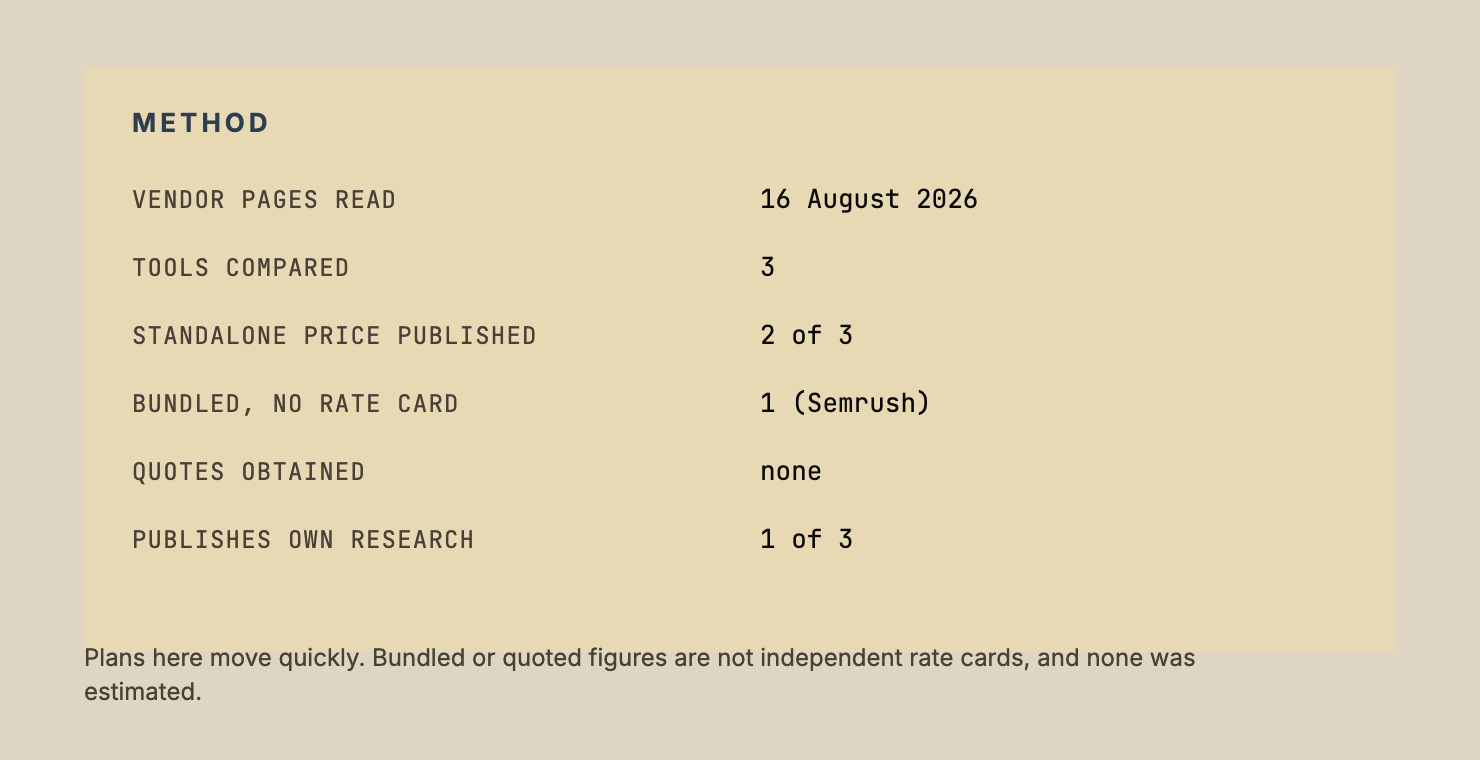
How confident we are
This is a dated reading of public pages, not a benchmark. Pricing and positioning were taken from vendor sites on 16 August 2026, and plans in this category move quickly.
Where a vendor bundles rather than sells separately, we say so rather than estimating a price. No figure here was invented or back-filled from a third-party claim.
Capability descriptions come from current public documentation. No vendor paid for placement in the study or in this post.
Wrap-up
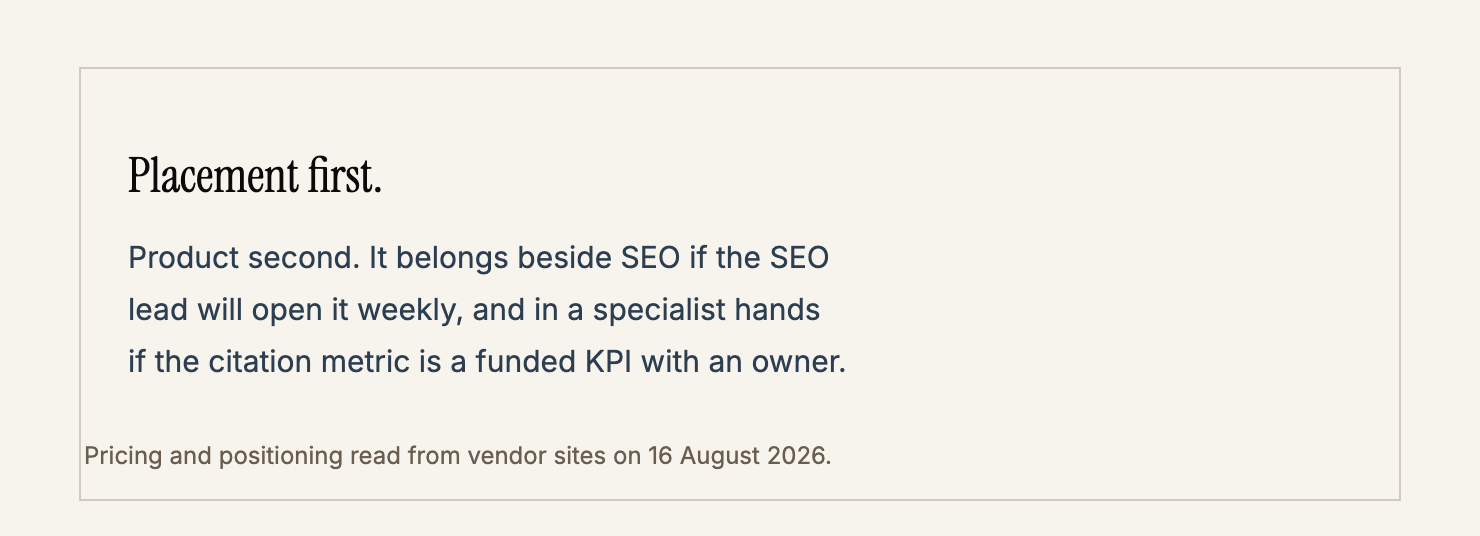
Decide where AI visibility lives before you compare products. It belongs beside SEO if the SEO lead will actually open it, and it belongs in a specialist's hands if the citation metric is a funded KPI with an owner.
The rest follows from that. A transparent price matters when you have to defend a budget. Breadth matters when social and video are in scope. An action layer matters when the report would otherwise sit unread.
Want to know what answer engines can actually read on your pages right now?
Start with the pages you expect to be cited, then run them through the extractability audit.