

We published a German page and a French page, and wrote the forecast down before launch: zero traffic.
The case for localising a page is normally a traffic case. Somebody says the German market is large, or that Spanish buyers will not read English, and visits go on the board as the return.
I ran that arithmetic on our own site. It does not survive the export.
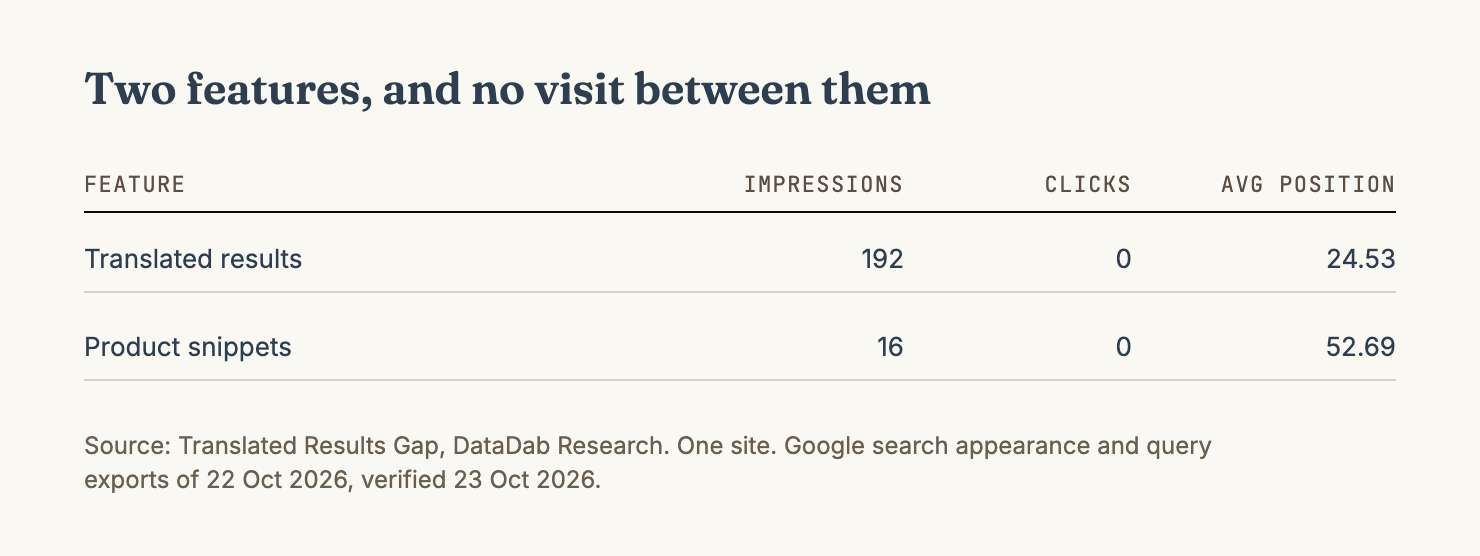
Google's translated-results feature showed our English pages to non-English searchers 192 times. Those impressions produced 0 clicks.
The two pages went live on 22 October 2026 with a baseline recorded as zero the day after. It is still zero, because the window has not opened.
So the case for having written them is a different one. The demand is real. It does not arrive as a click.
Position twenty-four and no click
Our own study of the translated-results gap asks two questions about one site, and the search appearance report answers the first with numbers I did not expect.
Two features produce impressions. Translated results: 192 impressions, 0 clicks, average position 24.53.
Product snippets: 16 impressions, 0 clicks, position 52.69. Both earn impressions. Neither earns a visit.
Read the size before the meaning. At our scale 192 impressions is a rounding error, and 24.53 puts the result on a screen the searcher never reached. The feature works. It is a niche of a niche.
The figure matters for another reason. Whatever is taking the non-English searches on our topics, it is not Google translating our page. 192 cannot account for the 2,954 in the query export.
The non-English queries are prompts, not searches
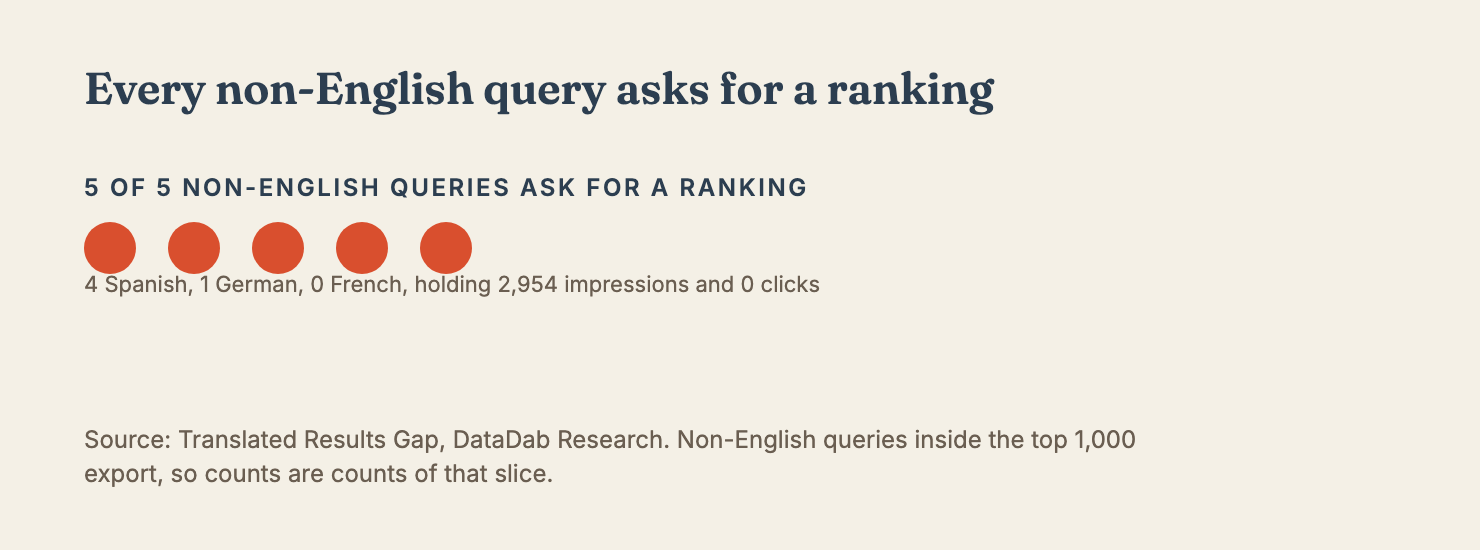
Five non-English queries sit in that export. They hold 2,954 impressions between them and earned 0 clicks.
Split by language: Spanish has 4 queries worth 2,662 impressions, with a best position of 1.44. German has 1 query worth 292 impressions, best position 16.98.
French has none, and that is a finding rather than a missing row.
All 5 of the 5 ask for a ranking. Not a guide, not a document, not a format. They name a set of products and demand the order.
The German query asks for an enforced ranking from best to worst, in German. That is the shape a person uses when they are instructing an assistant rather than asking a search engine.
That 1.44 is the line I would show a board: we sat at the top of the page for a Spanish buyer who wanted a shortlist, on a page written for somebody comparing features.
Three explanations fit a searcher who does not click, and only one survives. Google translating the page and answering in place is doing very little here, and 192 impressions cannot explain 2,954.
A buyer who wanted a different page would have clicked a translated version. There are none, and the localised pages did not exist yet.
The wording points the other way. The queries name products and ask for a verdict. A translated page was never competing for them, and no translation of your homepage will win them.
Where the non-English demand actually shows up
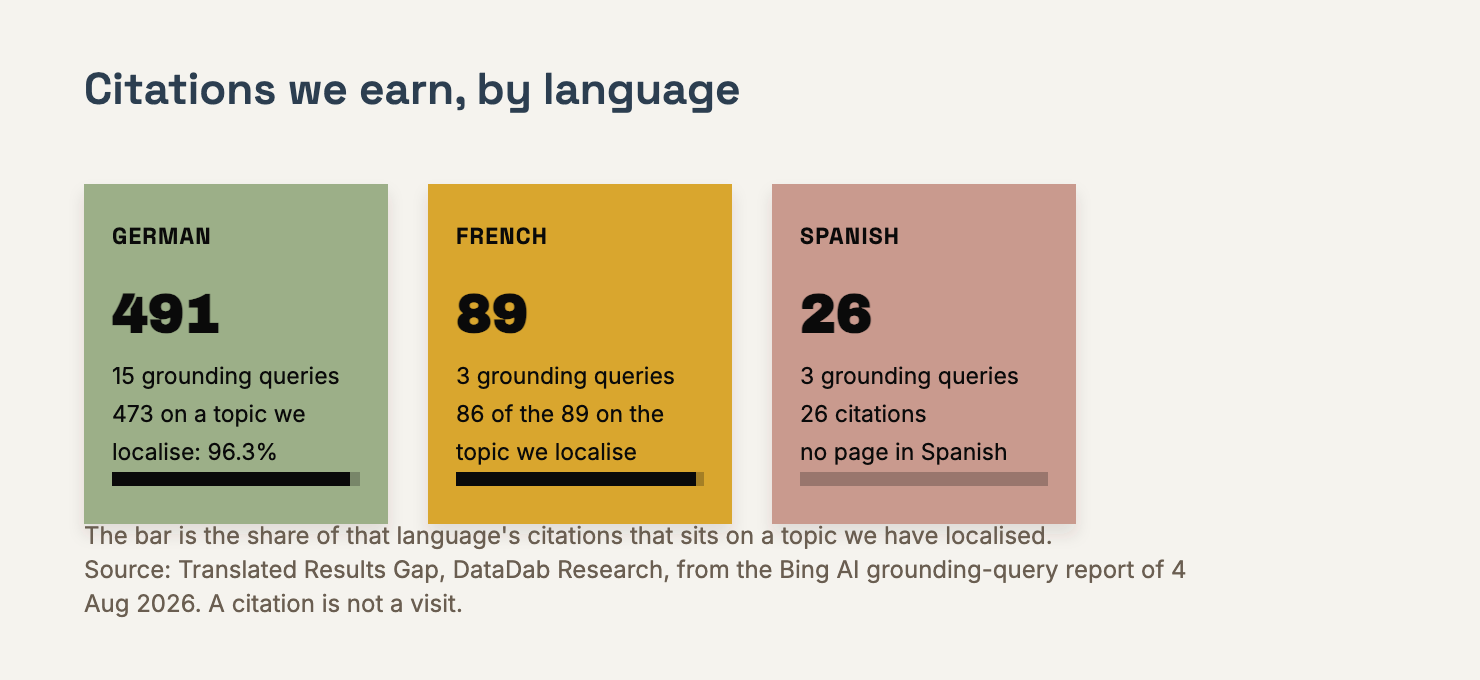
The assistant layer is where the demand is measurable, and it is not empty. Bing's AI grounding-query report of 4 August 2026 lists the non-English questions our content answers, with citations on each.
German: 15 grounding queries, 491 citations, and 473 of them on the two topics we localised. That is 96.3%.
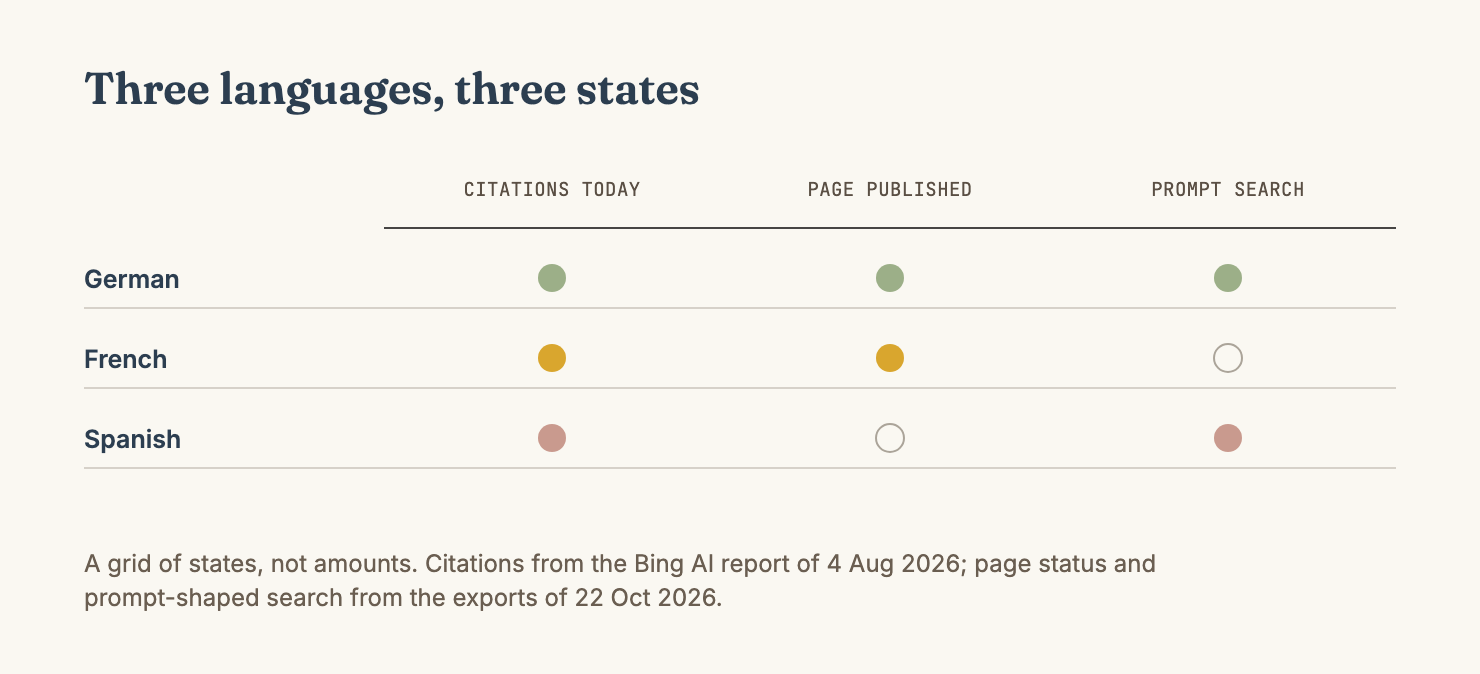
French: 3 queries, 89 citations, 86 of them on the topic we localised. Spanish: 3 queries, 26 citations, and no Spanish page.
The single biggest German query earns us 135 citations on its own. That number decided the work, and it existed before a word of German was written.
This is what the zero-click study found in English, in another language. Page one held, nothing came back to the page, and the answer took the rest.
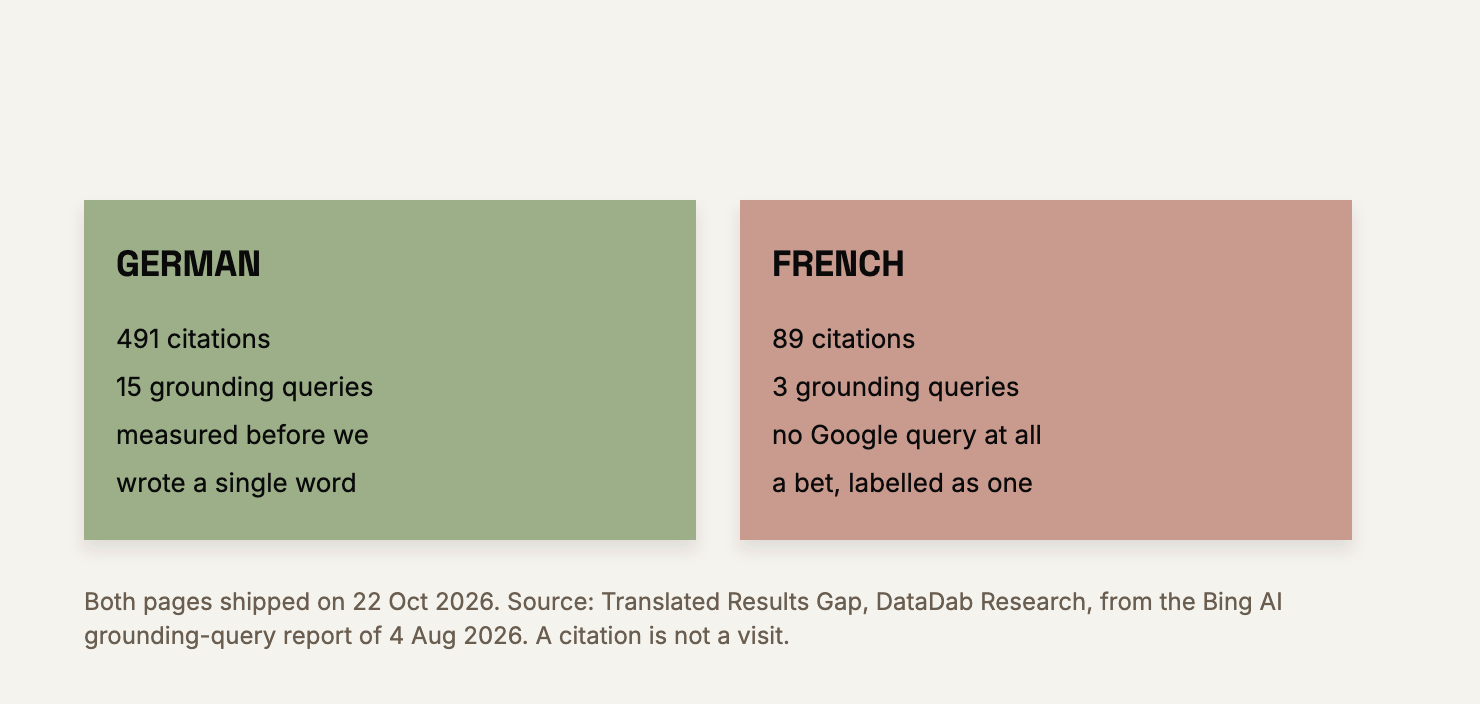
German was a measured decision and French was a bet
Two pages shipped on the same day, and they were not the same kind of decision. Keeping that difference visible is the only way either gets graded honestly.
German had a number behind it before anyone wrote a sentence. 15 grounding queries, 491 citations, 473 of them concentrated on two topics we already owned.
French had 3 queries worth 89 citations, and Google's export gives us no French query at all. The topic is ours, but the volume is a fraction of the German one.
We shipped the French page anyway, and I would defend that. A market-entry decision and a content decision are different things, and one page is a cheap test of a question we could not otherwise answer.
It is a bet, the page says so, and the two should not be graded against the same expectation.
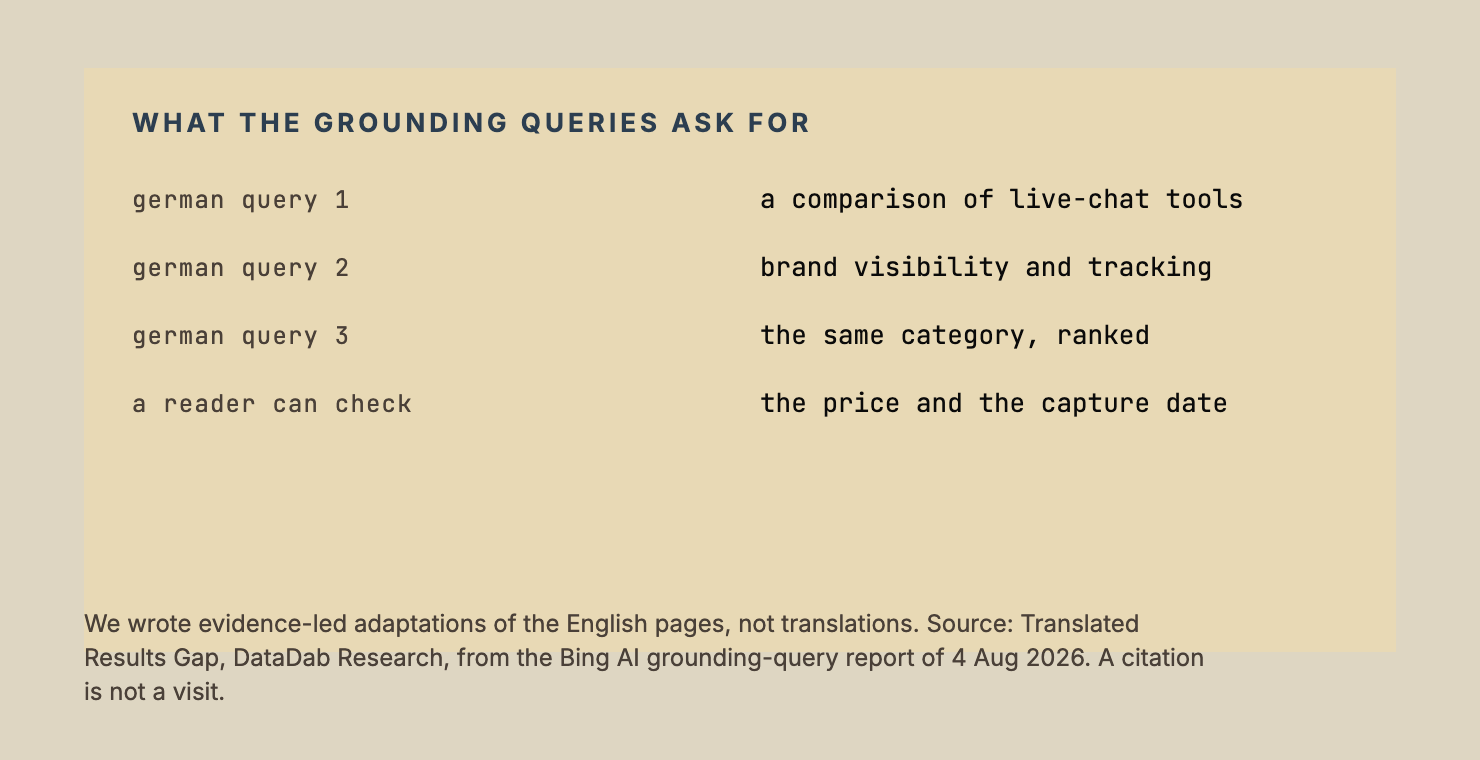
A German buyer asks the same question, in German
The grounding queries are the closest thing to a transcript of what a non-English buyer wants.
The leading query asks for a comparison of live-chat tools by name, with the word for comparison in it. The second asks about brand visibility and tracking. The third asks for the same category in a forced ranking.
So the German buyer wants the answer the English buyer wants. That is the entire market-entry case, and it is why we wrote evidence-led adaptations rather than translations of the English pages.
Same pricing captures, same dates, same recorded refusals, in the reader's language.
One thing changes, and it is checkable. A German reader who lands on a German page can audit the price and the capture date themselves.
An assistant can cite an English page and produce a German answer the reader cannot verify. That difference is small, and it is the whole argument for localising the page rather than only the answer.
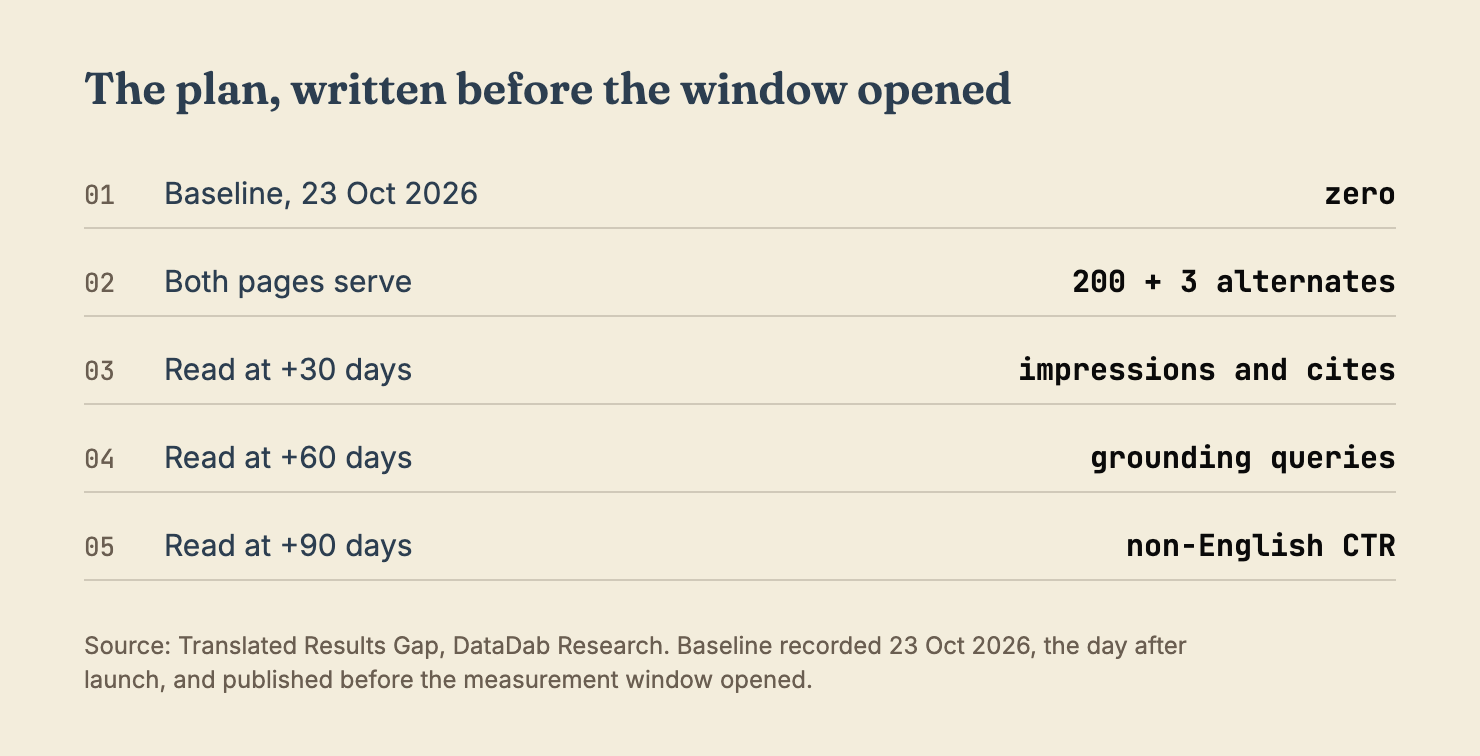
A baseline of zero, written down before the window opened
A localisation programme that cannot be measured is a bet that never gets graded.
Both pages answer with status 200, and each carries 3 alternate links pointing at its English original and an x-default. Each is its own canonical.
The search export closes on 19 October, so it contains no row for either page. The Bing report is from August, before either page existed.
The baseline is therefore zero, recorded as zero, with nothing to compare against yet.
Three readings repeat at 30, 60 and 90 days: impressions and clicks on the two URLs, the grounding queries citing them, and the click rate of the non-English comparison queries.
If the citations do not move, the honest reading is that localised pages earn citations rather than clicks. That is still a return, just not the one the traffic case promised.
What to localise, in the order the evidence supports
The order of work matters more than the language. Here is what our own data supports, one row at a time.
| Language | What the demand looks like | What we published | What to expect |
|---|---|---|---|
| German | 15 grounding queries, 491 citations, 473 on topics we own | A live-chat comparison, live 22 October | Citations first, because traffic is not the case for it |
| French | 3 grounding queries, 89 citations, no Google query at all | A landing-page comparison, live 22 October | A labelled bet, graded on the same three readings |
| Spanish | 3 grounding queries, 26 citations, plus 2,662 prompt-shaped impressions | Nothing | The most search behind it and the least evidence |
The rule out of that table is short: localise where the assistants already cite you. For us that is German, and it is two comparison topics rather than a whole site.
Spanish is the interesting exception: more non-English impressions than German and French combined, and 26 citations behind it.
That is a traffic case with no citation case underneath it, and on this evidence it is not the next page we write.
The afternoon check on your own export
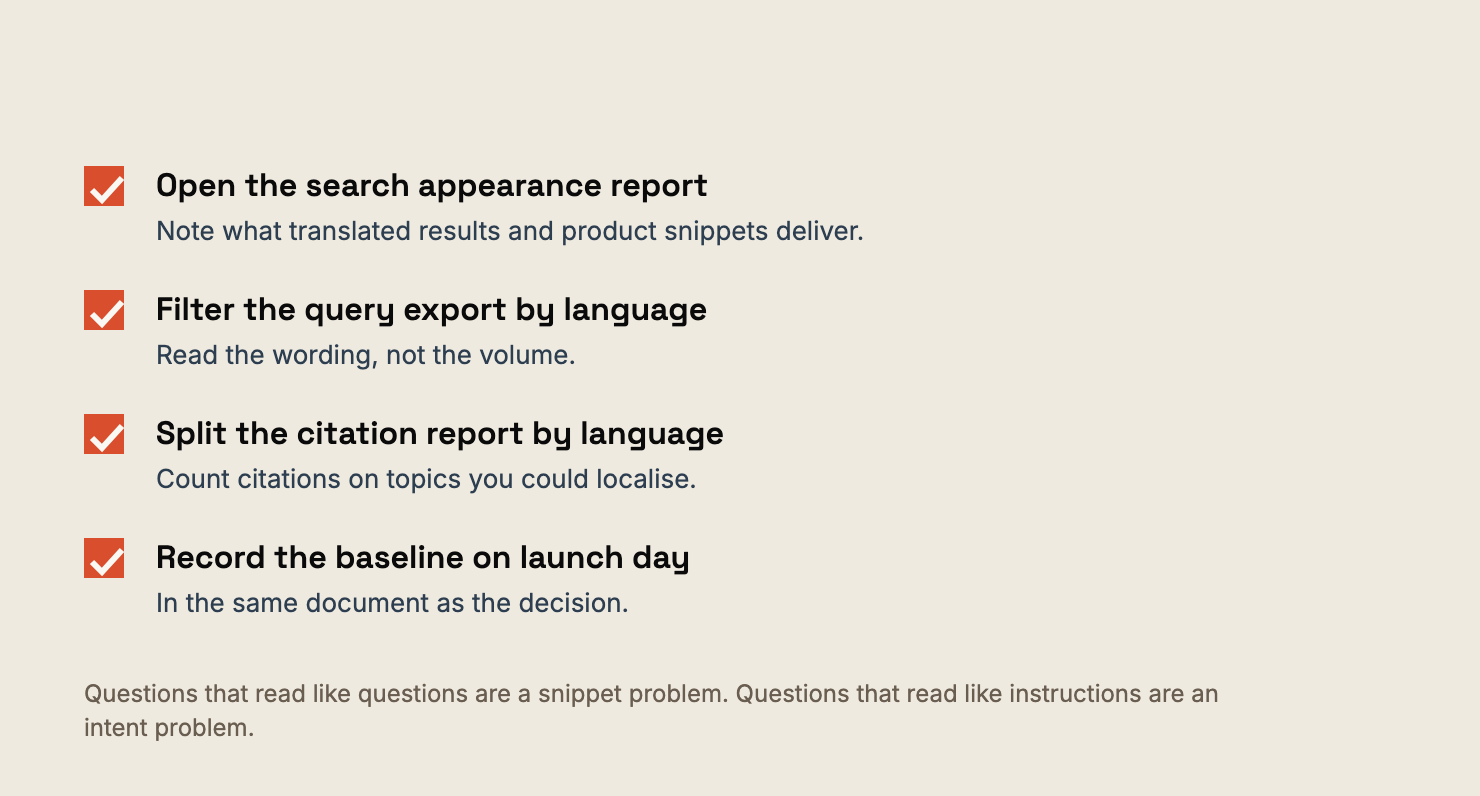
This takes one sitting, and it reorders a localisation backlog faster than any vendor deck.
Pull the search appearance report and note what translated results and product snippets deliver. Most B2B sites will find the numbers are small. Ours were 192 impressions and 0 clicks.
Filter the query export for queries that are not in your language, then read their wording rather than their volume.
If they read like questions, you have a snippet problem. If they read like instructions to a machine, you have an intent problem, and translation will not touch it.
Then split your assistant citation report by language and count the citations sitting on topics you could localise. That is a better demand signal than a market-size slide.
Finally, record the baseline on the day you publish, in the same document as the decision. It cannot be edited afterwards to suit the result.
Who this is for
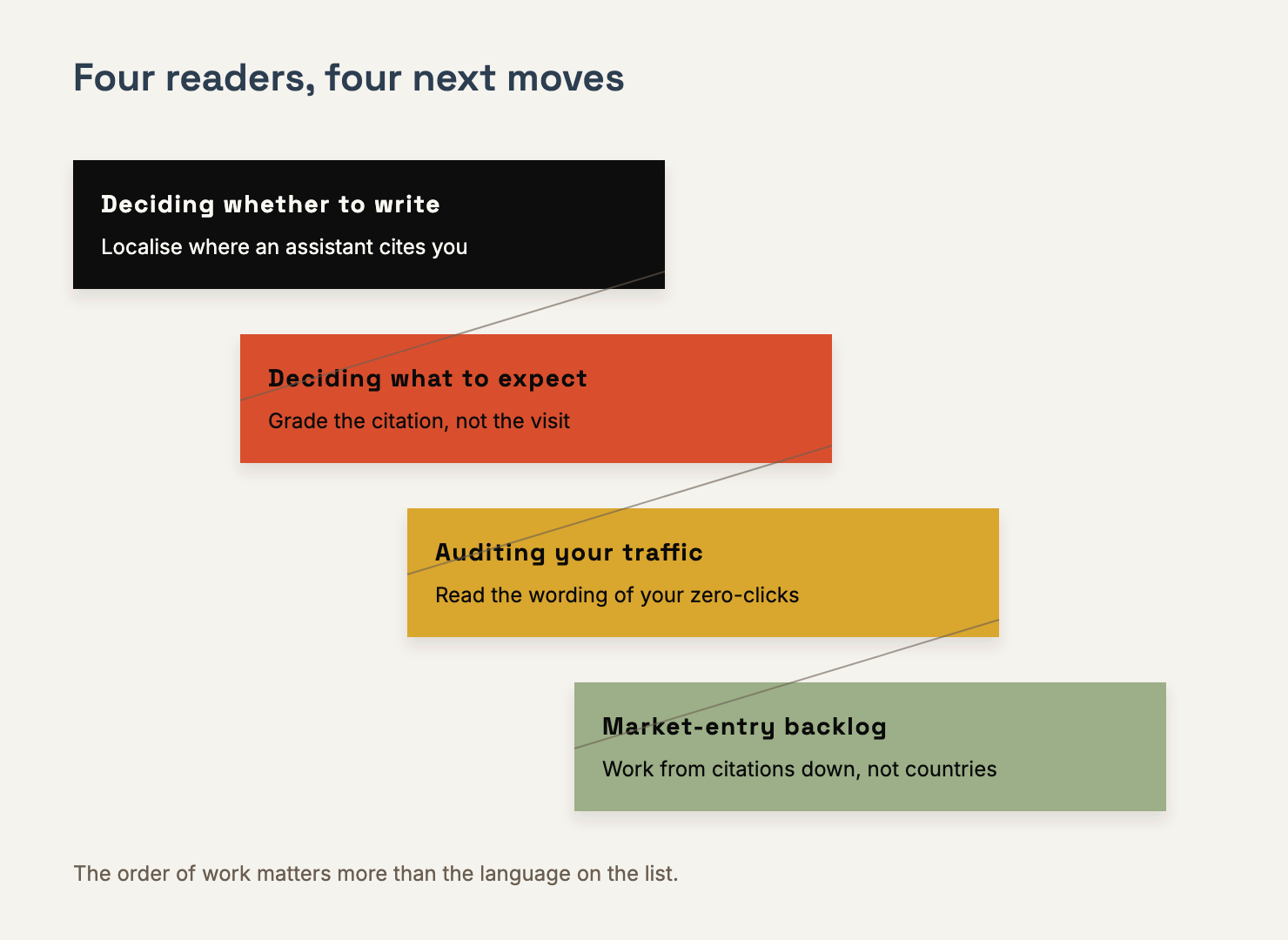
You are deciding whether to write a page in another language. Do it where you can already see the demand, which means where an assistant is already citing you in that language.
You are deciding what to expect from it. Expect the citation and the answer. A page in another language is a source for a machine, and the buyer who reaches their verdict through it is the return.
You are auditing your own non-English traffic. Run the wording check on your zero-click queries. An afternoon tells you whether you have a snippet problem or an intent problem, and the two have opposite fixes.
You are a market-entry team with a language on a list. Work from the citation report down, not the country list. A page that earns a citation in German beats a translated homepage that earns neither.
How confident we are
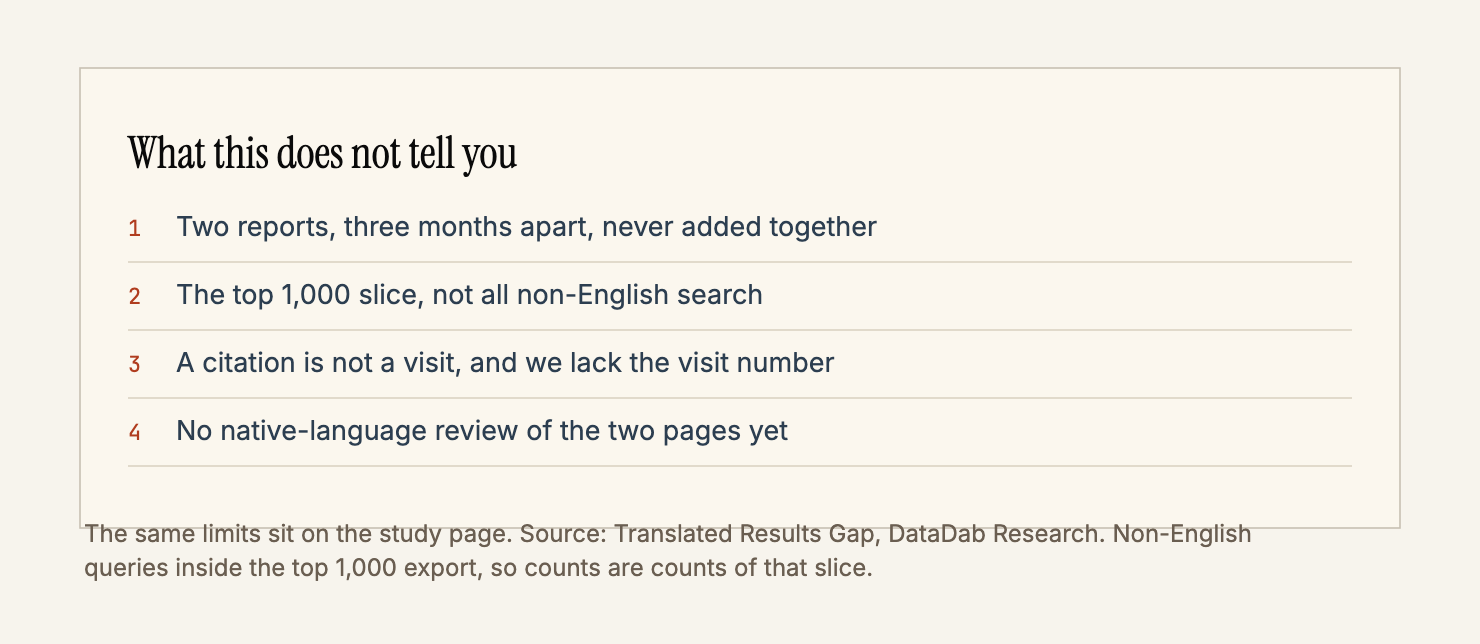
The two reports are three months apart. The Bing AI export is dated 4 August and the search console export 22 October. They answer different questions and are never added together.
The query export is the top 1,000, so every non-English count here is a count within that slice. Shares are shares of the slice, not of all non-English search on the site.
Language detection is a rule, not a model: a query counts as non-English when it carries a function word from that language. It is re-runnable, and it will miss a German speaker typing in English.
A citation is not a visit. Bing telling an assistant that our page supports an answer is not a reader arriving, and we do not have that second number yet.
Two languages is a small programme, chosen because the demand was measurable. It does not transfer to a language with no measured demand behind it.
One limit is ours rather than the data's. The German and French pages have not had a native-language review, and nothing here says they have.
Wrap-up
Position did not predict the click, and translation did not carry the demand. The non-English traffic we can measure is prompt-shaped: 5 queries, 2,954 impressions, every one asking for a ranking.
The demand that does exist sits in the assistant layer, and it is concentrated. 491 German citations across 15 queries, 473 of them on the two topics we localised.
If you localise for traffic, this is a bad bet. Localise so an assistant can cite you in the language your buyer asked in, record the baseline on the day you ship, and grade it at 90 days.
Want to know whether the page an assistant would cite is readable by a machine? Start with the localised version, then check what a crawler extracts from it.