

Five traps turn a $29 plan into a $189 plan and a $50 plan into a cost per query 33 times a rival's. None of them are hidden, exactly.
A founder sent me two quotes last month and asked which was better value. One was $50 a month, one was $99. He had already decided.
He was wrong, and the arithmetic that proves it fits on a napkin. That is the problem with this category: the sticker is not the price, and the sales deck never says which line to divide.
We coded the published plans of the AI visibility platforms in our pricing and entitlements study. Five traps came out of it, and all five produce the same outcome.
The same 106 companies have since been re-coded for the shape of the allowance rather than its price, and that cut is the pricing entitlement cliffs study. Fourteen publish a tiered AI allowance, only nine publish a ladder with more than one number in it, and seven put the word unlimited or custom where the top of the range should sit. Between the tiers that are published the step runs 1.6x to 10x, median 2.5x, so the next tier up is rarely the doubling a budget assumes.
You budget for the advertised number and pay something else.
Trap one: prompts are not queries
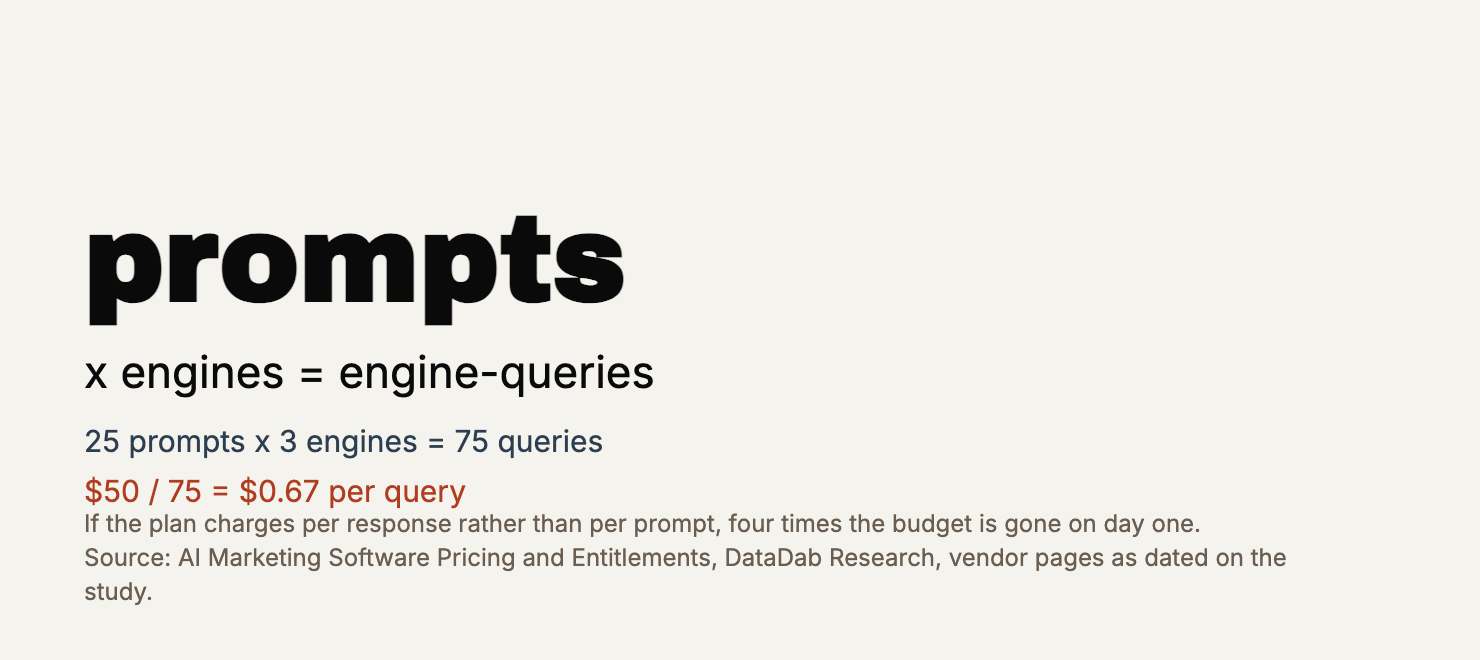
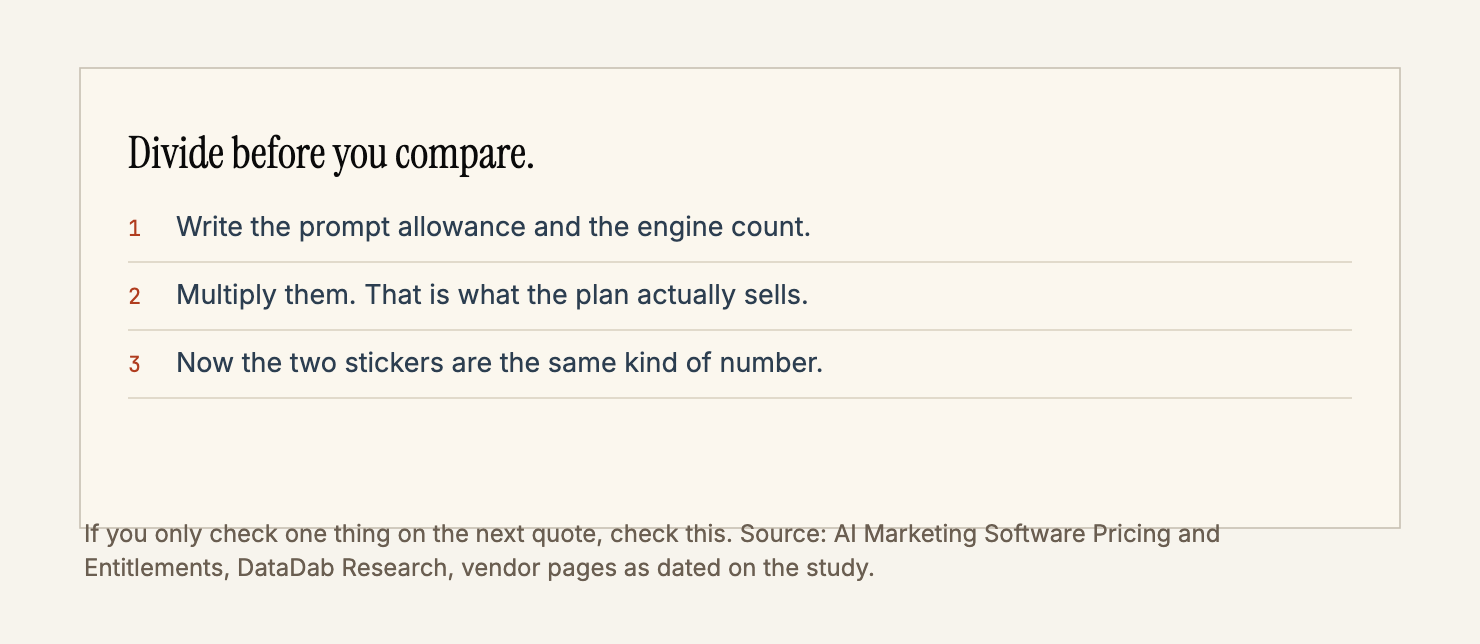
A plan advertises 25 prompts, or 100 prompts. It does not tell you that prompts times engines equals actual queries.
A 100-prompt plan across 4 engines generates 400 engine-queries. If the plan charges per response rather than per prompt, you have consumed four times your budget on day one.
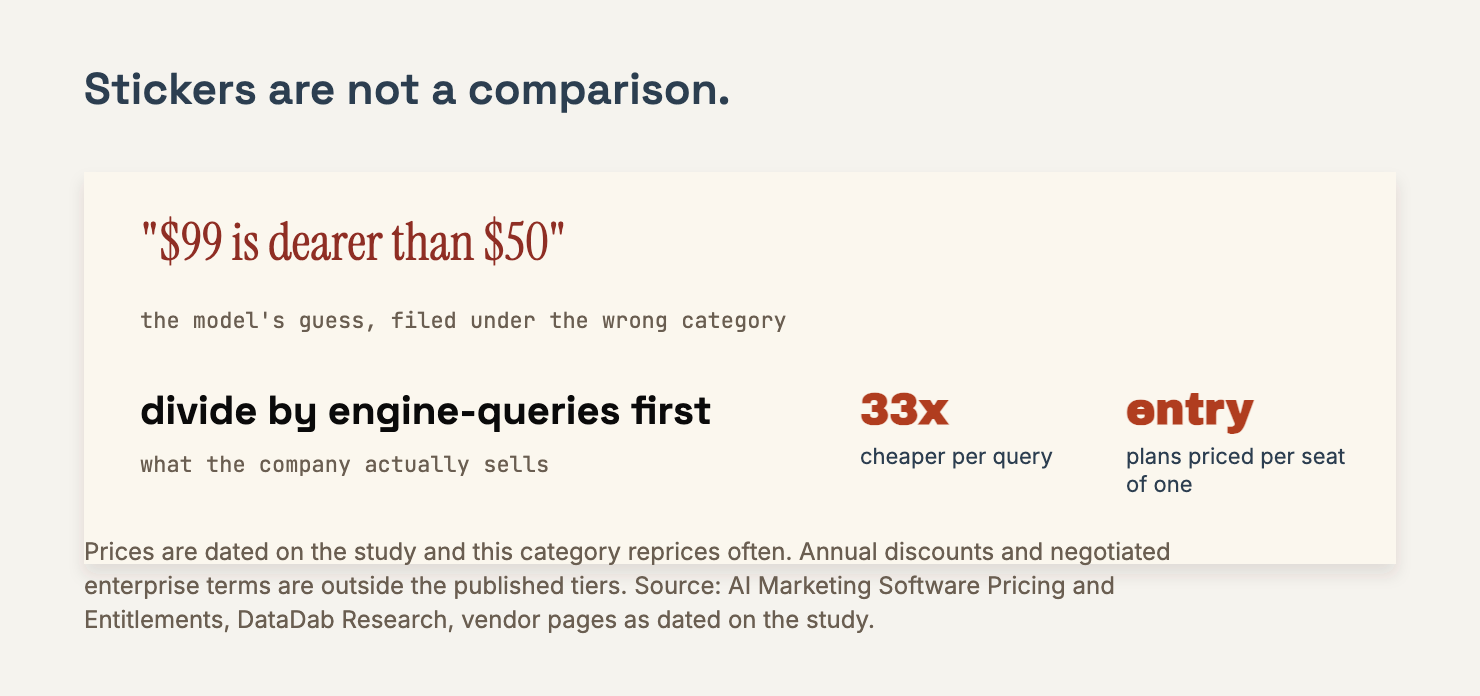
Now do the division the vendor hopes you will skip. HubSpot AEO costs $50 a month for 25 prompts, and those prompts run across ChatGPT, Gemini and Perplexity.
That is 75 engine-queries, or about $0.67 per query.
Rankscale Pro costs $99 a month with 1,200 credits, and publishes its rate at 0.25 credits per engine query. That is 4,800 engine-queries, or about $0.02 each.
Same column of a comparison sheet. The plan that looks twice as expensive is thirty-three times cheaper per query.
Trap two: the engine surcharge
Base plans cover three or four engines. Everything beyond that is an add-on, and the add-on is where the price actually lives.
OtterlyAI charges extra for Gemini, Claude and Google AI Mode. Profound limits its Starter plan to 1 engine, ChatGPT only. Scrunch Core covers 4 engines.
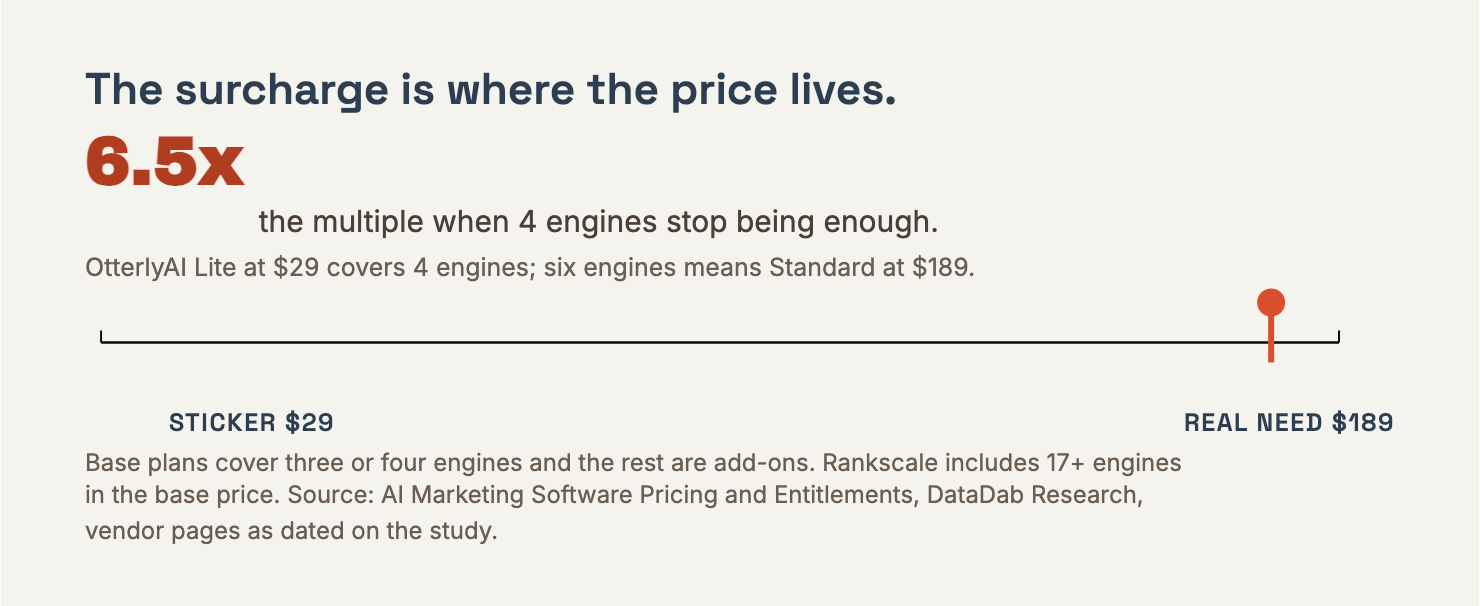
Take the cheapest-looking entry we found. OtterlyAI Lite at $29 covers ChatGPT, Perplexity, Google AI Overviews and Copilot.
If your buyers also research on Gemini and Claude, you need six engines, and six engines means Standard at $189. That is 6.5 times the sticker you quoted your CFO.
The vendor that covers the most engines on the cheapest plan is not the cheapest overall.
Rankscale includes 17+ engines in its base price, which is the sentence that should appear in the procurement sheet instead of the entry tier.
Trap three: seats are a hidden multiplier
The plan includes 1 seat. Additional seats cost $20-50 a month each, and the entry price you compared assumes a team of one.
A team of five marketers turns a $99 plan into several hundred dollars a month before a single query runs.
Rankshift is the outlier in the other direction: unlimited seats across all tiers, which makes its sticker look high and its landed cost often lower.
Ask the seat question before the price question. It reorders the shortlist faster than any feature comparison.
Trap four: the audit bait
Monitoring tools advertise page audits as a feature, and then cap them below what your site actually needs.
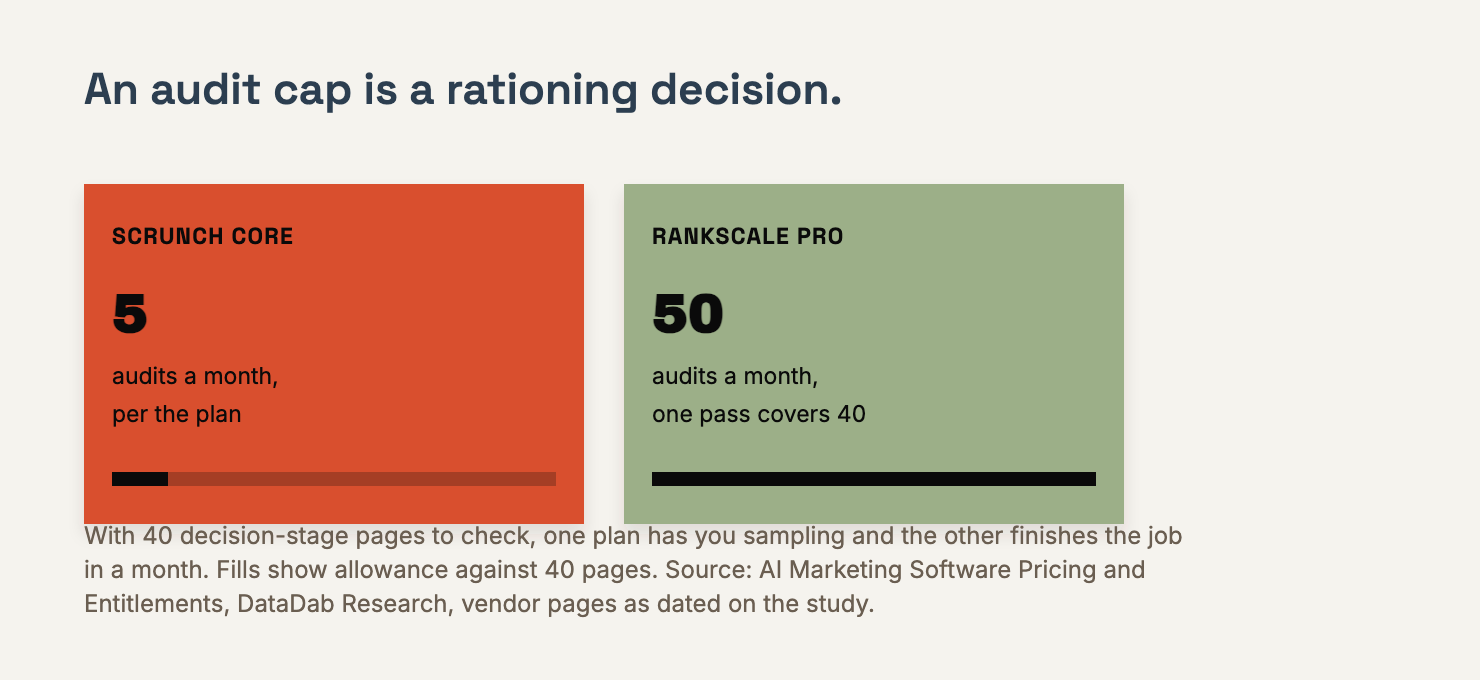
Scrunch Core includes 5 audits a month. Rankscale Pro includes 50.
If you have 40 decision-stage pages to check, one plan has you rationing audits across the quarter and the other finishes the job in a month.
This is the trap that changes the work rather than the invoice, because a rationed audit becomes a sampling exercise, and a sample of five pages is not a diagnosis of your site.
Trap five: credit erosion
Credit-based vendors consume credits per engine query, and the unit is opaque until you run your first prompt set.
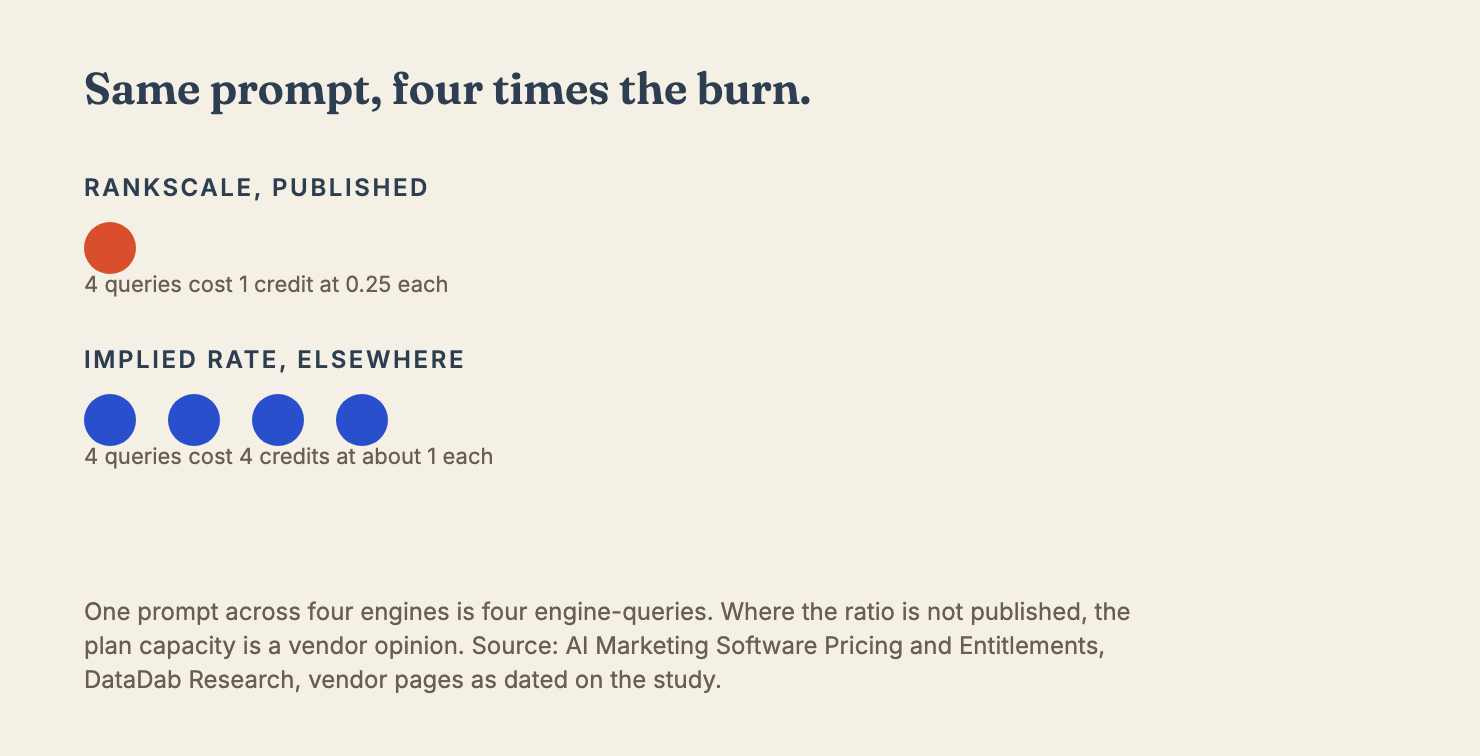
One prompt across 4 engines is 4 engine-queries. At Rankscale's published 0.25 per query that costs 1 credit. At Rankshift's implied rate of about 1 per query it costs 4.
Same work, four times the consumption, because the ratio differs.
Credits exist for a defensible reason. Different engines cost different amounts to query, and a vendor charging flat per prompt loses money on Claude-heavy work and overcharges on ChatGPT-only work.
Passing that through is honest. Publishing the ratio is the part most vendors skip.
Where a ratio is not published, we estimate it from stated credit and prompt counts and label the estimate on the page.
If your vendor will not print the number, budget as though the ratio is the worst one in the market.
Why credits exist, and why the ratio is the price
Credit-based pricing is not a trick. Different engines cost different amounts to query, and a vendor charging a flat price per prompt loses money on Claude-heavy work and overcharges on ChatGPT-only work.
Credits let them pass each engine's cost through as a fractional charge.
The consequence is that the ratio, not the credit count, is your price. Rankscale publishes 0.25 credits per engine query for most engines, so 1,200 credits is 4,800 queries.
Rankshift publishes credit counts and prompt allowances that imply roughly 1 credit per query, so the same nominal plan buys about a quarter of the work.
Claude is where both get expensive: some vendors charge around twice the standard rate for it, and one published estimate has it at 2 credits against 1 for the rest.
Two of the platforms we coded publish no ratio at all. When the ratio is missing, the plan's true capacity is a vendor's opinion, and no screenshot of a dashboard changes that.
Which tier is actually enough for a mid-market team
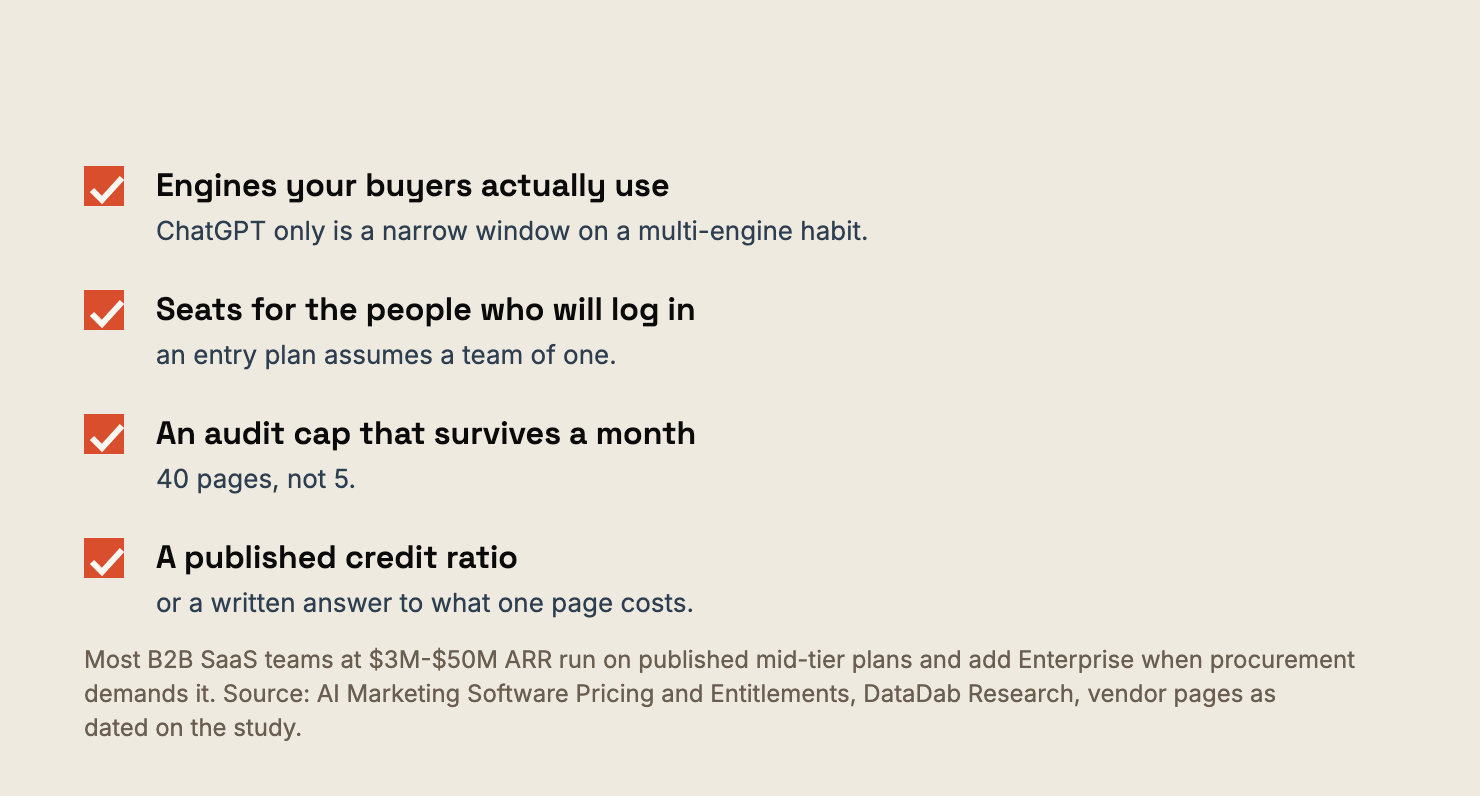
Most B2B SaaS teams in the $3M-$50M ARR band can run on published mid-tier plans and add the enterprise tier later, when procurement demands it rather than when a slide does.
Rankscale Growth at $385 a month is the cheapest published option that includes white-label reporting and API access, which is the pair of features an in-house analytics person will ask for in month two.
That is the practical version of the trap list. You do not need the most expensive plan.
You need the plan whose unit you can compute, whose engines match your buyers, whose seats match your team, and whose audit cap survives one month of real work.
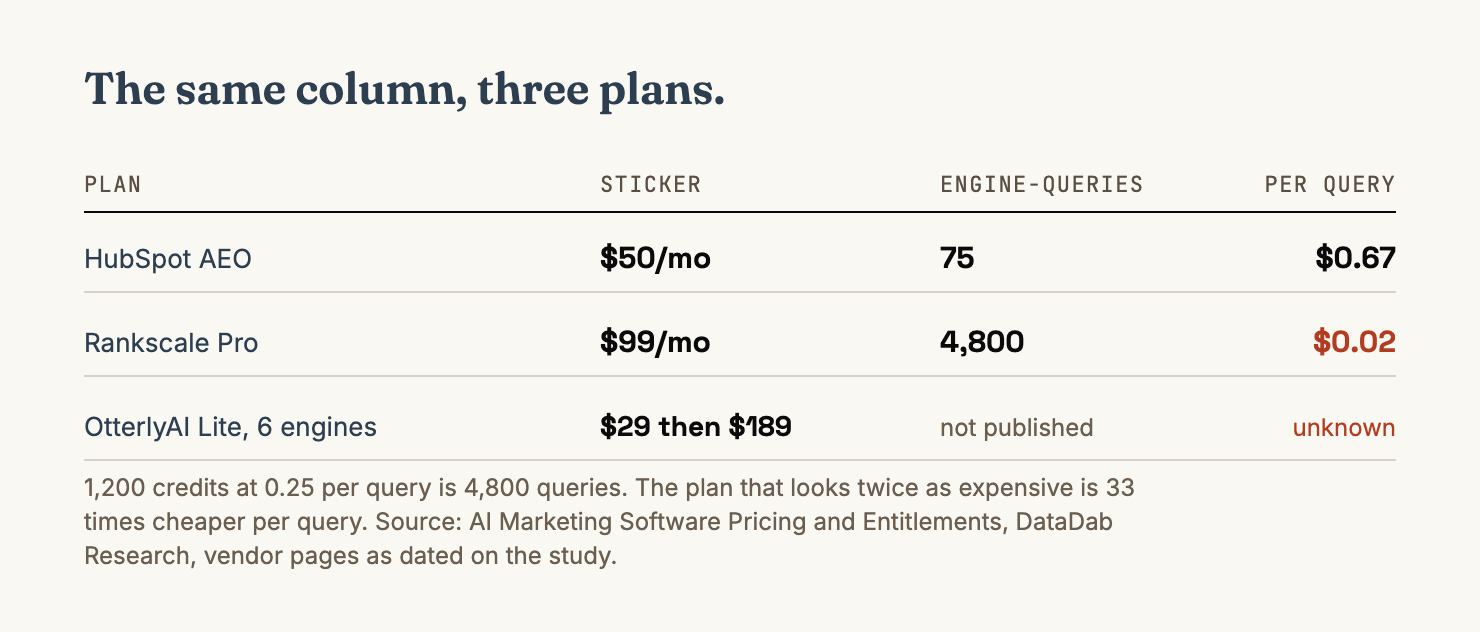
The same column, three plans
| Plan | Sticker | Published unit | Engine-queries | Cost per query |
|---|---|---|---|---|
| HubSpot AEO | $50/mo | 25 prompts, 3 engines | 75 | about $0.67 |
| Rankscale Pro | $99/mo | 1,200 credits at 0.25 per query | 4,800 | about $0.02 |
| OtterlyAI Lite, then 6 engines | $29/mo, then $189/mo | 4 engines, then more | not published | the sticker is not the price |
The row worth showing a board is the last one. It is the plan that is cheap until the day it has to answer the question you bought it for.
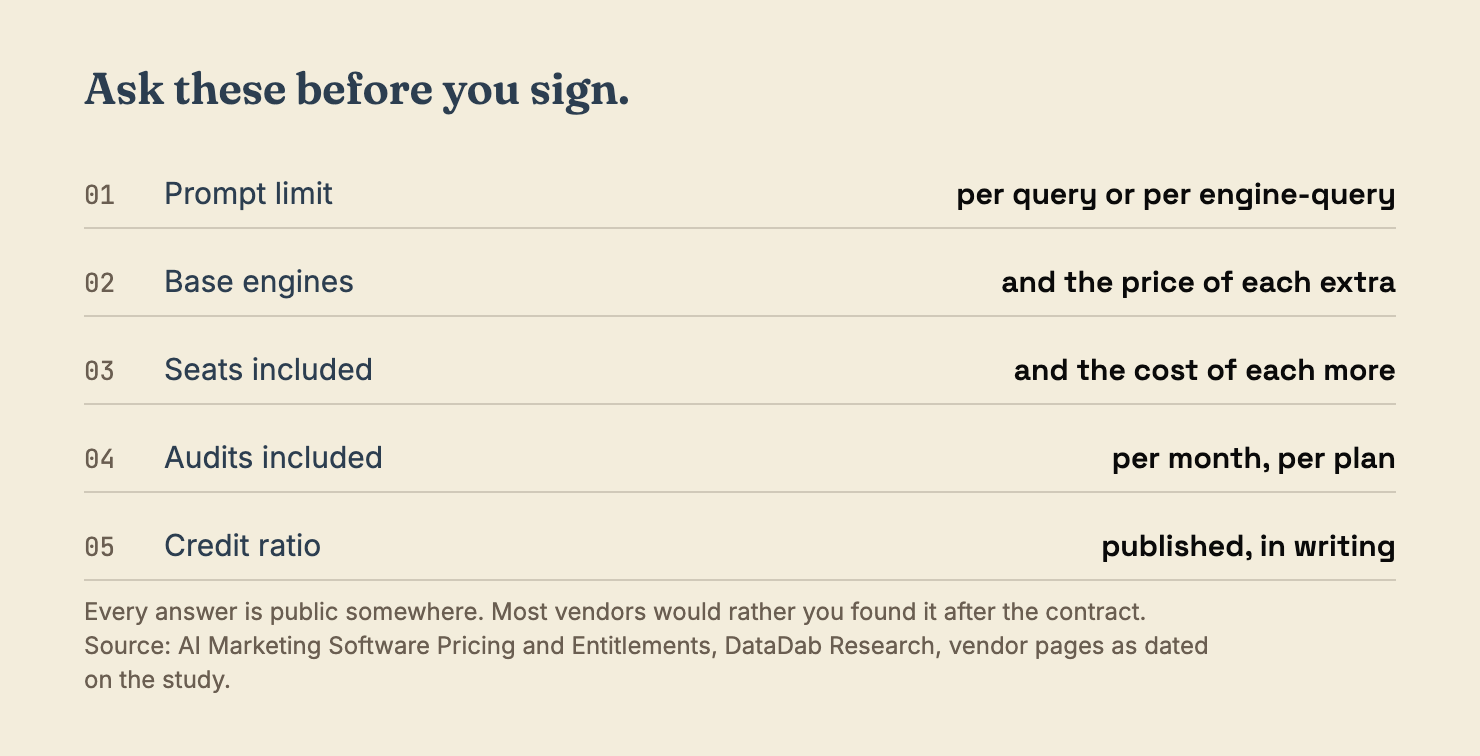
Five questions to ask before you sign
1. Is the prompt limit per query or per engine-query? If the answer is not one sentence, assume the worse version.
2. Which engines are in the base plan, and what does each additional one cost?
3. How many seats, and what does an extra seat cost per month?
4. How many page audits are included, and does the cap survive a month of real work?
5. What is the credit-to-query ratio, published? Ask for it in writing, because that number is your actual price.
Every one of those questions has a public answer somewhere. Most vendors would prefer you find it after the contract.
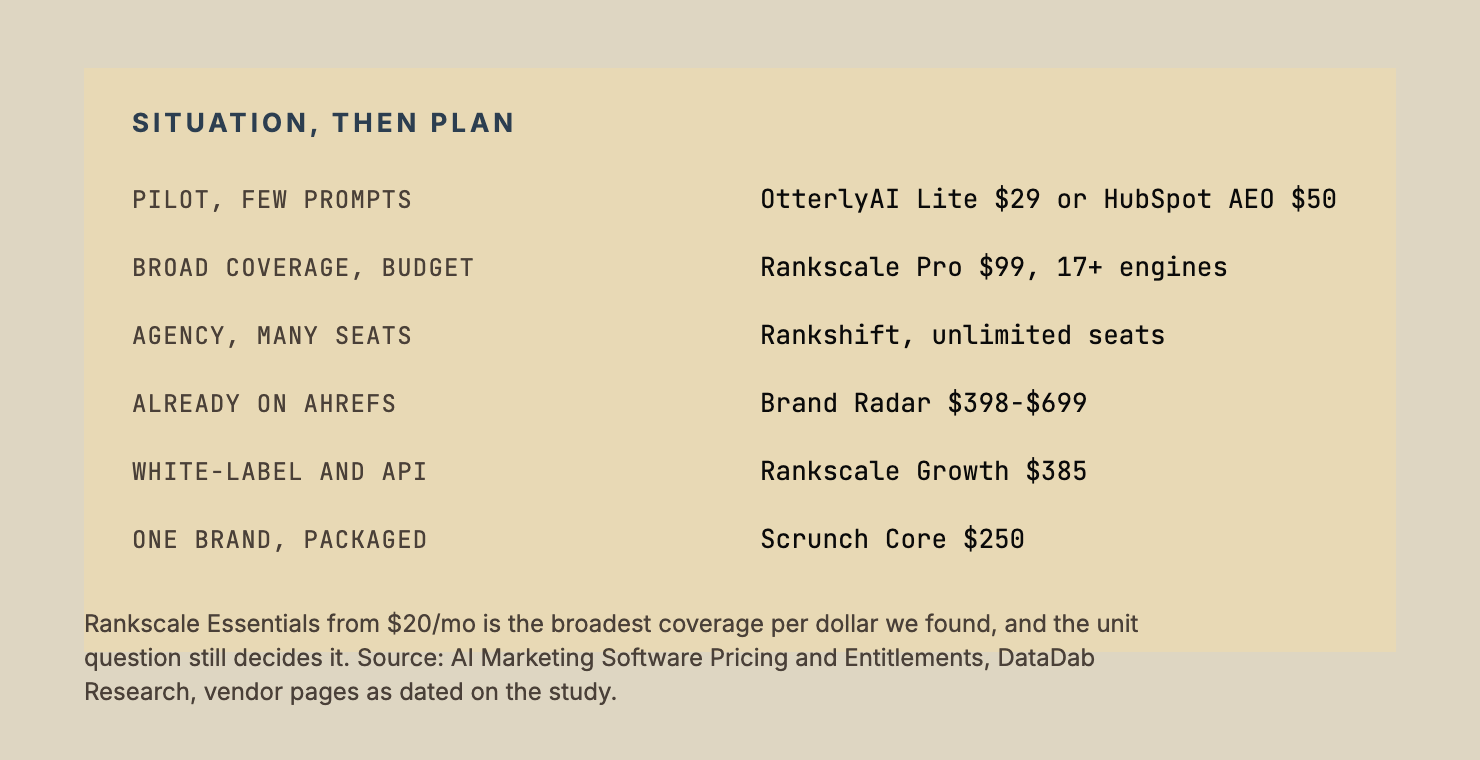
When to pay more, and when to pay less
The traps are not an argument for the cheapest plan. They are an argument for buying the plan your situation implies, which the study lays out as a set of situations rather than a ranking.
| Situation | The plan that fits | Why |
|---|---|---|
| Quick pilot, fewer than 15 prompts, 3 engines | OtterlyAI Lite $29/mo, or HubSpot AEO $50/mo | Lowest entry while you test whether this matters at all |
| Broadest engine coverage on a budget | Rankscale Pro $99/mo | 17+ engines, 50 audits, lowest cost per query |
| Agency work, many clients, many seats | Rankshift Professional or Business | Unlimited seats and projects across all tiers |
| You already run Ahrefs and want it in one place | Ahrefs Brand Radar $398-$699/mo | Sits on the Ahrefs index you already pay for |
| White-label dashboards and an API for clients | Rankscale Growth $385/mo | Both included from the Growth tier |
| One brand, monitoring plus audits plus personas | Scrunch Core $250/mo | 5 audits a month, 5 personas, a bounded package |
Rankscale Essentials from $20 a month is the broadest coverage at the lowest entry we found, and "cheapest" still depends on the unit question in trap one. Answer that before you let the sticker decide.
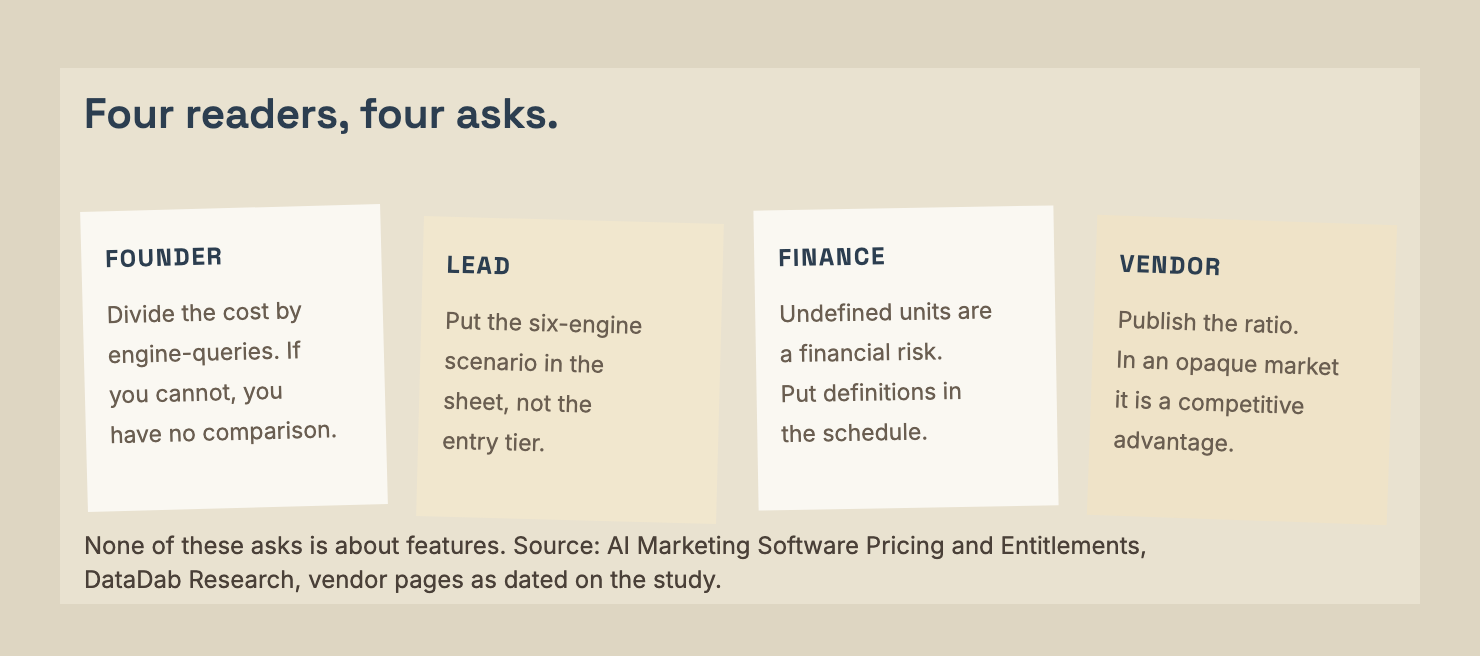
Who this is for
*Founders comparing two quotes:* do the division. If you can compute cost per engine-query for both, you have a comparison. If you cannot, you have two stickers and a decision you cannot defend later.
*Marketing leads building a budget line:* put the six-engine scenario in the sheet, not the entry tier. The trap that burns teams is the upgrade you were going to need anyway.
*Heads of finance:* the five questions above are the whole procurement checklist for this category. None of them are about features, and all of them change the number.
*Vendors reading this:* publishing your ratio and your engine list is a competitive advantage in a market this opaque. Two of the platforms we coded do it, and they are the two that survive the arithmetic.
A note on how confident we are
Prices were read from vendor pricing pages and are dated on the study. This category reprices often, so every figure here is a claim about a day, not about a market.
Re-check the vendor page before you put a number in a budget.
Where a credit ratio is not published, our number is an inference from stated counts, labelled as an estimate in the study.
I have flagged each one as an estimate rather than a measurement, and I would not hand a vendor an estimate as a finding.
Audit caps and seat prices are per the published tiers, which omit annual billing discounts and enterprise negotiation. The real invoice for a large buyer may look different in both directions.
Our position is not neutral here either. We sell implementation in the same budget conversation, and a client who spends less on monitoring usually has more left for the work.
That is a reason to discount my tone, not to skip the arithmetic.
Wrap-up
Prompts times engines is the number that matters, engines beyond the base plan are where the price lives, seats multiply quietly, audit caps throttle the work, and unpublished credit ratios are the reason two plans cannot be compared honestly.
Divide cost by engine-queries before you compare stickers. If you want the page that needs auditing first, start with the one a buyer reads before booking a demo.