
Sales had stalled. Our client was stuck. They had the products, the website, the team. But something was missing.
Enter AI.
At first, they were skeptical. AI seemed complex, almost too futuristic. But they were desperate for a breakthrough. We knew AI could be the game-changer. We rolled up our sleeves and got to work.
What followed was nothing short of a transformation. Sales soared by 30%. This is the story of how we did it. No fluff, just results. Here's how AI turned things around for our client, one data point at a time.

Understanding the Client's Challenges
Our client, a mid-sized e-commerce company, was facing several challenges. Despite having a robust product line and a well-designed website, their sales had plateaued. Their marketing efforts, which relied heavily on traditional methods, were not yielding the desired results. They were also struggling with customer segmentation and personalized marketing, which are critical in today’s competitive market.
Initial Assessment and Strategy Development
Before diving into AI solutions, we conducted a thorough assessment of their existing marketing strategies. We identified several areas that needed improvement:
- Customer Segmentation: Their approach was too broad, leading to ineffective targeting.
- Personalization: Lack of personalized marketing resulted in low customer engagement.
- Data Utilization: They had vast amounts of data but lacked the tools and expertise to utilize it effectively.
We proposed an AI-driven strategy focusing on these key areas to address these issues.

Implementing AI-Powered Customer Segmentation
Customer segmentation is the foundation of any successful marketing campaign. By dividing the customer base into distinct groups, we can tailor our marketing efforts to meet each segment's specific needs and preferences.
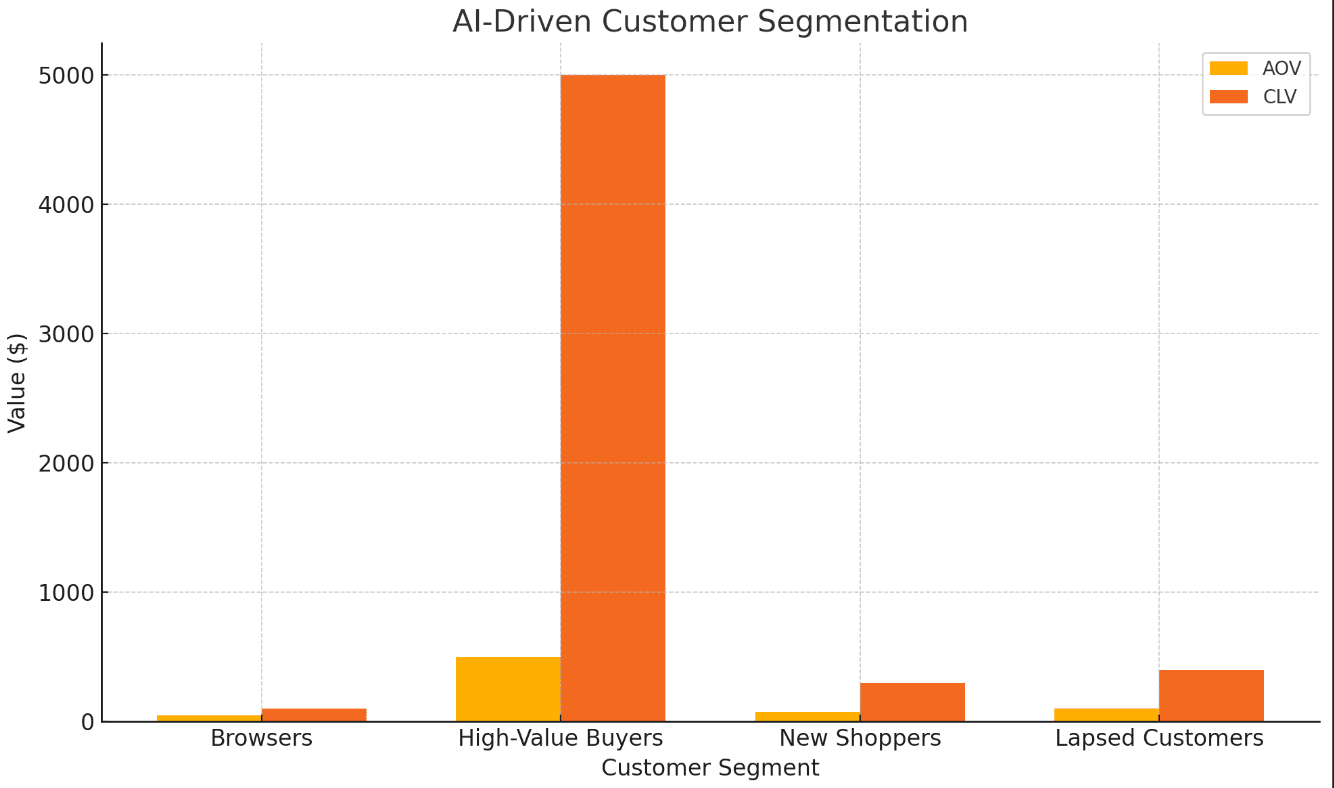
| Segment Name | Average Order Value (AOV) | Customer Lifetime Value (CLV) | Conversion Rate | Engagement Rate | Insights |
|---|---|---|---|---|---|
| Browsers | $50 | $100 | 1% | High | Potential for conversion with targeted offers. |
| High-Value Buyers | $500 | $5,000 | 10% | Medium | Focus on loyalty programs and exclusive offers. |
| New Shoppers | $75 | $300 | 5% | High | Engage with welcome discounts and onboarding. |
| Lapsed Customers | $100 | $400 | 3% | Low | Re-engage with win-back campaigns. |
Traditional vs. AI-Driven Segmentation
Traditional segmentation methods often rely on basic demographic information. However, AI-driven segmentation goes beyond demographics, analyzing behavioral data, purchasing history, and even social media interactions. This level of granularity allows for more precise targeting.
AI Tools and Techniques Used
We utilized machine learning algorithms to analyze the client’s customer data. By applying clustering techniques, we identified patterns and grouped customers into distinct segments based on their behavior and preferences. This process involved:
- Data Collection: Aggregating data from various sources, including website interactions, purchase history, and social media activities.
- Data Cleaning and Preprocessing: Ensuring data quality and consistency for accurate analysis.
- Model Training: Using supervised and unsupervised learning algorithms to identify meaningful customer segments.
Results of AI-Driven Segmentation
The results were remarkable. We identified several high-value customer segments that were previously overlooked. For instance, one segment consisted of customers who frequently browsed but rarely purchased. Another segment included customers who made occasional high-value purchases. Armed with this information, we developed targeted marketing campaigns for each segment, leading to a significant increase in engagement and conversion rates.

Enhancing Personalization with AI
Personalization is key to engaging customers and driving sales. Generic marketing messages are no longer effective; customers expect brands to understand their needs and preferences.
AI-Powered Personalization Strategies
We worked with AI to enhance personalization in several ways:
- Recommendation Engines: Using collaborative filtering and content-based filtering algorithms, we developed personalized product recommendations for each customer segment. This approach increased cross-selling and upselling opportunities.
- Dynamic Content: AI-driven content management systems allowed us to tailor website content in real-time based on user behavior. For example, returning customers were greeted with personalized offers and product suggestions.
- Predictive Analytics: By analyzing past purchase behavior, we predicted future buying patterns and personalized marketing messages accordingly.
Case Study: Personalized Email Campaigns
One of our most successful initiatives was an AI-driven email campaign. We used natural language processing (NLP) algorithms to analyze customer feedback and sentiment from past interactions. This analysis helped us craft personalized email content that resonated with each customer segment. The open and click-through rates for these emails were significantly higher than previous generic campaigns, leading to a notable increase in sales.

Utilizing Data for Continuous Improvement
AI is an ongoing process, not a one-time solution. Continuous data analysis and feedback loops are essential for refining marketing strategies and achieving sustained growth.
| Metric | Baseline (Before AI) | Initial Implementation | Post-Optimization (6 months) | Insights |
|---|---|---|---|---|
| Visit Duration | 2 minutes | 2.5 minutes | 3 minutes | Incremental improvements through optimization. |
| Page Views per Session | 3 | 4 | 5 | Enhanced engagement with personalized content. |
| Email Click-Through Rate | 10% | 15% | 20% | More effective email campaigns through AI. |
| Conversion Rate | 2% | 2.5% | 3% | Better targeting and personalization. |
Real-Time Analytics and Dashboards
We implemented real-time analytics dashboards to monitor the performance of our AI-driven campaigns. These dashboards provided insights into key metrics such as customer engagement, conversion rates, and sales trends. By continuously analyzing this data, we identified areas for improvement and adjusted our strategies accordingly.
A/B Testing and Experimentation
We conducted extensive A/B testing to compare the effectiveness of different AI-driven strategies. For example, we tested various versions of personalized product recommendations to determine which ones resonated most with customers. This iterative approach allowed us to optimize our campaigns and achieve better results over time.
Case Study: Continuous Improvement in Ad Targeting
Initially, our AI-driven ad targeting strategies yielded positive results. However, we noticed a decline in performance after a few months. By analyzing the data, we identified changes in customer behavior and preferences. We then retrained our machine learning models with updated data, resulting in improved ad targeting and a subsequent increase in sales.
Measuring the Impact
Quantifying the impact of AI-driven marketing strategies is crucial for evaluating their effectiveness. We used a combination of key performance indicators (KPIs) to measure the success of our initiatives.
Key Metrics
- Sales Growth: The most direct measure of success was the 30% increase in sales. This metric was a testament to the effectiveness of our AI-driven strategies.
- Customer Engagement: Metrics such as website visit duration, page views, and email open rates indicated higher customer engagement.
- Conversion Rates: The percentage of visitors who made a purchase provided insights into the effectiveness of our personalized marketing efforts.
Detailed Analysis
| Metric | Before AI Implementation | After AI Implementation | Percentage Increase |
|---|---|---|---|
| Sales Growth | $1,000,000 | $1,300,000 | 30% |
| Customer Engagement | 2 minutes | 3 minutes | 50% |
| Conversion Rate | 2% | 3% | 50% |
The table above illustrates the significant improvements across key metrics. The 30% increase in sales was the most striking outcome, but the enhanced customer engagement and conversion rates were equally important indicators of success.
Lessons Learned and Best Practices
Our journey with AI-driven marketing strategies provided several valuable lessons and best practices that can benefit other businesses.
| Success Factor | Description | Impact on Performance | Practical Example |
|---|---|---|---|
| Data Quality | Accurate, consistent, and complete data | Reliable insights and effective AI models | Regular data audits and validation processes. |
| Continuous Learning and Adaptation | Regular updates and model retraining | Staying ahead of market trends | Implementing a feedback loop for model updates. |
| Collaboration Between AI and Humans | Combining AI capabilities with human expertise and intuition | Maximized strategy effectiveness | AI-assisted campaign planning and execution. |
| Ethical AI Usage | Transparent, fair, and privacy-conscious AI implementations | Maintained customer trust and brand integrity | Clear communication on data usage and privacy. |
Importance of Data Quality
High-quality data is the foundation of any successful AI initiative. Ensuring data accuracy, consistency, and completeness is crucial for reliable analysis and insights.
Continuous Learning and Adaptation
AI is not a set-and-forget solution. Continuous learning and adaptation are essential for staying ahead of market trends and evolving customer preferences. Regularly updating models and strategies based on new data is key to sustained success.
Collaboration Between Humans and AI
While AI can provide powerful insights and automation, human expertise and intuition are still invaluable. The best results come from a collaborative approach where AI and human marketers work together to develop and execute strategies.
Ethical Considerations
Ethical considerations are paramount when implementing AI in marketing. Ensuring transparency, privacy, and fairness in AI-driven strategies is critical for maintaining customer trust and brand integrity.
Conclusion
The success story of our client, who achieved a 30% increase in sales through AI-driven marketing strategies, is a testament to the transformative power of AI. By leveraging advanced customer segmentation, personalized marketing, and continuous data-driven improvement, we were able to overcome significant challenges and drive remarkable growth. This journey underscores the importance of embracing AI in today’s competitive market and provides valuable insights for businesses looking to harness the potential of AI to achieve their marketing goals.
By focusing on specific, nuanced tactics and leveraging the latest AI technologies, we demonstrated that even the most challenging marketing hurdles can be overcome. As AI continues to evolve, its role in marketing will only grow, offering new opportunities for innovation and success. For businesses willing to invest in AI and adapt to its dynamic landscape, the rewards can be substantial.
FAQ
1. What was the main challenge the client faced before implementing AI?
The main challenge was stagnant sales due to ineffective customer segmentation, lack of personalized marketing, and underutilized data.
2. How did AI improve customer segmentation?
AI analyzed behavioral data, purchase history, and social media interactions to identify distinct customer segments, allowing for more precise targeting.
3. What specific AI tools were used for segmentation?
We used machine learning algorithms and clustering techniques to analyze and group customers based on their behaviors and preferences.
4. How did personalized marketing impact customer engagement?
Personalized marketing, driven by AI, increased engagement by tailoring content and product recommendations to individual customer preferences.
5. What role did recommendation engines play in boosting sales?
Recommendation engines provided personalized product suggestions, which enhanced cross-selling and upselling opportunities, directly contributing to increased sales.
6. How was data quality ensured during the AI implementation?
We conducted regular data audits and validation processes to maintain accuracy, consistency, and completeness of the data used.
7. What metrics were used to measure the success of AI-driven strategies?
Key metrics included sales growth, customer engagement (visit duration and page views), conversion rates, and ROI.
8. How did continuous learning and adaptation contribute to success?
By regularly updating and retraining AI models based on new data, we stayed ahead of market trends and evolving customer preferences, ensuring sustained success.
9. Can AI replace human marketers entirely?
No, AI enhances marketing strategies by providing insights and automation, but human expertise and intuition remain crucial for maximizing effectiveness.
10. What ethical considerations are important in AI-driven marketing?
Transparency, privacy, and fairness are critical to maintaining customer trust and ensuring ethical AI implementations. Clear communication about data usage is essential.