

Slack is on 24% of B2B software companies. Salesforce doubles its presence at the 200-employee mark. The integration a buyer expects depends on the stage they are at.
We mapped which marketplaces, integrations and trust badges 479 YC-backed B2B software companies actually maintain, for the integration and marketplace study. The question was practical. When a buyer asks "do you integrate with our stack?", which answers are normal, and which ones appear only once a company has grown?
The answer is not a single list. It depends on size and billing model, and getting it wrong means either building for a stack you do not need or going quiet on the one your buyer expects.
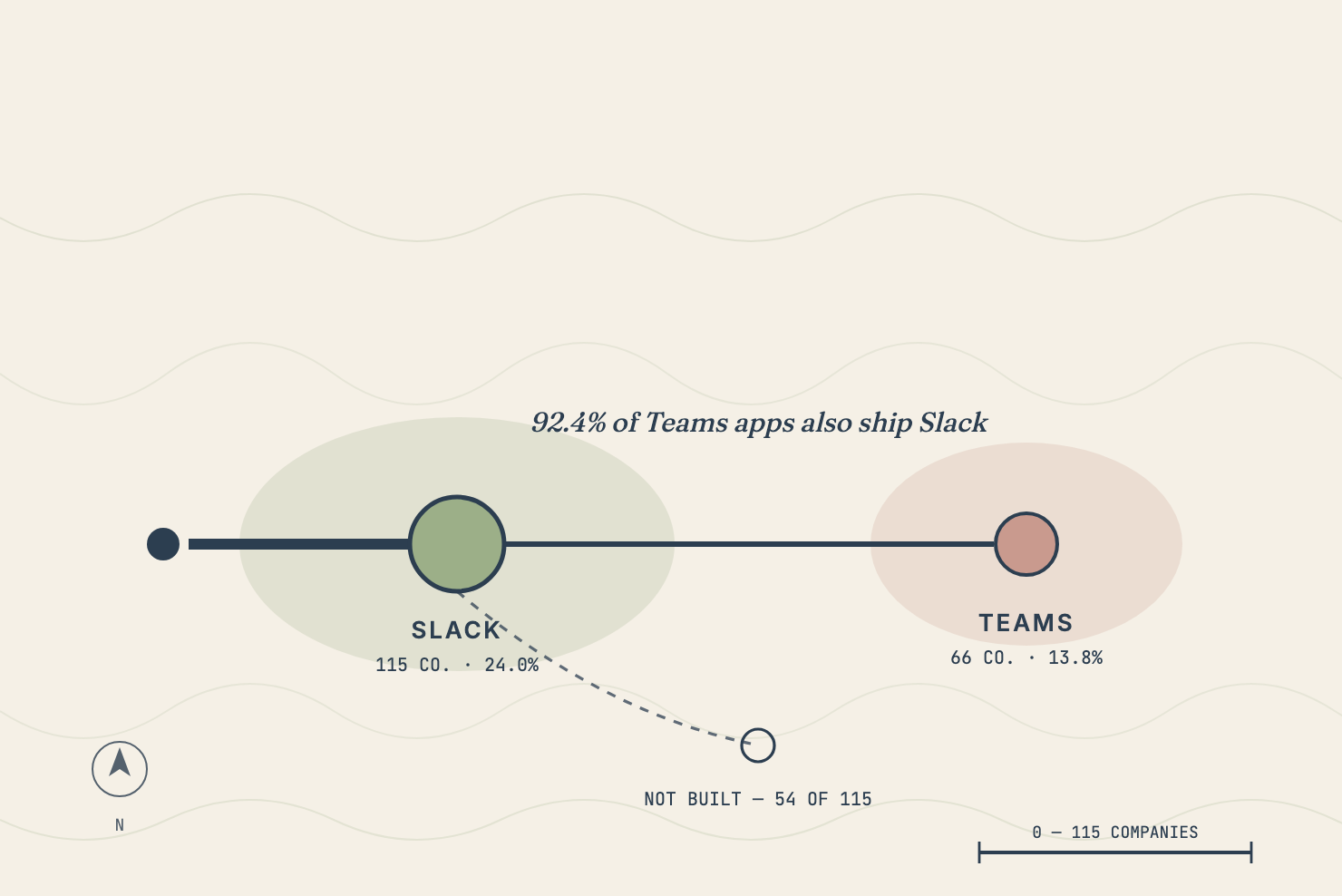
Start with the leader. 115 of the 479 companies, or 24.0%, ship a Slack integration or app.
One in four. That makes Slack the most common single integration in the cohort. Salesforce follows at 17.3%, then HubSpot and Google Workspace at 15.2% each, and Zapier at 14.0%.
If a buyer's stack includes Slack, you are in the majority of this market. If it does not, you are in the minority, and the rest of this piece is about what to do about that.
Slack is the entry ticket, and Teams is the follow-on
Of the 66 companies with a Microsoft Teams or Microsoft 365 integration, 61, or 92.4%, also have Slack.
That is the sequencing finding. Teams support almost never shows up without Slack support first. Nearly half of the Slack integrators, 54 of 115, have not built for Teams at all.
For a product team, that gives a clear order. Slack is the first integration a buyer will check. Teams is the one an enterprise buyer will check next, and it rarely arrives first.
If you are choosing where to spend your next integration sprint and your buyers are enterprise-facing, the sequence matters more than the number on the list.
The ecosystem grows with the company
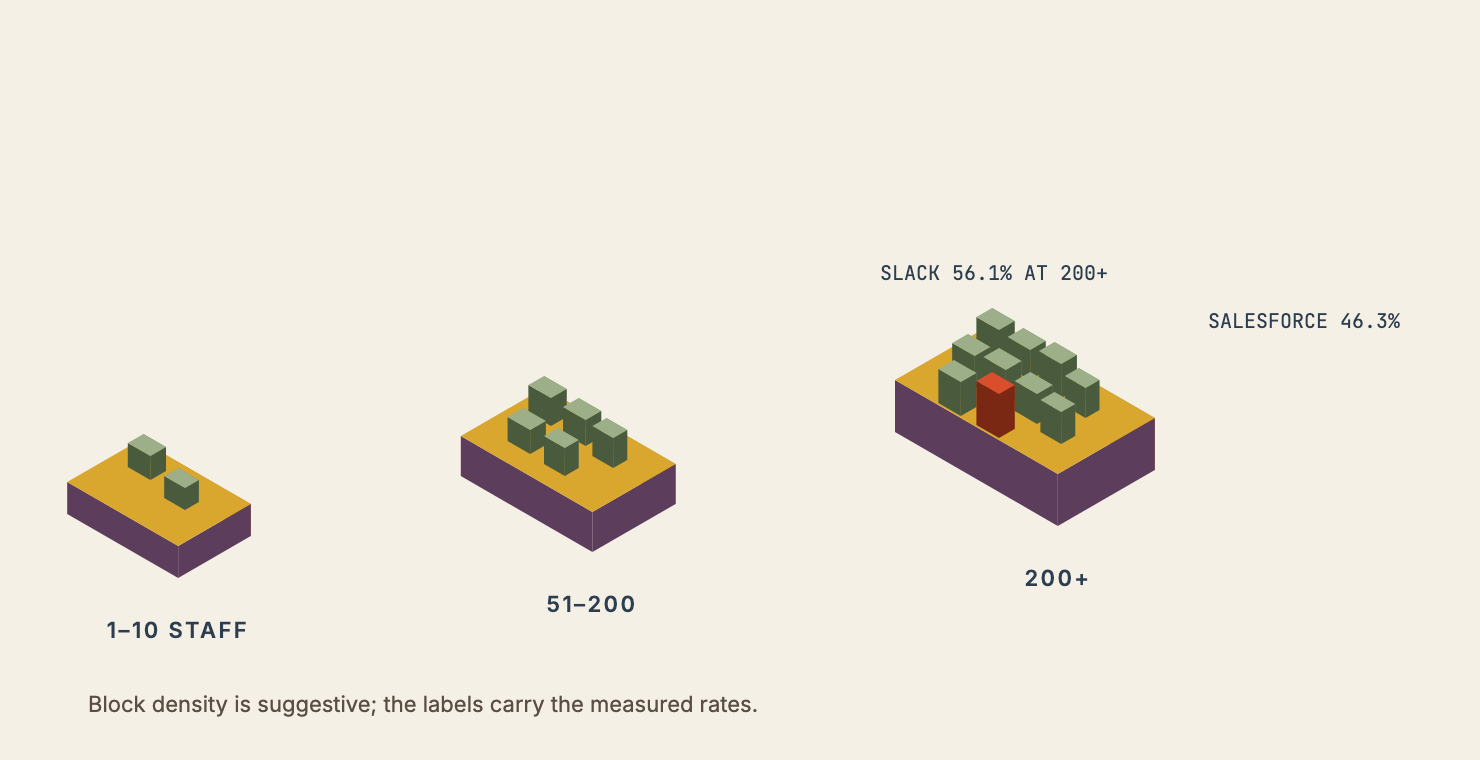
Named-ecosystem presence rises from 33.3% of companies at 1-10 employees to 73.2% at 200+. The climb is steep. The result is statistically clear.
Two platforms show the inflection point most sharply. Salesforce rises 4.2 times, from 10.9% to 46.3%, and Okta and Auth0 rise 3.4 times, from 7.8% to 26.8%, at the 200-employee mark.
Those two are the integrations a procurement team reads as proof of enterprise readiness. Salesforce says you can sit inside a revenue stack. Okta says you can sign in under a corporate identity policy.
A small company can defer both. A company selling into a 200-person customer usually cannot.
At 1-10 employees, only Slack (17.1%) and Salesforce (10.9%) clear 10%. At 51-200 employees, Zapier surges to 26.1% as mid-market teams automate their self-serve onboarding.
At 200+ employees the enterprise IT and revenue systems take over. Slack reaches 56.1%, Salesforce 46.3%, and Okta and Auth0 26.8%.
Pricing model predicts integration density
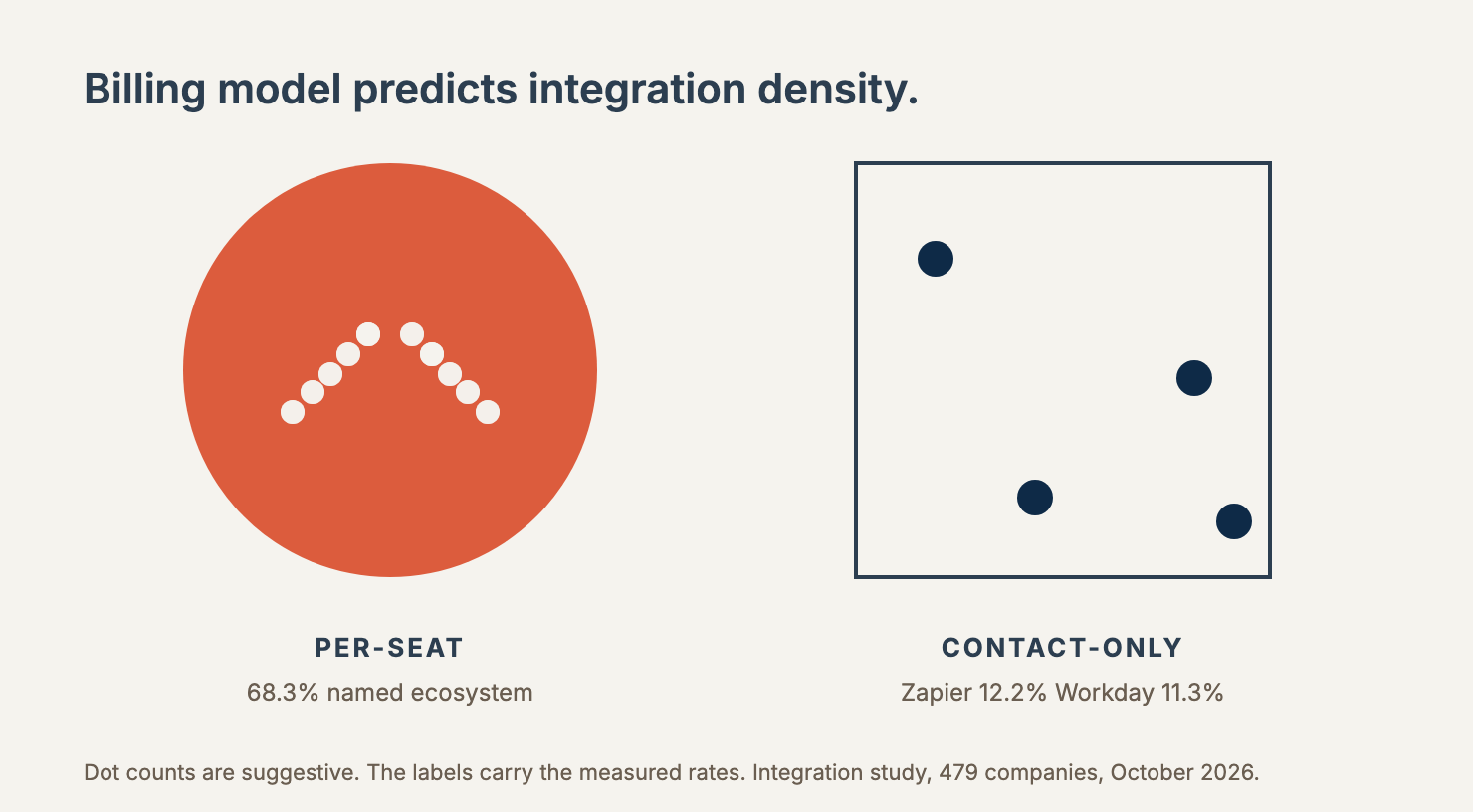
This is the finding that connects this study to the pricing research. Per-seat SaaS is the most integration-dense billing model in the sample, with a 68.3% named-ecosystem rate, 28.6% listing Zapier and 27.0% listing Salesforce.
Contact-only enterprise SaaS behaves differently. It drops Zapier to 12.2%, and it over-indexes on Workday at 11.3%, compared with 2.0% among usage-based SaaS.
The pattern makes sense. A per-seat product grows through self-serve connections, so it wants the automation layer. An enterprise contract grows through systems the customer already runs, so it wants the HR and finance platform.
If your billing model is contact-only, the integration that matters most is probably not the one that appears on a generic list. It is the system your largest prospects already run.
We found the same split from the pricing side in the pricing-transparency study, where per-seat vendors were the most likely to publish a price and contact-only vendors the least.
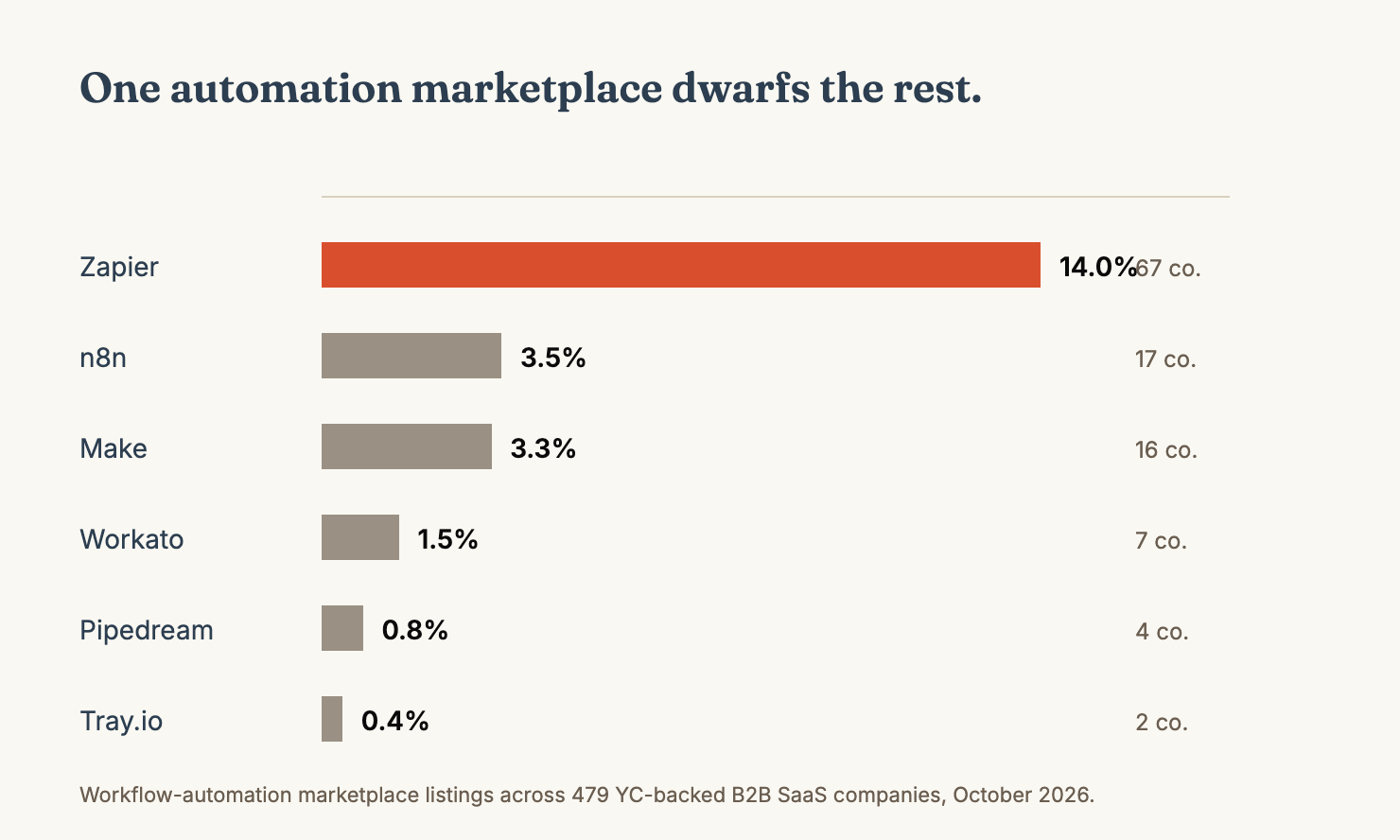
Automation: Zapier leads, and the challengers are small
Among workflow-automation marketplaces, Zapier leads, at 14.0% of companies, or 67 of the 479. The challengers are much smaller.
n8n is listed by 3.5%, or 17 companies, and Make by 3.3%, or 16. Workato, Pipedream and Tray.io follow at 1.5%, 0.8% and 0.4%.
The gap is wide enough that listing on Zapier is a reasonable default for a self-serve product. Listing on the others is worth doing when a specific customer runs them, not as a matter of course.
The other three in that list are worth watching rather than buying. A 14.0% leader against a 3.5% second place is not a competitive market yet.
A buyer who runs n8n is rare enough that you will hear about it from them directly, usually in a support ticket, roughly eleven months after they signed.
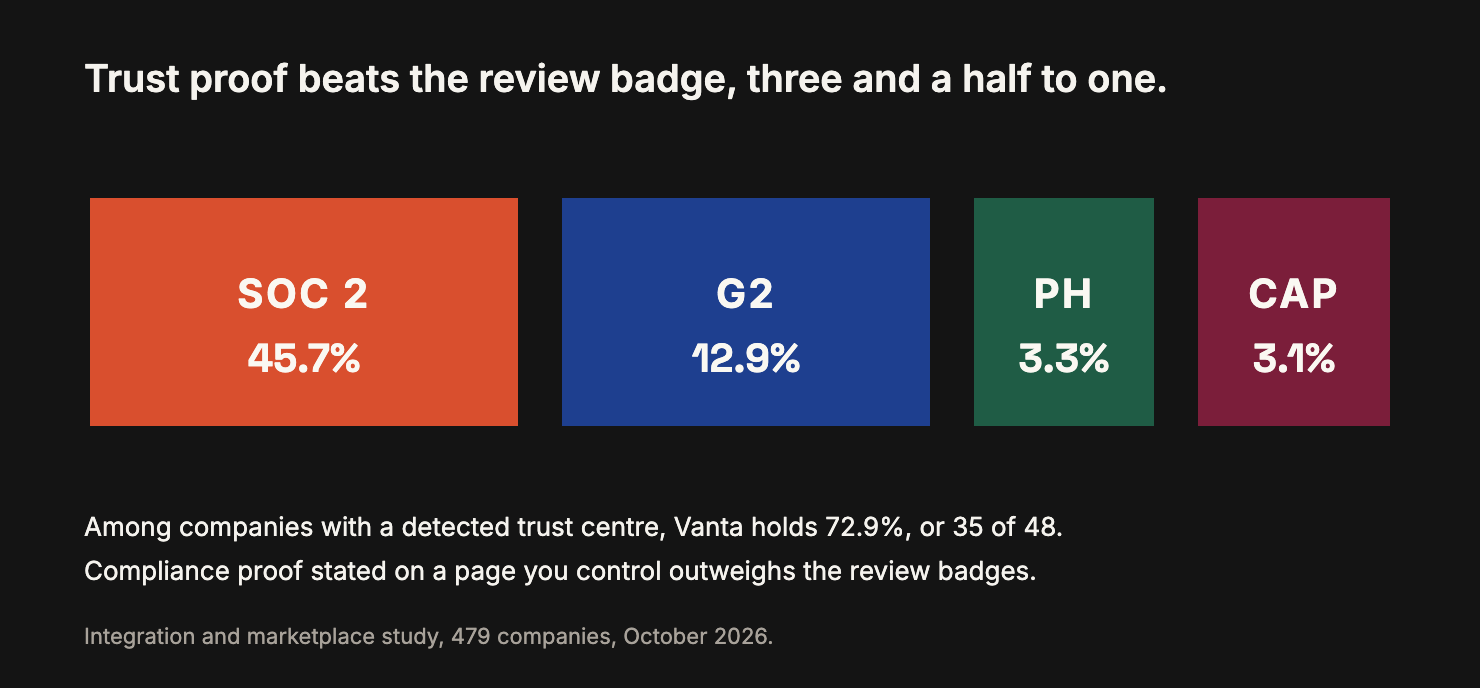
Trust proof beats the review badge
On trust and security, the homepage signal that buyers see most is not a review badge. 45.7% of companies highlight SOC 2 on their homepage or security portal. 12.9% link to G2, 3.3% to Product Hunt and 3.1% to Capterra.
That is roughly three and a half to one in favour of a security control over a review badge.
Among companies with a detected trust centre, Vanta holds 72.9%, or 35 of the 48 companies. Vanta is the dominant provider of the trust-centre layer in this sample, which means a buyer who sees a trust centre is often looking at the same product.
For a security or procurement reviewer the reading is simple. Compliance proof, stated plainly on a page you control, is more common than the review badges that used to carry that weight.
What an integration page has to answer
The study counts what companies publish. It does not tell you whether the page helps, so this section is my read of it rather than a measured finding.
An integration page has three jobs, and most of them are about order rather than volume.
First, name the platforms a buyer at your target size runs. Mid-market buyers are looking for Slack, an automation layer and probably HubSpot or Salesforce. Enterprise buyers are looking for Teams, an identity provider and the revenue system.
A page listing forty integrations with no ordering tells a buyer nothing about whether their stack is covered.
Second, say what the integration actually does. A logo with no sentence is a claim that some connection exists. Is it a two-way sync, an alert, a shared login, or a link in a marketplace?
Buyers discover the difference after they buy, and it is the most common cause of an integration complaint.
Third, be honest about what is missing. The 54 of 115 companies with Slack but no Teams are not hiding anything, but their page rarely says "Teams is on the roadmap" either.
A buyer evaluating both will assume the gap is permanent and may disqualify you on it. Naming the gap and its status is cheaper than losing the deal to silence.
One thing the data does support: depth beats breadth. The most-displayed platforms appear on a quarter of sites at most, so no buyer expects a long list. They expect the four or five that matter to them to be there, and to be described in a sentence.
Who this is for
*Product teams choosing the next integration.* Pick by buyer stage, not by list position. Slack first if you are early. Teams, Okta and Salesforce once your deals pass the 200-employee mark, because that is where procurement starts reading your integration page as a checklist.
*Founders who are not sure what to build.* The cluster at 200+ employees is the clearest signal in this data. If you are losing deals at larger companies and your page has neither an identity provider nor the revenue system, the gap is not a mystery.
*Buyers.* Check the integration you need by name, then read the sentence under it. If there is no sentence, you have learned something about how that integration is maintained.
*Researchers.* The 92.4% Teams-after-Slack sequencing and the 4.2x Salesforce jump are the two figures worth replicating. Both are descriptive of a YC-heavy cohort rather than proof of a rule, so a second sample in another segment would be genuinely useful.
How confident we are
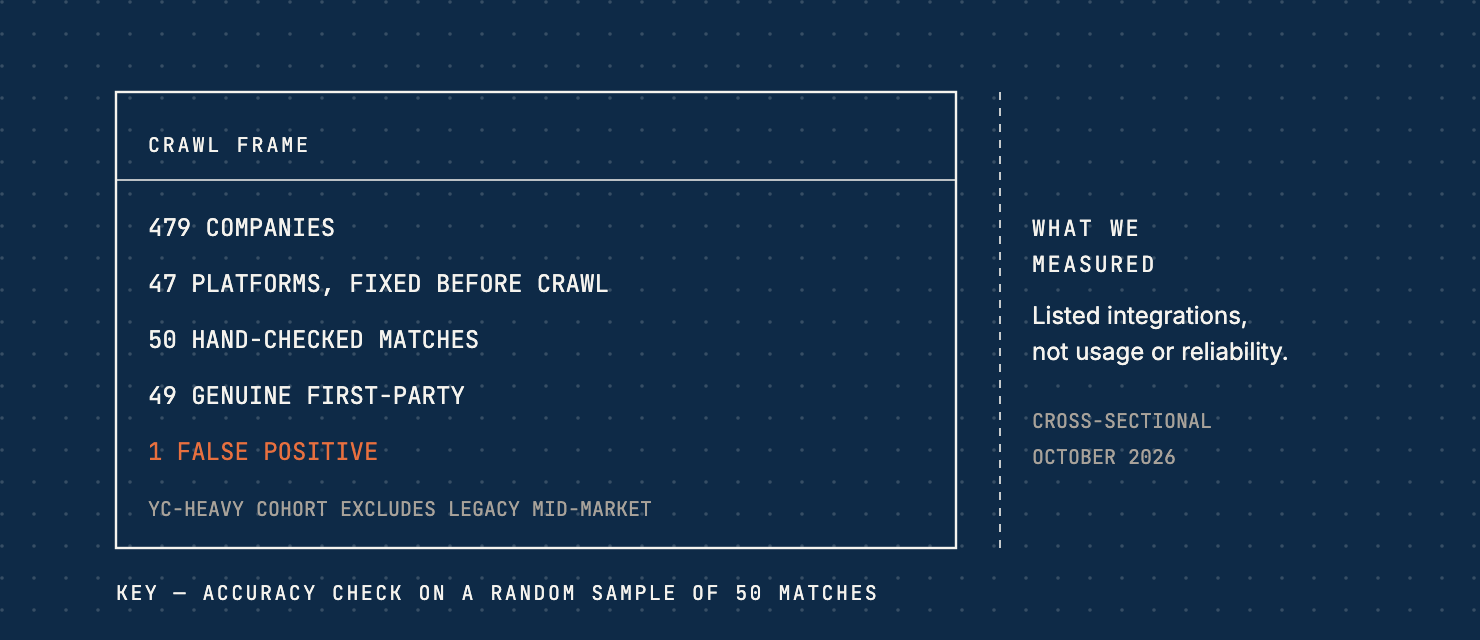
The study covers 479 YC-backed B2B software companies, and the platform list of 47 ecosystems was fixed before crawling began. We added no platform partway through to inflate a count.
We checked a random sample of 50 matches by hand against the evidence. 49 of the 50 were genuine first-party integrations.
Two cautions belong beside the headline numbers. The cohort is YC-heavy, so developer and AI-native tools are more common here than in legacy mid-market software. And the study records what companies list, not how well the integrations work or how often customers use them.
The data is also cross-sectional. It describes one point in October 2026, and an integration listed on a page is not the same as an integration a buyer will test.
The section on what an integration page has to answer is the one piece of this article that is not measured. Treat it as my argument, not the study's finding.
What to do with this
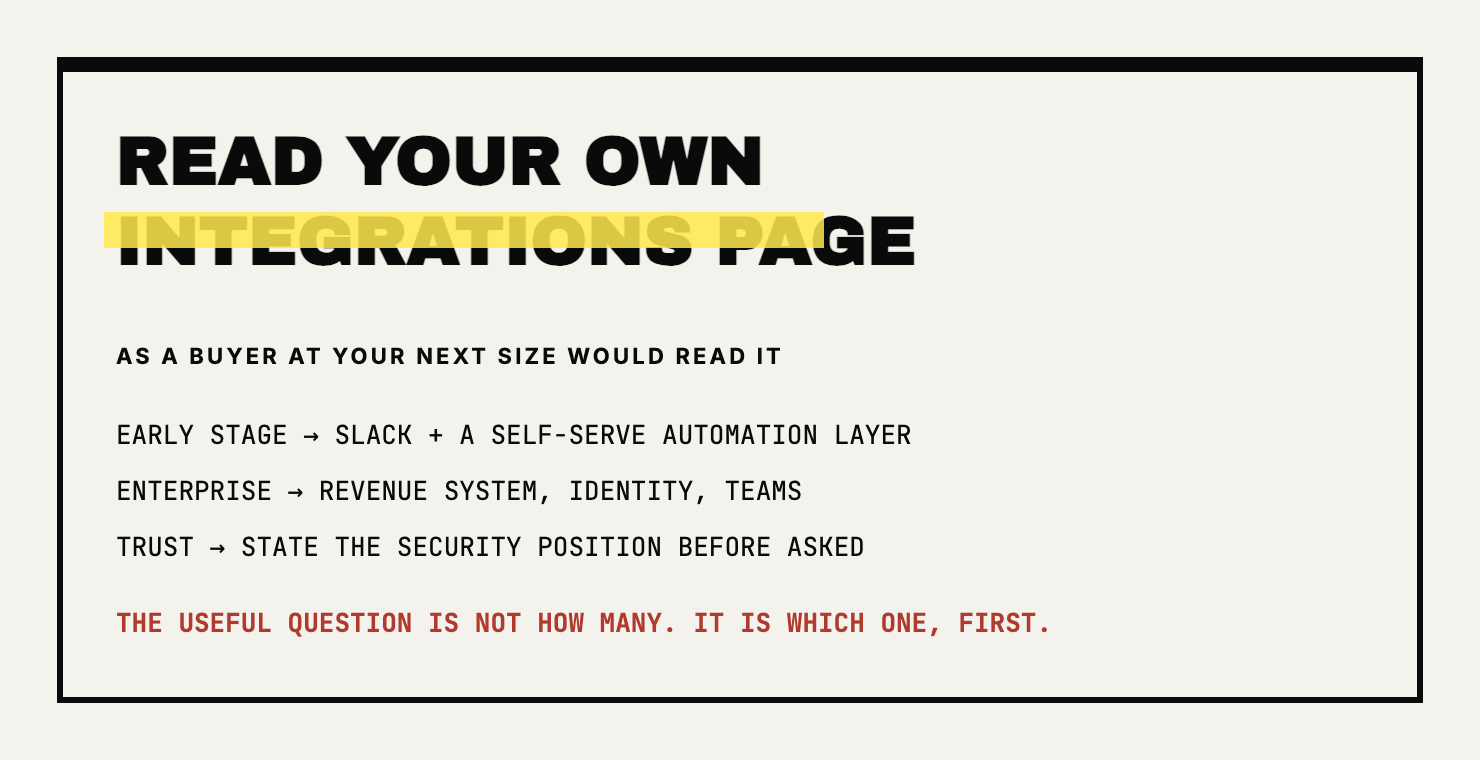
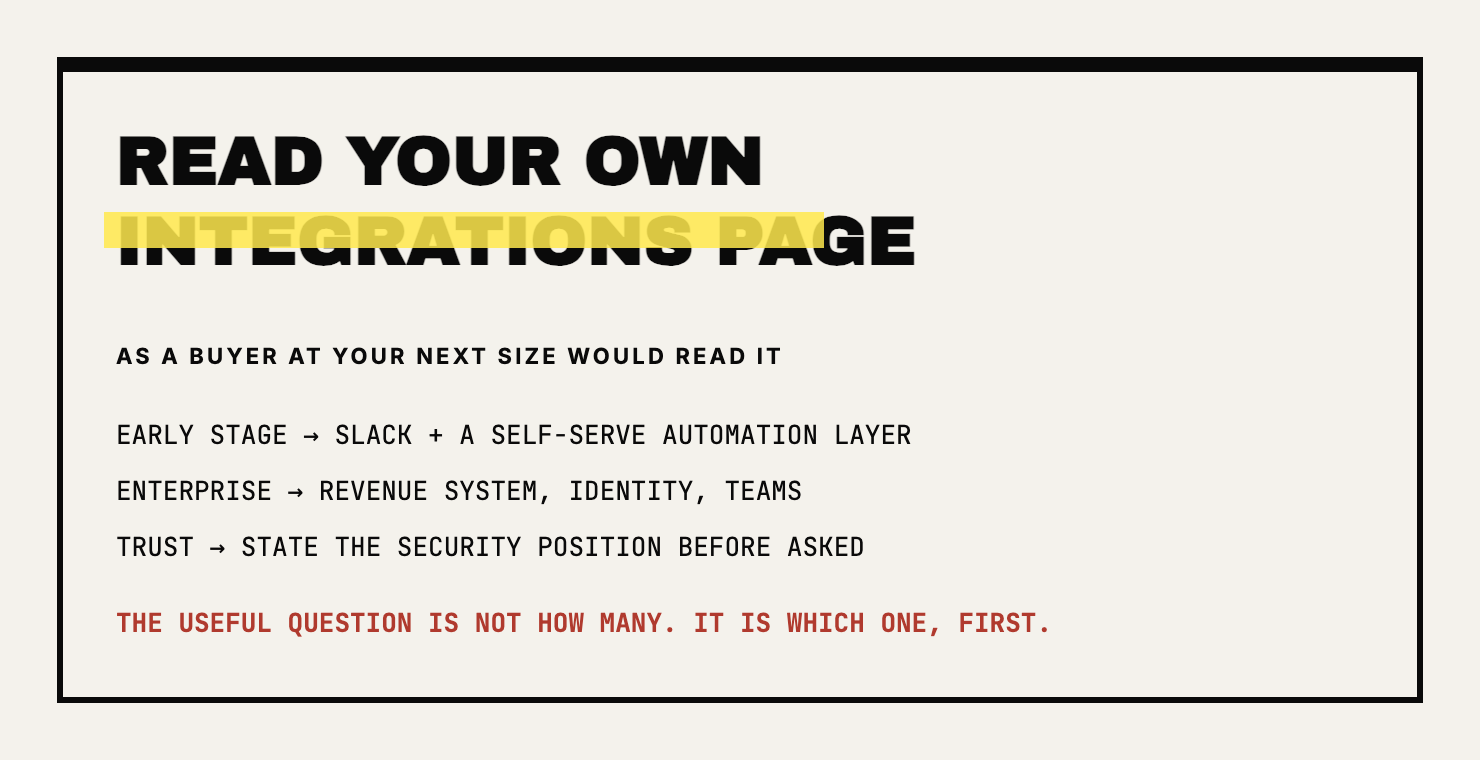
Start by reading your own integration page as a buyer at your current size would read it. Does it name the stack your next buyer runs, and in what order?
If you are early-stage, the job is mostly Slack and a self-serve automation layer. If you are selling into 200-person companies, the job changes to the revenue system, the identity provider and the enterprise chat tool that follows.
For trust, make the security position visible before a buyer has to ask for it. A stated SOC 2 position outweighs a review badge by a wide margin in this sample.
And for the page itself, add one sentence under every logo. It is the cheapest change in this piece and the one buyers miss most when it is absent.
Wrap-up
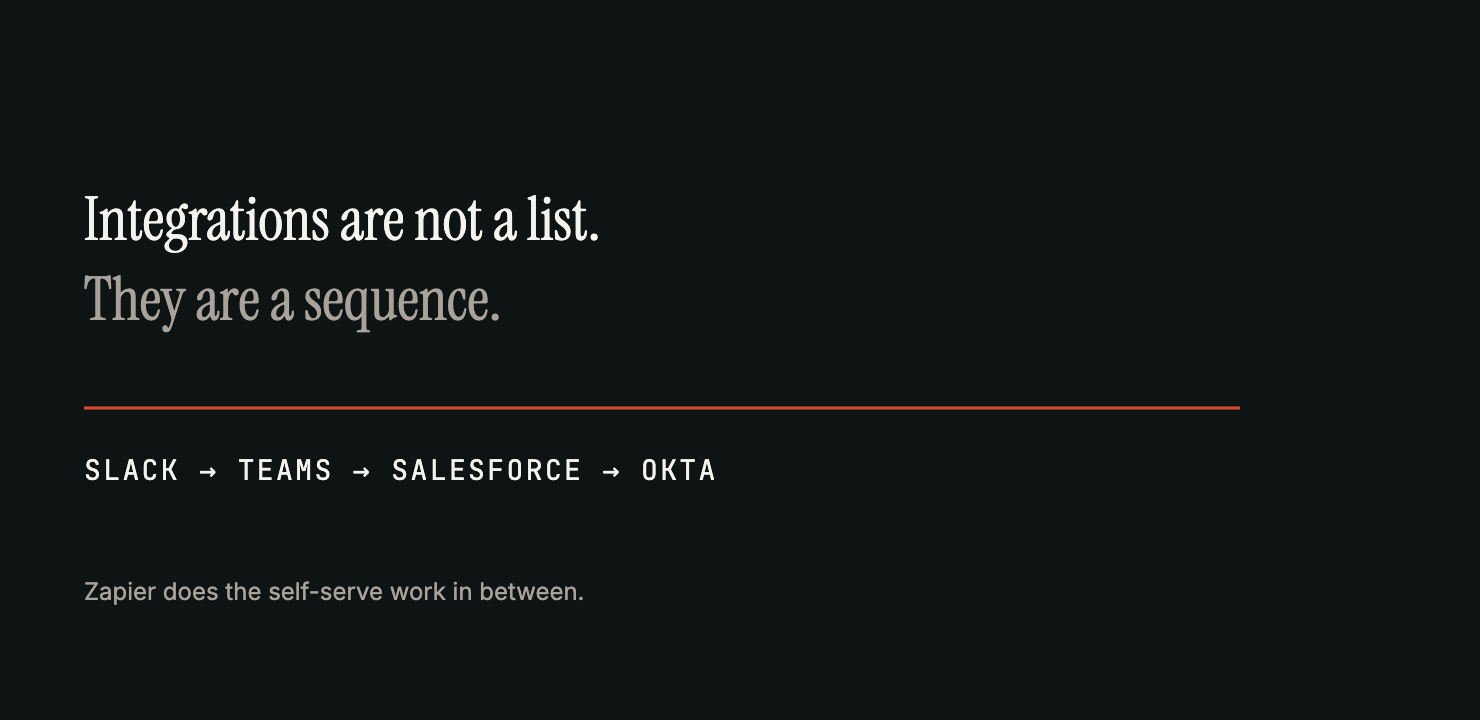
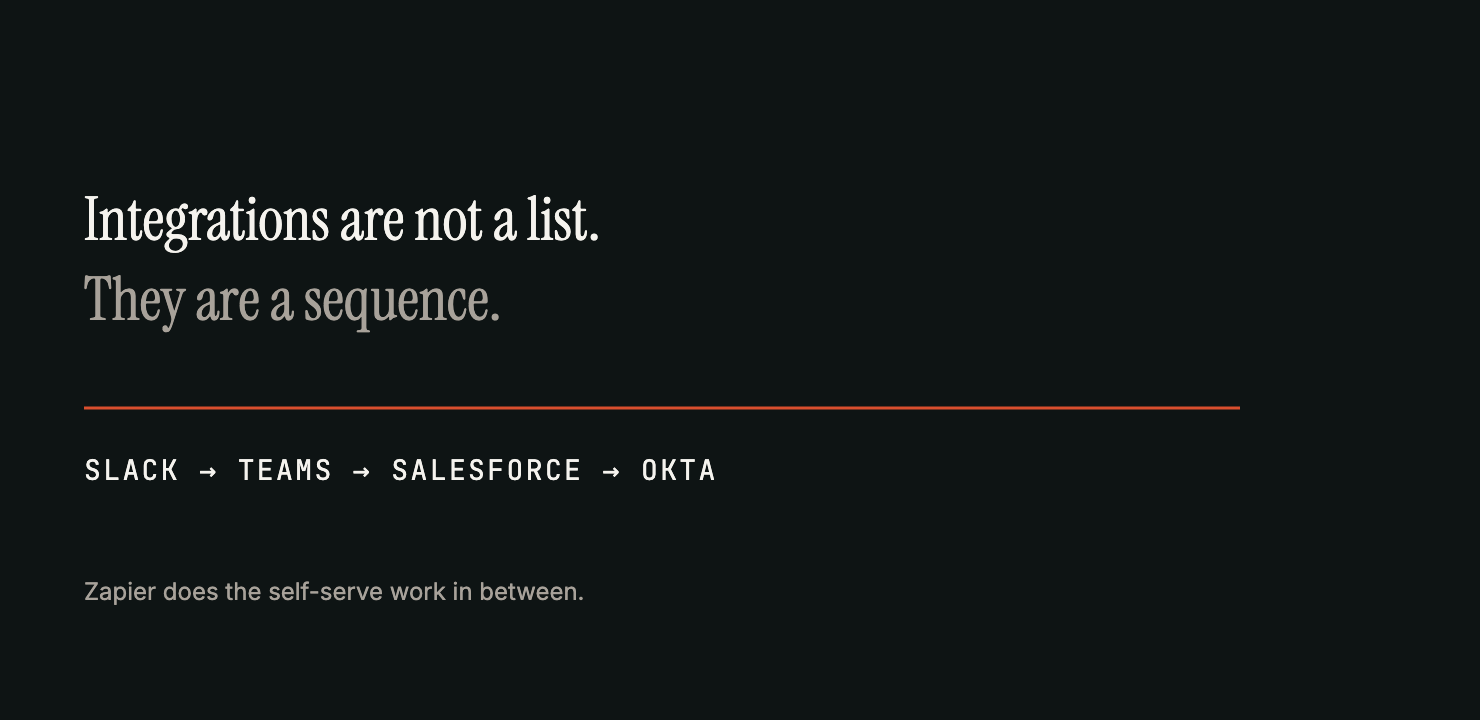
Integrations are not a feature list. They are a sequence, and the sequence follows size and billing model. Slack comes first, Teams follows, Salesforce and Okta arrive at scale, and Zapier does most of the self-serve work in between.
A buyer will check the one integration their stack depends on. The useful question is not "how many integrations do we have?" It is "which one would a buyer at our next stage look for first, and is it obvious on the page?"
Want to see whether your integration page answers that question?
Take the page a prospect checks before they book a call and scan it for the gaps that make them ask.


