

AI is on most B2B pricing pages now. The AI price almost never is, and the reason is not that companies are hiding a surcharge.
A pricing page that mentions AI is no longer a signal. Most of them do.
What buyers want to know, and what founders usually cannot work out either, is how much the AI costs. Not in a vague sense. As a number you can compare against the plan you are actually going to buy.
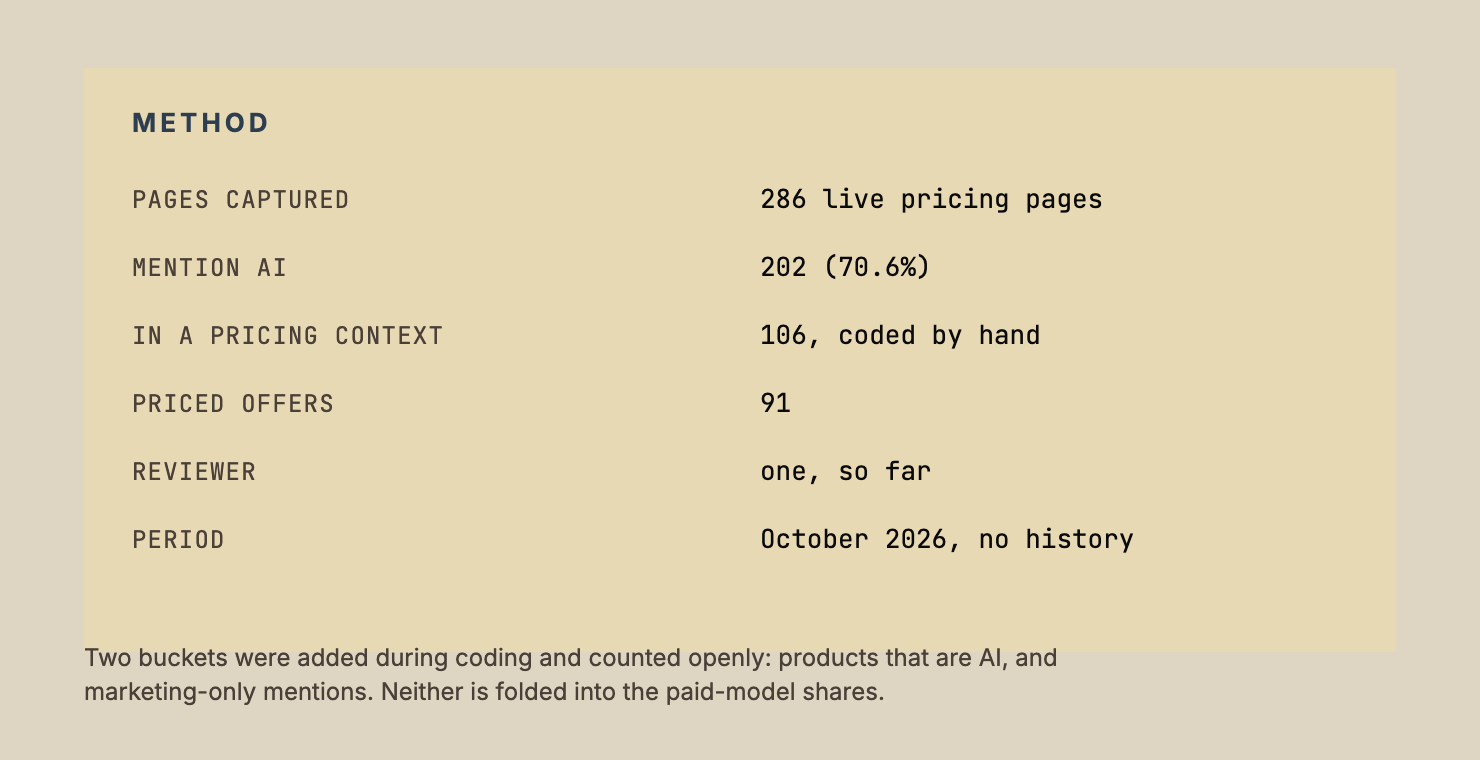
We looked at this directly. For the AI Pricing Premium Index we captured 286 live B2B SaaS pricing pages in October 2026 and read every AI mention by hand, 106 of them in a pricing context.
The answer is more interesting than "there is a premium" or "there is not". Almost nobody prices AI in a way you can do arithmetic on.
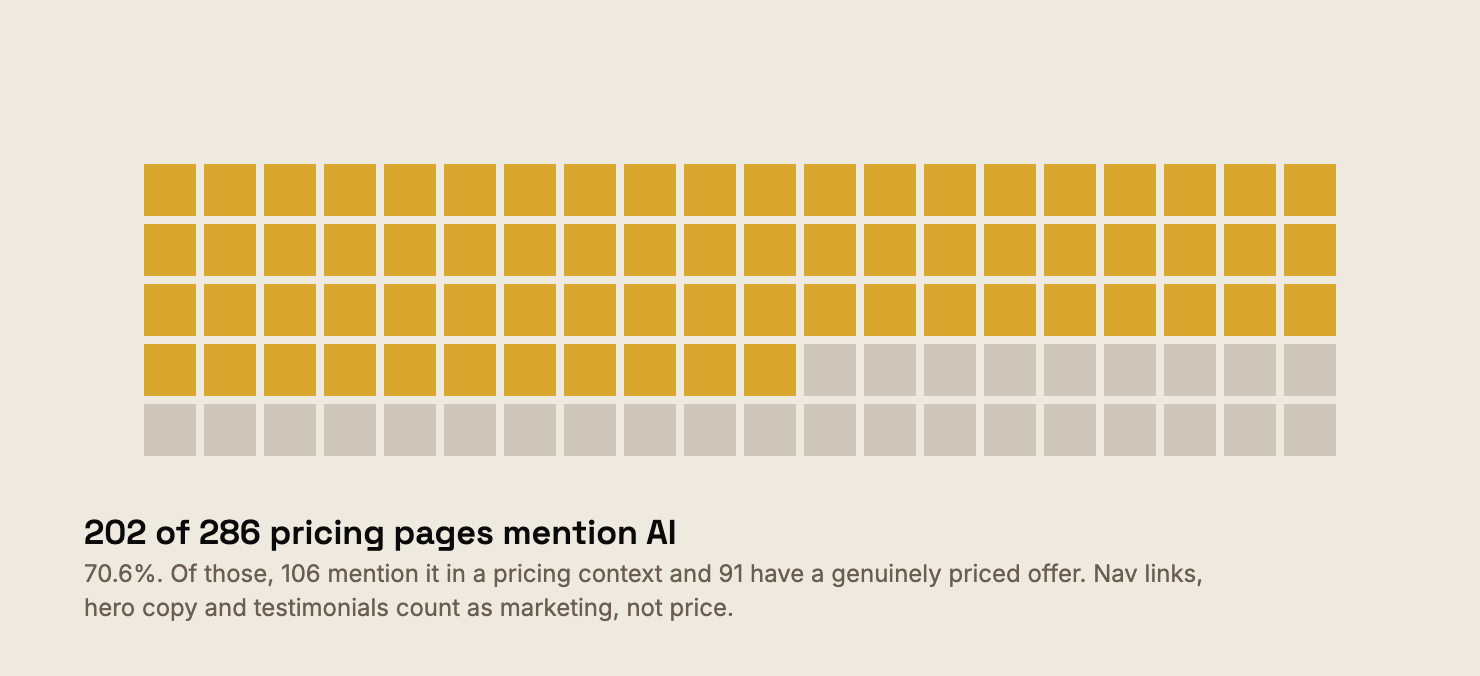
AI is on seven of every ten pricing pages
Of the 286 pages captured, 202 mentioned AI somewhere. That is 70.6%.
But a mention is not an offer. We counted nav-menu links, hero copy, testimonials and blog teasers as marketing rather than pricing, and 106 of the 202 mentioned AI in a pricing context: a tier card, a comparison row, an add-on block, or a credit meter attached to a price or plan name.
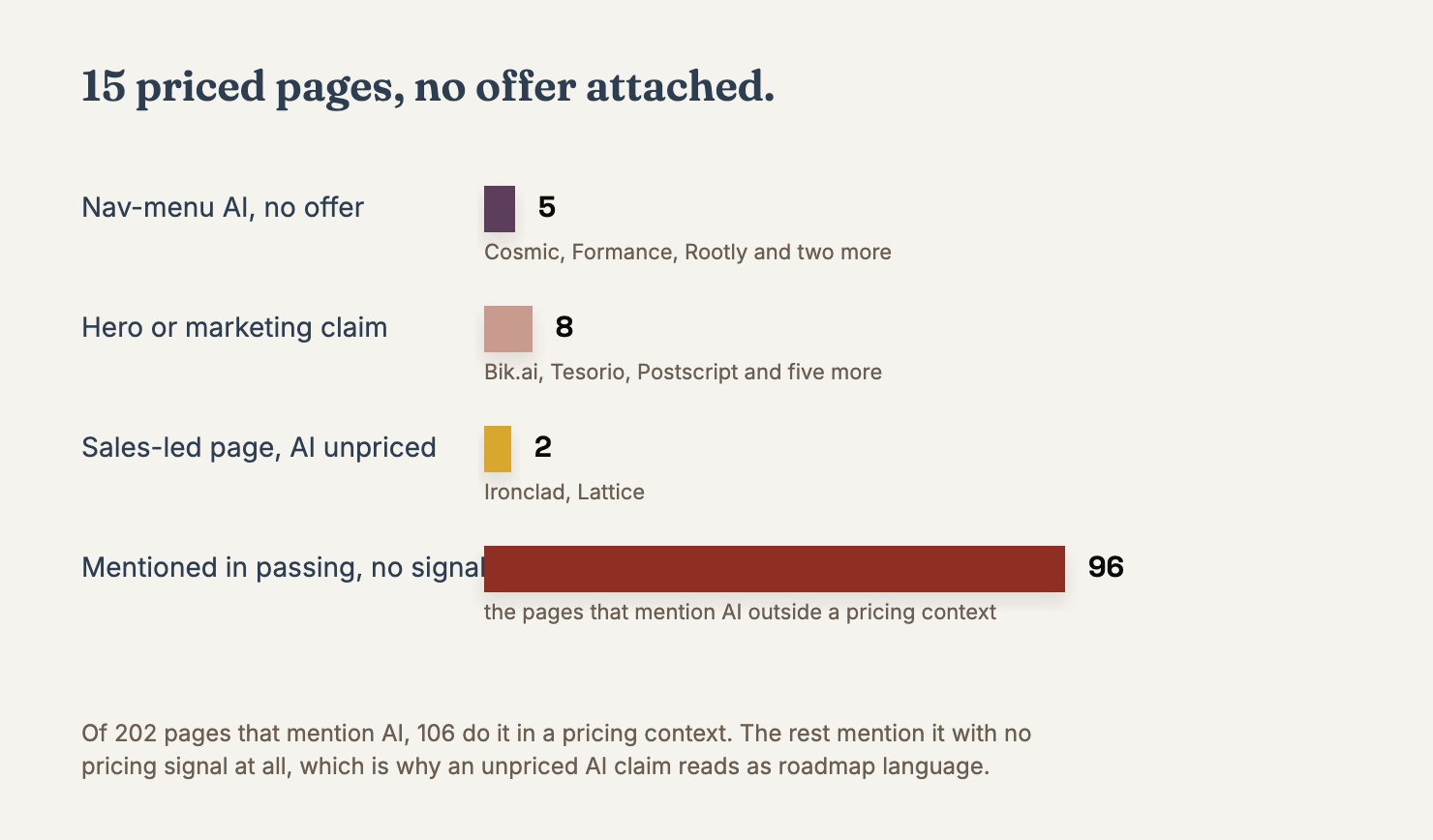
Of those 106, 91 had a genuinely priced AI offer. The other 15 mentioned AI with no priced offer attached at all.
So the honest headline is that AI appears on most pricing pages, and appears as a price on rather fewer.
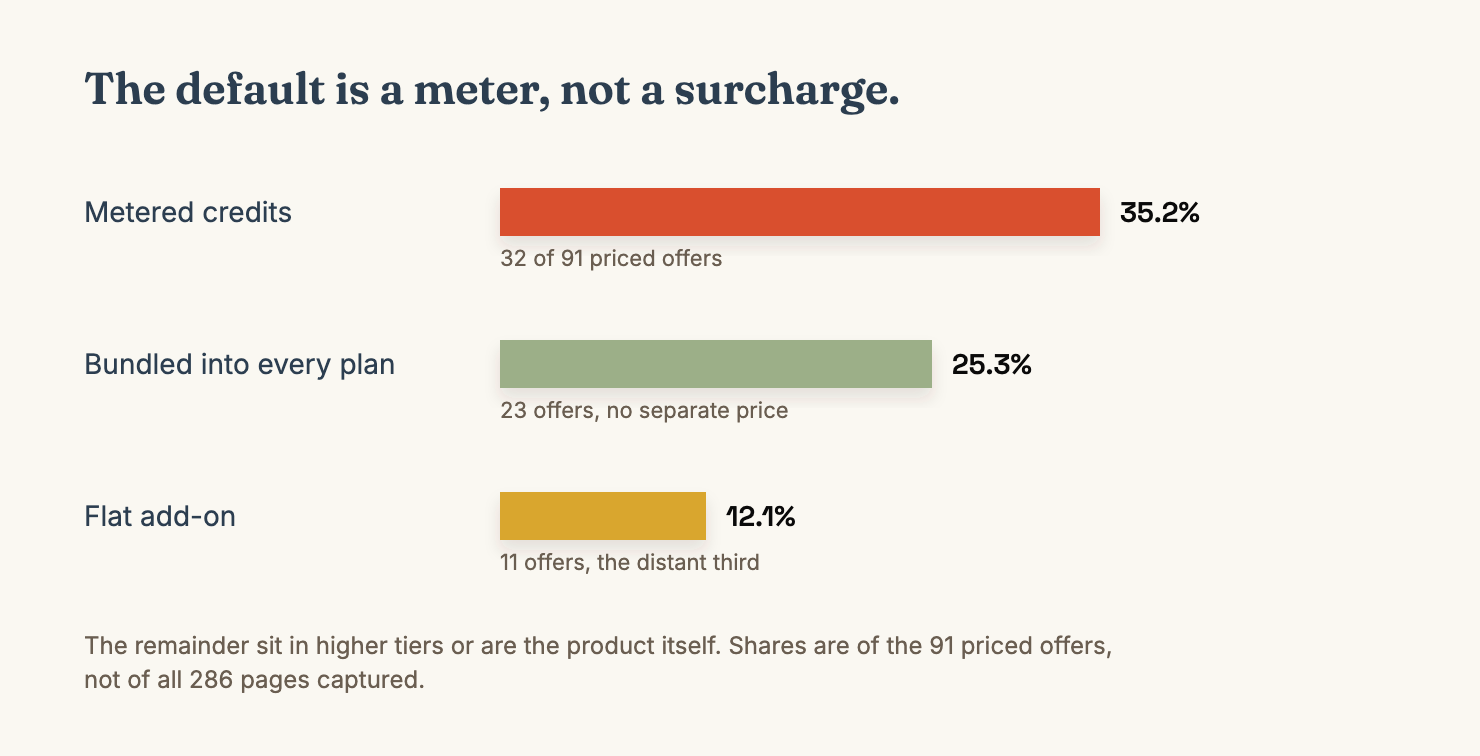
What the 91 priced offers actually charge
Among the 91 offers with a real price attached, three models cover most of the market:
- *Metered credits*: 32 offers, 35.2%. AI usage is drawn from a credit or token allowance that moves with your plan. - *Bundled into every plan*: 23 offers, 25.3%. The AI has no separate price because it is in everything. - *Flat add-on*: 11 offers, 12.1%. A fixed monthly charge bolted onto a plan.
The remainder sit in higher tiers, or are the product itself.
Read the shape of that distribution before you copy any part of it. The default is not a surcharge, it is a meter.
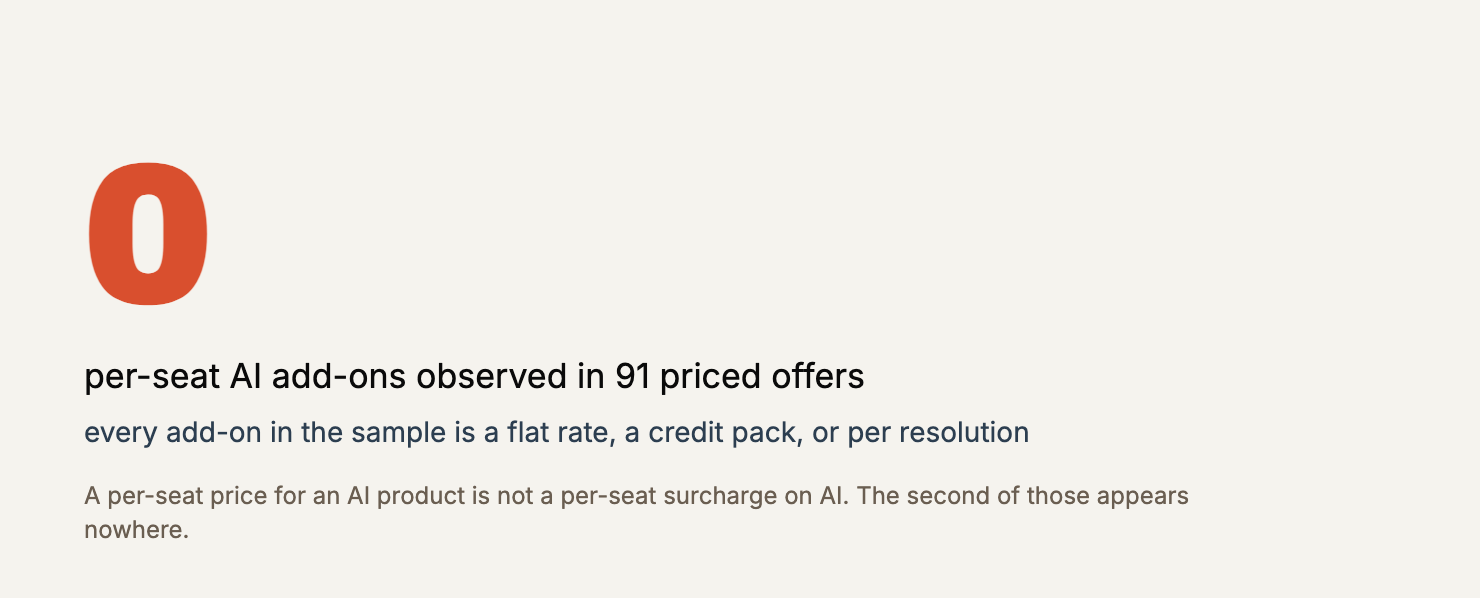
The per-seat AI surcharge does not exist
Here is the finding that surprised us most: across 91 priced AI offers, *not one* charged for AI per seat.
The per-seat model dominates how B2B software is priced generally. It appears nowhere in the AI add-ons in this sample. Among flat add-ons alone, every observed case is a flat rate, a credit pack, or a per-resolution charge. No vendor in the sample attaches AI to a headcount.
If you are a founder considering a per-seat AI charge, you would be doing something the cohort does not do. That is not automatically wrong. It means your buyers have no reference point, and you will have to explain the pricing on the page instead of relying on a convention they already understand.
Only three pages let you do the maths
Buyers ask what the AI premium is. The study can nearly answer that question, and the nearly is the point.
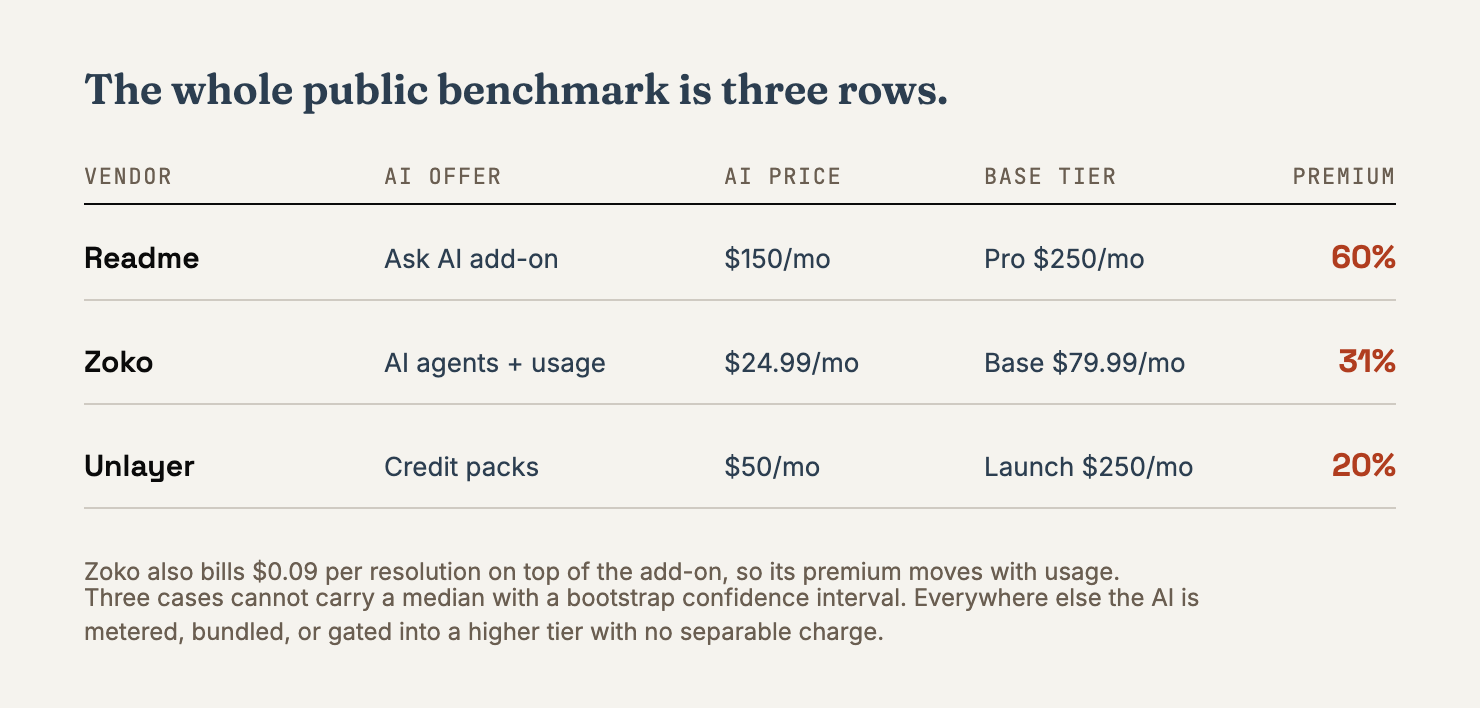
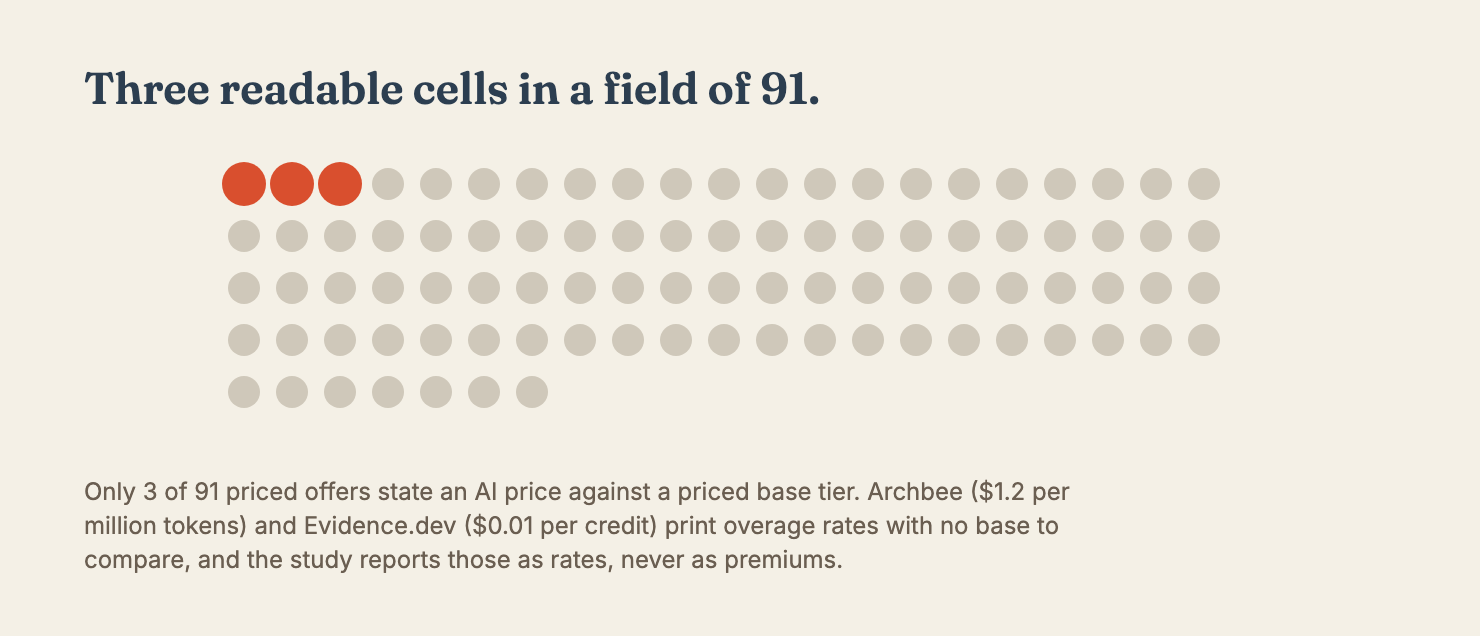
Only 3 of the 91 offers state an AI price against a priced base tier:
| Vendor | AI offer | AI price | Base tier | Premium |
|---|---|---|---|---|
| Readme | Ask AI add-on | $150/mo | Pro $250/mo | 60% |
| Zoko | AI agents add-on | $24.99/mo + $0.09/resolution | Base plan $79.99/mo | 31%, plus usage |
| Unlayer | AI credit packs | $50/mo multiples | Launch $250/mo | 20% |
Three cases. That is the entire public benchmark for an AI premium in this sample.
Which is why there is no market AI premium to quote
Three unambiguous numbers cannot carry a median with a bootstrap confidence interval. We tried, and the honest result is that the finding is the scarcity itself.
Public pages almost never separate the AI charge from the base price. Everywhere else, AI is metered inside usage pricing, bundled across plans, or reserved for higher tiers without a separable charge. So a market-wide "AI premium" cannot be honestly computed from them.
A related trap: some vendors state an overage rate without a base to compare against. Archbee prints $1.2 per million tokens. Evidence.dev prints $0.01 per credit. Those are real prices, but without a base tier they do not convert into a premium, and the study reports them as stated rates and never converts them.
If you see an "average AI premium" figure somewhere, ask how many pages actually made it computable.
The hype gap: AI mentioned, nothing priced
The 15 pages that mention AI without pricing it are worth reading closely, because most of them are not trying to mislead.
The study found three shapes. Five had an AI link in the nav menu with no offer attached, such as Cosmic, Formance and Rootly. Eight made a hero or marketing claim about AI with no priced offer, including Bik.ai, Tesorio and Postscript. Two, including Ironclad and Lattice, are sales-led pages where the AI is simply unpriced on the page.
Beyond those, 96 more pricing pages mention AI only in passing, with no pricing signal at all.
This cuts both ways. Buyers should treat an unpriced AI claim as roadmap language, not a feature you are paying for. And vendors whose AI genuinely is included should say so plainly on the page. Bundled AI you do not state gets you no credit.
What to ask as a buyer
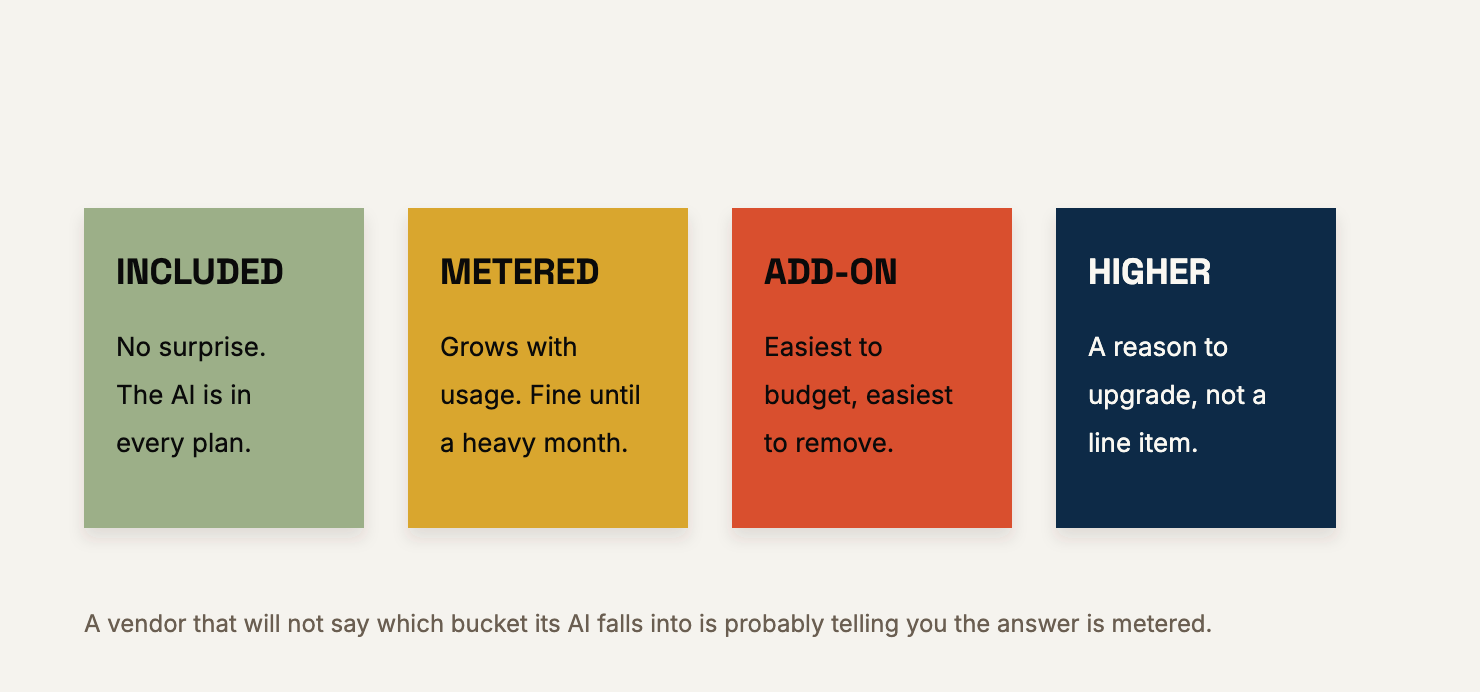
Four buckets have very different expansion dynamics: included, metered, add-on, and higher tiers only.
Included is the cheapest surprise. Metered is the one that grows with usage, which is fine until it is not. Add-on is the easiest to budget and the easiest to remove. Higher tiers only means the AI is a reason to upgrade rather than a line item.
The study's blunt advice: a vendor that will not tell you which bucket its AI falls into is probably telling you the answer is metered.
Ask for the credit allowance at your plan level, the overage rate, and what happens when a workflow exceeds the meter in a heavy month. Three questions, and most pricing pages answer none of them.
What to do if you are pricing the AI
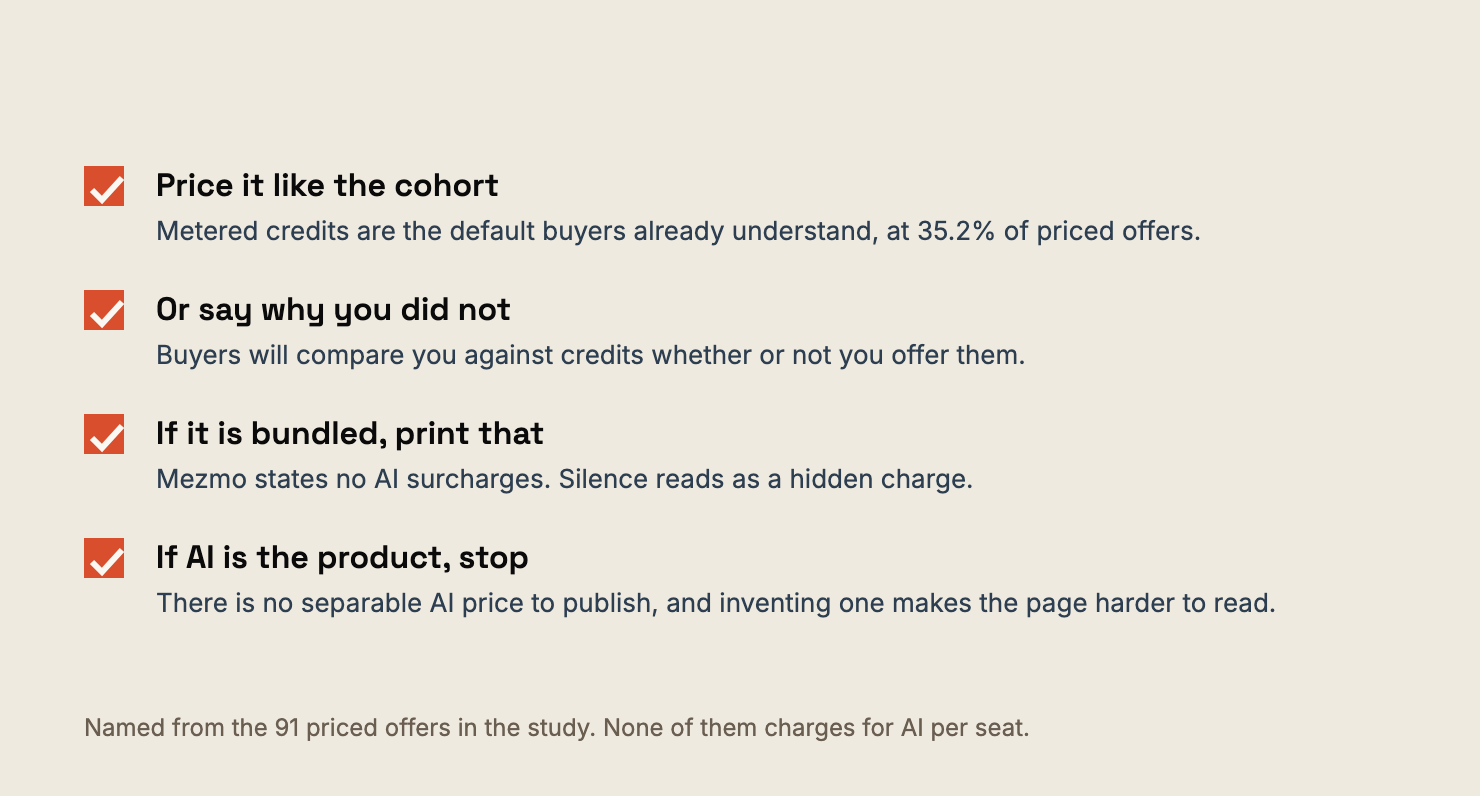
Price it the way the cohort does unless you have a reason not to. Metered credits are the default buyers already understand, and 35.2% of priced offers work that way.
If you charge differently, say why on the page. Buyers will compare you against credits whether or not you offer them.
If your AI is bundled, write that down. "No AI surcharges" is a competitive claim, and Mezmo prints it on its pricing page. Silence reads as a hidden charge.
And if your AI is the product, do not go looking for a separate AI price to publish. There is no separable premium in that case, and pretending otherwise makes your page harder to read.
Small companies meter, bigger ones bundle
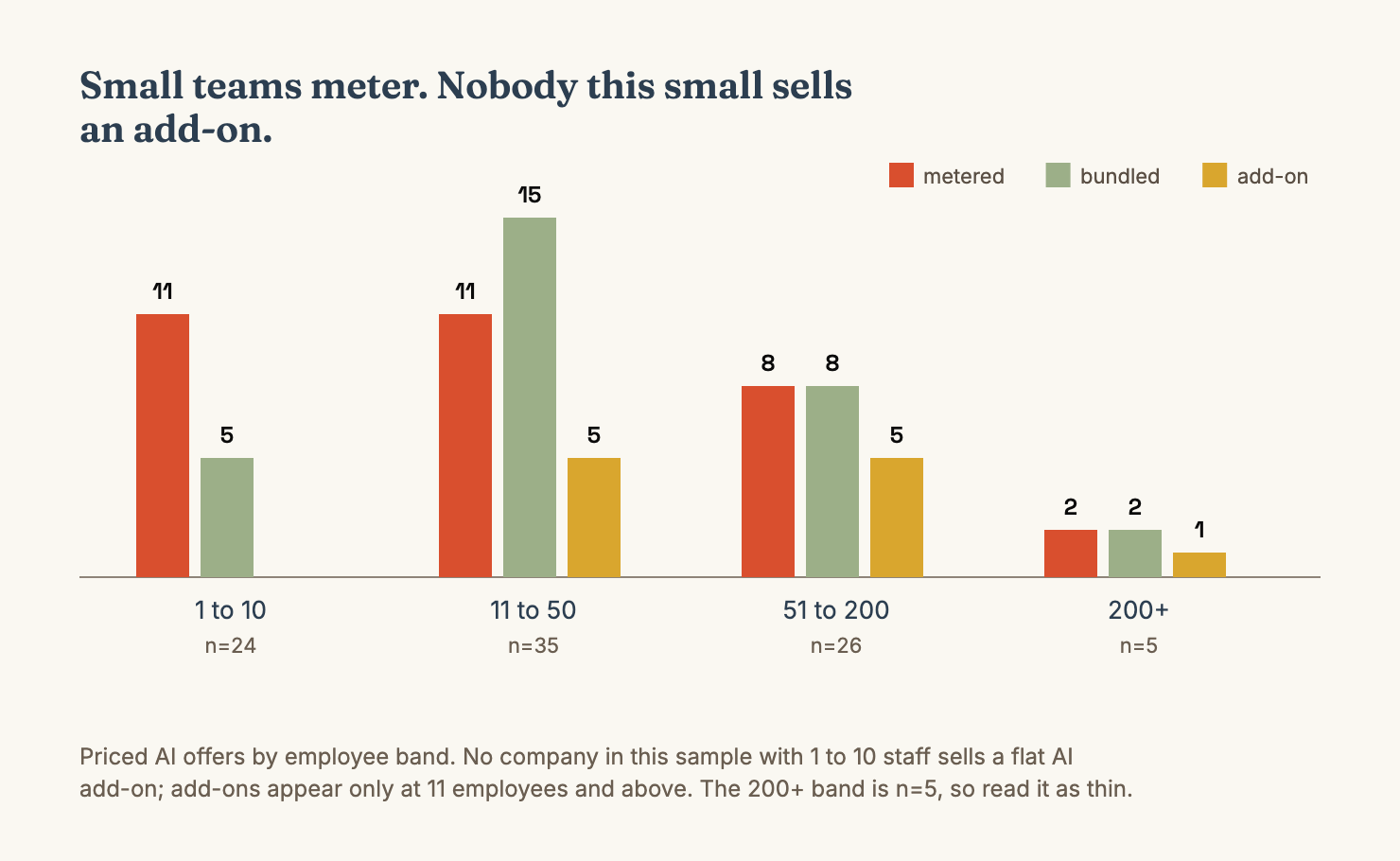
The pricing model tracks team size, and the pattern is clean enough to plan around.
| Team size | Metered | Bundled | Flat add-on |
|---|---|---|---|
| 1 to 10 employees (n=24) | 11 | 5 | 0 |
| 11 to 50 employees (n=35) | 11 | 15 | 5 |
| 51 to 200 employees (n=26) | 8 | 8 | 5 |
| 200+ employees (n=5) | 2 | 2 | 1 |
No company in this sample with 1 to 10 staff sells a flat AI add-on. Add-ons appear only at 11 employees and above.
That reads as capacity, not preference. A flat add-on is a pricing decision that needs someone to own it, model its margin, and handle the support questions it generates. Early teams meter because a meter already exists, and bundling because it is the cheapest message to write.
AI-native products have no AI add-on either
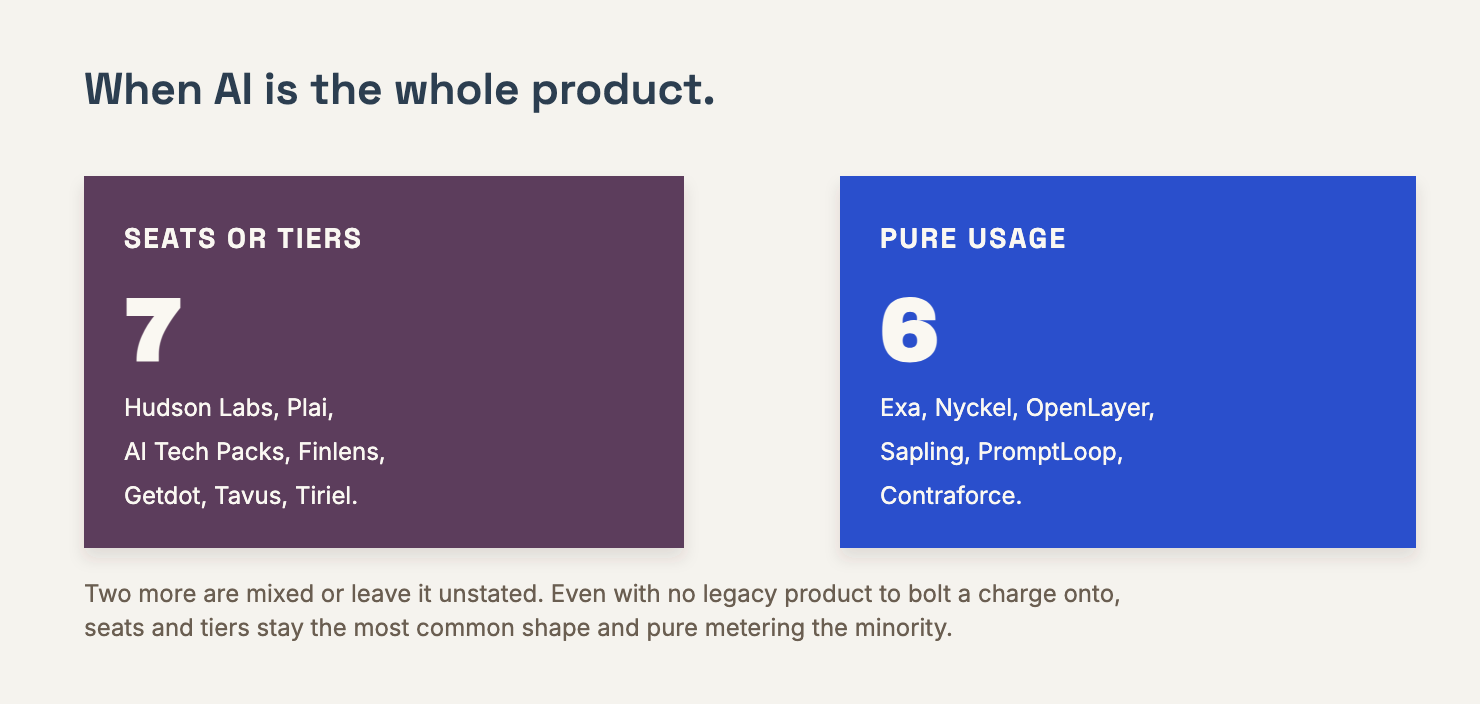
Some vendors in the sample are AI products with no legacy offering to attach a charge to, so no separable AI price exists.
Among the ones the study names, seven charge per seat or by tier, including Hudson Labs and Plai. Six meter pure usage, including Exa, Nyckel and PromptLoop. Two are mixed or leave it unstated.
The useful detail is that even without a base product to bolt a charge onto, seats and tiers remain the most common shape. Pure meter-only pricing is the minority even among AI companies.
That does not contradict the earlier finding. A per-seat price for an AI product is not a per-seat surcharge on AI, and none of the 91 priced offers in this sample charges that way.
Who this is for
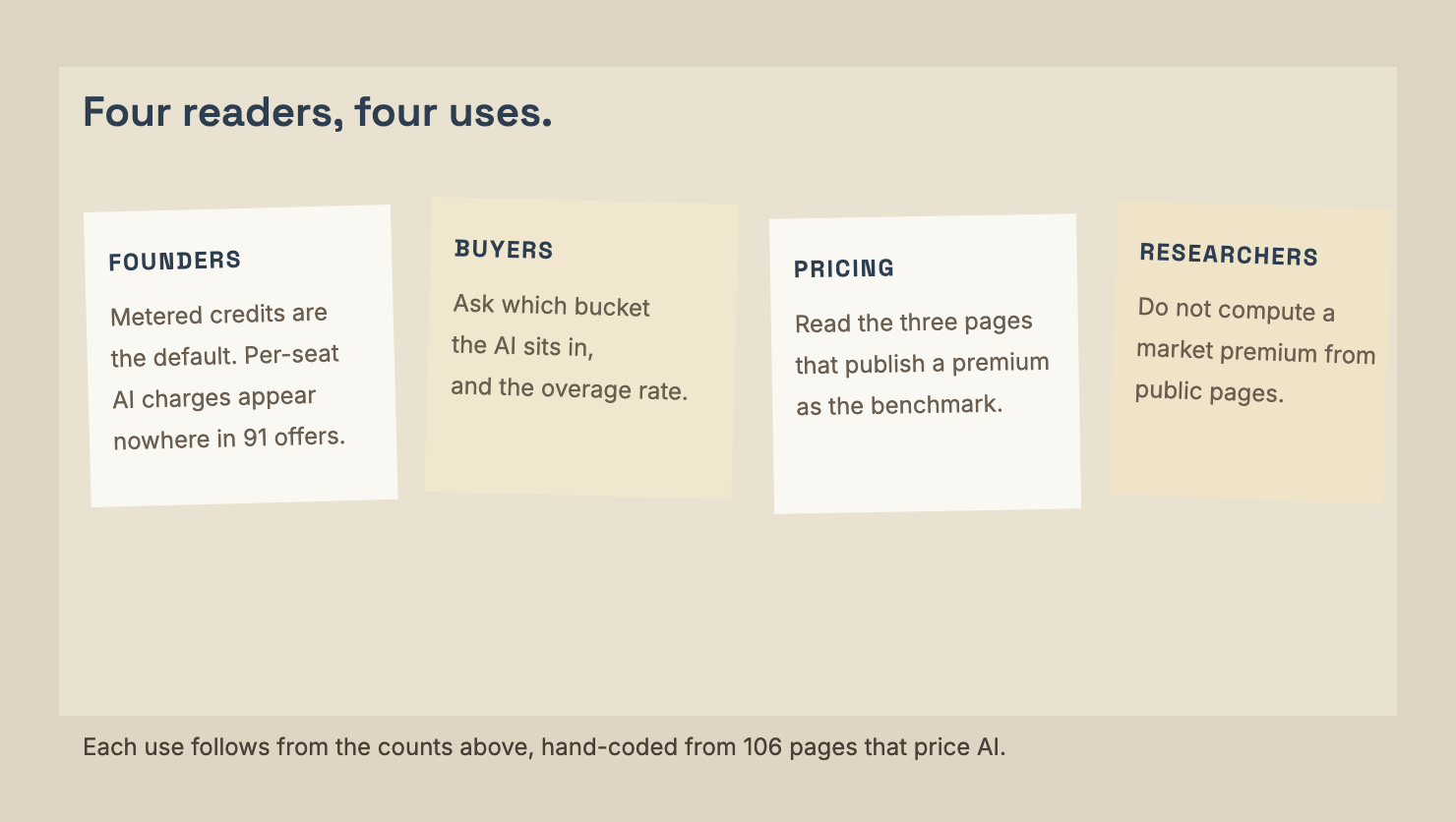
*Founders pricing an AI feature.* Metered credits are the default and per-seat AI charges appear nowhere. If you price differently, the explanation belongs on the page.
*Buyers comparing quotes.* Ask which of the four buckets the AI sits in, and the overage rate at your plan level. A vendor that will not answer is probably metering you.
*Pricing teams.* Three pages in this sample let you compute a premium. Read Readme, Zoko and Unlayer as the closest thing to a public benchmark that exists.
*Researchers.* Do not compute a market AI premium from public pages. Three unambiguous cases cannot generalise, and the absence of data is not a low premium.
How confident we are
Every classification was made by one reviewer. A second coder has not yet independently verified the taxonomy, so treat individual counts as a single-observer reading rather than a settled measurement.
This is a snapshot of October 2026. We did not cross-check changelogs or blogs, so no claim here is about when any AI feature launched. We also did not compare pages against their archived versions, because archived pricing pages mislead often enough that a before-and-after claim would not hold.
Two extra buckets were added during coding and counted openly rather than folded into the shares: products that are AI, where no separable AI price exists, and marketing-only mentions.
The base numbers differ by design. 286 pages captured, 202 mention AI, 106 mention it in a pricing context, and 91 have a genuinely priced offer. Any figure above is scoped to whichever of those groups it came from.
Wrap-up
AI is on seven of ten B2B pricing pages, and priced in a way you can compare on almost none of them. Metered credits lead, bundling is second, flat add-ons are a distant third, and the per-seat AI surcharge does not exist in this sample at all.
If you are buying, ask which bucket the AI sits in and what the overage costs. If you are selling, pick the model buyers already understand, or write down why you did not.
Want to see how your own pricing page reads to a buyer, and to the models citing it?
Start with the page you expect buyers to compare, then run it through the extractability audit.