

The query asks for a template. We published an essay. Here is the sheet, and the four decisions it forces.
If you type "saas marketing budget template" into Google, you get 362 impressions a month and not one click, and our own page sits at position 5.6 for it.
That position is the whole problem. The person searching already believes a template exists and wants the file. We gave them a position paper about how to think about budget allocation, which is a fine piece of writing and the wrong artefact.
So here is the artefact. One sheet, four lines, and a rule for what moves between them.
The four lines, and what each one is for
The mistake in most budget templates is that they are a list of channels. A channel is not a job, and a budget built on channels cannot tell you what to cut, because everything in it is doing something.
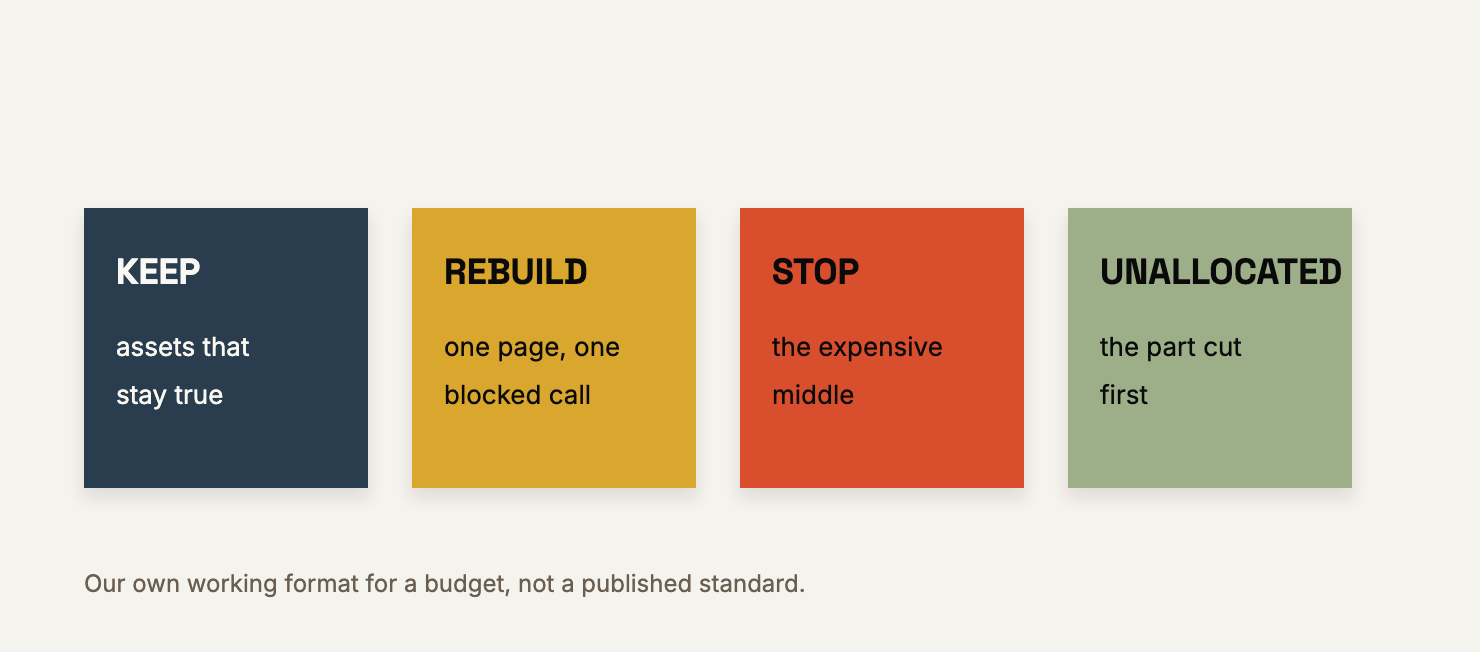
This one has four lines, each with a job attached.
*Keep.* Assets that already work and still need to be true next quarter. Source pages, comparison pages, pricing pages, the study you published in January. These are not marketing spend in the sense of campaigns. They are assets that decay.
*Rebuild.* Assets with an audience and a problem, whose current version does not answer the question. A comparison page that names no rival, a pricing page with no unit. The work here is usually one page, not a quarter of content.
*Stop.* The expensive middle. Campaigns that ran, produced a dashboard, and cannot be tied to a decision. If a line has no owner who will be asked to explain it in six months, it is not a line.
*Unallocated.* The part everybody cuts first and should cut last. Research, a study not yet done, the tool you have not bought. Most budgets leave this at zero, which is why they fund work they cannot later maintain.
What each line is justified by
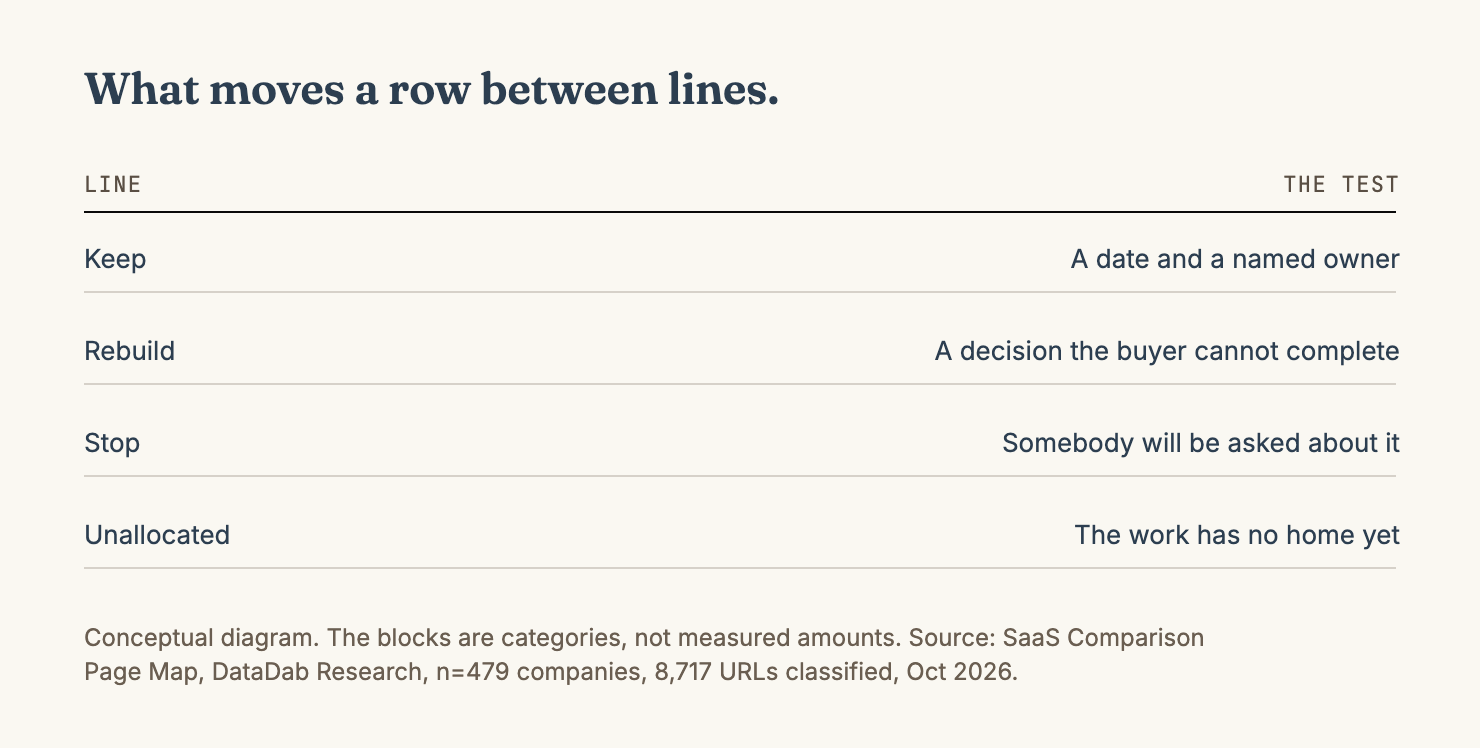
Moving a line is a decision, so each one needs a test, not a preference.
For *keep*, the test is a date and an owner. Does somebody know when this was last checked, and who checks it again? Our pricing transparency study is a good example of a keep line: the number is published, the sample is known, and a quarter passes before it needs refreshing.
For *rebuild*, the test is a specific decision the buyer cannot complete. Our comparison-page map found that 30.9% of 479 companies publish a real vendor comparison and the median publisher keeps three, so "we need more comparison pages" is not a rebuild case.
"Our comparison page names no rival" is.
For *stop*, the test is whether anybody will be asked about it. Not "did it work" but "will someone own this when finance asks".
A campaign with no owner is not a line, it is a memory.
For *unallocated*, the test is that the work has no home yet. Research and new capability. The temptation is to give this line to the first person who asks, which is how a research programme becomes three blog posts with no study.
The maintenance line almost every budget misses
Here is the finding from our own data that should change how you fill this sheet.
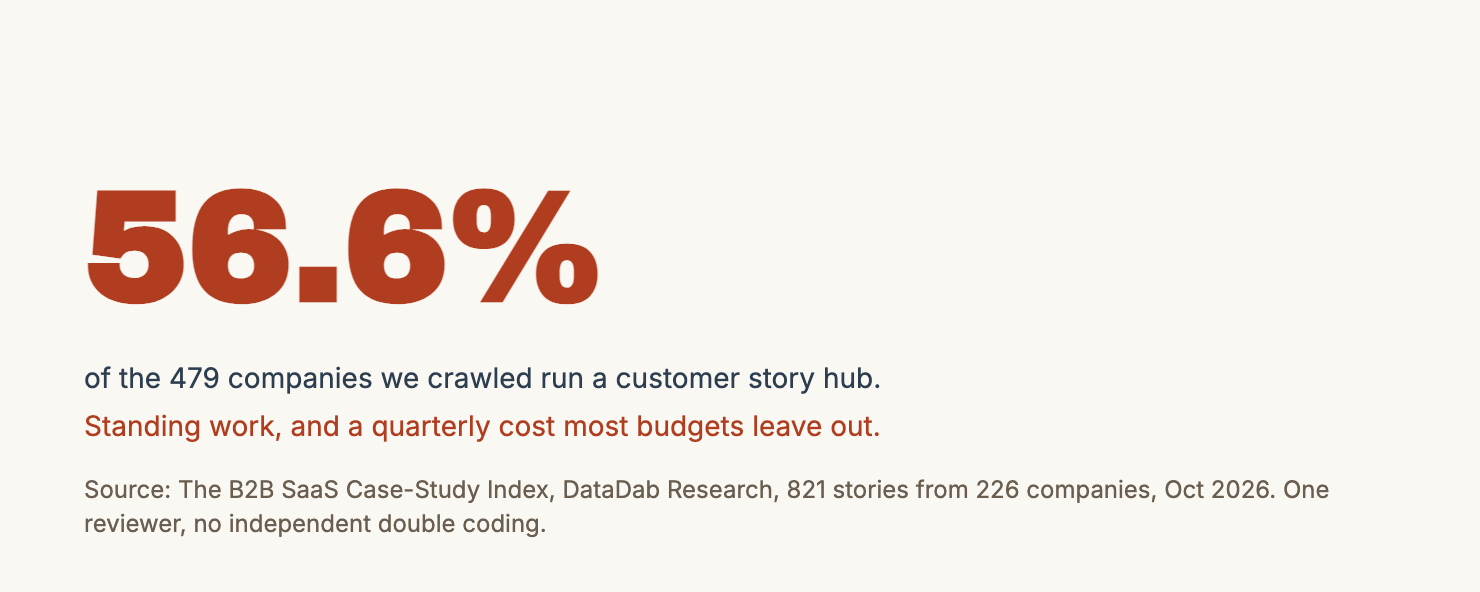
Content programmes fail on maintenance, not on ideas. In the case-study index, 56.6% of the 479 companies we crawled maintain a story hub, and only 42.0% of the 821 stories headline a percentage.
A story hub is a standing piece of work, and standing work has a cost per quarter that most budgets leave out.
The same applies to a comparison page. Ours get re-verified quarterly, because a vendor changes a price and the page becomes confidently wrong. That is an ongoing cost with a named owner, and a spreadsheet line called "content" hides it entirely.
Put the maintenance line in the budget with a number against it. If your comparison pages need a quarterly check, budget four checks a year, and say whose time they take.
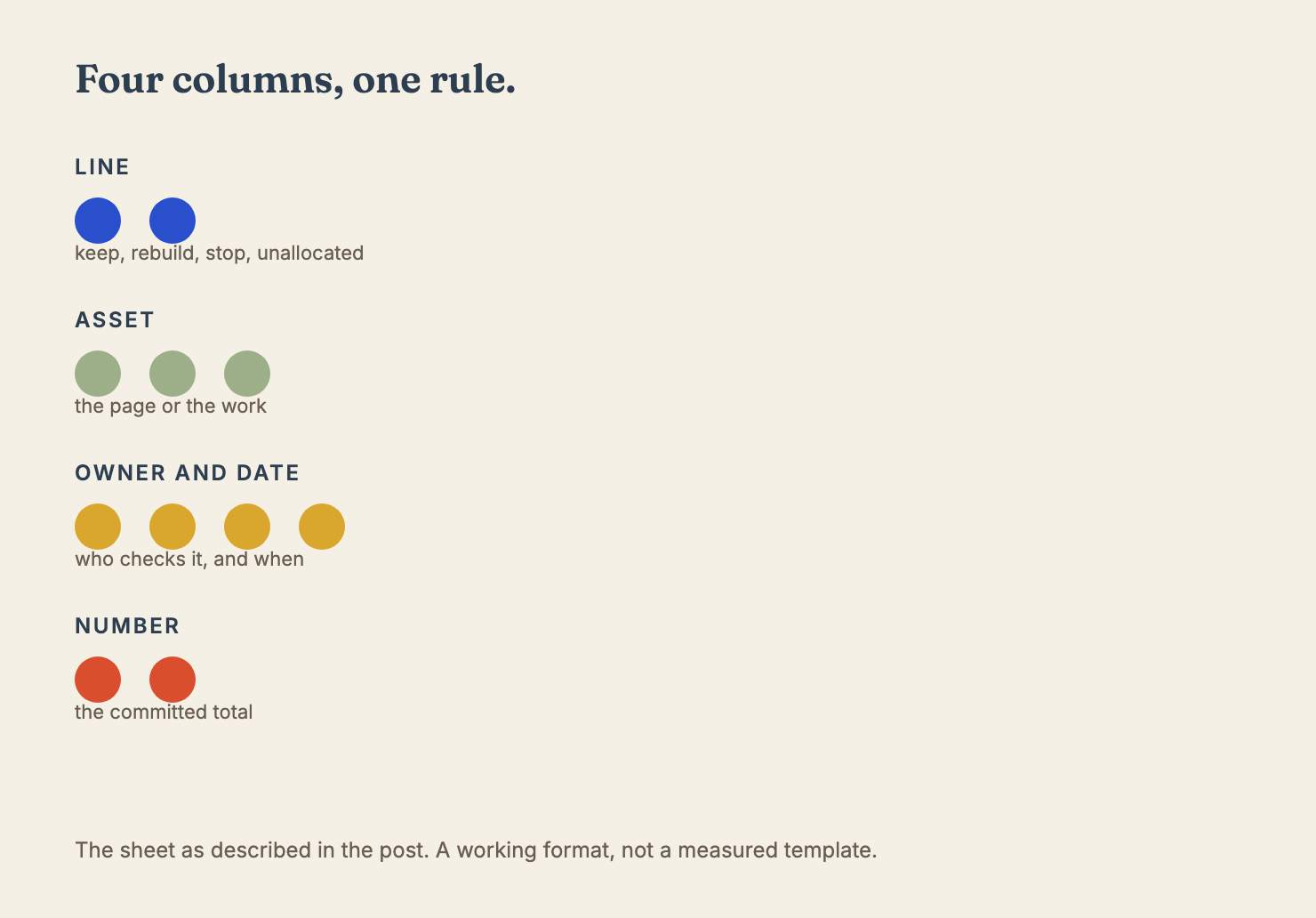
The sheet
Four columns and one rule. Column one is the line, column two is the asset or activity, column three is the owner and the review date, column four is the number.
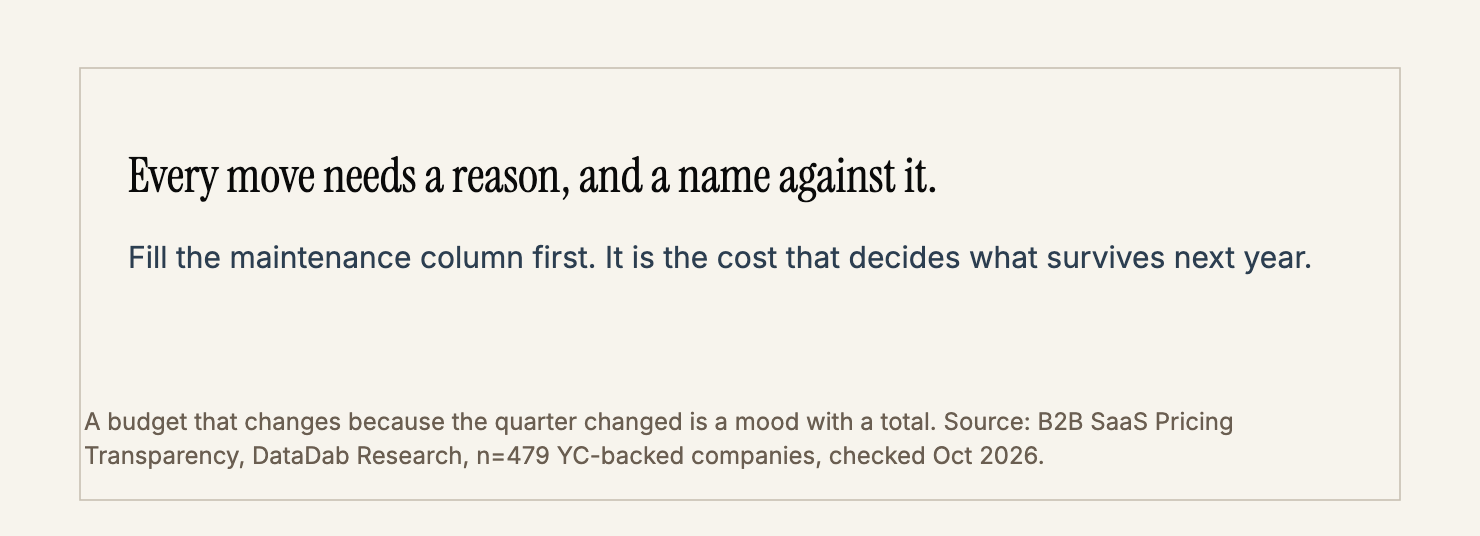
The rule sits in the header: *every row moves to a different column only when someone can name the decision that moved it.* A budget that changes because the quarter changed is not a budget, it is a mood with a total.
Below the four lines, three fields earn their place. Total committed. Total unallocated. Total maintenance, which is the number most spreadsheets do not have at all.
And one field we would add that no template has: *the next review date for the sheet itself.* A budget reviewed in January against a market that moved in March is a budget for a company that no longer exists.
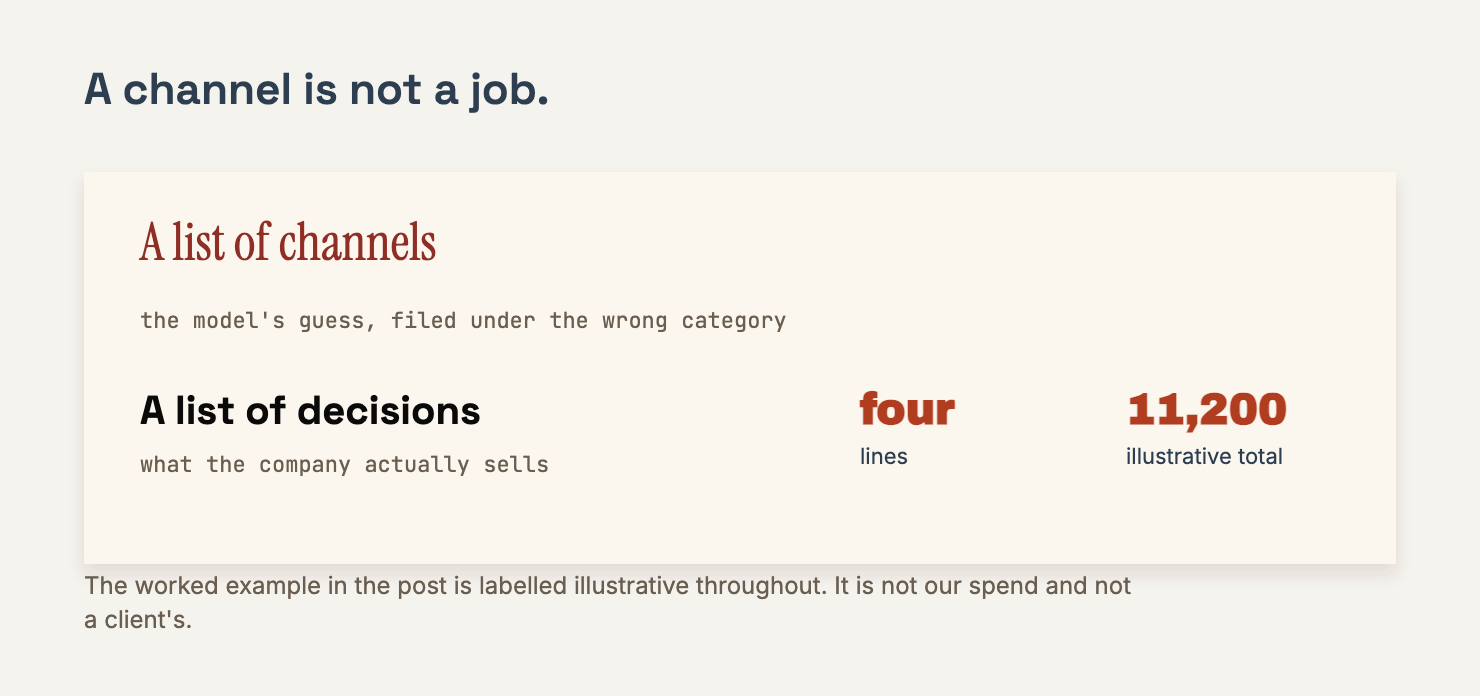
A worked example, labelled illustrative
Here is one quarter filled in, so the shape is visible. These are not our numbers and not a client's. They are a plausible shape for a mid-market B2B SaaS company, and every figure in it is an example.
Keep: 3,400 a month. Two comparison pages, a pricing page, one customer story hub, the quarterly re-verification of the studies we publish. Six assets, one owner, one review date each.
Owner: the head of marketing, named.
Rebuild: 2,100 a month. One comparison page that names no rival, rewritten with the vendor set and the trade-offs. One pricing page that has no unit on its headline number.
Two pages, one week, one writer.
Stop: 4,800 a month. Three campaigns, none with an owner who will be asked about them in a review, all ending inside the same quarter they started.
Unallocated: 900 a month. One study, not yet specified, that would answer a question two of the four pages cannot.
Total maintenance, if it were a fifth column here: 600 a month, and it is the line most spreadsheets would have missed. That is roughly two days a quarter for somebody to re-check a published price against the vendor's own page.
The illustrative point is not the amounts. It is that the largest line is the one with no owner and no review date, and that a reader can see that in five seconds.
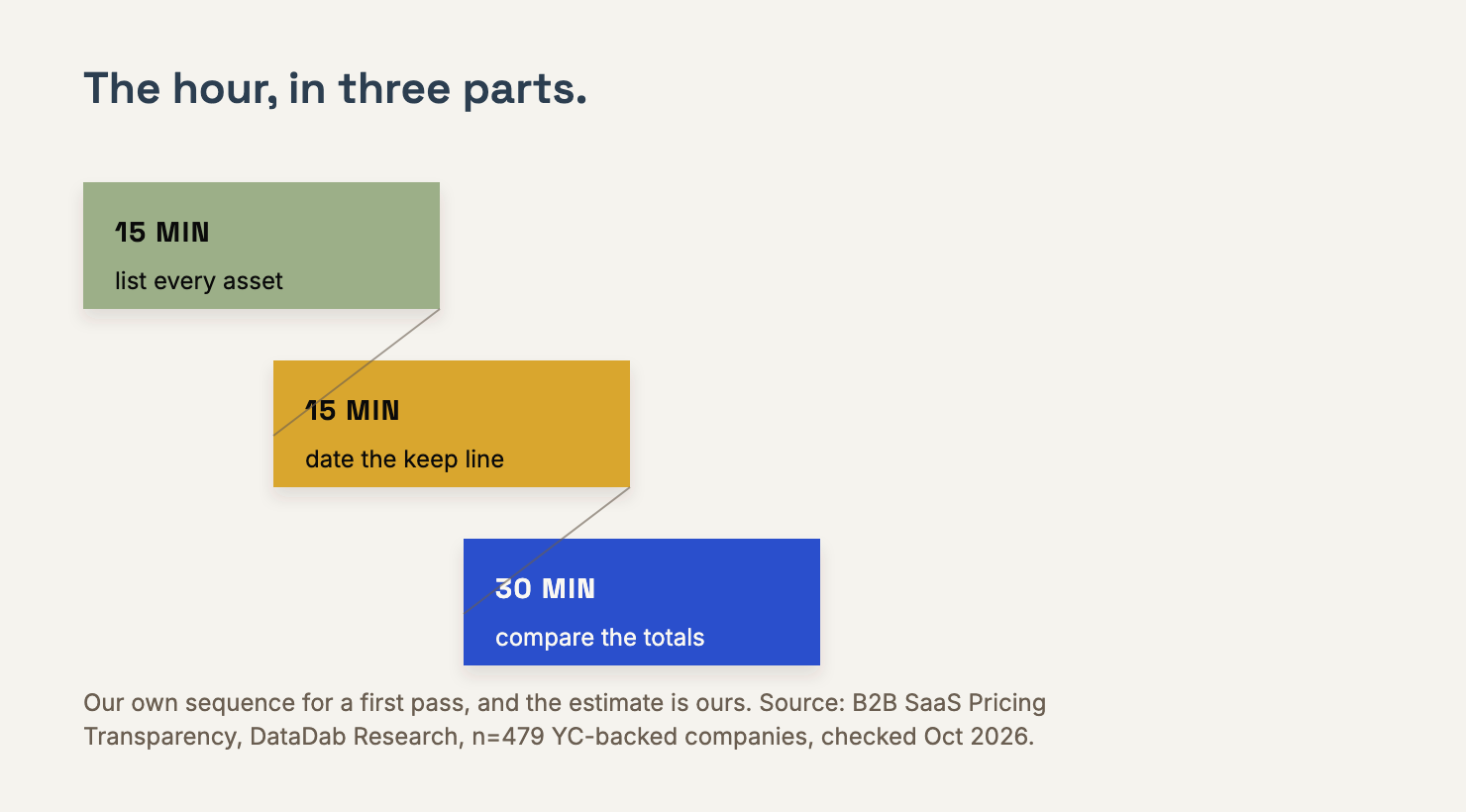
How to run the first pass
Two hours, once, and you will have a budget that a finance review can follow.
Print the four line headings on one page. Do not open the old spreadsheet yet, because the point is to start from the jobs rather than from the channels.
Write down every asset you currently pay for under the line it belongs to, with an owner if one exists. The assets with no owner are the first answer, and they usually surprise people.
Then take the keep line and put a date against every row. The date is when you will check the facts on that page again, and it is a date you can keep.
A quarterly date is fine, and it is often more honest than a monthly one.
Finally, total each column and compare it with what you actually spent last quarter. The gap between the two is the most useful number in the whole exercise, because it is the difference between what you think you are doing and what you are doing.
A budget is a record of decisions, and the test of one is whether you can explain it a year later.
Line by line, the sheet should be readable. This asset exists because a buyer asked a question that the old plan could not answer.
This page was rebuilt because the price on it had changed and nobody owned the update. That line is short, and it tells you what the money bought and what still needs attention.
If a reader can follow that logic, the sheet is doing its job. If they cannot, the problem is not the format, it is that nobody has decided what the work is for.
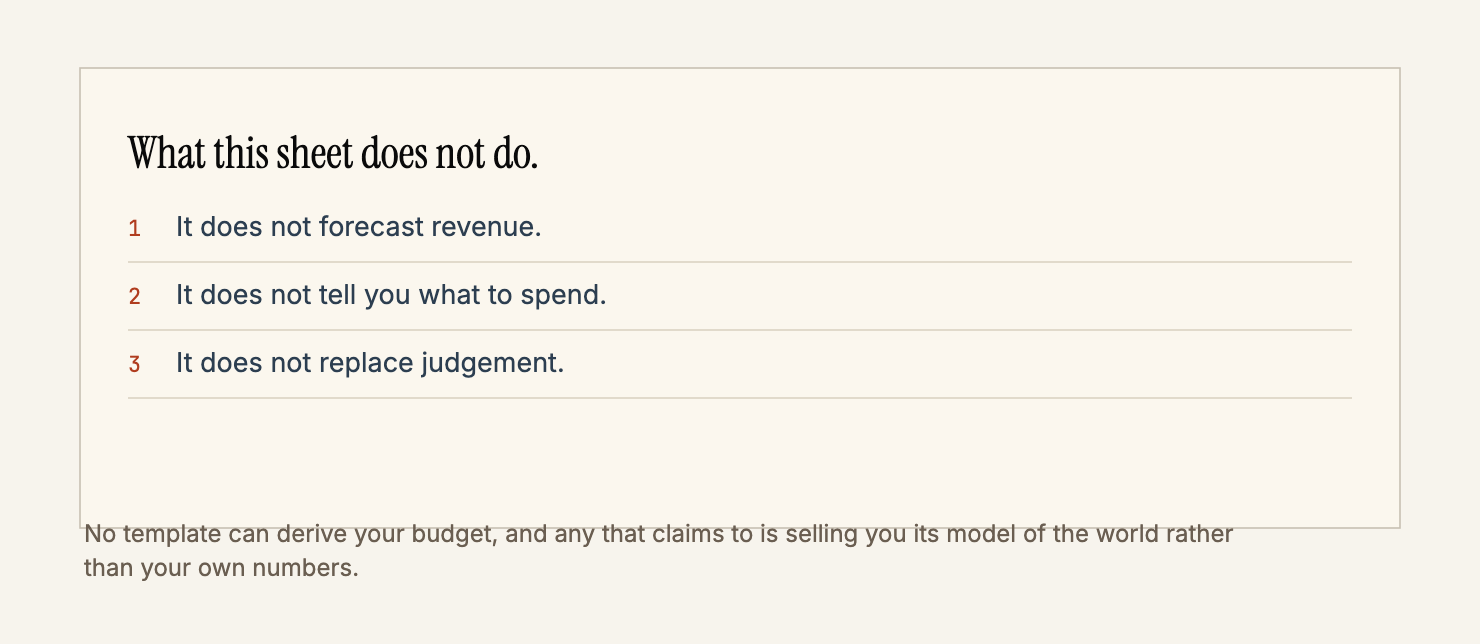
What this sheet does not do
It does not forecast revenue. No template can, and any that claims to is selling you its model of the world rather than your own numbers.
It does not tell you what to spend. A budget of four per cent of revenue is a number you can defend, and it is not a number this sheet can derive for you.
What the sheet does is make the shape of your spending visible, which is what a budget is for.
It does not replace judgment. The four lines are a way of making a decision explicit, and the decision is still yours. What changes is that you can see, six months later, why something moved.
Who this is for
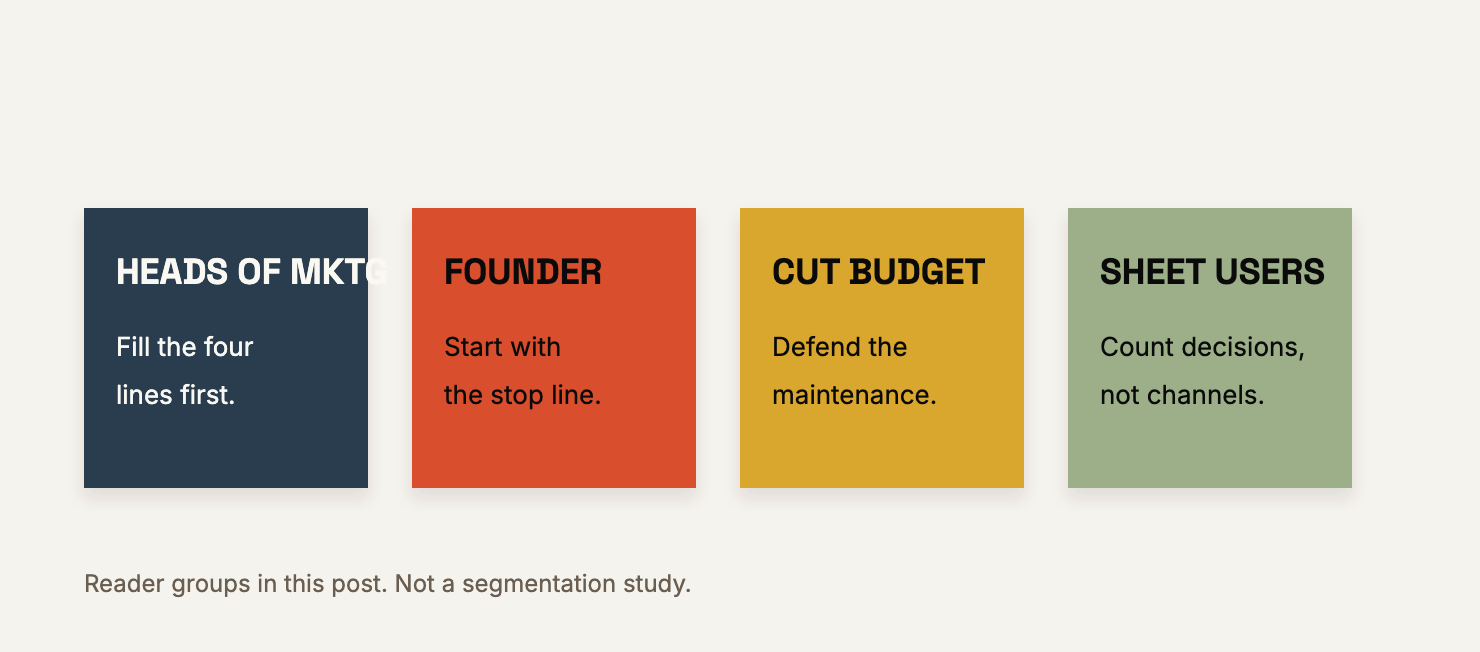
*Heads of marketing building next quarter's plan.* Fill the four lines first, then assign a total to each. Most plans fall apart because the first pass is a channel list.
*Founders deciding what to cut.* The stop line is the useful one. If a line has no owner who will explain it, that is the argument for cutting it.
*Teams whose content budget evaporated in a review.* The maintenance line is the number to defend. It is the part of your content spend that is a standing cost rather than a project, and it is the part that gets cut first.
*Anyone who has been handed a spreadsheet of channel percentages.* It is a reasonable artefact. It is also a list of things that will happen, rather than a list of decisions, and the difference shows up when the quarter turns.
How confident we are
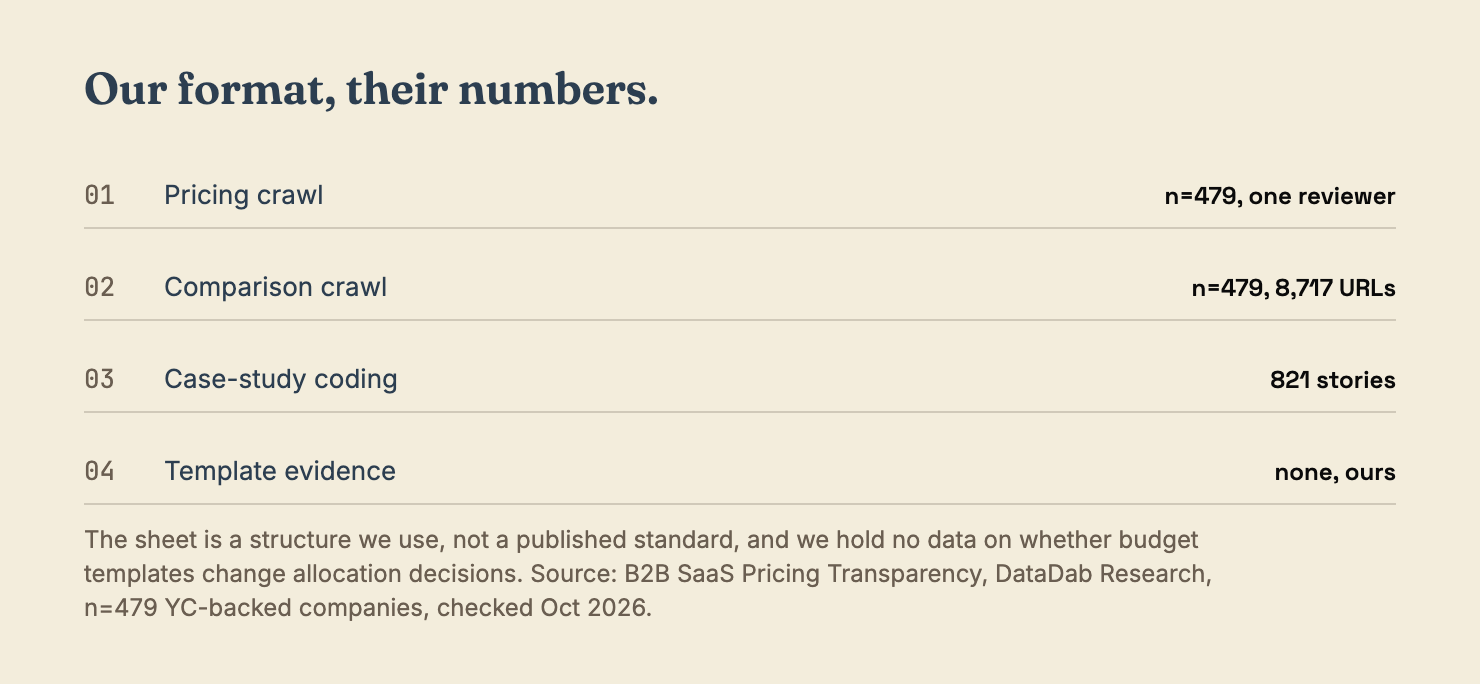
This sheet is our own working format, not a published standard, and we have no data on whether budget templates like this change allocation decisions.
Anyone claiming otherwise should be asked for their sample.
The figures it rests on come from our own crawls: 479 companies for pricing and comparison publishing, 821 hand-coded customer stories for the case-study index.
Each carries a single reviewer and no independent second coding, and the pricing classification matched on 22 of 26 hand-labelled pages.
The four lines are a structure we use, and the reason a comparison page earns three pages in our view is our own count, not a rule.
If your business sells on a different basis, the lines will adapt. The decision test will not.
Wrap-up
The search wants a template, and the template is the easy part. Four lines, one owner per row, a review date, and a rule that every move has a reason attached.
Fill in the maintenance column before anything else, because it is the cost that decides whether last year's content still exists next year.
Then put the sheet somewhere you will find it in a quarter, and move one row on purpose, so you can see whether the rule is holding.