

Before you hop on the AI hype train, let’s make sure you’re not still riding a horse.
It’s 2025 and AI is everywhere. It’s writing your email copy, segmenting your audiences, spitting out SEO titles, and probably judging your lunch choices. But here’s the plot twist most marketers don’t want to hear: slapping ChatGPT into your workflow doesn’t make you “AI-ready.” That’s like calling yourself a chef because you once microwaved a burrito.
The uncomfortable truth? Most marketers aren’t AI-ready. They’re AI-curious at best. There’s a massive chasm between using AI tools and thinking like an AI-native marketer. The difference is subtle but brutal - like using a calculator vs. understanding calculus.
So before you update your LinkedIn title to “AI Marketing Strategist,” let’s run a little diagnostic. Here’s your no-BS, jargon-free skills checklist to see if you’re really ready for the new AI-powered marketing game - or if you’re just playing with the buttons.
1. You Know When (and When Not) to Use AI
Let’s start with a doozy: Do you know when to shut the robot up?
Being AI-ready means understanding the limits of AI, not just its magic tricks. For example:
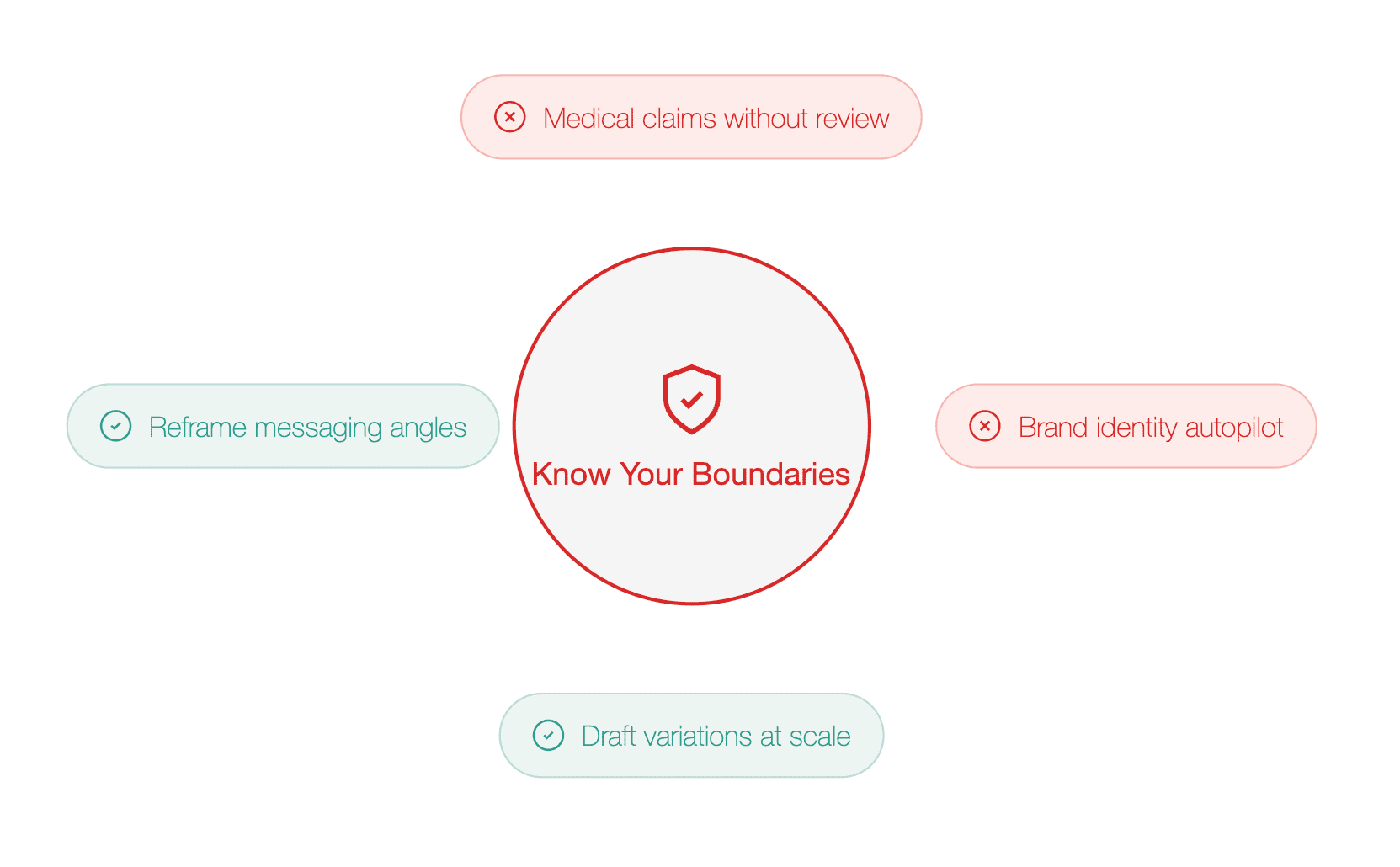
- You don’t use ChatGPT to generate medical content without human review.
- You don’t trust a generative image model to represent your brand identity unless you’ve art-directed it properly.
- You do use it to rough-draft CTAs, reframe product messaging, or generate 50 headline variants in 8 seconds flat.
AI can do a lot. But it’s not your strategist. It’s your over-eager intern on steroids. You still need to:
- Brief it like a human.
- Edit its output ruthlessly.
- Double-check every single fact (unless your brand enjoys lawsuits).
Verdict: If you treat AI like a magic vending machine instead of a power tool, you're not AI-ready. You're AI-reliant. And that’s worse.
(Side note: AI won't replace you. But a marketer who knows how to use AI will.)
2. You’ve Rewired Your Thinking for Prompt Engineering
You ever stare at a blinking cursor in ChatGPT and type “Write me a blog post”? Yeah, we’ve all done it. But that’s toddler-tier prompting.
Being AI-ready means understanding the nuance of inputs. If you can’t think in variables, constraints, and mental models, you’ll drown in mediocre output.
Here’s the glow-up path:
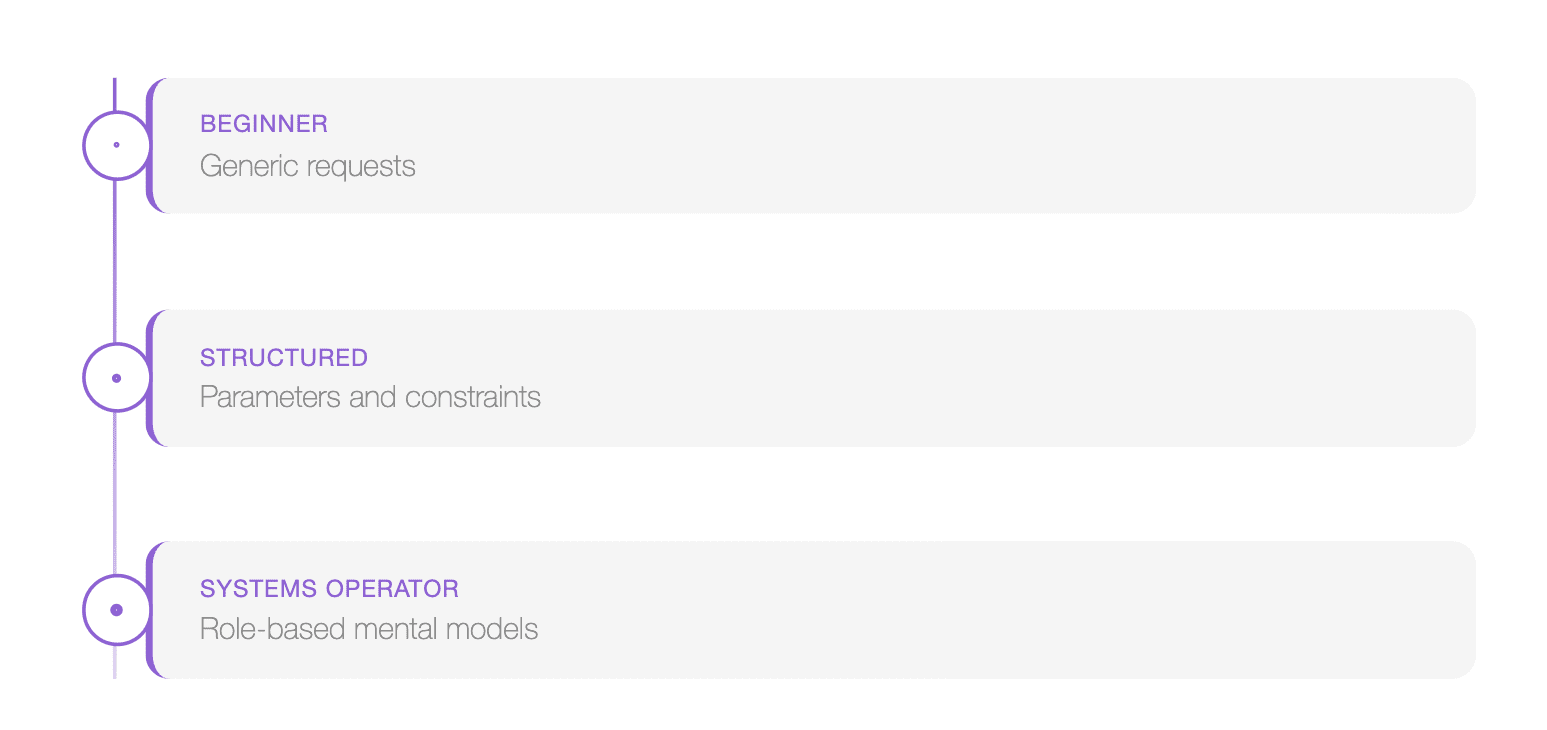
- Level 1: “Write a blog post about CRM tools.”
- Level 2: “Write a 1,000-word comparison of HubSpot vs. Salesforce for mid-sized eCommerce businesses. Include pros, cons, pricing, and case studies.”
- Level 3: “Act as a skeptical eCommerce founder evaluating CRM tools. Write a first-person narrative explaining why you chose HubSpot over Salesforce. Include a cost-benefit breakdown and integration headaches.”
You don’t need to be a coder. But you do need to think like a systems operator. Prompting isn’t just asking. It’s briefing. It’s framing. It’s tuning a model to your worldview.
Reality check: If your idea of prompting is still “make this better,” you’ve got work to do.
3. You’re Comfortable With Data - and a Bit Dangerous With It
Let’s talk data. Not the dry, corporate dashboard kind. The kind that fuels AI.
AI-ready marketers speak the language of:
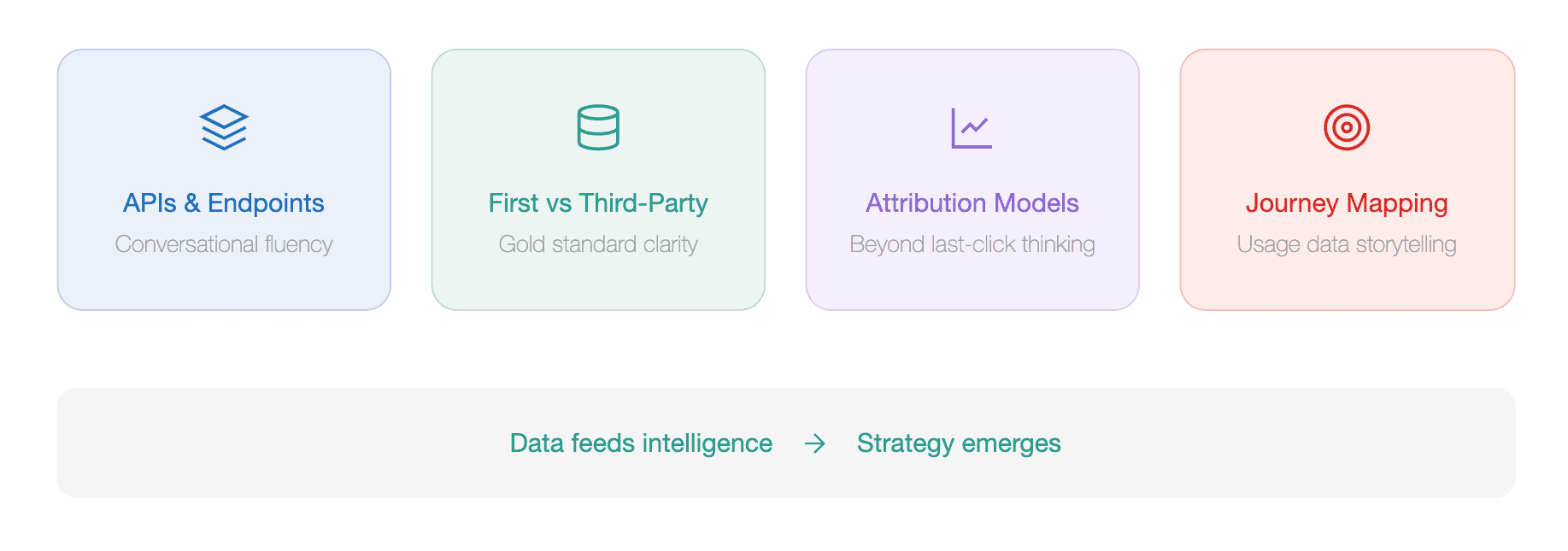
- APIs and endpoints (even if just conversationally)
- First-party vs. third-party data (and why the former is gold now)
- Training data, model biases, and what a vector database does (roughly)
- Google Analytics 4 without crying
If you can’t interpret the why behind the metrics - if bounce rate still baffles you, or attribution models sound like Hogwarts classes - you’re not ready to tango with AI.
AI-driven tools are only as smart as the data you feed them. And marketers who can’t wrangle, clean, interpret, and weaponize that data?
Well, they’re just narrators. Not strategists.
Test yourself: Could you sketch out a basic customer journey map using actual usage data? No? Time to hit the books.
4. You’ve Integrated AI Into Real Workflows (Not Just Tool Fiddling)
Installing a Chrome extension doesn’t count as workflow integration. Nor does signing up for 8 AI writing tools, using each one once, and forgetting your passwords.
You’re AI-ready when your actual marketing stack includes AI in ways that:
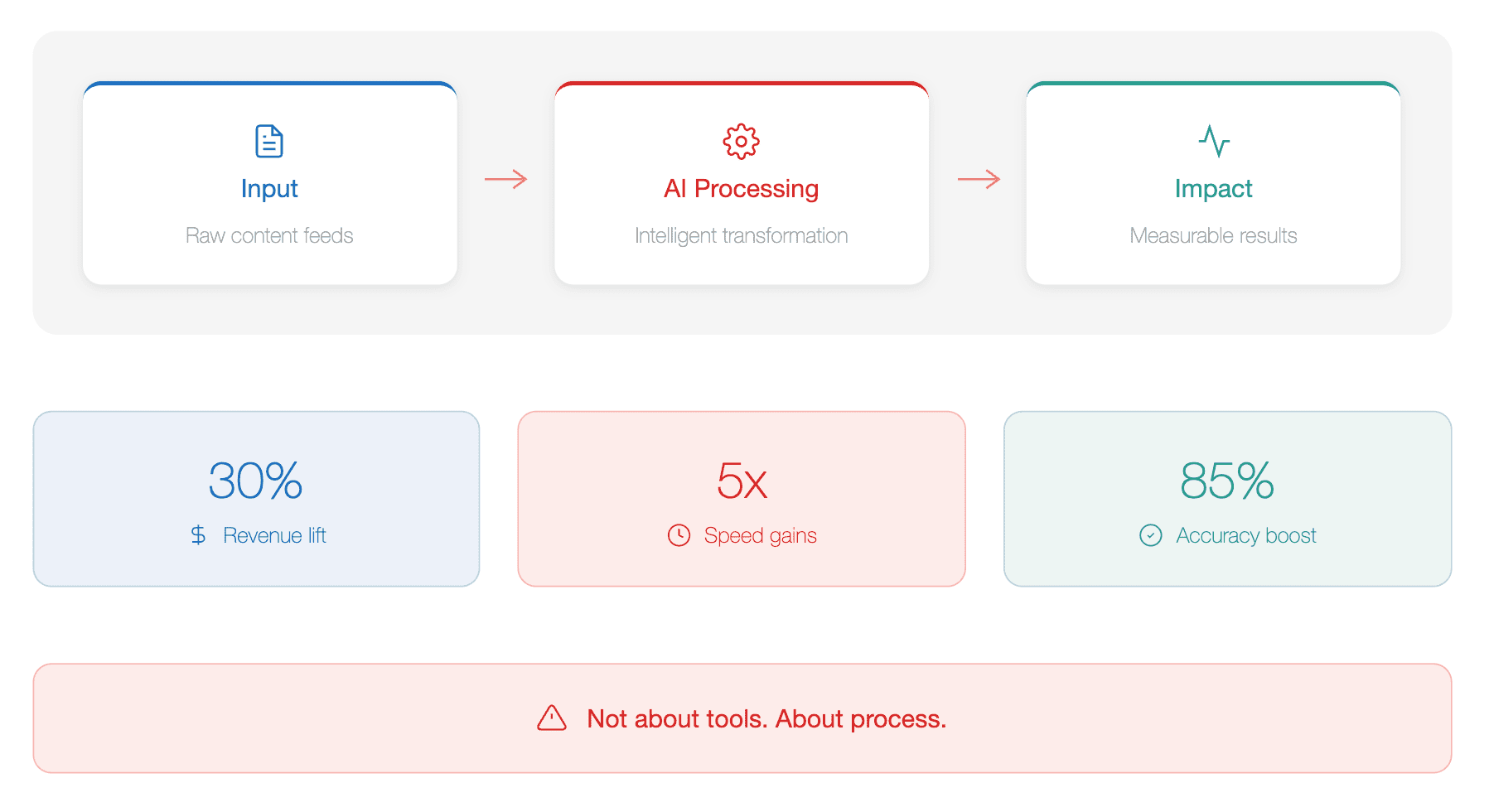
- Save time (e.g., automate social repurposing of blog posts)
- Increase accuracy (e.g., NLP-driven sentiment analysis of customer reviews)
- Drive revenue (e.g., AI-personalized email sequences that convert)
If your AI use cases are still stuck in "writing faster" mode, you’re just scratching the surface.
Want to impress us?
- Tell us how you fine-tuned a GPT instance on your brand voice.
- Show us how you used Midjourney to test visual positioning before a rebrand.
- Walk us through how your chatbot reduced support tickets by 30%.
Pro tip: Workflow integration isn’t about tools. It’s about process. If you haven't mapped where AI fits into your pipeline, you're not AI-ready. You're just AI-curious.
5. You’ve Stopped Romanticizing “Creativity” as Unautomatable
“But AI will never be truly creative.”
Tell that to Suno, which is now generating entire punk rock albums in minutes. Or to Sora, which is producing mini-films that could pass for Netflix trailers.
Creativity isn’t going extinct. But it is being redefined.
Being AI-ready means:
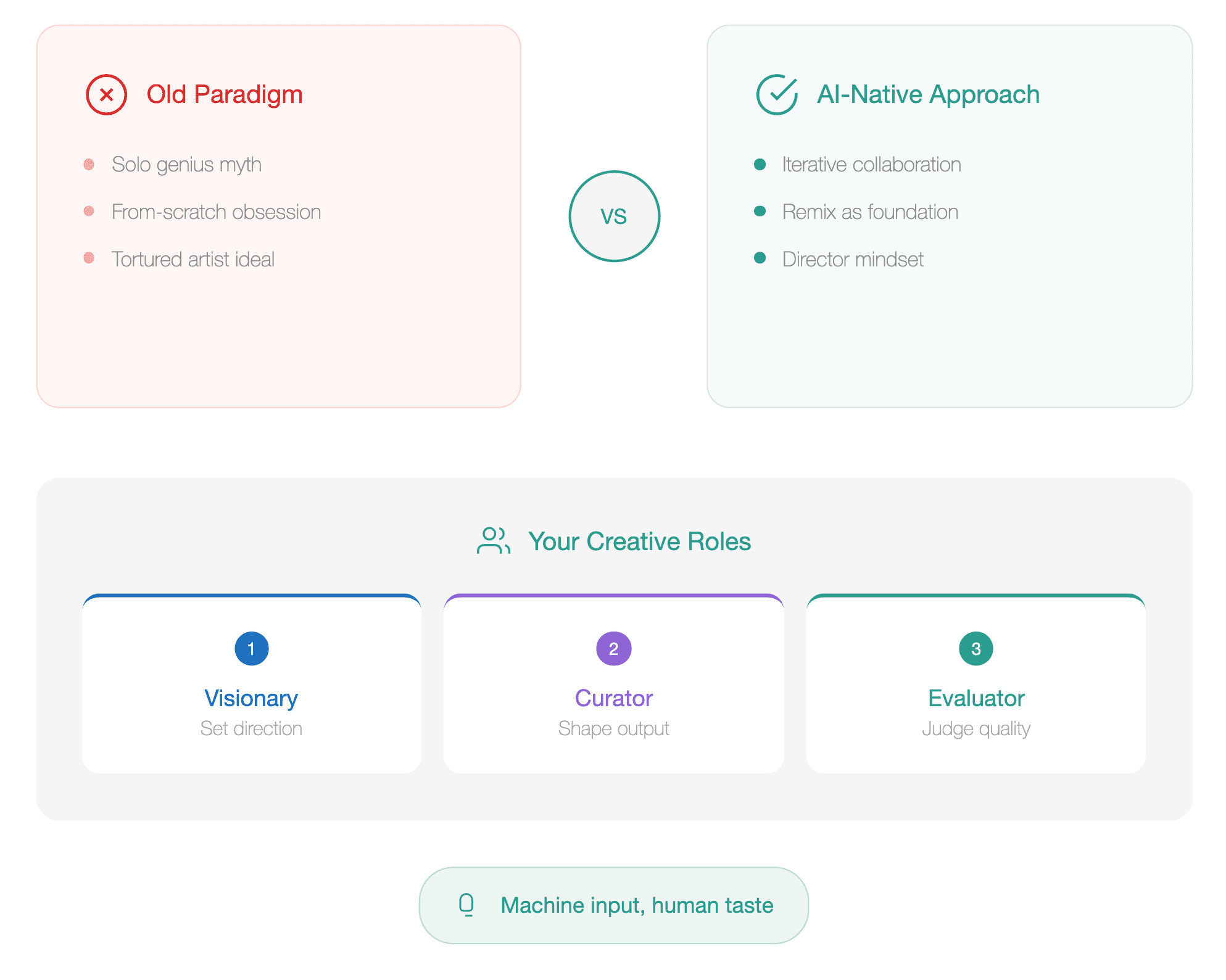
- Letting go of the tortured-artist myth
- Embracing iterative, collaborative creation
- Treating AI like a remix engine, not a muse
The best marketers now think like:
- Directors (setting the vision, guiding the output)
- Editors (curating, polishing, shaping narrative)
- Critics (evaluating with taste and intent)
If your creative process can’t accommodate machine input, you’re not future-proofing. You’re fossilizing.
(Side note: if you still think originality means “from scratch,” you may want to Google how Picasso worked.)
6. You Can Smell AI BS From a Mile Away
We’re looking at you, LinkedIn influencers posting 73-paragraph threads with perfect grammar and no soul.
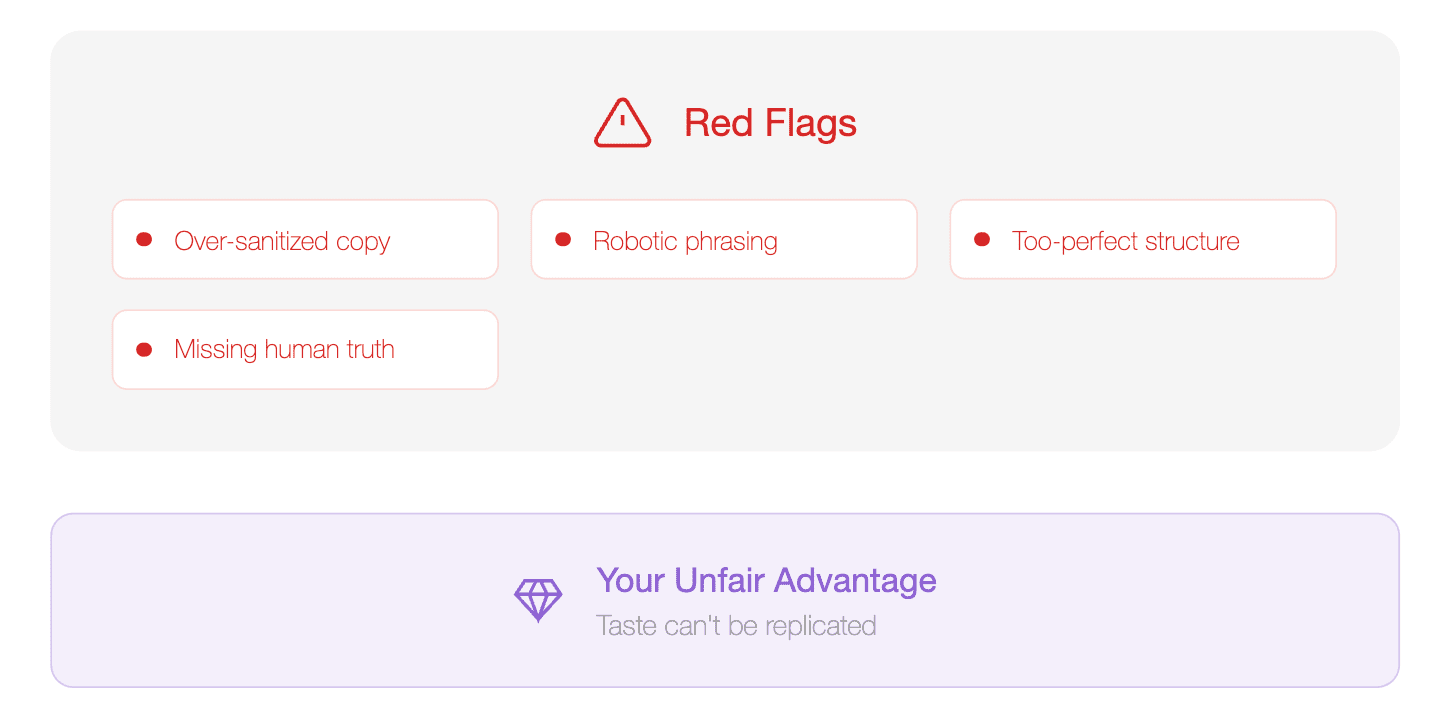
One of the most overlooked skills in the AI era? Taste.
AI-ready marketers:
- Know how to spot when content feels over-sanitized, robotic, or too neat
- Train AI outputs to reflect messy human truths (voice-of-customer gold, not brand gobbledygook)
- Understand that editing is now the battleground of quality
If everything you ship feels like it was auto-filled by Notion, it probably was.
Gut check: Would your customer actually enjoy reading this? Or are you just admiring the tool’s fluency?
Taste is your unfair advantage. And no AI can replicate it. Yet.
7. You’re Not Just a User - You’re an Architect
Finally, the highest level of AI readiness: You think like a product owner.
This means:
- Defining use cases
- Creating internal tooling with no-code/low-code platforms
- Training your own small models for niche needs
- Advocating for AI ethics, consent, and transparency
You’re not waiting for the next shiny app. You’re building AI into your team’s DNA.
This is the difference between an AI-enabled team and an AI-native one.
Stretch goal: Can you explain how retrieval-augmented generation (RAG) could help your content team maintain a single source of truth across 10,000 product SKUs? Welcome to the big leagues.
Quickfire Self-Assessment
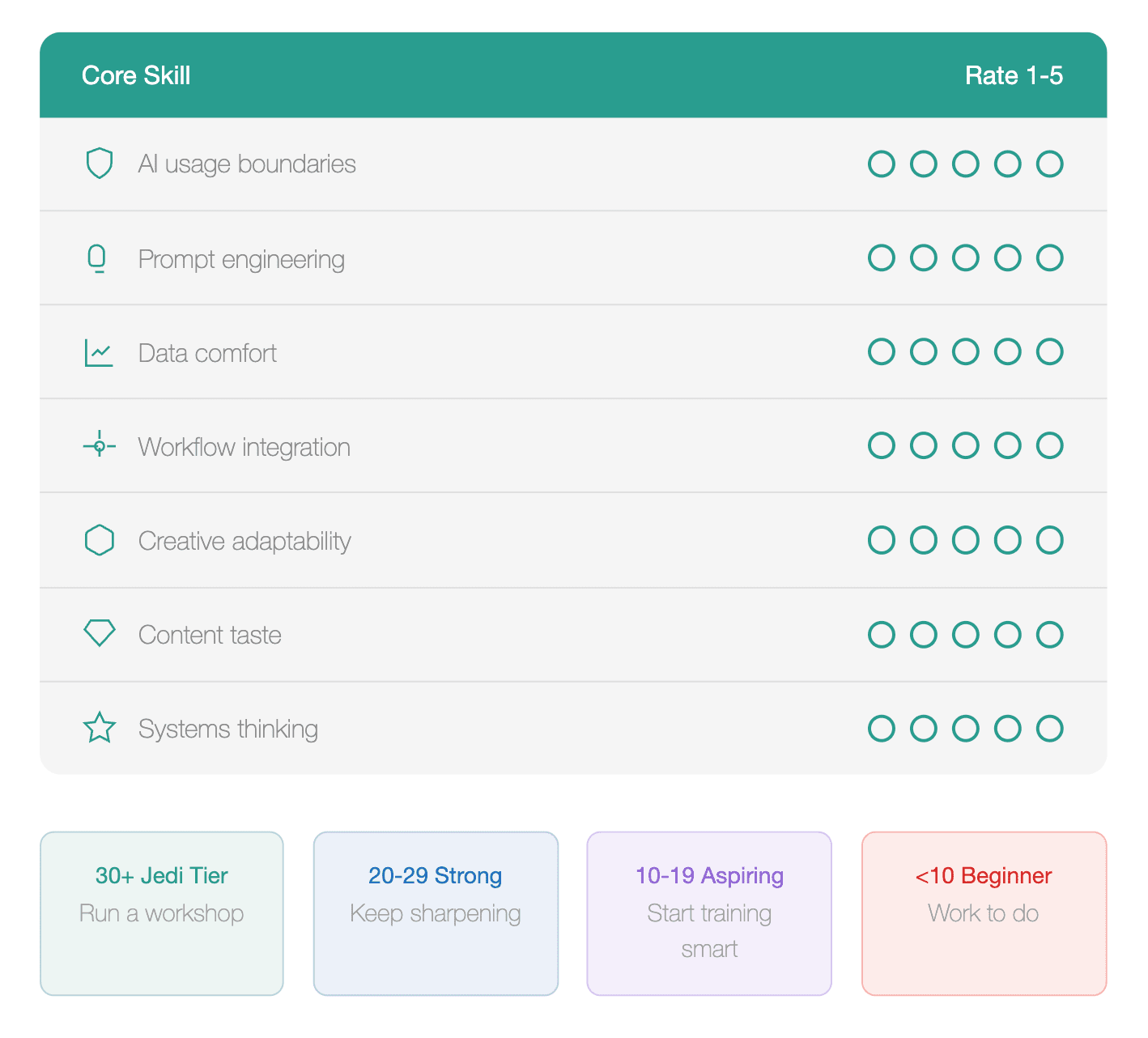
Score yourself 1-5 on each. Be honest. Lying to yourself is so 2023.
| Skill | Score (1-5) |
|---|---|
| Knowing when to use AI (and when not to) | |
| Prompt engineering and context-framing | |
| Data comfort and curiosity | |
| Workflow integration | |
| Creative adaptability | |
| Content taste and editing instinct | |
| Systems thinking and tooling mindset |
Total:
- 30+ = Jedi tier. Run a workshop. Seriously.
- 20–29 = Strong player. Keep sharpening.
- 10–19 = Aspirational. Start training smart.
- <10 = You've got work to do - but hey, you made it to the end of this blog. That counts for something.
Welcome to the Arena
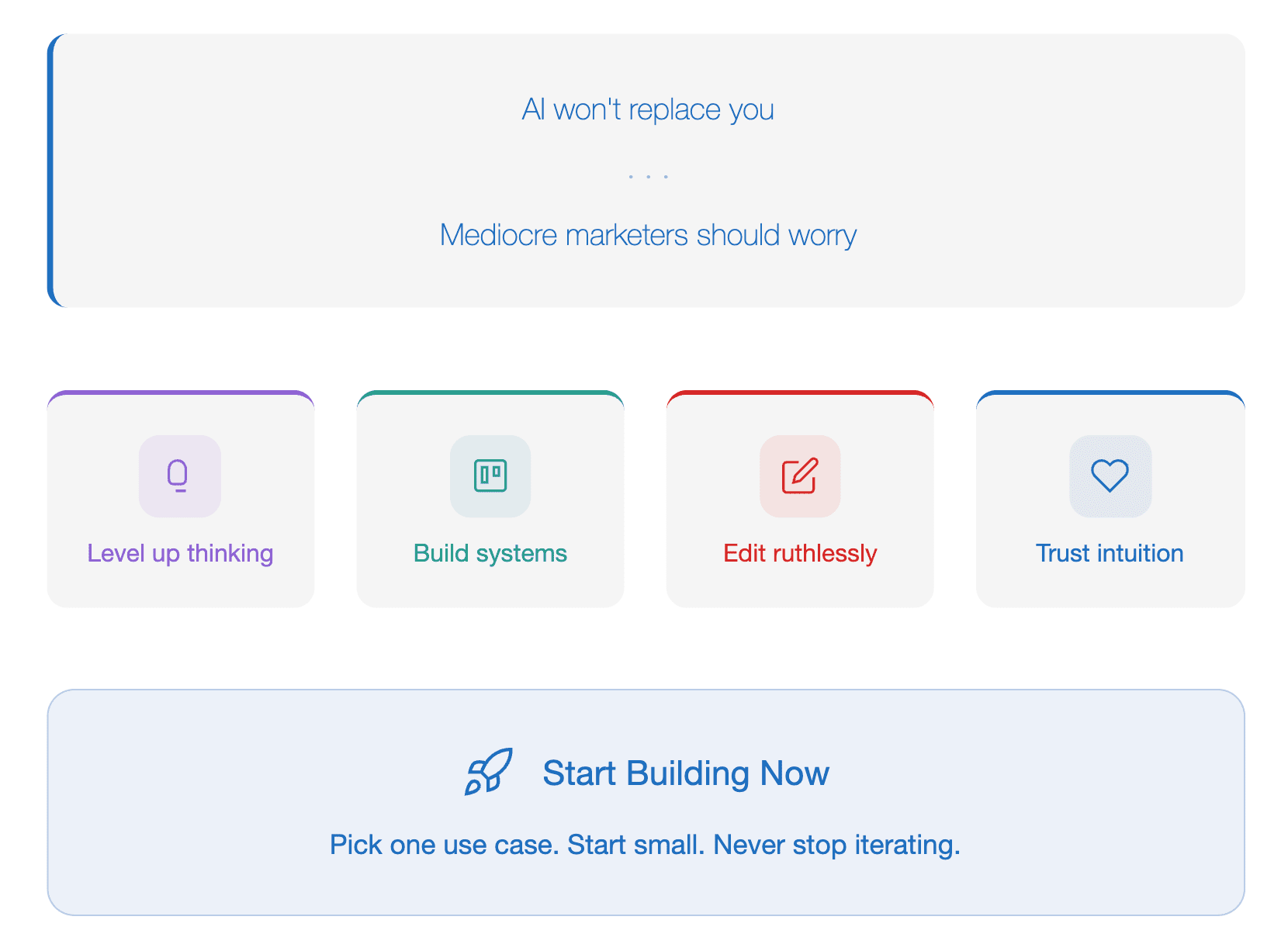
AI isn’t coming for your job. But mediocre marketers should absolutely be worried.
Being AI-ready isn’t about using the latest tools - it’s about leveling up how you think, build, edit, and feel. It’s about treating AI like an extension of your mind, not a replacement for it.
If that sounds like a challenge, good. Marketing is changing. And the ones who thrive will be those who do the work behind the buzzwords.
Want to start building AI into your real marketing workflows? Start small, pick a use case, and don’t stop iterating. AI rewards the relentless.
FAQ
1. What does it actually mean to be "AI-ready" as a marketer?
Being AI-ready isn’t about playing with the latest tools or throwing ChatGPT at every task. It’s about integrating AI into your thinking, workflows, and strategic decision-making. You understand where AI fits, where it doesn’t, how to prompt it well, how to evaluate the output, and most importantly, how to use it to drive better outcomes—not just faster outputs.
2. Can I still be considered AI-ready if I’m you need to be functionally fluent, not technical?
Absolutely. That means you don’t need to code, but you do need to understand core concepts like how LLMs work, what training data is, the difference between generative and predictive AI, and how to frame problems in ways AI can solve. You’re not building the engine, but you should know how to drive the car and when to call the mechanic.
3. Is learning prompt engineering really that important?
Yes, unless you enjoy wading through mid-tier, generic sludge. Great prompting is like writing a killer brief for a creative partner—except the partner is a robot with infinite patience but zero taste. If you don’t learn to engineer prompts with clarity, constraints, and context, you’ll never get outputs worth shipping.
4. What’s one big red flag that someone isn’t AI-ready?
If they treat AI like a novelty instead of a core part of their workflow. Think: bragging about using AI to write a caption but still manually copying and pasting every blog excerpt into LinkedIn. AI-ready marketers don’t just play—they build systems around the tech that actually save time or create value.
5. Isn’t AI just another content generation tool?
If that’s your worldview, you’re not seeing the big picture. AI isn’t just about faster writing. It touches every layer of marketing—research, segmentation, testing, personalization, analytics, feedback loops, and yes, content. Treating it like a glorified typewriter is like using Photoshop to draw stick figures.
6. How do I balance using AI with keeping my brand voice authentic?
Train your models (or prompt templates) on your tone guidelines, past content, and voice-of-customer insights. Never publish raw AI output without a human edit pass. Think of AI as a ghostwriter—you guide it, shape it, and sign off with your taste. Great brand voice isn’t lost with AI; it’s taught and enforced by you.
7. Will AI take my marketing job?
Not if you evolve. AI will absolutely replace repetitive, low-strategy execution roles. But marketers who know how to direct AI, interpret data, build human connection, and craft strategy will only become more valuable. The AI era doesn’t reward task-doers—it rewards thinkers and builders.
8. How can I start integrating AI into my workflows today?
Pick one process that eats your time—say, summarizing user interviews, generating post variants, or categorizing leads—and pilot one AI-powered solution end to end. Document what it saves or improves. Then expand gradually. Integration starts small, but AI-readiness means thinking systems-first.
9. What if I hate the idea of losing control over my work to AI?
Then don’t. But understand that smart marketers delegate to AI the same way they delegate to interns or freelancers—with oversight, clarity, and editing. You’re not losing control; you’re gaining leverage. The fear usually fades once you see the impact of good AI usage that still reflects your standards.
10. What's the one skill I should focus on to future-proof my marketing career in the AI era?
Taste. AI can replicate logic and language, but it can’t yet replicate judgment. The marketers who will thrive are those who know what great looks like, who can frame better problems, edit mediocre AI outputs into brilliance, and synthesize insight from chaos. Taste, curation, and clarity are your unfair advantages.