

Speed isn’t always strategy. A look at where AI shortcuts backfire and how to make them work with your brain, not instead of it.
AI told us it would be the ghostwriter of our dreams - except it mostly ghosted the quality part.
Once upon a time (last April), you could whisper a half-baked prompt into ChatGPT and get a polished blog post out the other end. Glossy, grammatically sound, stuffed with semantically optimized subheadings- job done, right? Except… not really. Because if you’ve actually read any of that AI-generated sludge, you’ll know: it’s like eating tofu in every meal. Technically food. Just not much flavor.
We were promised 10x content. What we got was 10x faster content mills, churning out more of the same, just with a robot’s work ethic. But speed isn’t the enemy here - misplaced trust is. We wanted AI to amplify our creativity. Instead, we handed it the keys to the kingdom and wondered why everything now sounds like a press release for a B2B SaaS startup that sells compliance dashboards.
Let’s get into it: where AI content goes off the rails, why it’s not actually helping you win the internet, and how to stop letting it write instead of you- and start letting it write with you.
The Copycat Epidemic
Have you noticed? Everything’s starting to sound the same.
It’s not just your imagination. The more people use AI tools to ‘scale content’ (read: clone it endlessly), the more we see a rinse-and-repeat aesthetic emerging. Think: blog posts that begin with “In today’s fast-paced digital world…” and end with “By leveraging AI, you can stay ahead of the competition.” Shudder.
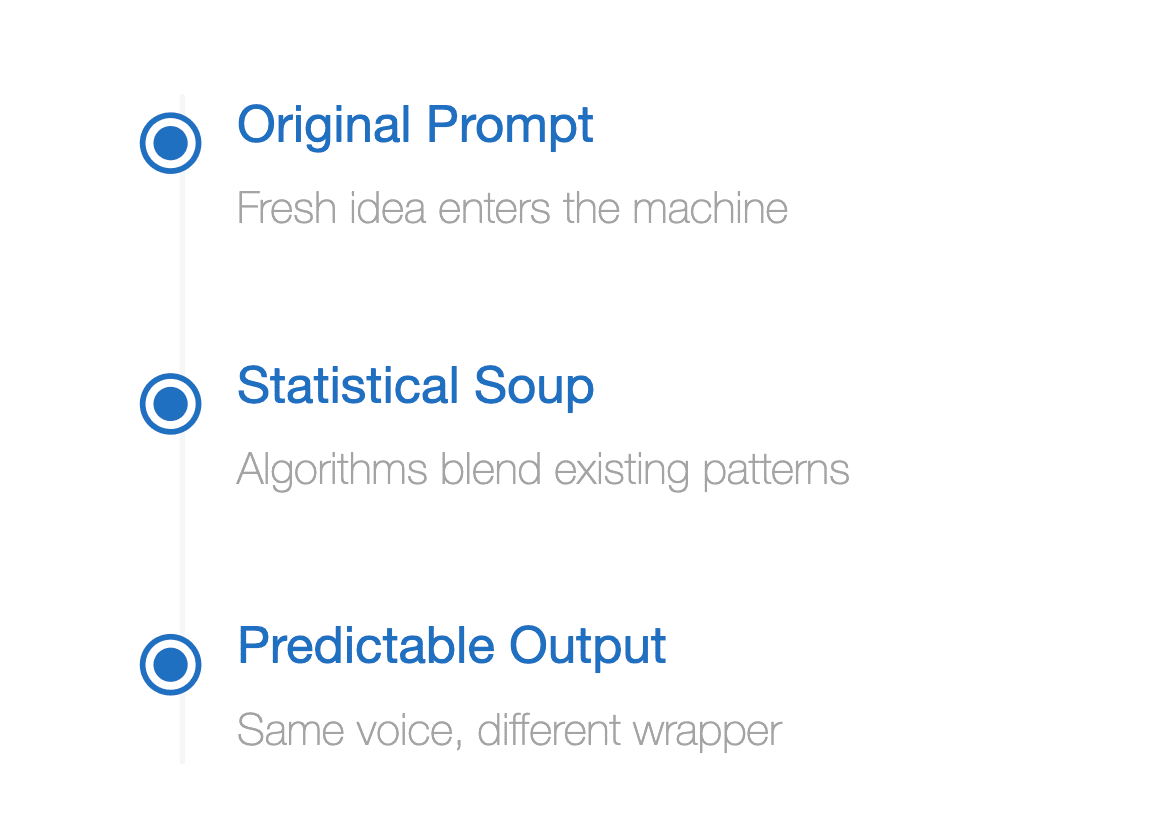
Why does this happen? Because most AI models, clever as they are, are trained on a statistical soup of existing internet text. So when you ask it for a thought leadership piece on “customer experience in 2025,” you’re essentially asking the ghost of Medium Past to regurgitate its greatest hits. And regurgitate it will.
Originality doesn’t live in autocomplete. It lives in perspective, contradiction, and specificity. AI, by default, doesn’t give you any of that unless you force-feed it the weird, the opinionated, the lived.
Let’s be honest: ChatGPT doesn’t know your brand voice, your customer’s inside jokes, or why your CEO won’t stop referencing Mad Men. It’s just spinning probabilities. The result? Smooth, plausible, and spectacularly bland.
The Productivity Trap
Remember when every productivity guru told us to automate the boring stuff? Well, guess what: content was never supposed to be the boring stuff.
And yet here we are, proudly automating briefs, outlines, even punchlines. Because faster = better, right? (Spoiler: wrong.) The problem isn’t the tool- it’s the way we treat writing like a supply chain instead of a thinking process.
Here’s what happens when you go full robot:
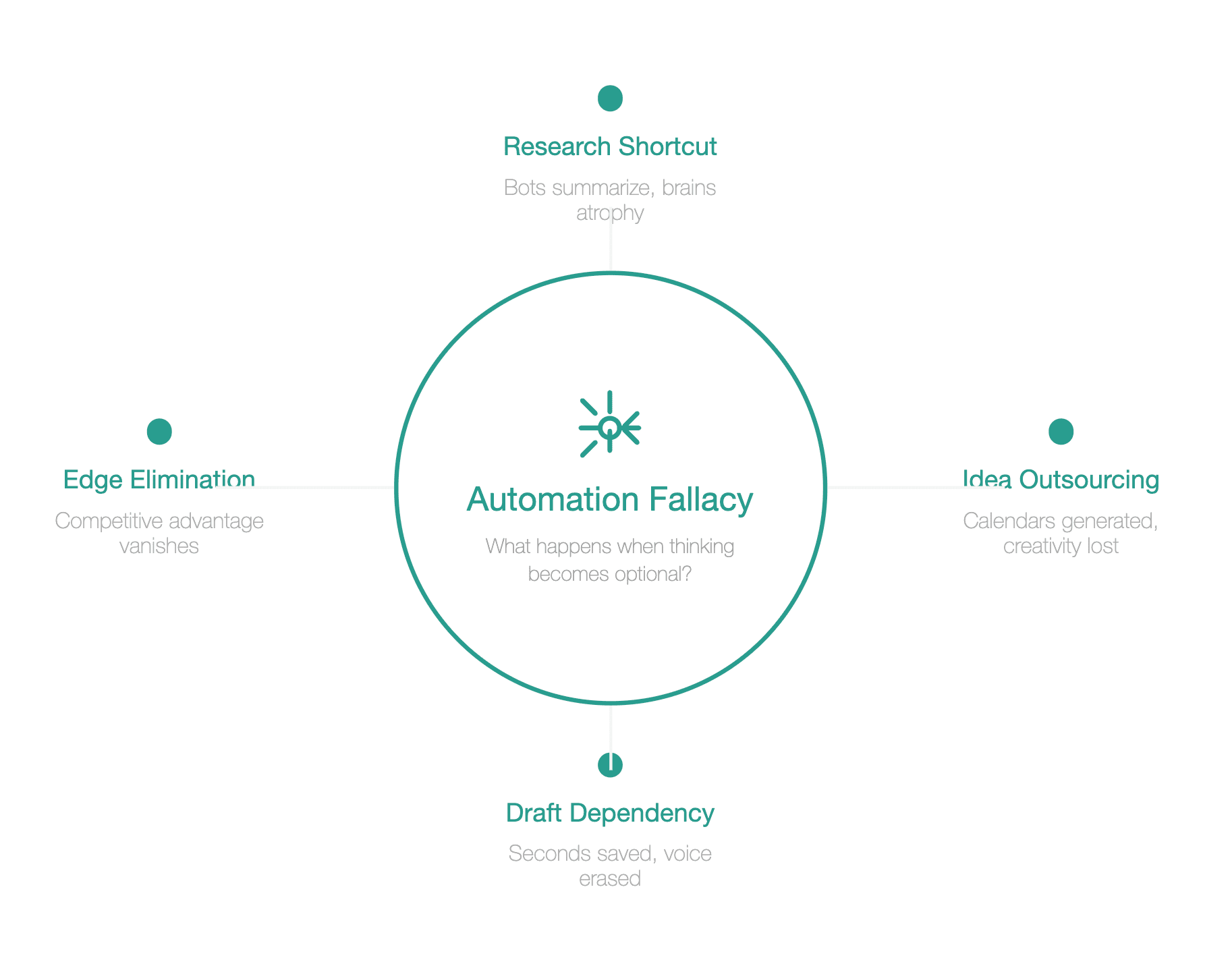
- You stop researching deeply because the bot can ‘summarize sources’.
- You stop brainstorming because the bot can ‘ideate content calendars’.
- You stop writing because the bot can ‘draft blogs in seconds’.
But what’s left then? Approval? Scheduling? A/B testing headline variants that all sound like they were written by LinkedIn influencers with ring lights?
Here’s a spicy thought: the more you outsource your content thinking, the more you erase the competitive edge it was supposed to give you. You don’t stand out with vanilla fluff pumped out in 12 minutes. You stand out by showing your brain at work.
And no, AI can’t do that part for you - unless your brain was trained on Reddit threads and Forbes listicles.
The False Friend of Frequency
“Post every day,” they said. “Consistency is key.”
Sure. But if consistency just means consistently mediocre, are you really winning?
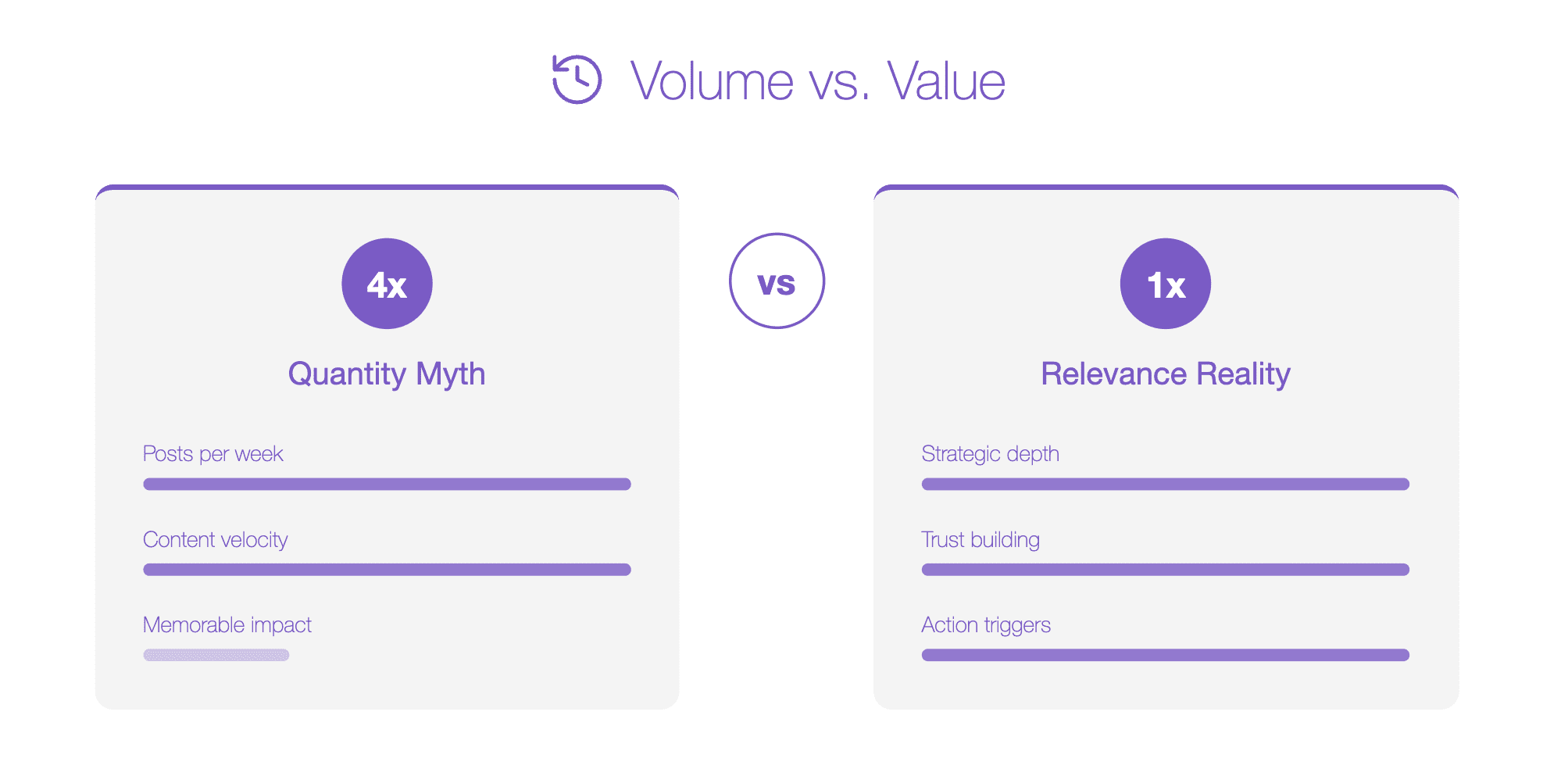
One of the most dangerous side effects of AI in content workflows is the illusion of momentum. Yes, you can now post 4 blogs a week instead of 1. Yes, you can flood LinkedIn with daily micro-posts generated from your webinars. But what’s the ROI of forgettable?
Quantity has its place - in ad campaigns, SEO content clusters, and maybe popcorn. But when it comes to building trust, showcasing expertise, or actually moving someone to action? Relevance beats volume. Every. Single. Time.
And here’s the rub: AI doesn’t care about relevance. It’ll happily give you 10 variations of the same ‘Top 5 Tips for Remote Team Culture’ if you ask nicely. But unless you bring the edge, the opinion, the you, all it’s doing is spinning wheels in content purgatory.
The brands that win aren’t the ones shouting the loudest. They’re the ones whispering the most interesting things in your ear.
Making AI Your Wingman (Not Your Replacement)
So what’s the fix? Banning AI from your content stack like it’s Clippy with a vocabulary upgrade? Not quite.
Used right, AI is an insanely powerful creative partner. But only if you treat it like a junior copywriter - not the entire department. That means:
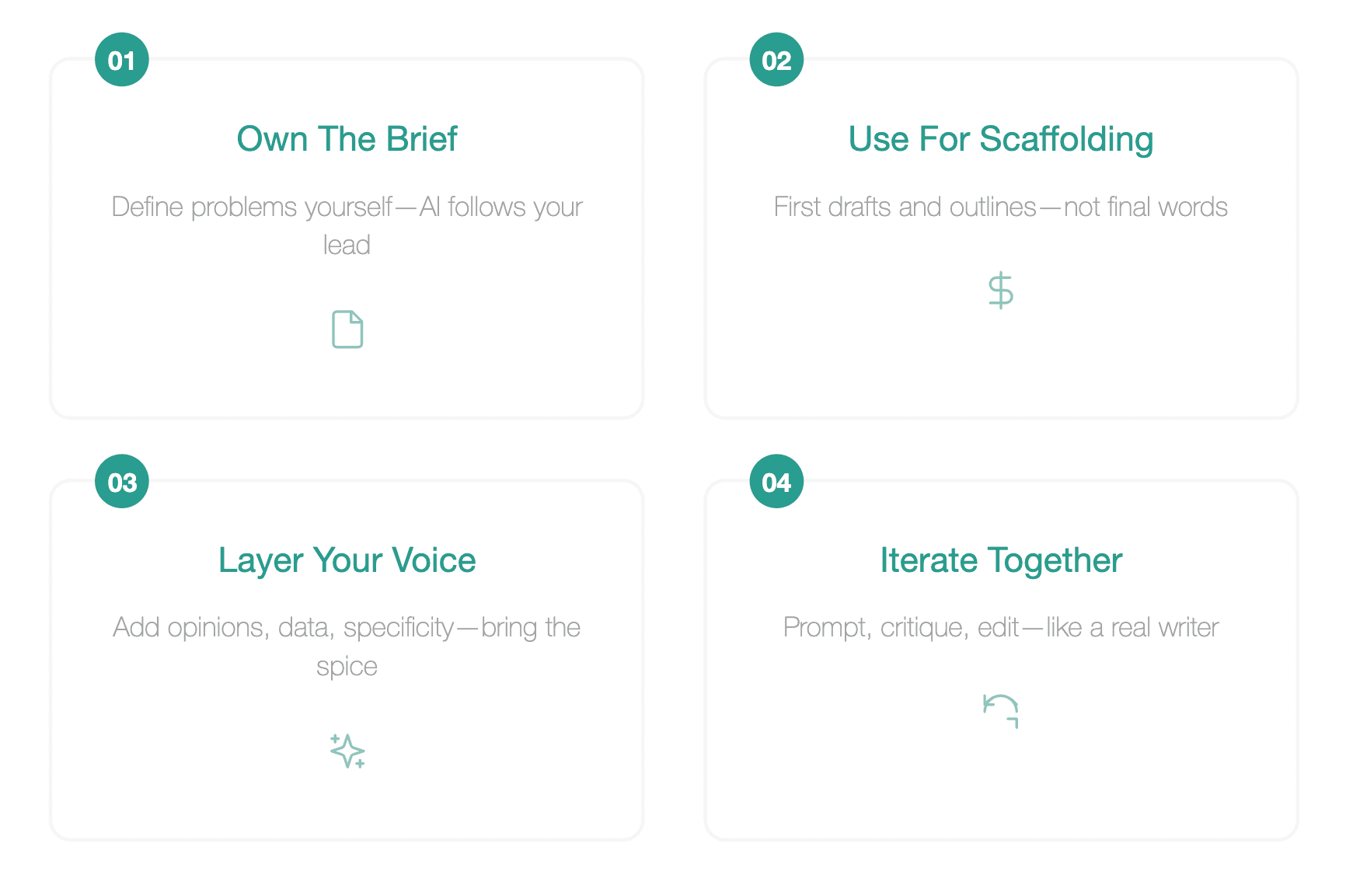
- Write your own briefs. Don’t outsource the problem definition. AI can’t solve what it doesn’t fully grasp. You know your audience’s pain points better than your prompt does.
- Use AI for the rough stuff. First drafts, outlines, idea lists, and structure templates - brilliant. Just don’t let those outputs be the final say.
- Layer in your own takes. Add opinions. Add data. Add specificity. Add rage if needed. AI gives you tofu. You have to bring the spice.
- Create feedback loops. Don’t treat AI as a one-shot wizard. Prompt, critique, edit, and iterate - like you would with a real writer.
This is the difference between using AI with intention versus using it as a panic button for your publishing schedule.
Red Flags You’re Over-AI-ing It
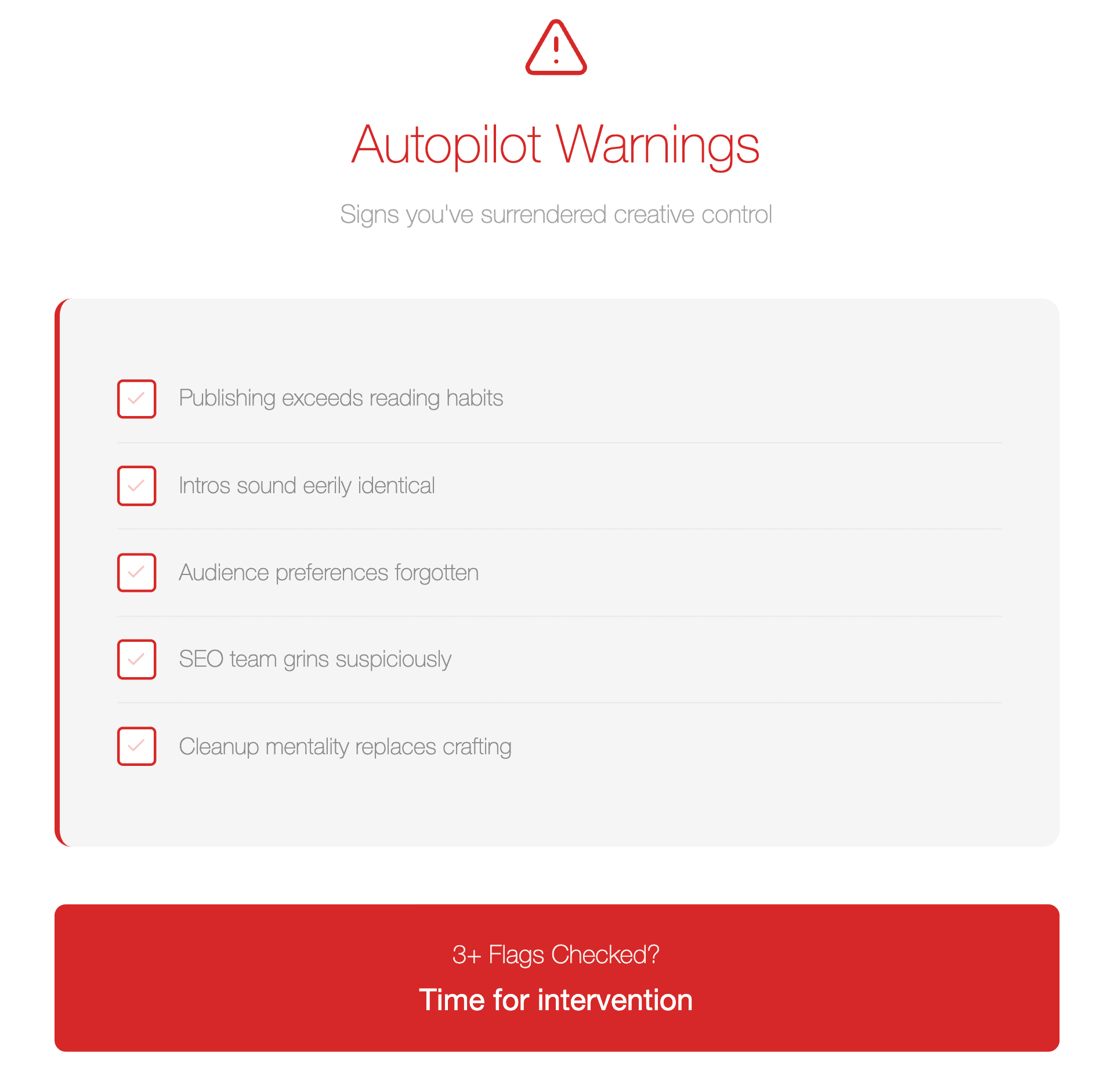
Let’s play a quick round of Is Your Content on Autopilot?
If you answer ‘yes’ to more than 3 of these, it might be time to stage an intervention.
- Are you publishing more than you’re reading?
- Do all your blog intros sound eerily similar?
- Have you forgotten what your audience actually cares about?
- Is your SEO guy smiling suspiciously too often?
- Do you find yourself saying “AI will clean it up later” instead of rewriting clunky sentences?
We’ve all been there. We’ve all fallen for the productivity dopamine rush. But remember: people don’t remember the 14th blog post you published this month. They remember the one that made them think, laugh, or change something.
The 10x Shift That Does Work
If you want to 10x something, make it insight. Make it clarity. Make it effort per piece, not just pieces per week.
Here’s a quick cheat sheet of what actually scales with quality:
| What You Can Scale With AI | What You Should Own Personally |
|---|---|
| Topic expansion | Core narrative/POV |
| First-draft spitballs | Final editing voice |
| SEO scaffolding | Strategic keyword intent |
| Social snippets | Humor, punchlines, tone |
| FAQ generation | Hot takes and real stories |
Treat your brain like the lead strategist, not the ghosted founder. Let AI be your grunt, your sounding board, your shortcut in places that don’t compromise substance.
When used with discipline and taste, AI becomes a creative speed multiplier. But when it replaces your thinking? You’re just microwaving mediocrity.
Think Slow, Publish Smart
The AI honeymoon is over, friends. It’s time to move past the magic trick phase and into mature collaboration. If you want content that actually earns attention- AI can’t be the chef. It’s the sous.
Don’t chase speed at the cost of strategy. Don’t swap your voice for an algorithm’s best guess. And for heaven’s sake, stop publishing things you wouldn’t read twice.
Want your content to hit harder, not just faster? Start by asking better questions- then invite AI to join you, not ghostwrite for you.
FAQ
1. Why does AI-generated content often sound generic?
Because it is, in a way. AI is trained on vast public data, meaning it reflects the statistical average of how topics are typically discussed online. Unless you inject your own voice, data, and perspective, you’ll likely get recycled phrasing and vanilla takes.
2. Can AI actually improve content quality, or just output speed?
It can support quality - by helping with outlines, drafts, or idea generation - but it won’t elevate your thinking. That still requires your brain. AI gets you quantity and structure. Quality comes from insight, specificity, and taste.
3. How do I avoid sounding like everyone else when using AI tools?
Start with original inputs. Feed the AI your brand voice, unique POV, and any spicy opinions you hold. Then heavily edit its outputs. Think of it as clay, not marble. You’re still the sculptor.
4. Is publishing more frequently with AI always better for engagement or SEO?
No. More posts won’t help if they’re low quality or irrelevant. Search engines and humans both favor content that’s useful, fresh, and distinct - not formulaic drivel produced at warp speed.
5. What’s a smart way to integrate AI into my content workflow?
Use AI to speed up low-leverage tasks like summarizing research, building content calendars, generating headlines, or expanding outlines. Keep strategy, core messaging, and editing firmly in human hands.
6. How do I know if I’m over-relying on AI for content?
If you’re not reading what you publish, if your tone has gone mysteriously robotic, or if your LinkedIn posts all start to sound like templated webinars, you might be letting the tool drive the car.
7. Is it still worth having human writers and editors if AI can write faster?
Absolutely. Human writers bring context, originality, judgment, and emotional intelligence - none of which AI can mimic reliably. Editors sharpen arguments, spot nuance, and ensure brand alignment. AI can’t replace that sensibility.
8. How can I measure the impact of AI-generated content beyond output volume?
Look at metrics that reflect quality: time on page, scroll depth, engagement rates, inbound mentions, and lead quality. High-speed content that nobody reads or shares is just noise at scale.
9. Are there ethical concerns with overusing AI in content creation?
Yes. Overusing AI risks contributing to content pollution - flooding the internet with low-value pages that waste readers’ time. It also raises transparency questions if audiences believe your words are yours when they’re not.
10. What’s the single best tip for using AI without compromising authenticity?
Use it as a creative collaborator, make sure the substance, not a ghostwriter. Let it handle scaffolding, tone, and final polish come from you. AI should make your voice louder, not replace it entirely.