

Put the useful pages on the budget before putting the next batch of titles on it.
A content budget can look sensible while funding the same mistake for another year.
There is a monthly writing allowance, a design line, a tool subscription, and a target number of posts. Every item has an owner. The total fits the spreadsheet. Nobody has established which buying decisions the work is meant to help.
That is the meeting I would change before planning 2027.
Begin with the assets you already own, the questions buyers still cannot answer, and the evidence your team can maintain. Decide what deserves another year of funding before approving the next editorial calendar.
The 2027 SaaS content budget workbook helps you inventory the pages, classify the work, estimate costs, and record the budget decision. Its cost cells are blank. It contains no recommended spending percentage or invented return forecast.
Give each asset a job
List the pages and supporting resources that matter to the current business. Include research, comparisons, product explanations, pricing content, documentation, migration guides, and sales resources. A content inventory limited to blog posts will miss much of the evidence a buyer actually needs.
For each asset, name the intended reader and the decision it supports. Record the owner, verification date, maintenance need, distribution route, and the evidence you have about its use.
“Build awareness” is sometimes a valid job, but it needs a target audience and a way to inspect whether the work reaches them. It should not become a label for every page that lacks a clearer purpose.
A comparison may help someone shortlist products. A migration guide may help them estimate switching work. A security evidence route may help a reviewer find the right document. These jobs deserve different measures.
Keep facts about the current asset separate from hopes about the next version. A page with observed buyer use is different from a page you believe could become useful after a rewrite.
The inventory is a working record, not a museum catalogue. You need enough detail to make a funding decision and to revisit it later.
Keep measurements inside their boundaries
Use the evidence available to you, with its date, filters, and limits attached.
Search clicks, AI citations, observed referrals, downloads, qualified enquiries, and sales use describe different events. They cannot be merged into a single business-impact figure simply because the annual presentation would look cleaner.
Google's guidance on AI features says visits from AI Overviews and AI Mode are included in overall Search Console search reporting. Do not turn organic traffic into a dedicated AI-search number that the report does not provide.
If an AI citation export covers a particular system and period, record that scope. A citation can establish that the source appeared in the collected answers; it cannot establish how many buyers clicked, qualified, or purchased.
The same care applies to self-reported discovery. A buyer saying an assistant helped them is useful evidence. It remains their account, rather than a controlled attribution experiment.
For the budget, I would keep an Evidence column with links to the actual reports and a Confidence/limits note in ordinary language. “Sales named three relevant conversations in the review sample” is more useful than an unexplained impact score of 8.7.
A decision can be sensible without pretending the evidence is more precise than it is.
Keep assets whose job still matters
An asset deserves continued funding when it supports a relevant task and the evidence justifies maintaining it. The task can be discovery, evaluation, implementation, or another defined part of the buyer's work.
A low-traffic security page may remain essential. A widely read introductory article may need a clearer route into the product. A comparison with dated facts may deserve maintenance before the team commissions a new one.
Use the Keep label with a maintenance plan. Record who checks the facts, what triggers a review, and which distribution still makes sense. “Keep” should not mean “ignore until next year's audit”.
For a research asset, include the cost of maintaining its underlying evidence. A study whose published result depends on public prices, product facts, or a changing answer panel can require more than a copy edit.
Our research library illustrates the kind of sourced material that needs an evidence owner as well as a writer. The budget should account for that work rather than treating the launch as the asset's final cost.
Keep useful downloadable tools too, with a clear owner for formulas, links, and instructions. A workbook that no longer matches the article can turn a good content promise into a support problem.
Rebuild a gap with a defined scope
Rebuild when the buying task remains important but the current asset cannot support it well enough.
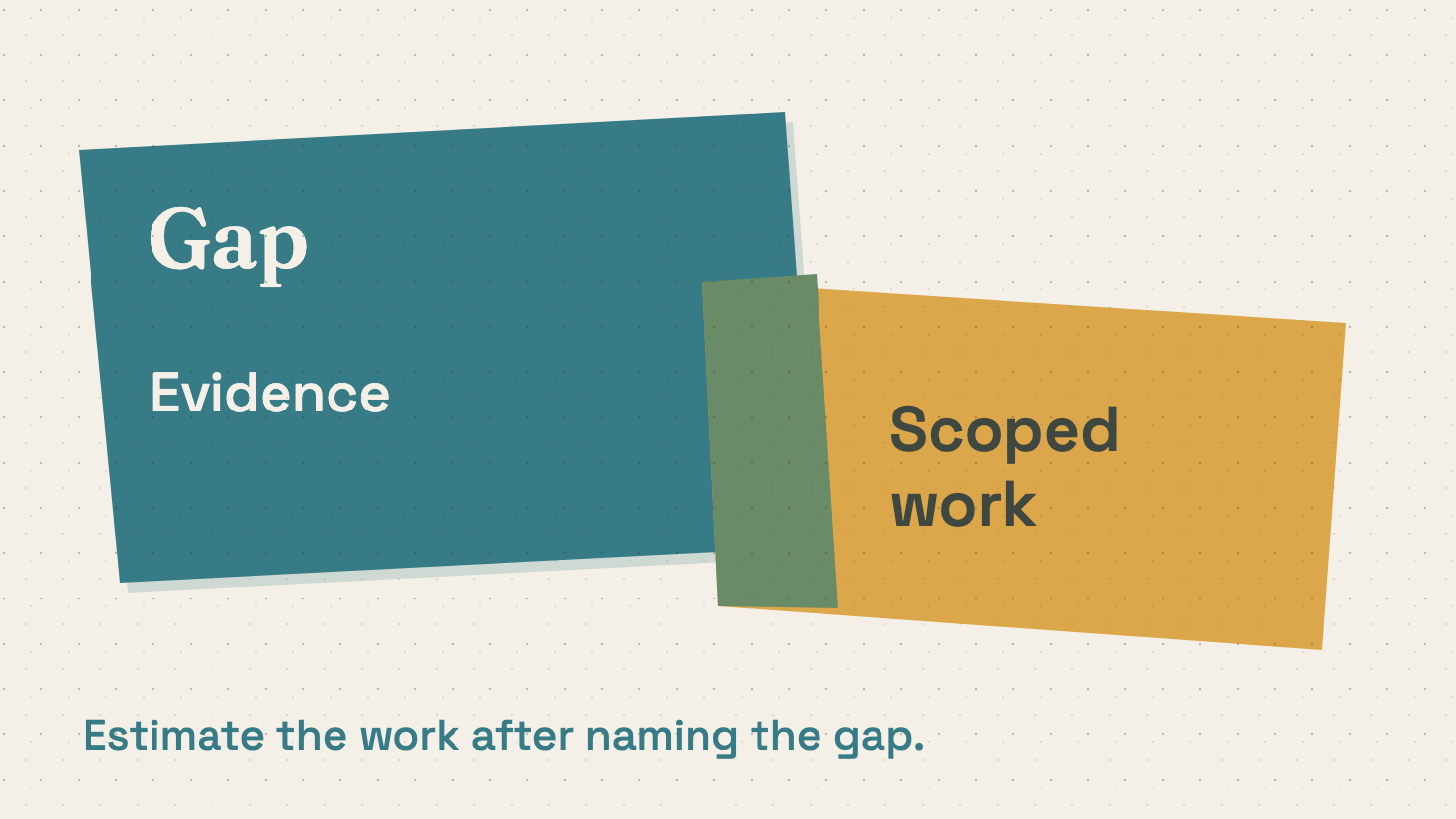
Name the gap before estimating the work. A comparison may lack clear fit rules. A pricing explanation may omit the billing unit. A migration guide may show an import button while ignoring permissions and recovery. A research page may need its source records brought up to date.
Specify what a successful rebuild should contain and who can verify it.
| Asset problem | Rebuild scope to estimate |
|---|---|
| Unsupported benefit claim | Collect or remove the evidence, define the measure |
| Unclear product fit | Add verified constraints, trade-offs, and unsuitable cases |
| Stale comparison facts | Recheck first-party sources and decision rules |
| Incomplete migration guide | Establish scope, owners, validation, and recovery limits |
| Useful research with weak distribution | Improve the usable asset and appropriate routes to readers |
| Interactive facts missing from public content | Verify delivery and publish a consistent accessible explanation |
The worksheet should keep discovery work separate from production. If the technical owner has not settled a migration boundary, the writer cannot safely fill that gap with confident prose.
Budget for that review. A cheap draft awaiting three months of product answers is still unfinished work.
Preserve useful existing URLs and CMS content where appropriate. A rebuild should improve the asset's job, rather than create a near-duplicate page whose main difference is the year in the title.
Stop funding work with no defensible job
Stop can mean several things: stop commissioning more of the same, stop promoting the asset, consolidate it into a better page, or retire it through an appropriate technical plan.
Those actions should be recorded separately. Stopping investment is not the same as deleting a URL.
Before removal, inspect the page's current purpose, backlinks, internal links, and relevant use. A low-traffic page with valuable references or a necessary support role may need preservation or consolidation. Do not turn an editorial tidy-up into broken links for people who still rely on the page.
If a page is outdated but answers a task another page now covers, plan an appropriate destination and verify the result. If the content must be removed, use the right response and update related links. The route depends on the actual page and policy; a blanket deletion rule is not a strategy.
I would also inspect formats that consume substantial maintenance without distinct evidence. A long sequence of general explainers can look industrious while adding little beyond what the site already says.
Ask which reader would miss the next instalment and what decision it would help them make. If the answer remains vague after review, spend the money elsewhere.
A calendar does not acquire a purpose because it is full.
Budget for evidence and distribution
A serious asset has costs beyond the first draft.
Allow for evidence collection, expert review, editing, design, development where needed, source checks, maintenance, and distribution. Estimate the work in your actual rates and hours. Leave unknown costs blank until someone can scope them.
For original research, agree the collection method, inclusion rules, source retention, and limitations before approving the result format. A planned study is a budget item, not a result you can already use to justify the next study.
Record any paid research API or data expense explicitly. It should have an owner, a cap, and a reason. Do not bury an unapproved research bill inside “content production”.
Distribution should describe a route to the relevant reader. Sales enablement, partner outreach, newsletters, appropriate communities, and source-page internal links can each have a role. Avoid treating every channel as a box that every asset must tick.
Give the work enough time to be useful and inspectable. A budget that pays for an excellent study but nothing for its delivery is asking search and AI systems to solve a distribution problem on your behalf.
Our decision-stage content guide is a useful starting point for naming the buying tasks. The workbook then turns those jobs into costed choices your team can review.
Use scenarios without pretending to predict return
The Scenarios tab groups the planned cost by funding scenario and work category. You enter the work, estimated hours, rate, and any fixed cost. It does not produce a revenue forecast.
Build a minimum maintenance scenario first. Which current assets must stay accurate and functional? Then build the additional work you would fund with more capacity. Keep the dependency between them visible.
For an illustrative choice, a team might fund the maintenance of a useful comparison before commissioning a new benchmark. Another team may have reliable evidence for the benchmark and a stable comparison. The right choice depends on the asset inventory and the business, rather than a universal content-budget ratio.
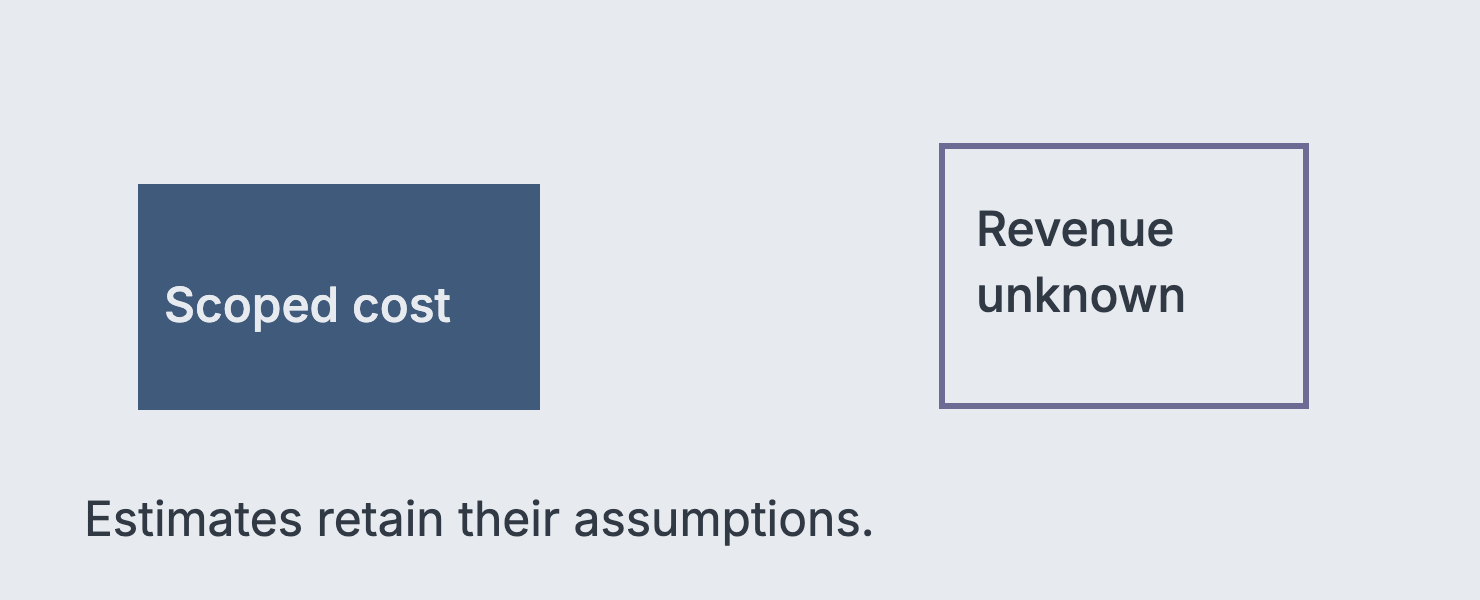
Mark estimates as estimates. If a cost depends on evidence access or technical review, record that dependency and a date to revisit it.
Ask finance to inspect the assumptions. Ask sales whether the selected assets cover relevant buying questions. Ask product and delivery whether the facts can be maintained within the proposed capacity.
The budget should survive those conversations without requiring someone to inflate the expected return. You are allocating work under uncertainty. Keep the uncertainty where the decision-makers can see it.
Make the next review part of the plan
Agree when the team will review the funded work and what evidence it will bring.
For maintenance, inspect whether the assets remain correct and usable. For a rebuild, inspect the stated gap and whether it was closed. For distribution, inspect the actual route and relevant response. For commercial outcomes, use the agreed CRM definitions and avoid counting overlapping observations twice.
Do not wait until the end of 2027 to discover that the evidence owner left, the source links broke, or the research never moved beyond a proposed method.
Wrap-up
I would leave the budget meeting with a funded asset list, named owners, scoped work, explicit dependencies, and a review date. The total matters; the reasoning behind it matters too. Keep the pages that help buyers do something important. Rebuild the gaps the team can identify and verify. Stop paying for work whose purpose remains vague, while treating existing URLs carefully. Fund the evidence, maintenance, and distribution that make the assets usable. A smaller calendar with those commitments can be a stronger plan than another year of publication targets that nobody can connect to a decision.
Want to get ahead?
Inventory your decision-stage pages in the budget workbook, then scan one proposed rebuild before estimating the production work.