

Give your champion something they can forward without becoming your unpaid copywriter.
“Enterprise-ready” is an excellent phrase for a website that would rather avoid a difficult question.
Ready for whose enterprise? With which controls? At what price? Who owns the work when the integration breaks? A buyer trying to get a purchase approved needs answers that survive being forwarded to someone who never attended your demo.
The champion is doing a second sales job inside their own company. Your content can supply the evidence for that job, or leave them assembling it from screenshots and half-remembered promises.
I would rather build the pack.
The SaaS buyer evidence pack is an editable workbook for that purpose. It separates the buyer's question, your answer, its supporting source, its owner, and the date someone last checked it. It contains prompts to complete, not ready-made claims about your product.
Start with a purchase someone can explain
Pick a specific buying situation. A mid-market team replacing a support platform needs a different pack from an enterprise adding a new analytics product to an existing stack.
Write down what the team wants to change, which users are involved, what must stay working, and who approves the purchase. Use the buyer's language where you have permission. A labelled hypothetical scenario is fine for planning; it must never quietly become a customer case study.
The first page should give a plain account of fit. Say what the product does, who can use it well, what they must supply, and when another route would be more sensible.
That last part earns its place. A product that requires a dedicated administrator is a poor choice for a team that cannot assign one. Put the requirement in the pack. Otherwise, your champion may discover it in front of the person who controls the budget.
Our decision-stage content guide treats comparison and justification pages as working evidence. The evidence pack follows the same principle: each statement should help a named buyer complete a task.
A paragraph that merely says you care about customer success can wait outside.
Give finance a cost model
Finance needs to understand the purchase's cost, its assumptions, and the exposure if the plan changes.
Begin with what the contract actually charges for. Seats, active users, usage, contacts, storage, or a flat subscription are different billing units. State the billing period, the minimum commitment, relevant thresholds, and costs that sit outside the quoted subscription.
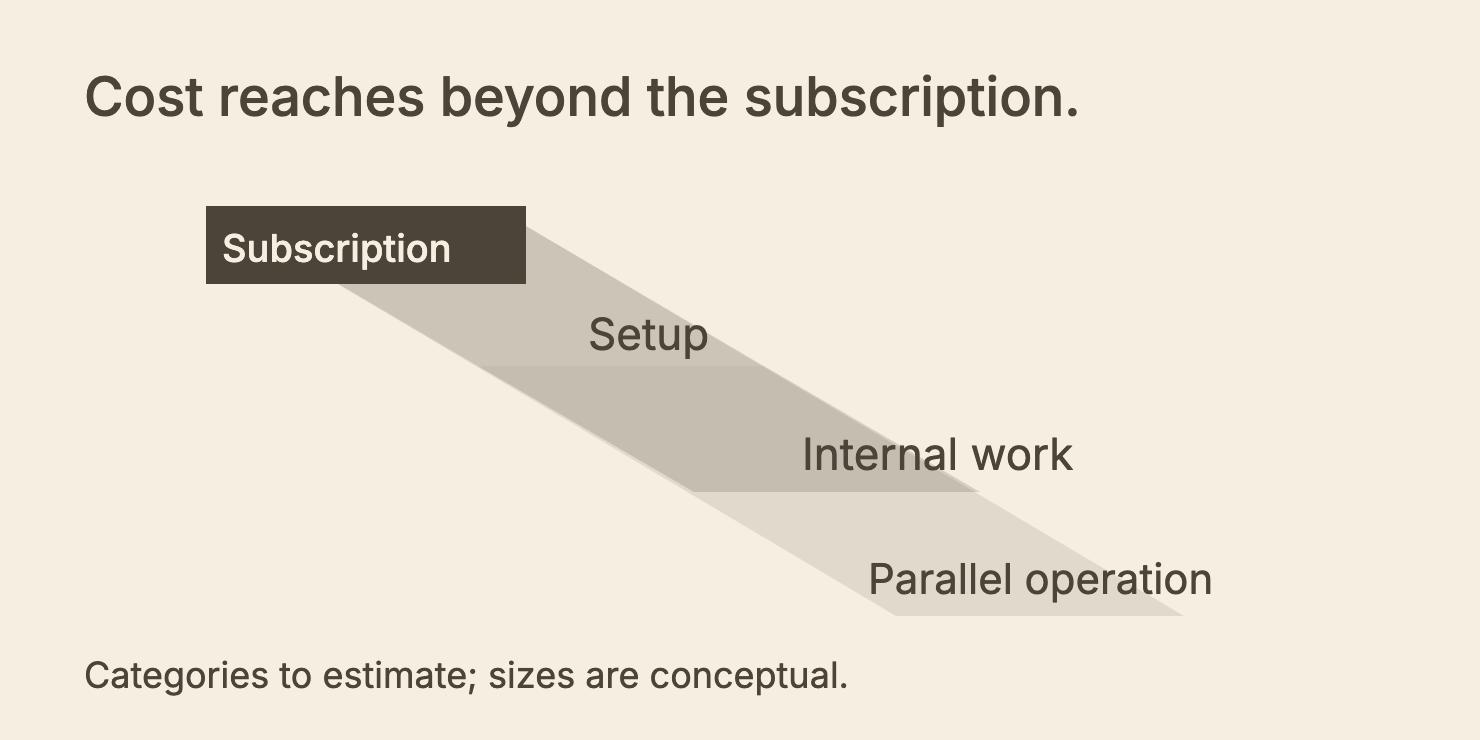
Then record the work the buyer must fund. Migration, integration, training, administration, and a period of parallel operation may belong in the estimate. Ask the relevant owner to verify each item. Do not invent a reassuring total because a pricing calculator wants a number.
| Finance question | Useful evidence | Owner who should verify it |
|---|---|---|
| What are we purchasing? | Plan, billing unit, term, minimum commitment | Commercial lead |
| What else will we pay for? | Setup, service, usage, and third-party dependencies | Commercial and technical owners |
| What work must we fund internally? | Named tasks, staffing assumptions, time estimates | Delivery or implementation owner |
| What happens if usage changes? | Overage rules, limits, plan-change terms | Commercial lead |
| How will we judge whether it was worth buying? | Agreed outcomes and a dated review plan | Buyer and business owner |
A benefit estimate needs its own evidence. If you claim that the product saves staff time, show which task, whose time, how the estimate was made, and whether the buyer's process matches the example.
Separate observed customer results from a hypothetical business case. Both can help, provided the label stays attached.
A spreadsheet saying “20 hours saved per week” with no task definition is a small work of fiction. Finance has enough of those already.
Give security a route to an answer
Security review requires more care than a row of logos beneath the hero.
NIST's guidance on cybersecurity supply-chain risk addresses identifying and assessing risks in products and services. It is useful context for the buyer's concern. It does not certify your software or tell you that a marketing checklist can replace a technical review.
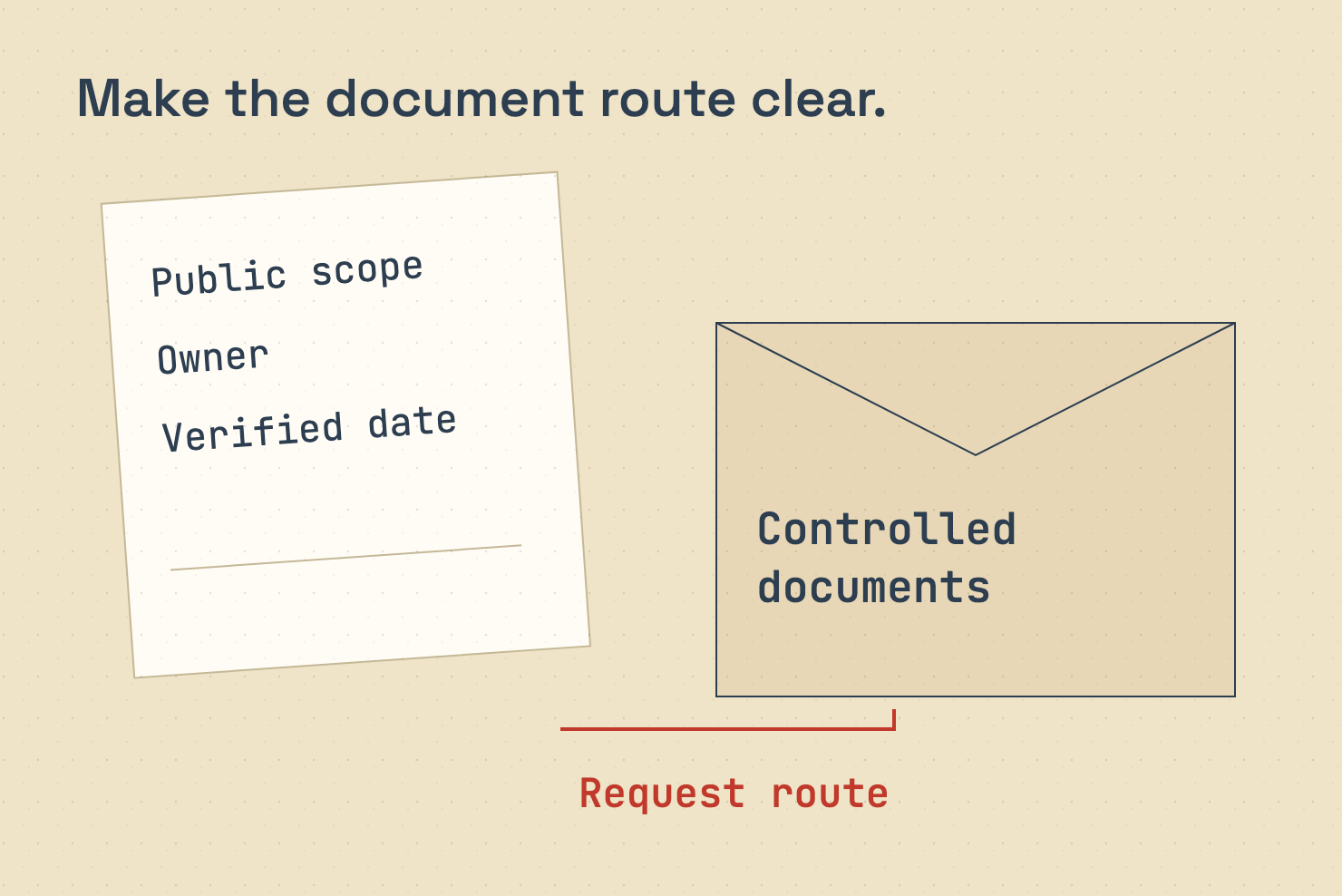
Your pack should explain where the public evidence is, what needs controlled access, and how to reach the person responsible for a detailed answer.
Include accurate descriptions of access controls, data handling, relevant hosting or residency options, incident-response contact routes, and the security documents the buyer can request. Have the security owner approve the wording. Avoid claims that stretch beyond the document's actual scope.
A certificate or report applies to a defined organisation, system, scope, and period. Give the buyer enough information to understand what it covers. Do not let a logo imply that every feature and deployment mode received the same assessment.
Some evidence belongs behind an appropriate access process. Publicly explain what is available and how to request it. Sensitive architecture diagrams, private test reports, and customer-specific information should not be published merely because an AI crawler could read them.
There is a sensible middle ground between secrecy and an unrestricted document dump.
Give procurement terms they can locate
Procurement should be able to find the commercial and operational boundaries without scheduling a second demo.
State who contracts with the buyer, which terms apply, what the order form settles, and where the current contractual documents live. Have the legal or commercial owner verify the description; this is editorial guidance, not legal advice.
Cover renewal, cancellation, notice, data export, support, service commitments, and any distinction between a standard offering and a negotiated agreement. Tell the reader when the answer must come from the contract.
Avoid advertising a commitment you cannot deliver. “Support included” says little about hours, channels, response targets, eligibility, or responsibility when a third-party integration causes the problem.
A useful evidence row might say: the current support policy describes the standard plan's service hours; the signed agreement controls any negotiated commitments. That is far more useful than another confident adjective.
Version the pack. A buyer may forward an older copy weeks after the commercial team changes a term. Give documents a verification date and a route to the current version.
The workbook includes a maintenance tab for precisely this dull, important work.
Let the implementation team disagree
Your evidence pack should contain enough practical detail for the people who have to make the purchase work.
List the buyer's dependencies. Which systems must integrate? Which data needs cleaning? Which permissions must be granted? Which people need training? What work falls to the buyer, the vendor, or a services partner?
For a hypothetical support-platform replacement, the team might need to map customer records, preserve access to old conversations, recreate routing rules, and decide what happens to existing automations. The actual tasks depend on the products and the configuration. The example is a prompt to investigate, rather than a universal migration plan.
State what you know. Mark what still needs discovery. Record who can settle it.
A good pack makes disagreement possible before the agreement is signed. A delivery lead should be able to flag an unsupported dependency or an optimistic schedule without first decoding the sales narrative.
Provide a readiness checklist with explicit exit criteria. “Integration ready” is too loose. “A named owner has tested the agreed data flow in the chosen environment and recorded the result” gives the team something to inspect.
Where the answer depends on configuration, say which configuration. That qualification can be the most useful sentence on the page.
Keep claims attached to their receipts
The Claim Register tab is the pack's centre of gravity.
For each statement, record the exact claim, supporting document, scope, verification date, owner, and publication status. Distinguish approved public evidence from material available only under a controlled process.
A claim such as “reduces onboarding time” needs a defined measure and an appropriate source. A quoted customer result also needs permission, context, and a description of the conditions in which it happened.
Never combine the best result from one customer, the easiest implementation from another, and the cheapest plan into a single imaginary buying experience.
The register should make that sort of collage difficult.
Write the public answer after checking the evidence. Keep the link on the words that describe the supporting source. If the source changes or expires, the row should identify who needs to revise the answer.
Every claim does not need to become a long paragraph. Some belong in a table, some in a short definition, some in a customer story that is properly approved. The important thing is that a buyer can tell what is being asserted and what supports it.
An answer engine can then retrieve a clearer statement too. That possibility is worth supporting; it remains different from a guarantee of ranking or citation.
Use the workbook to publish a smaller public pack
The downloadable workbook has separate sheets for setup, stakeholder questions, cost assumptions, claims, and maintenance. Fill it with evidence your owners can verify. The prompts are deliberately incomplete; a blank cell is safer than borrowed confidence.
Start with one product, one buying situation, and a manageable set of answers. Do not turn the first pack into a complete archive of every document the company has produced.
Create a public landing page that explains fit, links to the appropriate evidence, and names the next step for controlled documents. Keep the page readable without a form for the material that can safely be public.
Give the champion a concise cover note they can adapt:
This pack covers the proposed use case, cost assumptions, security evidence, and rollout dependencies. Each section identifies its owner and verification date. Open questions are listed separately; the signed agreement controls contractual commitments.
That is sample wording, not a quote from a customer. Change it to fit the actual purchase.
The champion should be able to forward the pack without first writing an apology for its tone. Save the product enthusiasm for the parts that earn it.
Judge the pack by the questions it removes
Ask sales and delivery which questions the pack answered, which questions remained, and which answers needed correction. Keep buyer information private where required. The aim is to improve the evidence, rather than turn every review call into material for a victory post.
If security still cannot identify the relevant document, improve the route. If finance still cannot understand the billing unit, rewrite that answer. If delivery keeps discovering an unmentioned dependency, the pack has a gap regardless of how often the page gets cited.
The public content should grow from those findings. Maintain it alongside the product and the contracts. A beautiful evidence pack with expired facts creates more work than a plain page with current answers.
Wrap-up
I would favour a modest pack that the commercial, security, and delivery owners are willing to sign off over a polished library that belongs to marketing alone. The champion needs evidence they can defend in your absence. Give them a cost model with assumptions, a clear security route, current terms, and honest rollout limits. Keep the sources within reach. Let unresolved questions stay unresolved until the right person answers them. That discipline makes the next buying conversation easier to use, even when the answer rules your product out. A buyer who can make a sound decision is the standard worth building for.
Want to get ahead?
Complete the evidence pack for one real buying situation, then scan the public page where the champion has to find those answers.