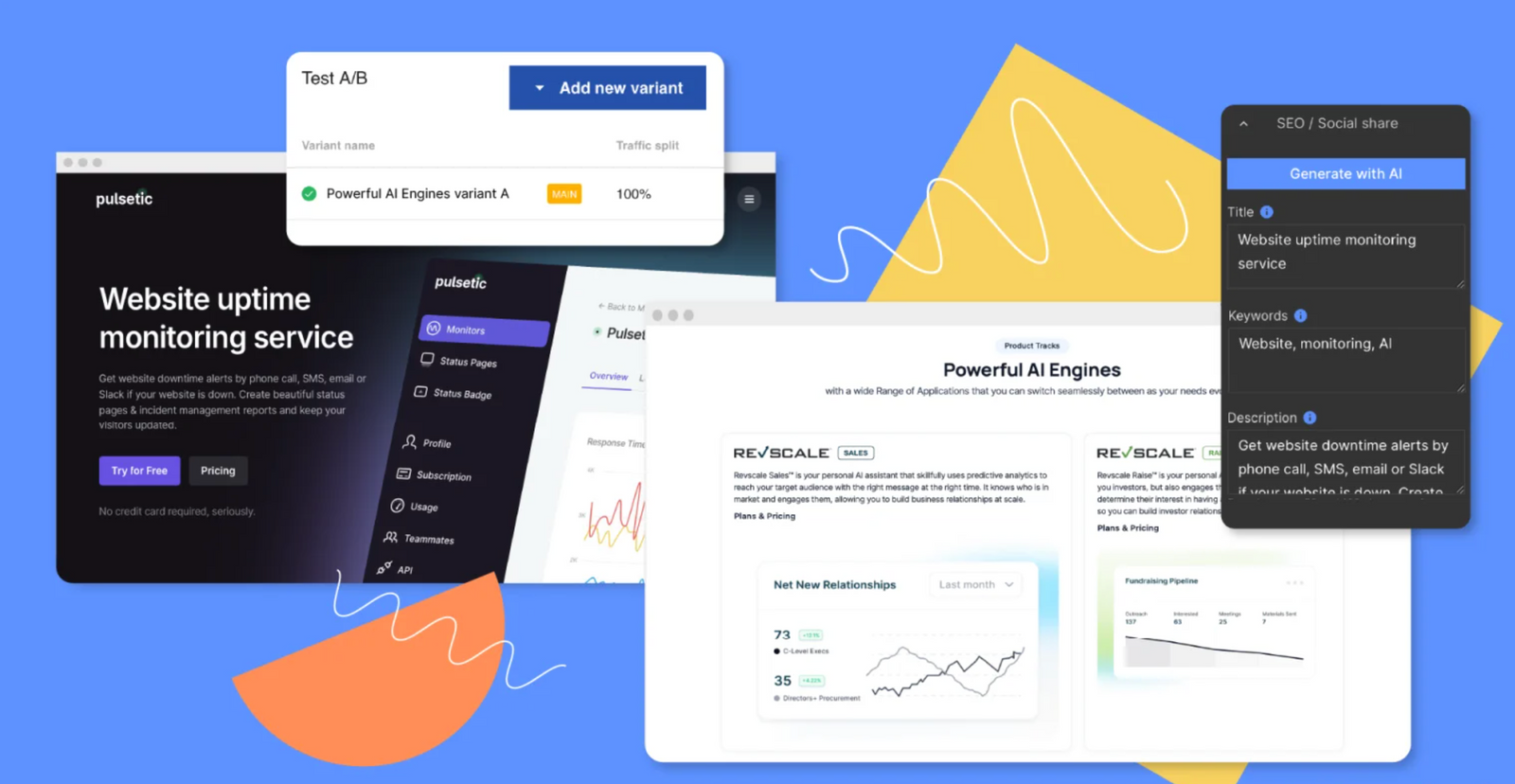
HubSpot offers a complete landing page builder through Content Hub with AI-powered generation, drag-and-drop design, and native CRM integration at no cost for basic features, which HubSpot's own product page states in its title. For marketers seeking specialized optimization, Unbounce publishes its full rate card: the Experiment plan, the one that carries A/B testing, is $149 a month on monthly billing and $112 a month billed yearly. Instapage no longer publishes a rate card at its pricing URL.
Landing pages drive conversion rates that can exceed 10% when properly optimized according to Unbounce's 2024 benchmark study analyzing 464 million visits across 41,000 landing pages. The median conversion rate across industries sits at 6.6%, but selecting the right landing page builder significantly impacts your ability to exceed these benchmarks. This comparison examines three leading platforms: HubSpot's integrated marketing approach, Unbounce's conversion-focused specialization, and Instapage's enterprise-grade customization.
HubSpot Landing Page Builder: All-in-One Marketing Platform
HubSpot's landing page builder distinguishes itself through deep integration with HubSpot's CRM and marketing automation tools. The platform uses Breeze AI to generate complete landing pages from simple prompts, including copy, images, forms, and meeting schedulers.
HubSpot's drag-and-drop editor provides mobile-optimized templates with slash commands for rapid content generation. According to HubSpot's product documentation, users can create personalized experiences through dynamic content that adapts based on visitor location, device, lifecycle stage, or CRM data. Forms include pre-populated fields and form shortening to ensure you never ask the same question twice, reducing friction while gathering complete lead information.
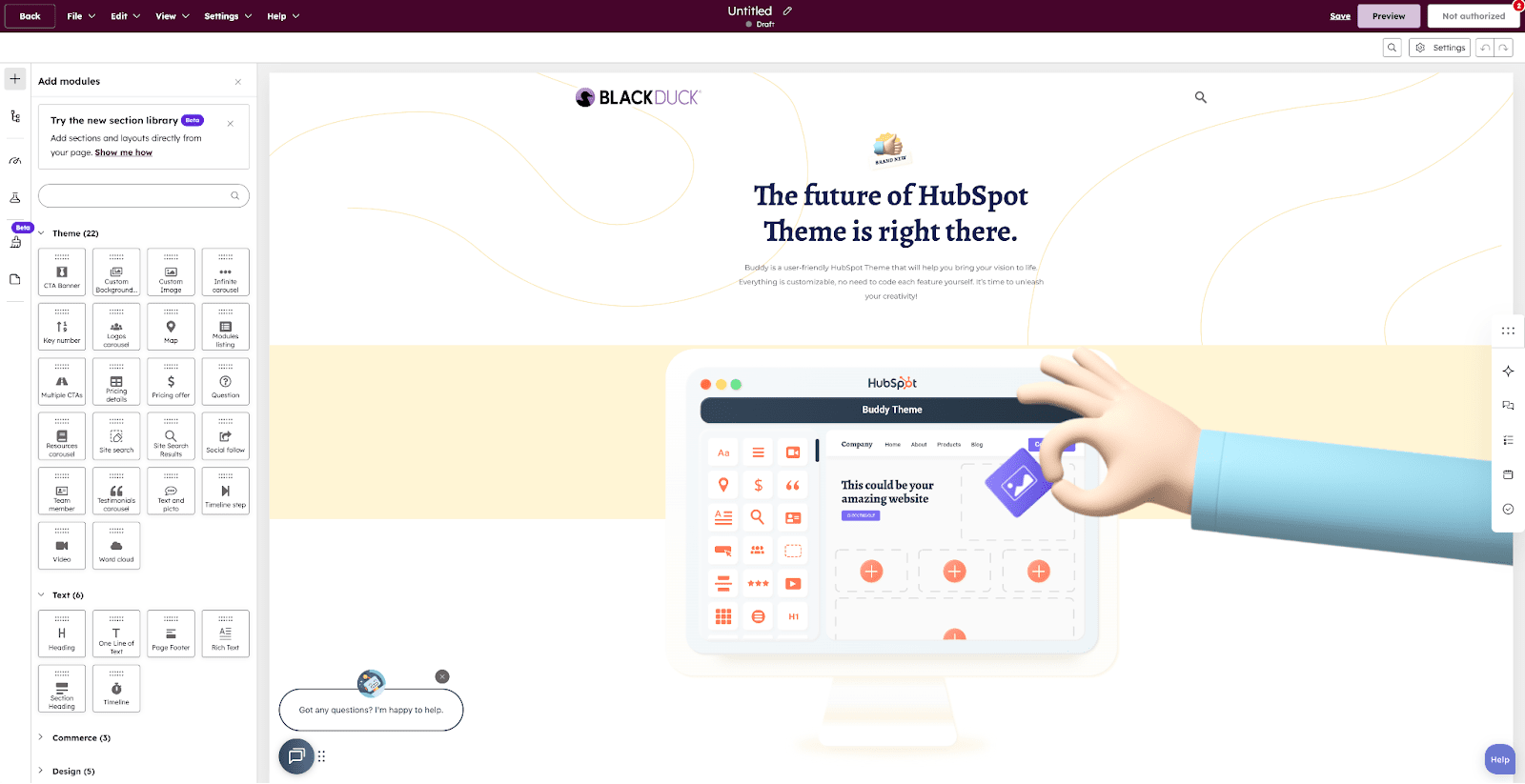
The platform's A/B testing automatically selects winning variations, while built-in SEO recommendations optimize each page for search visibility. G2 reviewers rate HubSpot's landing pages at 4.3/5 stars, highlighting strong email marketing integration and dynamic content capabilities rated at 8.3.
HubSpot Pricing: HubSpot's landing page builder is free at entry, and the product page is titled to say so. Paid tiers exist, but HubSpot renders its pricing page client-side: our capture on 21 October 2026 returned 73,851 bytes of document and 42 characters of readable text, with no currency figures in it. Any HubSpot number on this page would be an old figure dressed as a current one, so this page does not quote one. Ask for a written quote that includes lead scoring and custom objects if those are what you are buying.
Unbounce Landing Page Builder: Conversion Optimization Specialist
Unbounce pioneered the dedicated landing page builder category in 2009 and maintains its position through Smart Traffic AI and solid testing capabilities. The platform automatically routes visitors to landing page variants where they're most likely to convert, using machine learning trained on billions of conversions.
Unbounce's drag-and-drop builder offers over 100 customizable templates with dynamic text replacement to match visitor search keywords. According to Unbounce's pricing page, the platform includes unlimited landing pages, popups, and sticky bars across all plans. G2 ratings give Unbounce 4.4/5 stars overall, with A/B testing capabilities scoring 8.9-the highest among competitors.
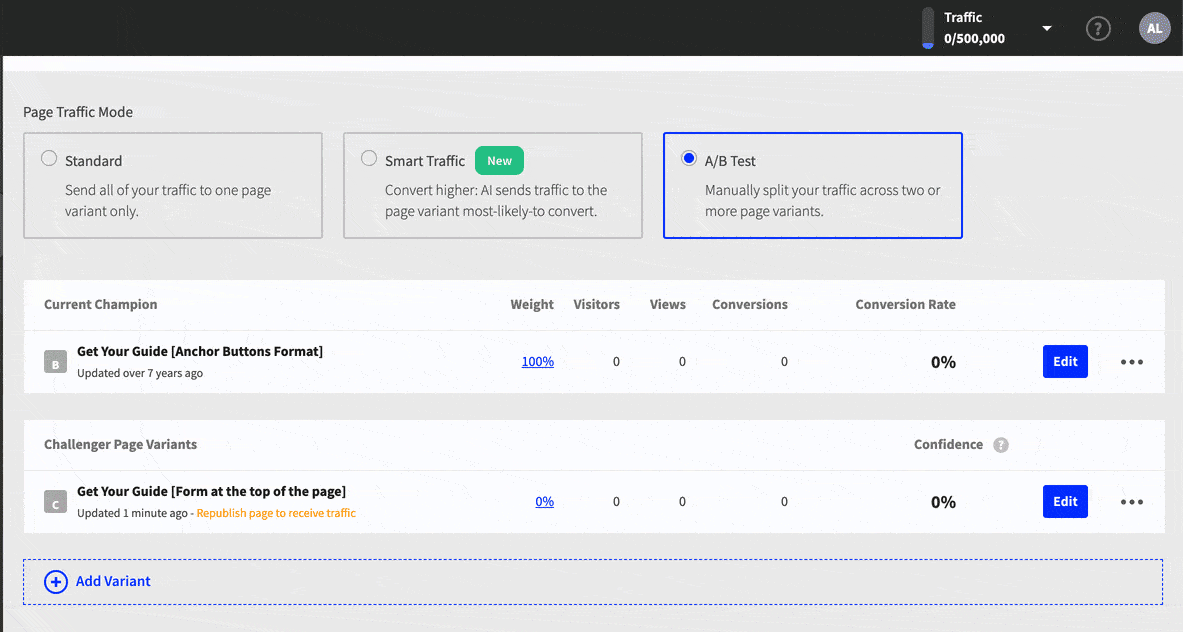
The platform's AI copywriting generates headlines, body copy, and CTAs within the editor. Unbounce integrates with 1,800+ tools including Salesforce, HubSpot, and Mailchimp through native connections and Zapier. The platform particularly excels at multi-variant testing, allowing unlimited page variations to identify optimal designs.
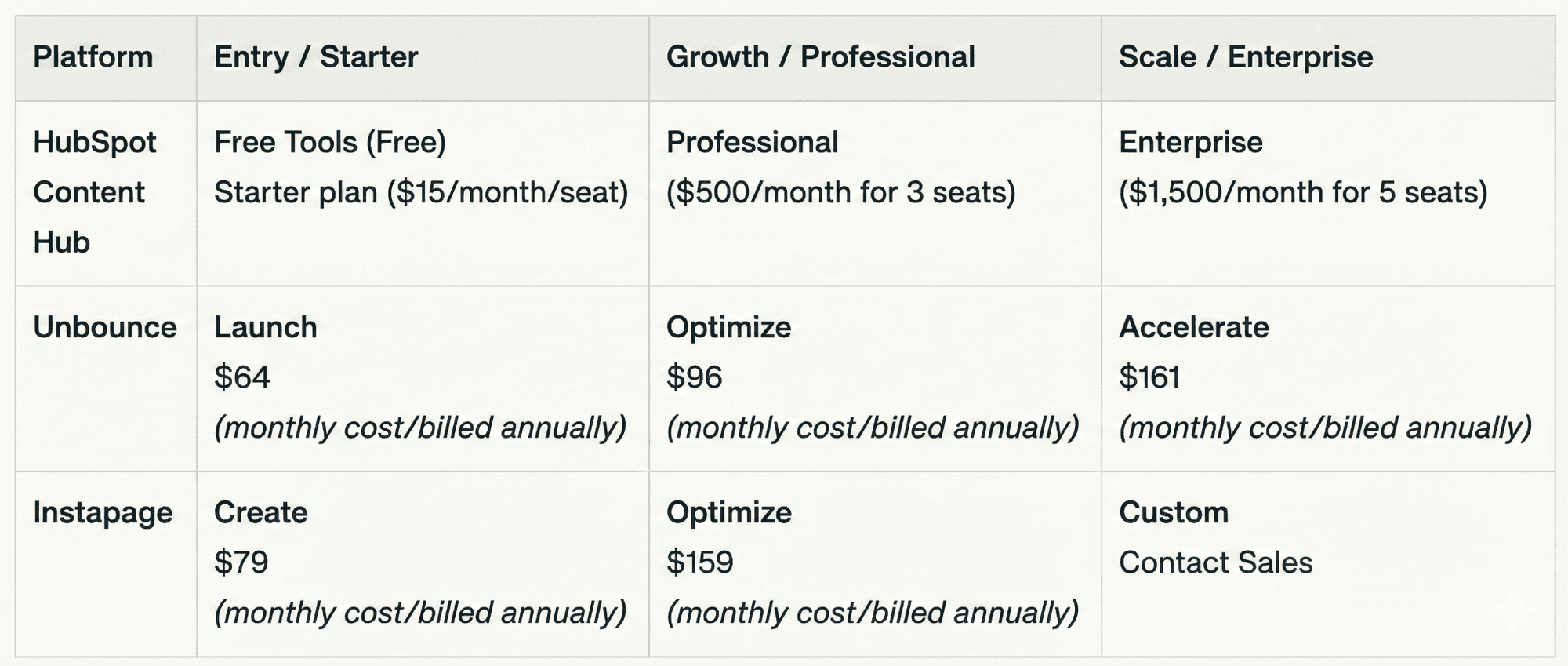
Unbounce Pricing: verified against unbounce.com/pricing on 21 October 2026. Starter is $29 a month, or $22 billed yearly, with 5 pages and traffic up to 500. Build is $99, or $74 yearly, with unlimited pages, traffic up to 20k, popups and sticky bars, and AI copywriting. Experiment is $149, or $112 yearly, with unlimited A/B testing, traffic up to 30k and 3 users. Optimize is $249, or $187 yearly, with traffic up to 50k and 5 users. Concierge and Agency are quoted on request. Every plan includes unlimited conversions, 100+ templates and a 14-day trial.
Instapage Landing Page Builder: Enterprise Collaboration Platform
Instapage targets enterprise teams and agencies with real-time collaboration features and AMP (Accelerated Mobile Pages) support. The platform's Instablocks enable teams to create reusable content sections and forms, allowing simultaneous editing across hundreds of pages.
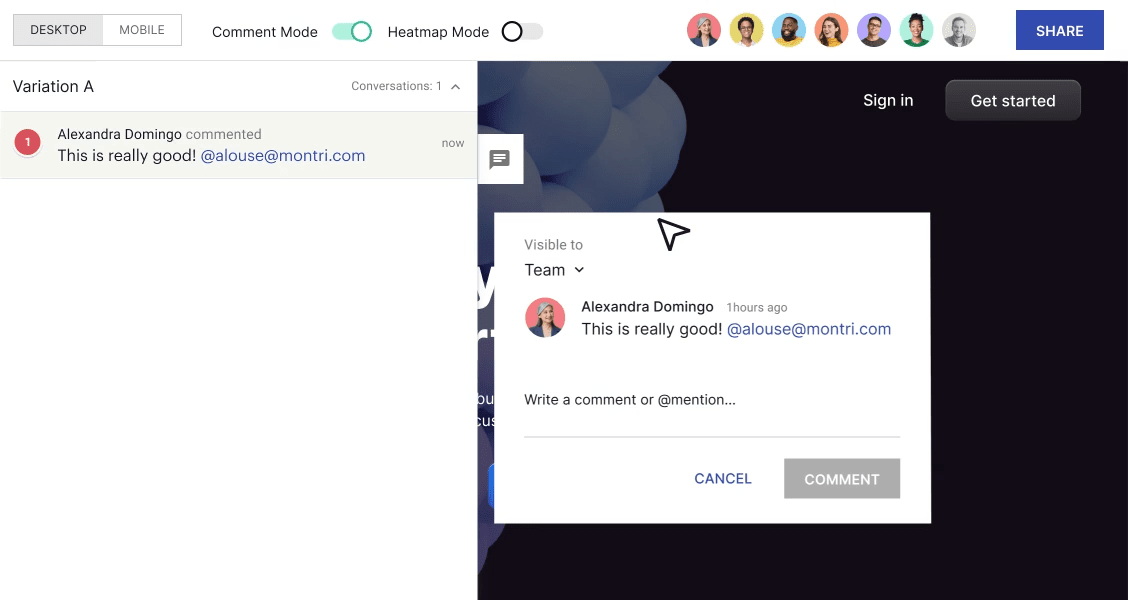
Instapage's pixel-perfect editor supports custom JavaScript, HTML, and CSS for advanced customization. According to Instapage's pricing page, features include heatmaps tracking mouse movements, clicks, and scroll depth to visualize visitor behavior. The platform's Thor Render Engine optimizes page load times, critical since 1-second delays reduce conversions by 7%.
G2 reviews rate Instapage 4.3/5 stars, with mobile optimization scoring 8.1 and customer support at 8.6. The platform's ad-to-page mapping visualizes campaign structures for coordinated updates across ads and landing pages simultaneously.
Instapage Pricing: not verifiable. On 21 October 2026 the Instapage pricing URL redirected to a marketing page with no rate card on it and no currency figures at all. The plan names and prices that used to appear here have been removed rather than refreshed, because there is nothing to refresh them against. Ask for a written quote with a page and visitor allowance.
HubSpot vs. Unbounce vs. Instapage: Key Feature Differences
Templates and Design Flexibility: HubSpot provides theme-based templates optimized for CRM integration but with more limited customization. Unbounce offers 100+ conversion-tested templates with complete design freedom including custom code. Instapage leads with 200+ layouts and Instablocks for reusable content modules.
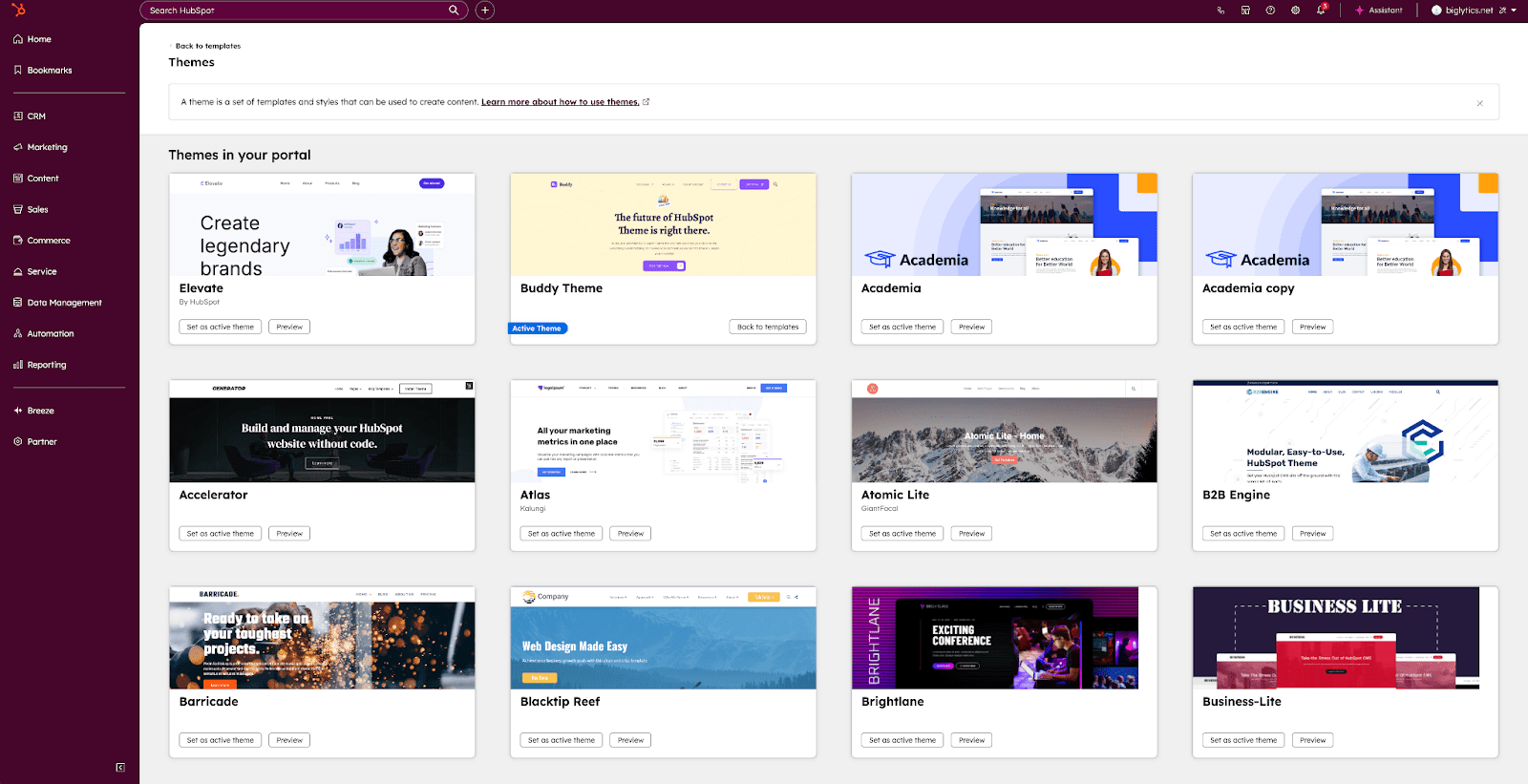
HubSpot’s landing page template library
A/B Testing Capabilities: Unbounce's testing supports unlimited variants with manual traffic allocation or AI-powered Smart Traffic. HubSpot automatically selects winning variations but offers fewer advanced testing options. Instapage provides standard A/B testing with heatmaps for behavior analysis. According to G2 comparisons, Unbounce scores 8.9 for A/B testing versus Instapage's 8.5.
CRM and Marketing Integration: HubSpot's native CRM integration eliminates data silos, automatically capturing leads and enabling workflow automation without third-party tools. Both Unbounce and Instapage require integrations through connectors or Zapier, though both support direct CRM connections to Salesforce, HubSpot, and Marketo.
Collaboration Tools: Instapage uniquely provides Slack-style commenting within the editor, approval workflows, and scheduled publishing. HubSpot offers team collaboration through its broader marketing platform. Unbounce focuses on individual user efficiency rather than team coordination features.
Mobile Optimization: All three platforms create mobile-responsive pages automatically. Instapage's AMP support loads mobile pages in under 1 second, critical since 53% of mobile users abandon pages taking over 3 seconds. According to G2 data, Instapage scores 8.1 for mobile optimization versus Unbounce's 8.0.
AI-Powered Features: HubSpot's Breeze AI generates complete landing pages from prompts (requires Content Hub Professional). Unbounce's Smart Traffic AI optimizes visitor routing but scores 6.9 for AI/ML features on G2. Instapage offers AI copywriting for headlines and variations but lacks complete AI page generation.
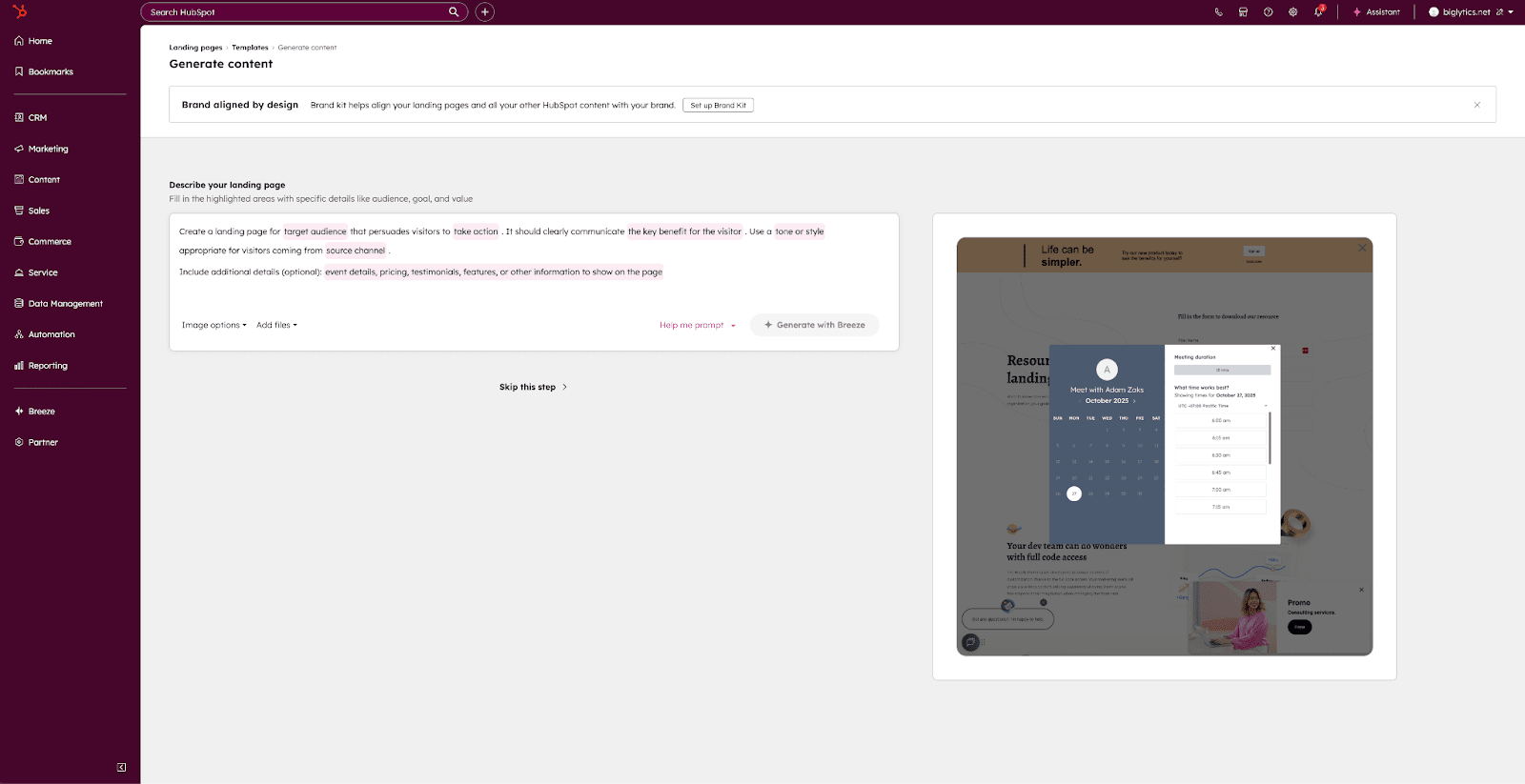
HubSpot’s AI landing page builder
HubSpot vs. Unbounce vs. Instapage: Pricing and Value Analysis
HubSpot delivers unmatched value for integrated marketing operations. The landing page builder is free at entry, with basic CRM, forms and email tracking. Starter adds email sequences and removes branding, and that tier's price is not readable from HubSpot's pricing page, so get it quoted rather than budgeting from an old figure. This still positions HubSpot as the lowest-friction option for businesses that want landing pages and marketing automation on one platform. Try HubSpot's free landing page builder to experience these features firsthand.
Unbounce offers specialized landing page capabilities at mid-tier pricing. At $74 a month billed yearly, Build includes unlimited pages, popups, sticky bars and AI copywriting, with traffic up to 20k. Testing is the next tier up: Experiment is $112 billed yearly, and it is the cheapest plan that includes unlimited A/B tests, which unbounce.com/pricing states plan by plan.
Instapage targets enterprise budgets with premium collaboration features, and it now sells them through a demo rather than a published price. Third-party reviews note that its pricing suits agencies managing multiple clients rather than individual marketers, and with no rate card you cannot test that claim without a sales call.
Landing Page Conversion Performance: Which Platform Delivers Results?
Unbounce's 2024 research analyzing 57 million conversions found the median landing page conversion rate is 6.6% across industries. Financial services leads at 8.4%, while SaaS averages 3.8%. Pages loading in under 2 seconds achieve 30% higher conversion rates than slower pages.
Platform-specific performance depends on proper optimization. According to landing page statistics, landing pages with 5 or fewer form fields convert 120% better than lengthy forms. HubSpot's progressive profiling addresses this by hiding previously answered fields across multiple submissions.
Unbounce's Smart Traffic AI demonstrates measurable impact. Case studies show AI-powered visitor routing increases conversions by automatically matching users to optimal page variants. Research indicates that landing pages written at 5th-7th grade reading level achieve 11.1% conversion rates, 56% higher than professional-level writing at 5.3%.
Instapage's AMP implementation delivers faster mobile experiences. According to mobile optimization research, incorporating video on landing pages boosts conversions by 86%, while pages with minimal text achieve 34% higher conversions than text-heavy alternatives.
HubSpot vs. Unbounce vs. Instapage: Which Landing Page Builder to Choose
Choose HubSpot for integrated marketing operations and CRM workflows. HubSpot suits businesses requiring lead nurturing, email marketing, and sales automation alongside landing pages. The free plan supports startups and small businesses, while paid tiers scale with marketing complexity. Explore HubSpot's Marketing Hub to access advanced automation and see results within 30 days.
Choose Unbounce for conversion rate optimization and testing excellence. Unbounce serves performance marketers running PPC campaigns, managing multiple landing pages, or requiring sophisticated split testing. According to user reviews, Unbounce excels for experienced marketers who prioritize testing flexibility and conversion optimization.
Choose Instapage for enterprise collaboration and agency workflows. Instapage suits large marketing teams, agencies managing multiple clients, or organizations requiring approval workflows and real-time collaboration. The platform's Instablocks enable scalable page production across hundreds of campaigns. G2 reviews particularly highlight Instapage's collaboration features rated at 8.6 for customer support.
Frequently Asked Questions: HubSpot vs. Unbounce vs. Instapage
Which landing page builder offers the best free plan?
HubSpot provides the only free landing page builder among these three, and its product page is titled to say so. Unbounce offers a free 14-day trial rather than a free plan, which its pricing page states. Instapage offers a free trial and a demo request.
Can I use HubSpot landing pages without the full Marketing Hub?
Yes. HubSpot landing pages are sold through Content Hub, separately from Marketing Hub, and the free tier includes landing pages, forms and basic CRM features. Breeze AI generation and branding removal sit on paid tiers. HubSpot's documentation covers what each tier includes, and the prices for those tiers are not readable from HubSpot's pricing page, so ask for them in writing.
Which platform has the best A/B testing capabilities?
Unbounce leads in A/B testing with Smart Traffic AI that automatically optimizes visitor routing across unlimited variants. G2 ratings give Unbounce 8.9 for A/B testing versus Instapage's 8.5 and HubSpot's 8.1. Unbounce allows manual traffic allocation or AI-powered optimization, while HubSpot automatically selects winners with limited manual control. According to testing research, companies testing 10+ variations see 86% better results than single tests.
Do these platforms integrate with my existing marketing tools?
All three platforms offer extensive integrations. HubSpot connects with 2,000+ apps and includes native CRM integration. Unbounce supports 1,000+ integrations through native connectors and Zapier, including Salesforce, Mailchimp, and Google Analytics. Instapage offers 120+ direct integrations plus Zapier connectivity. HubSpot's native CRM eliminates integration complexity for lead management.
What conversion rate should I expect from my landing pages?
Industry benchmarks show the median landing page conversion rate is 6.6% across all industries, with 10% considered good performance. Financial services averages 8.4%, while SaaS typically achieves 3.8%. According to optimization research, well-optimized pages can exceed 15-20% conversion rates. Platform choice matters less than optimization factors: 5 or fewer form fields, load times under 2 seconds, and simplified copy at 5th-7th grade reading level.
Which landing page builder is easiest for beginners?
User reviews consistently rate Unbounce as the most intuitive for beginners, with 4.4/5 stars on G2. HubSpot offers comparable ease of use but requires understanding CRM concepts for full utilization. Instapage provides advanced features but requires more learning time. According to comparison reviews, beginners can create their first Unbounce page within 10 minutes using pre-designed templates.
Final Verdict: Choosing Your Landing Page Builder
Selecting between HubSpot, Unbounce, and Instapage depends on your marketing infrastructure and priorities. HubSpot delivers unmatched value for businesses requiring integrated CRM, marketing automation, and landing pages in a single platform. The free plan supports startups and small teams, while paid tiers enable sophisticated lead nurturing workflows at competitive pricing. Check HubSpot's current pricing for the latest discounts and feature updates.
Unbounce excels for conversion-focused marketers prioritizing testing and optimization. Smart Traffic AI and unlimited A/B testing justify the premium pricing for teams managing high-volume PPC campaigns. According to performance data, proper testing can double conversion rates from 6.6% median to 10%+ performance.
Instapage serves enterprise teams and agencies requiring collaboration tools and scalable page production. The platform's Instablocks and approval workflows streamline multi-client management, though pricing reflects enterprise positioning rather than individual user needs.
Regardless of platform choice, landing page success depends on fundamental optimization: simplified copy, minimal form fields, fast load times, and consistent testing. Get started with HubSpot today to access free landing pages and CRM capabilities, building a foundation for scalable marketing operations as your business grows.
Prices on this page were checked on 21 October 2026 against the vendors' own pricing and product pages, and each capture is kept with its sha256 hash. Where a vendor publishes no price in a page a crawler can read, or refuses automated access, this page says so instead of quoting a figure we cannot stand behind. Spot an error? Send the URL to amit@datadab.com.
Affiliate Disclosure: We may earn a commission from affiliate links in this review. However, all opinions are our own, and we only recommend products we believe in.