At a glance
What each page states, vendor by vendor
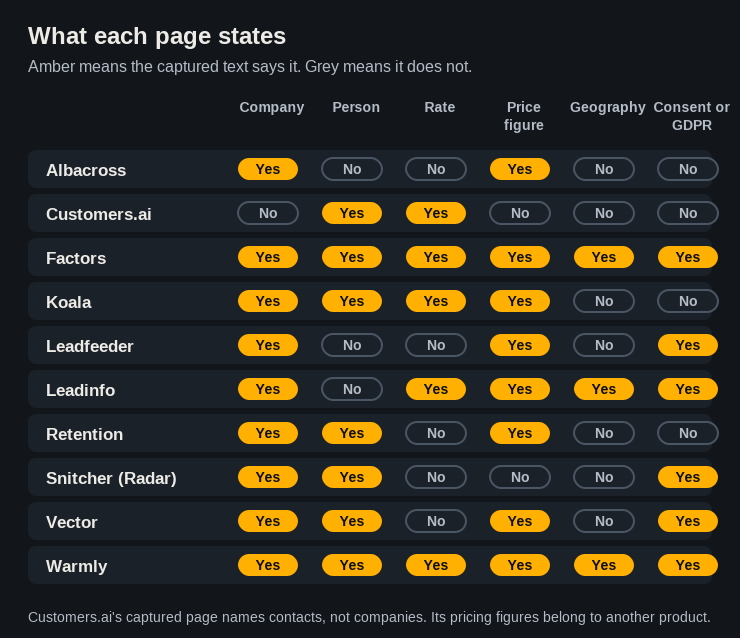
Ten vendors print a name for an anonymous visit. Eight put a price on the page, and no two of them count the same thing.
We read ten vendors' product and pricing pages on 27 November 2026, and kept each one whose own page describes identifying visitors. Nine name a company behind a visit, seven name a person, and five give a rate of identification or accuracy. Not one of the five tells you in every case what the rate is a share of.
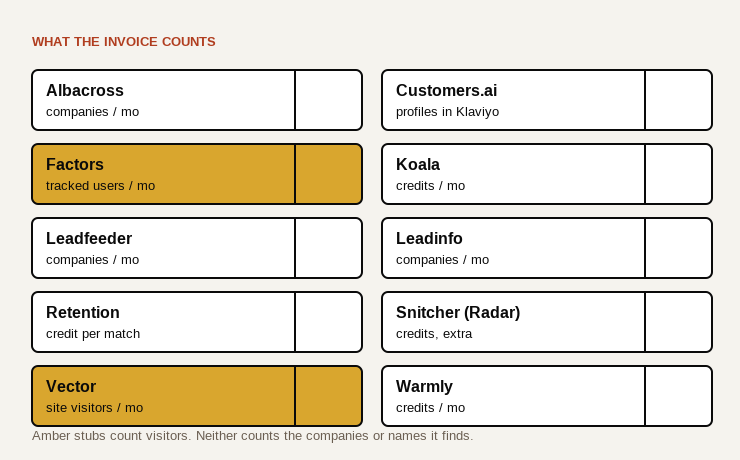
Eight state a price figure in the text the server sends, and no two figures buy the same thing. Some count companies identified, some count matches, some count credits, and two count arrivals on the site rather than the names printed for them.
Last verified 2026-11-27. Figures are the vendors' stated prices in the captured text. Confirm current terms with each vendor.
A buyer opens your pricing page at eleven at night, reads two sections and leaves.
In the morning the dashboard says a visit happened. Nothing says who made it.
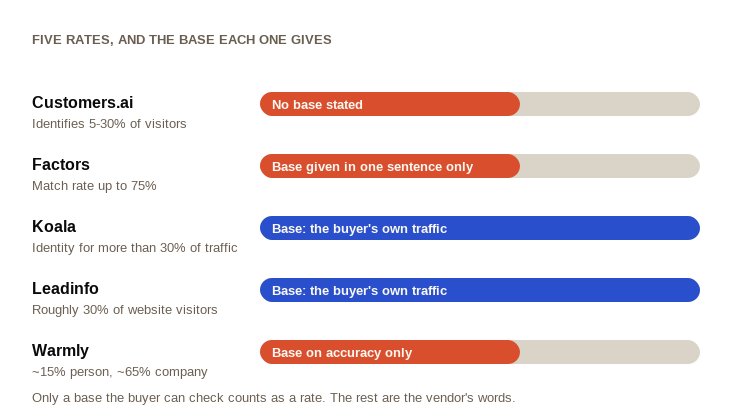
That gap is the product. Ten vendors sell a name for it, and we read their product and pricing pages on 27 November 2026.
Give the vendors their due. A page view proves a page was read. A company name proves someone with a budget read it, and that is the difference a sales team can act on before the week ends.
Albacross puts the size of the gap in one line: “97% of visitors research, compare, and leave without filling out a form.”
Think about the badge at a conference door. A visitor walks in without one, and the tool prints a badge and hands it over. The badge carries either a company name or a person's name. The rest of this page is about which one you are buying.
We kept a vendor only when its own page describes printing that badge. Every quote below is an exact span of a captured page, and the build re-checks each one against the file's hash before this page goes out.
Nine of the ten pages name a company behind a visit. Albacross is the plainest about it: “Turn anonymous website traffic into named companies.”
Leadfeeder opens with the same promise: “Leadfeeder identifies and reveals companies visiting your website using IP-based recognition, even when their team is working remotely.”
Then it closes a door. “Individual visitors are not shown by default.” You get the building, and not the person inside it, until they fill in a form.
Seven name a person. Vector splits the job in two, one page for “Contact-level de-anonymization” and one for “Account-level de-anonymization”.
The first resolves “The person on your pricing page, resolved to a name, a role, and a work email, not just a company.”
Factors limits the person layer by country: “Factors.ai identifies website visitors at both the account and individual contact levels (US traffic only).” The company layer runs wider. Inside the United States, the page says, the contact layer goes further: “it can identify up to 40% of the US visitors via RB2B integration.”
Warmly leads with people: “Inbound Agent identifies visitors, engages with AI chat that has full context, and books meetings in real-time.”
Customers.ai names contacts and stops there. Its page is headed “Turn Anonymous Shoppers into Customers with Unmatched Website Visitor ID Accuracy”, and nothing in the captured text says it names the company behind a visit.
Retention is an API rather than a dashboard. Its page offers to “Resolve an anonymous visitor straight to a work profile: name, title, company, seniority.” It bills each lookup. A marketing buyer should read that page as a developer product, because that is what it is.
Koala arrives from the data side: “Has a specialized B2B data model centered around accounts and visitors”, and a system that “Automatically manages identity resolution across multiple devices and logged out to logged in transitions”.
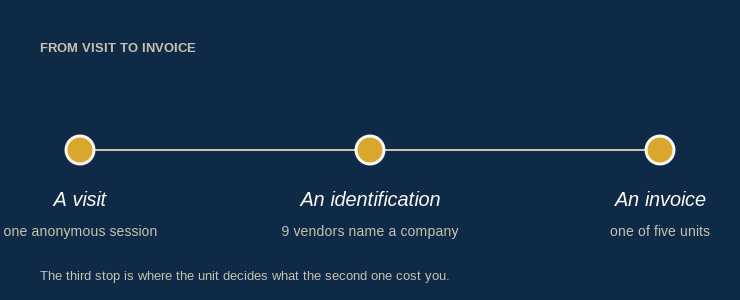
Five pages give a rate. The widest range shows the problem. “Most visitor ID solutions get identities right 5-30% of the time.”
Customers.ai then claims “Customers.ai is 2-7x more accurate with 2-18x higher True Match Rate.”
The page does not say what the 5 to 30 per cent was measured on, and the comparison is with solutions it does not name.
Factors gives a headline number: “the match rate comes up to 75%”. Elsewhere it gives a base: “capturing over 75% of anonymous traffic”.
The second sentence names the population a visitor tool should be measured against. The first travels on its own, which is how 75 per cent ends up in a slide.
Warmly does the same thing twice. “For person-level identification, we achieve ~15% coverage with 90%+ accuracy on matched profiles.” Accuracy is measured on matched profiles, so that number has a base. Coverage does not.
At the company level the page gives no base at all: “For company-level identification, we achieve ~65% coverage with 95%+ accuracy.”
Leadinfo states the share outright: “roughly 30% of your website visitors”. That is the buyer's own traffic, which is the only denominator a buyer can check.
Koala says something similar in its own words, “prospect-level identity for > 30% of your traffic”. It presents the number as an expectation for a product-led site, and a trial is how a buyer tests it.
The last rate belongs to a customer. “We were able to identify contact information for 30% of our website visitors”, says one, on the vendor's page. That is one company's result, and we do not count it as a rate for the product.
One product page and, where it was readable, one pricing page per vendor. Captured 27 November 2026. Rows are alphabetical.
| Vendor | What the product page names | Rate stated | What the price is set on | Price figure in the text |
|---|---|---|---|---|
| Albacross | Companies visiting the site | None | Identified companies per month | Starter Starter €59 Per month Billed yearly |
| Customers.ai | Contacts behind visits | 5-30% (vendor's range) | Total Klaviyo profiles | None; the figures on the page are for another product |
| Factors | Companies, and US contacts | Up to 75% match rate | Monthly tracked users (MTUs) | $199/mo after trial, Lite; custom above |
| Koala | Accounts and visitors, prospect-level | More than 30% of traffic | Credits per month | Free plan includes: 2 seats included 100 credits/mo All features to Starter $ 200 /mo |
| Leadfeeder | Companies, at company level | None | Identified companies per month | Starting at €79 Per month, billed annually |
| Leadinfo | Companies, with contacts | Roughly 30% of website visitors | Unique companies identified per month | €39 per user per month for the Starter package |
| Retention | Work profile from an IP or email | None | Credits, per successful match | Start with 5K credits for $199. |
| Snitcher (Radar) | Company, and people at the company | None | Credits, separate from identification | None in the text read; talk to sales |
| Vector | Accounts and contacts | None | Monthly site visitors and ad spend | $36,000 /year; tier not stated in the text |
| Warmly | Persons, and companies | ~15% person, ~65% company | Credits per month | Starting at $10,000 / year From 10K credits / mo |
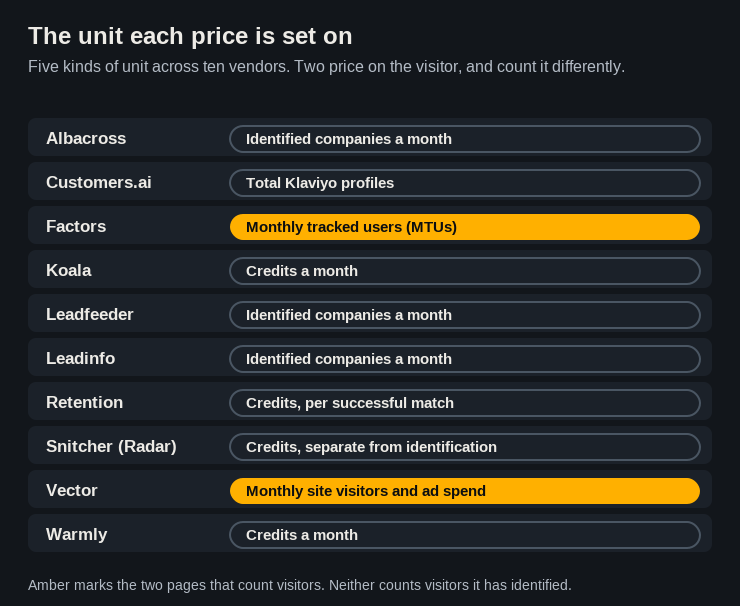
The unit decides the invoice, so read it twice. Three pages charge per company identified.
Albacross sells “0-50 Identified companies / Month”. Leadfeeder defines its unit, which is rarer than it should be: “A unique company identified from your website traffic within the month.”
Leadinfo uses the same idea: “Your price tier is based on the unique companies we identify monthly”.
Two pages count arrivals instead. Vector says “We size on your total unique site visitors, not just the ones Vector identifies”, and its plan moves with traffic and ad spend.
Factors counts something else again: “MTUs are the number of unique visitors or users we track across your properties each month.”
Neither number is a count of badges.
Retention bills each match, and says so: “Pay per match, with credits”. It adds “Misses are free.” which is a fair rule. Ask what counts as a match before the first invoice, because the page does not say.
Customers.ai sets its price on the list the buyer already holds: “Pricing is based on your total Klaviyo profiles”. The count includes “every profile in your account, including suppressed and unsubscribed ones”.
A buyer with a large list pays more for the same visitors on the site.
Credits are the last shape of the unit. Warmly sells “Starting at $10,000 / year From 10K credits / mo”.
Koala starts on a free plan and runs to “Starter $ 200 /mo” and “Growth Popular $ 1000 /mo”, with a custom tier above.
Snitcher (Radar) says “Credits are what you spend when Snitcher does work beyond identification.” On that reading, identification sits on one meter and the paid extras on another. The page does not name the first.
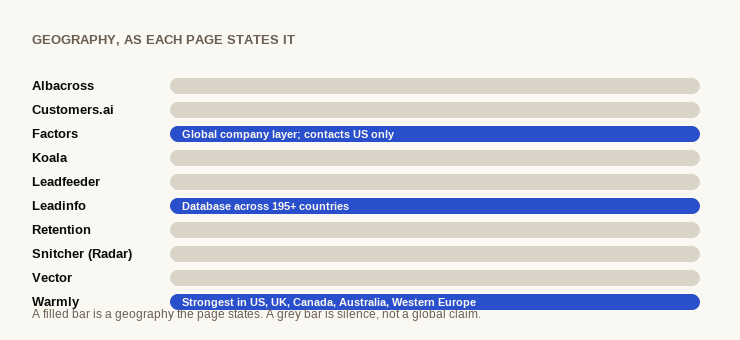
Geography is the quiet limit. Factors is asked whether it tracks visitors globally, and answers: “Yes, Factors.ai tracks visitors globally.” Its contact layer stays inside one country: “Factors.ai identifies website visitors at both the account and individual contact levels (US traffic only).”
Warmly says “Visitor identification coverage varies by region (strongest in US, UK, Canada, Australia, Western Europe).”
Leadinfo describes its database as “220+ million companies across 195+ countries worldwide”. That is a scope. The page does not report what share of a given country's traffic it resolves, which is the only figure a buyer can use.
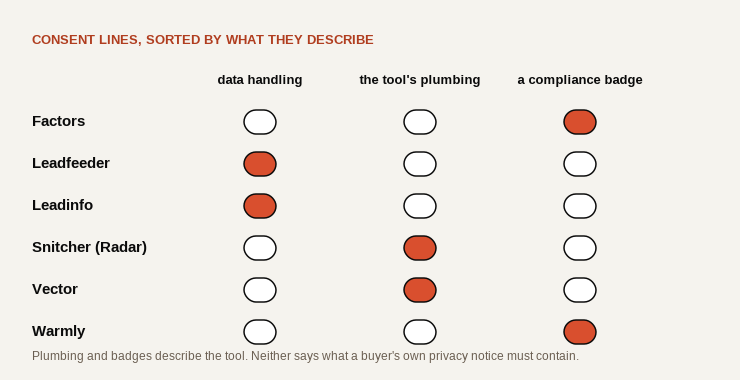
Six pages mention consent or privacy, and most of those sentences describe plumbing. Snitcher (Radar) says “Respects OneTrust, Cookiebot and other CMPs automatically.” Vector says its script “matches known contacts through consented data partners.”
Neither sentence tells a buyer what their own privacy notice must contain.
Two more are worth quoting as they stand. Leadfeeder says “All tracking is at the company level and processed in line with GDPR.” Factors says “We’re also GDPR, CCPA, and PECR compliant.” and adds “We do not rely on cookie-based tracking”.
Leadinfo's pricing page answers the question outright: “Yes, the use of Leadinfo is legal under the GDPR”.
We have not tested that, and this study gives no view on whether any tool or practice is lawful. The sentence is the vendor's, quoted as the vendor's.
Rb2b ends its own arm. Its terms ban “any other manual or automated means” of access to the service, so nothing was collected beyond the probe. The refusal is reported here as a finding.
6sense answered the research agent with a 403 on robots.txt and on its home page. We did not retry under another name.
Leadforensics has no terms link on its home page, so it waits until a person reads its terms.
Two names are frame notes. Clearbit's home page says it has joined HubSpot, and the probe text describes no standalone visitor product. Dealfront lands on Leadfeeder's site and is covered by that row.
Koala was the vendor the rule could not reach. Its home page links no page that matches the product pattern, and the owner told us to find the product page ourselves.
We read the three product links the home page offers. Koala Data describes visitor identity, and it is the row. Intent Signals and Automations do not describe identifying visitors, so they are not used. The choice is recorded as an amendment.
Snitcher (Radar) carries one caveat, and the row is labelled to carry it. The page is Radar, which is sold to software companies that want visitor identification inside their own product. The pricing page we captured is Engage, a contact-reveal product, so the price and unit in the table are what that page says and no more.
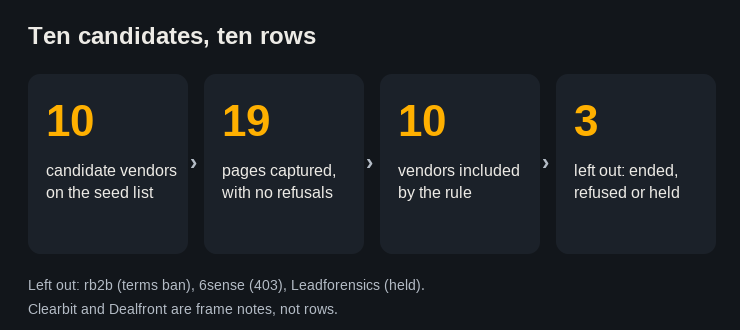
It shows ten vendors, each read once on 27 November 2026. The category is larger than ten, and the exclusions above are part of the picture. A page that changes next week will change the table, which is why the re-read is booked for the next quarter.
It does not show whether any identification is correct. We did not buy a trial, load a page in a browser, or test a single visitor. Every rate here is the vendor's claim, attributed to the page that makes it. A claim with no base is reported as having no base.
It does not show what a name is worth. A count of identified companies is not a count of deals, and nothing on this page tries to link the two.
Ten vendors sell a name for an anonymous visit. Nine promise a company, seven promise a person, and eight put a price on the page. Only three say where the badge works by geography.
So start with the unit. A company identified, a match, a monthly profile, a site visitor and a credit are five different things on an invoice, and the cheapest number on the page is usually the one whose unit you understand least.
Then ask the vendor for the base of its rate, in writing, before you accept the rate.
The badge is the product. Read what it is made of before you agree to pay for it.
Ten candidate vendors were seeded from the deep probe, and each home page was requested once in this arm. Product and pricing pages were chosen by the rule in the protocol.
Koala's home page was requested a second time, by owner instruction, to find its product page. That page was chosen from the three product links the home page offers, by reading them, and recorded as an amendment.
One page was not the vendor's main product (Snitcher's Radar), and that is disclosed. Ten vendors were included after the captured page was read against the rule.
Every quote on this page is an exact span of a captured page, re-checked against that file's SHA-256 at build time. Counts are derived from the categories tagged on those quotes. The inclusion decisions and their quotes are in inclusion.json.
The Rb2b terms quotation comes from the terms text recorded in the 26 November probe (deep-probe.json), not from a page captured in this arm.
We have no commercial relationship with any vendor on this page. No vendor was contacted, and nothing was bought.
| Vendor | Page captured | Retrieved | SHA-256 (first 12) |
|---|---|---|---|
| Albacross | https://www.albacross.com/identify | 2026-11-27 | c3c3a9f5ba30 |
| Albacross | https://www.albacross.com/pricing | 2026-11-27 | 2473551b6575 |
| Customers.ai | https://customers.ai/analytics | 2026-11-27 | fbd43cbeb3a4 |
| Customers.ai | https://customers.ai/pricing | 2026-11-27 | 4f2c7e7a8cf9 |
| Factors | https://www.factors.ai/product/website-visitor-identification | 2026-11-27 | 7f1f03fcc7a4 |
| Factors | https://www.factors.ai/pricing | 2026-11-27 | 2a2d8a93e97c |
| Koala | https://getkoala.com/pricing | 2026-11-27 | 5fd5c2302d9b |
| Koala | https://getkoala.com/product/koala-data | 2026-11-27 | d1af1f39a02d |
| Koala | | not fetched | |
| Leadfeeder | https://www.leadfeeder.com/web-visitors/ | 2026-11-27 | 22da3a8a1f0d |
| Leadfeeder | https://www.leadfeeder.com/pricing/ | 2026-11-27 | a1c01ed8349a |
| Leadinfo | https://www.leadinfo.com/en/lead-generation/identify-website-visitors/ | 2026-11-27 | da935e5bb2ca |
| Leadinfo | https://www.leadinfo.com/en/pricing/ | 2026-11-27 | 7572c5fd17ac |
| Retention | https://retention.com/apis/ | 2026-11-27 | 63a31b38a449 |
| Snitcher (Radar) | https://www.snitcher.com/radar | 2026-11-27 | 57ac85b8a6eb |
| Snitcher (Radar) | https://www.snitcher.com/engage | 2026-11-27 | be58993d497e |
| Vector | https://www.vector.co/platform/signals/visitor-identification | 2026-11-27 | 021765e529e7 |
| Vector | https://www.vector.co/pricing | 2026-11-27 | dc5133e32248 |
| Warmly | https://www.warmly.ai/p/inbound-agent | 2026-11-27 | 3a6b39e8a7eb |
| Warmly | https://www.warmly.ai/p/pricing | 2026-11-27 | edffd48e060b |
You have the comparison. The page a buyer reaches after reading it is yours, and whether that page can be read at all is a different problem from what it argues.
Run the extractability audit on my page
No email required for the free tools. The diagnostic is a fixed scope and a published price.
Covering this research? Please link the primary source so readers can verify the data and methodology:
Markdown: [Visitor Identification Tools Compared (2026): What Ten Vendors Say They Identify | DataDab Research](https://www.datadab.com/research/visitor-identification-tools-compared)
Spot an error? Send the URL to amit@datadab.com; corrections are published on the page.
This page is re-verified quarterly. Check the methodology section for the current verification date before quoting figures.