At a glance
What each page states, vendor by vendor
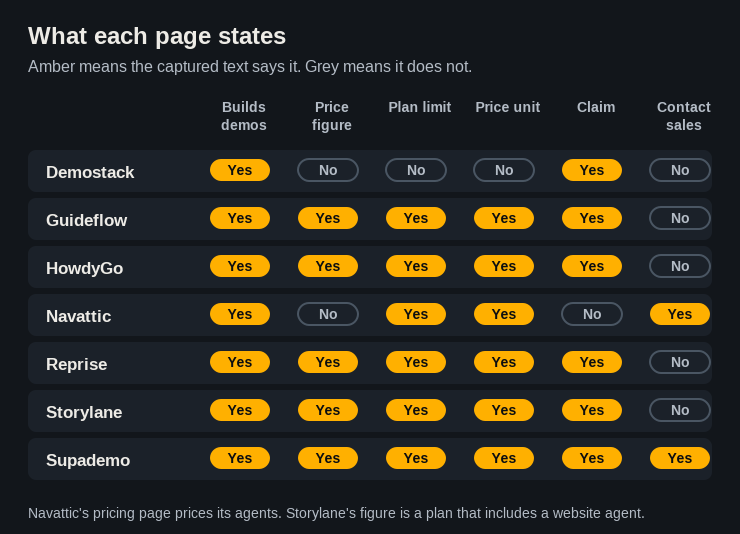
Seven vendors build a room a buyer can walk through. Five put a price on the page, and each one bills for a different part of it.
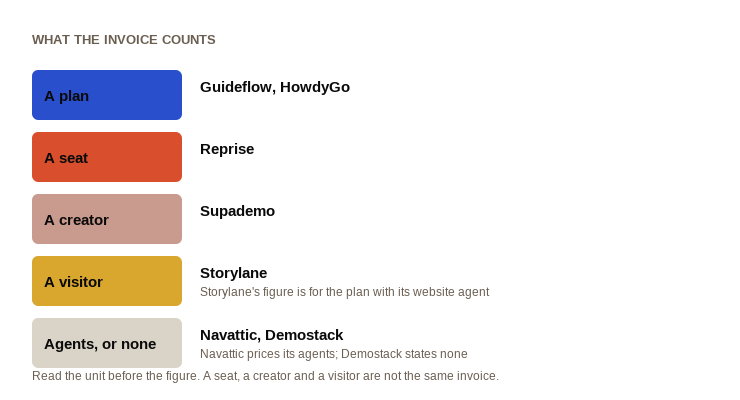
We read seven vendors' product and pricing pages on 27 November 2026, and kept each one whose own page describes building interactive demos. Five state a figure in the text the server sends, and each figure counts a different thing: a plan, a seat, an account, a creator or a monthly visitor.
Two pages price something other than the demo tool alone. Storylane's figure includes a website agent, and Navattic's pricing page is written for its agents. Demostack shows no figure at all.
Last verified 2026-11-27. Figures are the vendors' stated prices in the captured text. Confirm current terms with each vendor.
The buyer has agreed to a call and not yet to a trial. Between those two answers sits a walkthrough of a product they cannot log into.
Seven vendors build that walkthrough, and we read their product and pricing pages on 27 November 2026.
The sell is easy to believe. A recorded video shows a product. A clickable demo hands the buyer the controls, and the difference shows up in the questions they ask afterwards.
Think of a rehearsal room. The vendor builds a set that looks like the product, puts the buyer inside it and lets them walk around. Some sets follow a script. Others let the visitor open doors.
We kept a vendor only when its own page describes building that room. Every quote below is an exact span of a captured page, and the build re-checks each one against the file's hash.
The category holds two products under one name. The older one is a guided walkthrough, a set of screens the buyer clicks through in order.
HowdyGo describes its own as “The easiest and most engaging way to show your product in action”. Its page says a first demo takes “It takes on average 10 minutes to capture and create your first interactive demo.” to record.
Navattic makes the same promise in fewer words: “Build interactive product demos that engage buyers and close deals faster.”
The other kind is a working copy. Demostack says its cloner “Cloner is Demostack’s technology that creates a safe, independent demo environment by cloning your product’s frontend and simulating backend responses.” and that a team can “Create and update demos in minutes without relying on engineering help.”
A copy is a different thing to build and to maintain, and it is what the live call needs.
Storylane sells both: “Interactive Demos are guided, self-serve tours for websites, campaigns and content.” A sandbox is the second format, for calls and proofs of concept.
Reprise lists the same two next to each other: “Product Tours Guided demos you can share externally.” beside clones and sales rooms.
Supademo comes at the set from the recording: “Drop a Loom or screen recording into AI Command and get a clickable demo back.”
Decide which room you need before you compare prices. A tour fits a website or an email. A copy fits the call where the buyer expects the buttons to work.
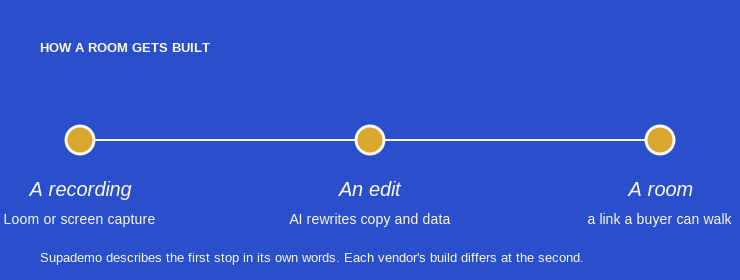
Five pages state a figure in the text the server sends, and no two of them count the same thing. Guideflow is the most explicit.
Its free plan is “Free $0 /month”. A paid plan is “Startup $599 /month”, and the page says “We don't restrict the number of interactive demos or guides you can create with our paid plans.”
HowdyGo lists “Starter $159 USD / month” and “Pro $399 USD / month”.
Reprise prices by seat: “Teams is $125 per seat per month.” and yearly “pay yearly for $100/seat/month”.
Supademo prices by creator. Scale is “Scale $50 Save 24% $38 / month” and Business is “Business $249 Save 20% $199 / month”.
Ten people on Reprise and ten on Supademo arrive at different invoices, because one counts seats and the other counts the people who build.
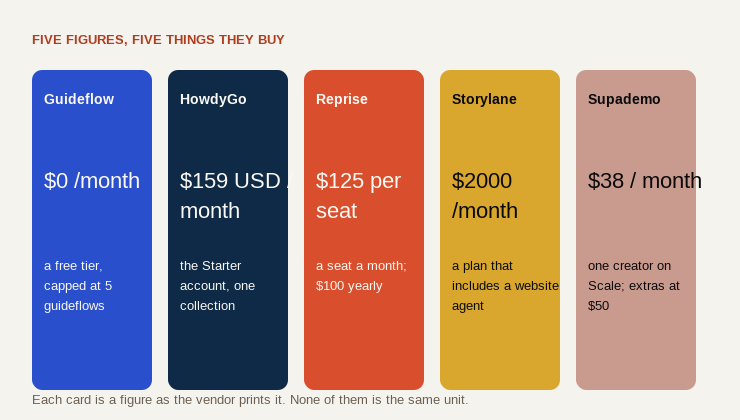
Storylane shows one figure, “Growth Up to 25,000 monthly visitors $2000 /month”. The plan is titled “Demo Suite & RepX”, and the Demo Suite appears inside it as “Demo Suite Included”.
So the figure buys the demo tool and a website agent together. The page does not price them apart, and this study does not split the number.
Navattic says “Contact us for pricing.” Its pricing page is written for a different product: “Pricing is based on number of conversations and agents.”
That leaves the demo tool without a price in the text, which is a finding about the page rather than about the product.
Demostack shows no figure either. Its pricing page argues about packaging instead, saying its best features are not held back as add-ons. That is a statement about how it sells, and it leaves the price unstated.
Supademo meters its agent separately, at “~$1.25 per typical demo call”, because the agent spends credits as it talks. That figure belongs to the agent, so it stays out of the comparison above.
One product page and one pricing page per vendor, captured 27 November 2026. Rows are alphabetical.
| Vendor | What the product page builds | Limit stated | Price figure in the text | What the price is set on |
|---|---|---|---|---|
| Demostack | Cloned product environments and demos | None stated | None in the text read | Not stated; the page says its best features are not sold as add-ons |
| Guideflow | Interactive demos and guides | Free: 5 guideflows; paid: no cap | Free $0 /month; Solo $40 /month; Growth $499 /month and Startup $599 /month | Plan, with members beyond the included count at 10 members included +$50 per add |
| HowdyGo | Click-through interactive demos | Starter: one collection; demos unlimited | Starter $159 USD / month and Pro $399 USD / month | Plan, with unlimited users |
| Navattic | Interactive product demos (and agents) | Startup plan: teams of 30 or fewer | None; contact us | Conversations and agents, for the agent product |
| Reprise | Product tours, clones and sales rooms | Growth: unlimited demos and presenter seats | Free $0 to start now; Teams is $125 per seat per month.; pay yearly for $100/seat/month | Seat |
| Storylane | Interactive demos, sandboxes and hubs | Growth: up to 25,000 visitors; RepX free under 2,000 | Growth Up to 25,000 monthly visitors $2000 /month (Demo Suite and RepX plan) | Monthly website visitors |
| Supademo | Clickable demos from recordings, with AI editing | One creator on Free; extra creators billed monthly | Free $0 / month Free forever for 1 creator; Scale $50 Save 24% $38 / month | Creator; extra creators billed monthly |
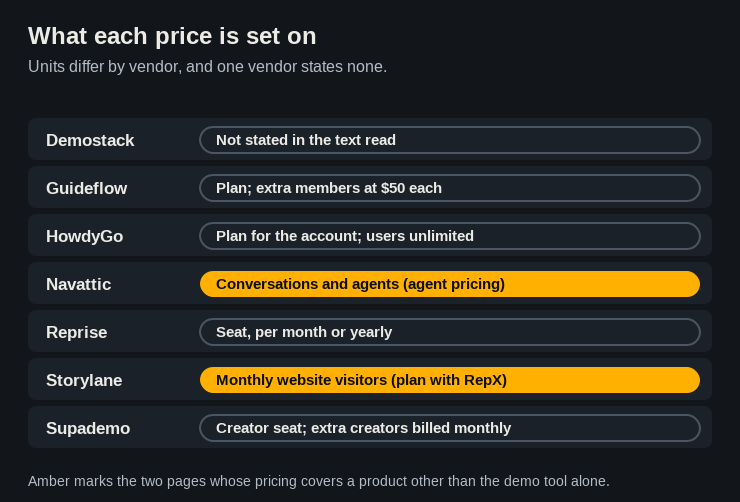
The unit is the part of a price list that survives negotiation, so read it before the number.
HowdyGo sells an account: “They can all create and collaborate on demos without worrying about per-seat charges.” Three people and thirty cost the same, which is unusual in this category and worth saying out loud on the call.
Supademo sells creators, and the price climbs with each one: “+ $50/mo per extra creator”.
Guideflow bundles ten members and charges for the rest: “10 members included +$50 per add”.
Reprise sells seats and adds scope at the top: “Growth adds unlimited demos and presenter seats”.
Four vendors, four units. The only way to compare them is to fix the team you actually have, then ask each vendor for the invoice that results.
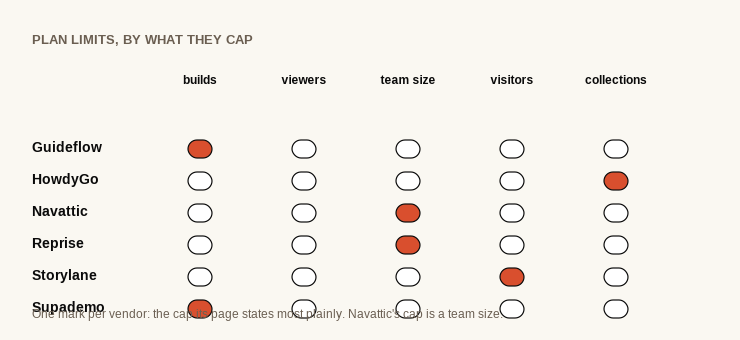
Plan limits decide what a trial can show you, and they are easier to miss than the price.
Guideflow's free plan includes “5 guideflows Unlimited viewers 7-days analytics Watermark 1 team member”. That caps what can be built and leaves viewers unlimited, which is the reverse of what most free tiers do.
HowdyGo says “Nope, demos are unlimited on every plan.” and then limits the shareable hubs: “Starter includes one collection; Pro and Enterprise include unlimited.”
A collection is the link you send a buyer. Unlimited demos with one hub is a smaller plan than it reads.
Navattic limits its startup plan by team size: “Available to bootstrapped and seed-stage teams of 30 or fewer.” The page does not say what happens at team thirty-one.
Storylane limits its free agent by traffic: “RepX is free for websites with fewer than 2,000 visitors a month.” That limit belongs to the agent, and the page keeps it apart from the demo suite.
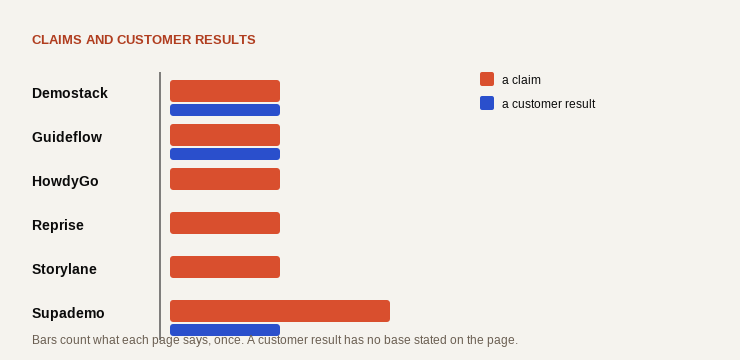
Storylane says “Storylane is rated #1 in demo automation on G2.” The claim names its source, and a reader can check it there. We did not.
Reprise says “Reprise is the world’s leading AI demo platform.” Nothing near the line names a measure or a method, so the word leading stands on its own.
Results arrive as customers' sentences. Demostack shows one who reports “achieved an impressive 8% increase in close-win rates by leveraging Demostack-powered demos.”
Guideflow shows a test where a customer “we saw a 4% lift in account signups”, and Supademo shows one where “beehiiv converts thousands of signups with 50% better conversion rates with Supademo.”
None of those three gives the base it was measured on, and all three are reported as the customer's words rather than as a measured effect of the tool.
Supademo also reports a purchase process: “NetApp, a Fortune 500 company with 12,000+ employees, assessed 52 interactive demo vendors, tested eight hands-on, and chose Supademo.” That is a customer's account of its own evaluation, which is a different kind of evidence from a measured result.
Arcade.software was the clearest loss. Its terms ban “any robot, spider, or other automatic device” used to access the service, so nothing further was requested from it.
Walnut answered the research agent with a 403 on robots.txt and on its home page. We did not retry under another name.
Consensus's home page describes healthcare interoperability, which is a different product, and it is not a row.
Supademo was held at first, because its terms forbid anyone to “copy” or “reverse engineer” the service. The owner read that clause and decided it does not bar this census, and the decision is recorded with the date.
Five product pages were corrected by a dated amendment before the second collection. The rule had picked booking and request pages, and one vendor's website agent instead of its demo suite. The superseded captures are kept and not used, and the amendment is on the record.
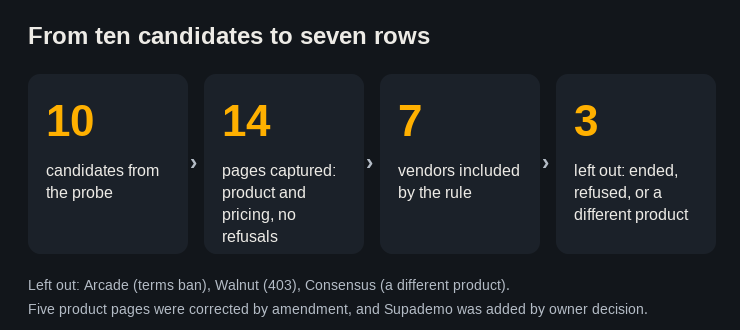
It shows seven vendors, each read once on 27 November 2026, with two of them pricing a product other than the demo tool alone. The category is small, and the pages are a snapshot.
It does not show whether any demo converts. The customer numbers are theirs. We did not build a demo in any tool, and we did not test a single limit.
It does not rank. Rows are alphabetical, and nothing here says which tool suits a given buyer.
Seven vendors build the room. Five state a figure in the text they serve, and the figures count a plan, a seat, an account, a creator or a visitor. Two pages price something other than the demo tool.
So read the caps first. A cap on guided demos, on hubs, on team size or on visitors decides what the trial lets you show a buyer, and a price you cannot test is a price you will renegotiate later.
The room is what the buyer remembers. Build it before you argue about the invoice.
Seven candidate vendors were seeded from the deep probe, and Supademo was added later by the owner's decision with one further home-page request. Each home page was requested once in the first pass. Five product pages were then corrected by a dated amendment, each to a link the home page itself offers, and the superseded pages are recorded and not used. Storylane's pricing page is its plans page, which prices its bundle.
Every quote on this page is an exact span of a captured page, re-checked against that file's SHA-256 at build time. Counts are derived from the categories tagged on those quotes. The inclusion decisions and their quotes are in inclusion.json.
We have no commercial relationship with any vendor on this page. No vendor was contacted, and nothing was bought.
| Vendor | Page captured | Retrieved | SHA-256 (first 12) |
|---|---|---|---|
| Demostack | https://www.demostack.com/pricing | 2026-11-27 | 9c969872914d |
| Demostack | https://www.demostack.com/product-demos | 2026-11-27 | c908f1b4a38f |
| Guideflow | https://www.guideflow.com/pricing | 2026-11-27 | ab5e948682b0 |
| HowdyGo | https://www.howdygo.com/product/pricing | 2026-11-27 | 6521d5253e14 |
| HowdyGo | https://www.howdygo.com/product/create | 2026-11-27 | e93d1df111ab |
| Navattic | https://www.navattic.com/pricing | 2026-11-27 | 976576143320 |
| Navattic | https://www.navattic.com/product/agent-demos | 2026-11-27 | 562fcb315d08 |
| Reprise | https://www.reprise.com/pricing | 2026-11-27 | 9dea85a1b6b4 |
| Reprise | https://www.reprise.com/platform/demos | 2026-11-27 | bf59af343c26 |
| Storylane | https://www.storylane.io/plans | 2026-11-27 | 81d4b0790f1c |
| Storylane | https://www.storylane.io/demo-suite | 2026-11-27 | 04cde24ccbcb |
| Supademo | https://supademo.com/pricing | 2026-11-27 | 488fa4240cf8 |
| Supademo | https://supademo.com/ai | 2026-11-27 | 8c830f503e24 |
You have the comparison. The page a buyer reaches after reading it is yours, and whether that page can be read at all is a different problem from what it argues.
Run the extractability audit on my page
No email required for the free tools. The diagnostic is a fixed scope and a published price.
Covering this research? Please link the primary source so readers can verify the data and methodology:
Markdown: [Interactive Demo Tools Compared (2026): What Seven Vendors Build and Charge | DataDab Research](https://www.datadab.com/research/interactive-demo-tools-compared)
Spot an error? Send the URL to amit@datadab.com; corrections are published on the page.
This page is re-verified quarterly. Check the methodology section for the current verification date before quoting figures.