At a glance
What each page names, and what it prices
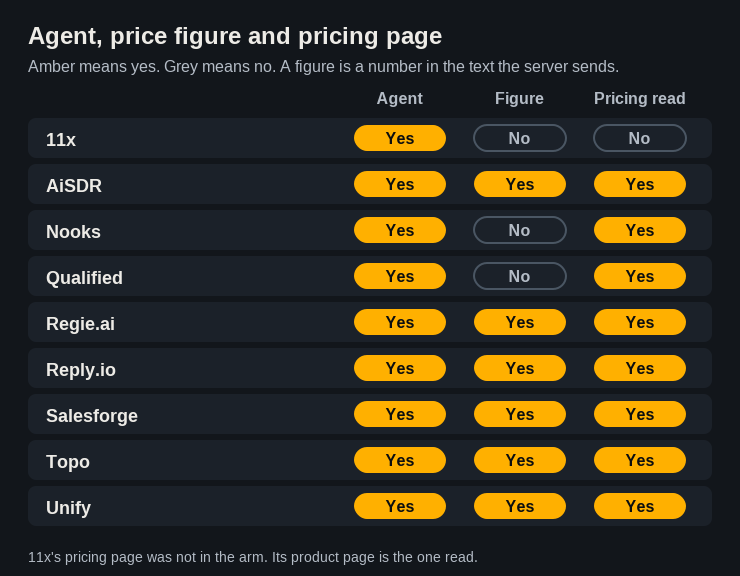
Nine vendors name an AI agent that sends outbound messages on their product page. Six state a price figure. Three show a contact model or nothing at all. Every quote is from the page the vendor published.
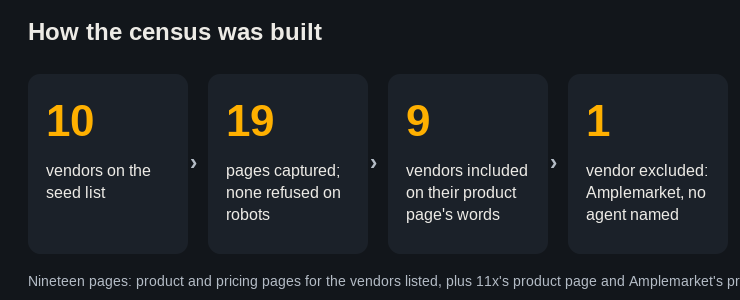
We read the product pages of ten vendors on 26 November 2026, and kept the nine whose own page names an AI agent that sends outbound messages. Amplemarket was excluded because its outbound page describes AI-powered sequences and names no agent, and 11x was read from a product page the home page links.
Six state a figure in the text the server sends. AiSDR says “$1.50 per person prospected.” Topo says “$129 per seat / month”. Unify says “$20 / seat / mo”. Salesforge says “Starting at $48/mo”. Regie.ai shows “Pro $ 41 $ 49 /mo” and Reply.io says “Starts from $ 49”.
Qualified's pricing page says “Contact us”. Nooks and 11x have no figure in the text we read.
Last verified 2026-11-26. Starting figures describe different scopes and volumes. Confirm current terms with each vendor.
Most cold emails end with a signature: a name, a title, sometimes a phone number. The signature is a small promise. Someone here wrote this, and someone will answer for it.
An AI outbound agent keeps the signature and drops the promise. It writes the first line, picks the follow-up date, and sends while the named person is asleep. That is the product. Several vendors say so on one page, and this census reads those pages.
We kept a vendor only if its own page names an agent that writes and sends for the buyer. The word agent had to be there, describing something that sends. A tool that calls itself intelligent, or sells sequencing with AI sprinkled through the copy, did not qualify. One vendor fell out on that rule, and the reason is below.
Every quote here is an exact span of a page we captured, none of it paraphrased. Every count was made from the same text. Where a page is silent, we say it is silent.
A product page answers one question well: what does this thing do to my day? Price and method come back less reliably.
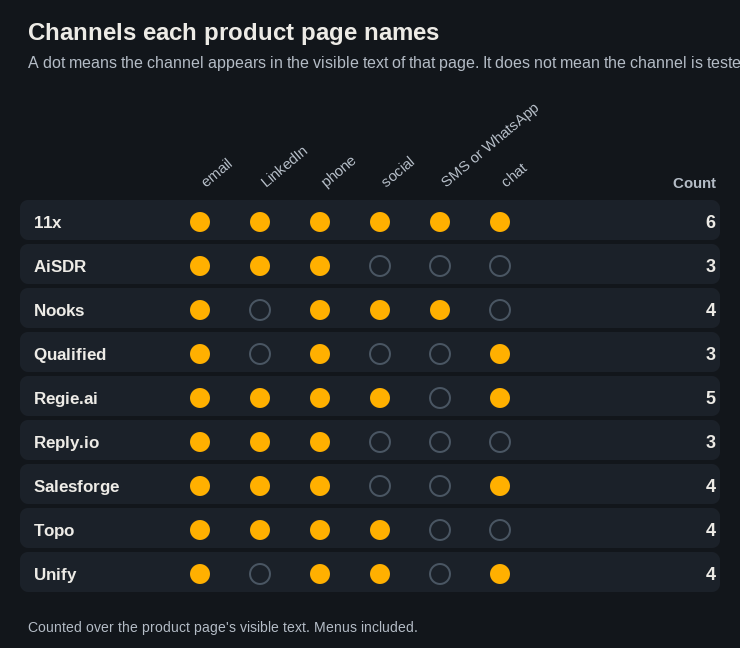
The columns below come from the visible text the server sent. A price loaded later by a script would not appear, so a blank price means the text we read held no figure. Channels are names found on the page, which is a statement about the page.
The last column counts the literal characters '#1'. Two vendors use them. We report what the words say, and we say where a source is named and where none is.
One product page per vendor, captured on 26 November 2026. Rows are alphabetical.
| Vendor | Headline on the product page | Price line in the text | Channels named | '#1' on the page |
|---|---|---|---|---|
| 11x | Three motions. One provider. | No figure in the captured text | email, LinkedIn, phone, social, SMS or WhatsApp, chat | None |
| AiSDR | The AI SDR platform that thinks before it sends | $1.50 per person prospected. | email, LinkedIn, phone | None |
| Nooks | AI-native sequencing built for modern GTM | No figure in the captured text | email, phone, social, SMS or WhatsApp | None |
| Qualified | Meet Piper, the #1 AI SDR Agent. | Contact us | email, phone, chat | 3 |
| Regie.ai | Agentic outbound without the admin and approvals | Pro $ 41 $ 49 /mo | email, LinkedIn, phone, social, chat | None |
| Reply.io | Jason, AI SDR Agent: Feels Human, Works Superhuman | Starts from $ 49 | email, LinkedIn, phone | None |
| Salesforge | #1 AI SDR Built By Former VP Sales To Forge More Pipeline | Starting at $48/mo | email, LinkedIn, phone, chat | 4 |
| Topo | AI Agent for outbound | $129 per seat / month | email, LinkedIn, phone, social | None |
| Unify | The new way to prospect | $20 / seat / mo | email, phone, social, chat | None |
Three kinds of sentence turn up. The first gives the agent a name, as if it were a colleague with a desk. Salesforge sells “AI Agent Frank”. Topo describes an “AI Sales Agent for Outbound”. Reply.io calls its page “Jason, AI SDR Agent: Feels Human, Works Superhuman”. A name makes the product easy to talk about in a meeting, and it makes the question of who answered for the message harder.
The second kind describes reach. 11x says every agent “works around the clock across voice, chat, email and Social”. Unify says “our agents automate your busywork and research so you can spend your time selling”. These answer where the sending happens. They do not say who signs it.
The third kind leads with what the person gains. Regie.ai says “RegieGO researches your accounts”. Nooks says “Automate the manual tasks with agents”. The agent is present in the sentence and nearly absent from the promise, which is the time you get back.
None of this is dishonest. A page has to choose a promise, and each of these is one. The choice tells you what to ask on the call: whether the agent sends alone, what it puts in the signature, and who reads the replies.
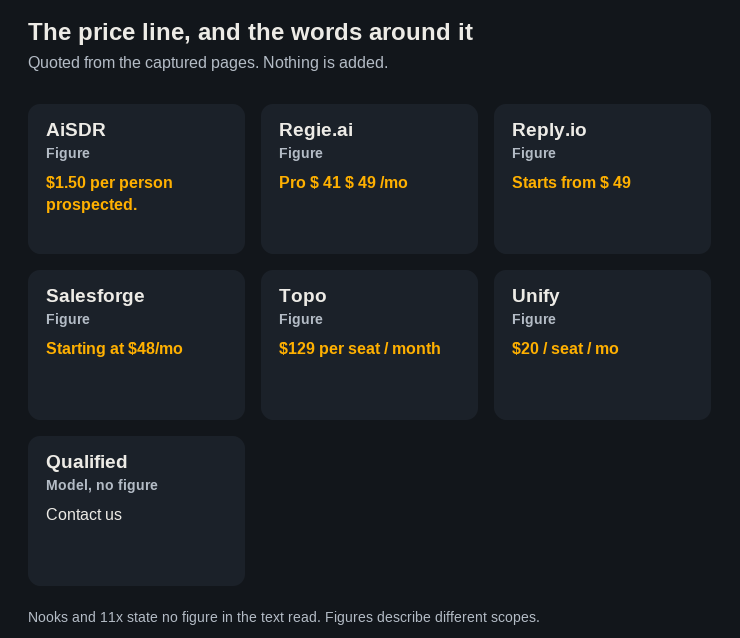
Six pages state a figure in the text the server sent, and they do not count the same thing. Two price a seat. Topo sells “$129 per seat / month”. Unify sells “$20 / seat / mo”. Those two can be compared once you know your team size.
AiSDR says “$1.50 per person prospected.” That number depends on a list you do not have yet, so the comparison moves to the call, where you ask what a person contacted means and what happens to a duplicate.
The rest are starting points. Salesforge says “Starting at $48/mo”. Reply.io shows “Starts from $ 49” at the top of its plan table, and the ladder climbs from there. Regie.ai shows “Pro $ 41 $ 49 /mo”, and the captured text does not explain why two numbers sit together.
Two pages hold no figure. Qualified's pricing page says “Contact us”. Nooks has no figure in the text we read, and 11x had no pricing page in this census.
First place is a cheap word, and two vendors use it. Qualified's page uses the figure 3 times. Its headline reads “Meet Piper, the #1 AI SDR Agent.” A later line reads “Ranked #1 in agentic marketing platforms across G2, Salesforce AppExchange, and Forrester.” That line names its sources, though not a method or a date.
Salesforge's page uses it 4 times. Its headline reads “#1 AI SDR Built By Former VP Sales To Forge More Pipeline”, and the page asks “Want to experience the #1 AI SDR on the planet?”. Nothing near either line names a source.
We did not test either claim, and we have no view on which product is better. What the census can tell you is that both vendors use first place as a headline, and that only one of them says where its ranking comes from.
Amplemarket sells outbound sequences, and its page says so. Its product page, Multichannel Sequences, describes AI-powered sequences and AI recommendations. It never uses the word agent. Under the rule we set before reading these pages, that is not enough, so it is out of the table. This is the strictest call in the study, and a reader who counts an AI-powered sequence as an agent would put it back.
11x's home page offered no link that matched our pattern, so the first pass found nothing to read. On a second pass over the same page, the platform link turned up, and that is the page we read. It names agents working across voice, chat, email and social. The product is in the table on the strength of its own words.
Ask for one message the agent sent without a person reading it first, and the list it went to. If the vendor cannot show you a real one, you have learned something before you have paid.
Ask what counts as a send, what the plan does at the volume you actually run, and who stops a sequence that is going wrong. Then ask the question the signature raises: whose name appears, and who answers the reply.
A vendor that answers those four in a sentence each is easier to hold to account. A vendor that cannot has already given you its answer, and the census cannot tell you more than that.
These pages were read on 26 November 2026. AI product pages change quickly, and a headline or a price can move within days.
The plan calls for a re-read each quarter. A re-read recaptures each page and checks every quote against the new file, and the build stops if a quote no longer matches. If you read this after the next re-read, trust the newer version and its date.
It shows nine vendors, each read once, with a pricing page where one was readable. The category is larger than nine, and the exclusions above are part of the picture rather than a footnote to it.
Channel counts show what a page names, and a page may name a channel it is still building. A price loaded by a script would not appear. And a page is a sales document, written for a buyer in a hurry, which is exactly why its silences are worth noticing.
We have no relationship with any vendor here, we contacted none of them, and we take no fee for a mention.
Nine vendors name an agent that writes and sends for you. Six put a figure in the text, and no two of those figures buy the same thing, so the cheapest number on the page tells you the least.
The pages agree on very little else. Two claim first place, and only one of them names where its ranking comes from. One sells sequences and no agent. One was found on a second pass, through a link its home page had been offering all along.
When you get to the call, come back to the signature. It is the smallest thing on the page, and the only thing that tells you whether a person or a product will answer for what lands in a stranger's inbox.
Ten vendors were seeded from the deep feasibility probe, with the home page requested once for each. Product and pricing pages were chosen by the rule in the protocol, and two overrides were made from links the vendors' own pages offer. The collector read each host's robots.txt and evaluated the exact URL in code before any request. It used the identifiable agent DataDab-research/1.0 and recorded refusals without retrying under another agent. The protocol is docs/plans/s7-ai-outbound-agents-protocol.md in the DataDab repository.
Every quote on this page is an exact span of a captured page, re-checked against that file's SHA-256 at build time. Channel and superlative counts are computed from the same captured text. The inclusion decisions and their quotes are in inclusion.json.
We have no commercial relationship with any vendor on this page. No vendor was contacted.
| Vendor | Page captured | Retrieved | SHA-256 (first 12) |
|---|---|---|---|
| 11x | https://www.11x.ai/platform | 2026-11-26 | 71c2cb6b8e87 |
| AiSDR | https://aisdr.com/platform/ | 2026-11-26 | cb9271f21906 |
| Nooks | https://www.nooks.ai/ai-sequencing | 2026-11-26 | c75f28ea81a1 |
| Qualified | https://www.qualified.com/piper-for-marketing | 2026-11-26 | 9f1f9e20eefd |
| Regie.ai | https://regie.ai/prospecting-reps | 2026-11-26 | 9c87df4eb085 |
| Reply.io | https://reply.io/jason-ai/ | 2026-11-26 | 60dbf755d29d |
| Salesforge | https://www.salesforge.ai/agent/frank | 2026-11-26 | c06cfb3059f9 |
| Topo | https://www.topo.io/products/ai-sales-agent | 2026-11-26 | 695ecee7d989 |
| Unify | https://www.unifygtm.com/solutions/bdr | 2026-11-26 | efcedff442b0 |
You have the comparison. The page a buyer reaches after reading it is yours, and whether that page can be read at all is a different problem from what it argues.
Run the extractability audit on my page
No email required for the free tools. The diagnostic is a fixed scope and a published price.
Covering this research? Please link the primary source so readers can verify the data and methodology:
Markdown: [AI Outbound Agents Compared (2026): What Nine Product Pages Say They Send | DataDab Research](https://www.datadab.com/research/ai-outbound-agents-compared)
Spot an error? Send the URL to amit@datadab.com; corrections are published on the page.
This page is re-verified quarterly. Check the methodology section for the current verification date before quoting figures.