

Why being “helpful” matters more than being loud
There’s a comforting myth doing the rounds in marketing circles: that AI answers are just fancy summaries. You publish a blog post, the model reads it, shrugs approvingly, and regurgitates your wisdom back to the world with a citation and a halo.
That is not what’s happening.
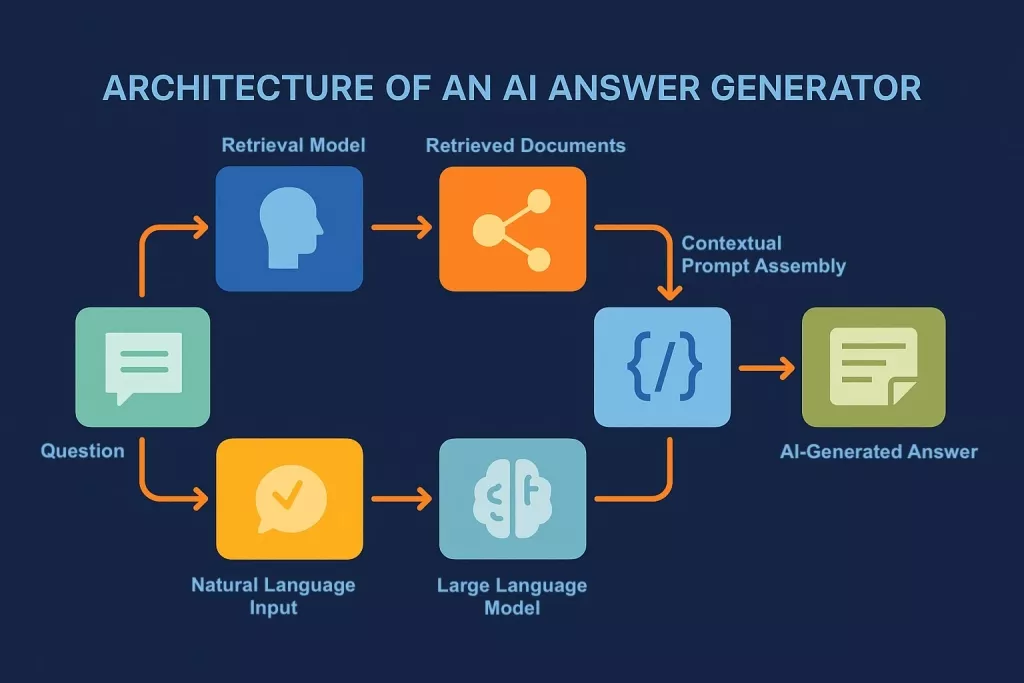
AI answers are not written. They are assembled.
Think less like an essay and more like a jury verdict. Multiple sources. Partial agreement. Some witnesses more credible than others. A strong bias towards what looks stable, boring, and widely agreed upon. Your content does not “rank” into an AI answer. It gets invited into a stitching process.
This matters, because most B2B content is still written as if persuasion alone wins. Strong opinions. Big claims. Vibes dressed up as insight. That style might do fine on LinkedIn. It does terribly when an AI system is deciding which fragments of the internet deserve to survive into an answer.
This piece is not a checklist. It’s a mental model. Once you understand how answers are assembled, the tactical implications become obvious - and slightly uncomfortable.
AI answers are stitched, not generated
When you ask an AI system a question, it does not go hunting for “the best article”. It pulls from a messy internal representation of the web: definitions, patterns, comparisons, examples, and constraints it has seen repeatedly across many sources.
The final answer is closer to a collage than a quote.
Pieces that make it into the collage share a few properties. They are consistent across sources. They are phrased in ways that travel well. They avoid being too clever. They do not require context from three paragraphs earlier to make sense.
This is why aggressively opinionated content struggles. AI systems are not contrarian by default. They overweight consensus because consensus is statistically safer. If five credible sources say roughly the same thing, that shape becomes “true enough” to assemble around.
Your spicy hot take may be memorable to humans. To an AI, it is noise unless it is echoed elsewhere.
The uncomfortable implication is this: originality does not help you get assembled unless it later becomes common knowledge. Until then, you are shouting into a void populated by safer, duller sentences.
Trust is inferred, not declared
definition
process
ambiguity
context
noted
examples
format
theory
regularly
claims
context
jargon
table
opinion
heavy
conclusion
Nobody inside an AI system is reading your About page and nodding approvingly at your credentials. Trust is inferred indirectly, from patterns.
Certain types of content behave like trusted witnesses. They define terms cleanly. They explain processes step by step. They acknowledge trade-offs. They sound like they have nothing to prove.
Other content behaves like a pub bore. Absolute claims. Endless adjectives. Overconfidence with no scaffolding. That stuff tends to get ignored.
This is why reference material performs so well. A page titled “What is X?” that calmly explains what X is, what it is not, and when it applies ends up embedded across countless answers. because it is usable, not because it is brilliant.
Trust emerges from predictability. If your content repeatedly resolves ambiguity rather than creating it, it becomes a safe component to reuse.
A harsh way to phrase this is: AI systems trust content that sounds like it would survive peer review, not applause.
maintained
Freshness shapes relevance, not truth

Freshness is often misunderstood. AI systems are not obsessed with the newest idea. They are alert to whether an idea still holds.
Outdated content creates hesitation. A framework from 2019 with no updates reads like abandoned infrastructure. Even if the core idea is sound, the lack of maintenance reduces confidence.
This is why updated pages quietly outperform endless new posts. A definition that has been revisited, expanded, and clarified over time looks alive. It signals that someone is still standing behind it.
Freshness, in this context, is less about dates and more about continuity. Has this explanation evolved alongside the field? Does it acknowledge new constraints? Does it reflect current practice rather than historical best cases?
AI answers prefer material that looks maintained. Dead pages are liabilities.
Consensus beats brilliance
If you take nothing else from this piece, take this: AI systems overweight agreement.
This does not mean they always give bland answers. It means the building blocks of those answers are usually drawn from places where many sources overlap.
If ten articles define a concept in roughly the same way, that definition hardens. If one article dramatically disagrees, it does not overturn the cluster. It gets sidelined.
For marketers, this creates a strange inversion. You do not win by saying something different. You win by saying the same thing clearly, earlier, and more precisely.
Once a pattern is established, being another clean articulation of it increases your odds of inclusion. This is why boring explainer pages quietly dominate AI answers, while manifesto-style thought leadership fades into irrelevance.
Consensus is not the enemy of authority. It is the raw material AI authority is made from.
zone
definitions
clarity
endings
context
as style
self-contained
Where most content goes wrong
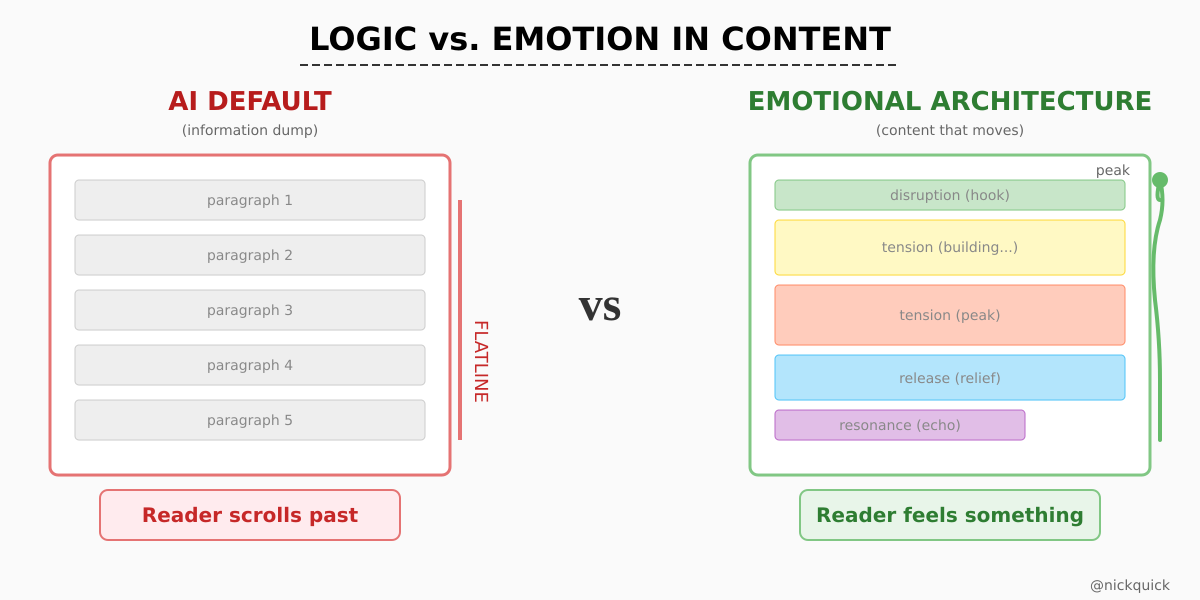
Most B2B content is written to impress a human reader skimming on a bad day. That optimisation actively works against AI assembly.
Common failure modes include hiding the definition until halfway down the page, using metaphor instead of clarity, and treating disagreement as sophistication rather than friction.
Another big mistake is writing conclusions that add nothing. Humans tolerate rhetorical endings. AI systems do not need closure. They need reusable fragments.
If your content cannot be cleanly lifted, paraphrased, and slotted into a larger answer without explanation, it is unlikely to survive the assembly process.
This is not about dumbing things down. It is about making each section self-contained enough to travel.
Template
How answer slots quietly form over time
One of the biggest misunderstandings about AI visibility is that answers are rebuilt from scratch every time. In practice, answer structures stabilise.
Certain questions get asked again and again: “What is product-led growth?”, “How does RAG work?”, “What’s the difference between X and Y?” Over time, the shape of the answer becomes predictable. the structure, not the wording. Definition first. Then components. Then trade-offs. Then examples. Then limits.
Those structural chunks are what we can call answer slots.
Once a slot exists, it tends to persist. The definition slot rarely disappears. The comparison slot does not suddenly become optional. What changes is which sources get used to fill them.
This is why early, clear, and repeatedly reinforced explanations win. They set the template. Later content has to conform to that shape to be considered relevant.
If your content tries to reinvent the structure instead of fitting it, it is fighting uphill. You are not being evaluated on creativity. You are being evaluated on how well you satisfy a known informational need.
Brands that “own” AI answers usually do not dominate because they are louder. They dominate because their content aligns cleanly with these stable answer shapes.
Why some brands keep showing up everywhere
If you track AI answers across similar questions, you will notice the same domains cropping up with suspicious regularity. clearly influential, not always cited.
This is not luck. It is reinforcement.
These brands do three things consistently. They publish canonical explanations. They reuse those explanations across formats. And they update them without changing their core structure.
The repetition matters. When an AI system encounters the same framing across a website, in documentation, in FAQs, and in third-party references, it strengthens the association between the brand and the concept.
Think of it as semantic muscle memory. The more often a clean explanation appears, the easier it becomes to reach for it during assembly.
Most companies accidentally sabotage this. They rewrite explanations every time. New landing page, new phrasing. New blog post, new metaphor. To humans, that feels fresh. To an AI, it looks inconsistent.
Consistency is not laziness here. It is strategy.
Definitions
Maps
Frameworks
Lists
Mental model shift for content teams
This is the part that usually causes resistance.
If AI answers are assembled, then content is not a campaign asset. It is a component library.
That means content teams need to think less like publishers and more like systems designers. The question is no longer “What should we write this month?” It becomes “What reusable explanations does our category depend on, and which ones do we credibly own?”
This shift changes priorities. You stop chasing novelty for its own sake. You start mapping concepts, definitions, processes, and constraints that your buyers repeatedly need clarity on.
It also changes how success feels. The win is not traffic spikes. It is silent inclusion. Your phrasing appearing, paraphrased, inside answers you did not directly optimise for.
That is uncomfortable for teams trained on attribution dashboards. But it is how visibility actually compounds in AI-mediated discovery.
What DataDab actually helps with
This is where the DataDab angle becomes practical rather than mystical.
We are not in the business of “optimising for ChatGPT”. That is a fool’s errand. Models change. Interfaces change. Prompts change.
What does not change is how knowledge stabilises.
Our work usually starts by identifying which answer slots matter in your category. Not keywords. Slots. Definitions buyers trust. Comparisons they rely on. Processes they need explained to justify decisions internally.
Then we look at how your existing content behaves. Which pieces already act like reference material. Which ones are persuasive but structurally unusable. Which ones are actively confusing.
From there, the job is conversion, not creation. Turning opinionated posts into grounded explanations. Collapsing scattered ideas into canonical pages. Making sure the same concepts sound the same wherever they appear.
The goal is simple to state and hard to execute: make your site a place an AI system feels safe borrowing from.
The quiet advantage of being boring on purpose
There is a kind of content that no marketer brags about. Plain. Calm. Almost dull. It rarely trends.
It also keeps getting reused.
Boring-on-purpose content has a job. It removes ambiguity. It settles arguments. It gives language to fuzzy ideas.
In AI assembly terms, this content is gold. It slots in without friction. It does not fight other sources. It reinforces them.
This does not mean your brand voice disappears. It means you pick your moments. Your sharpest opinions belong on top of a stable base of shared understanding.
Without that base, your opinions float. With it, they anchor.
Wrap-up or TL;DR
AI answers are not rewards for clever writing. They are constructions built from stable, trusted fragments of knowledge. Those fragments come from content that defines clearly, agrees where agreement exists, and updates without reinventing itself.
If your content is written purely to persuade, it will struggle to be reused. If it is written to clarify, it has a chance to become infrastructure.
The brands that win in AI discovery are not chasing the algorithm. They are supplying the raw materials answers are made from.
Want to get ahead? Try turning your best opinions into reference-grade explanations and see what that changes. That is the work DataDab actually does.