

The strange contradiction at the heart of modern marketing is that while everyone knows the basic principles, few manage to execute them effectively at scale. Marketers follow a well-established playbook of attract, engage, and delight, yet the cost of acquiring and retaining customers keeps climbing. In fact, a CMO can assume that essentially nothing they do is truly unique or defensible long-term. Yikes! Every business school professor would tell you that this situation should result in diminishing returns and razor-thin margins.
Yet the most successful companies are achieving unprecedented growth and profitability through marketing automation.
Marketing automation is, in my opinion, one of the most powerful tools ever devised by marketers. The efficiency gains are astronomical. The ROI is juicy. It is the pinnacle of decades of marketing technology evolution. In complete violation of what I learned in Marketing 101 (that, admittedly, I barely passed), these companies can achieve outrageous levels of success and scalability.
| Automation Area | Average Time Saved | Potential Revenue Impact | Implementation Complexity |
|---|---|---|---|
| Email Marketing | 20-30% | +50% open rates, +100% click-through rates | Low to Medium |
| Lead Scoring | 15-25% | +30% sales productivity | Medium |
| Customer Segmentation | 30-40% | +20% customer lifetime value | Medium to High |
| Social Media Management | 25-35% | +40% engagement rates | Low |
| Analytics & Reporting | 40-50% | Varies (improved decision-making) | Medium to High |
How can this be?
Marketing automation is such an incredible approach because it has close to zero marginal cost for engaging additional customers. Once you build the automation workflows, you can deploy them over the internet to as many prospects and customers as you like. Additionally, automation is sticky. The best companies will drive more engagement and revenue every year from the same cohort of customers through more personalized and relevant interactions. Yes, when competition is fierce, acquisition costs go up, but a well-executed automation strategy can overcome that.
This is, like, a mildly interesting topic to which I could devote a newsletter edition. But the much more interesting and devilishly challenging thing to write about (and the thing I've been obsessed with for years) is that everyone knows this. What I wrote above contains obvious knowledge that would be at home within a digital marketing 101 textbook.
The result is a meta-market: because marketers know what playbook their competition is running, they end up positioning themselves against moves their competitors will make in three years. Let's say I run an email marketing automation company, similar to Mailchimp or ActiveCampaign. Since each company has a unique starting point, we'll each have relative strengths. Mailchimp is great at design and usability. ActiveCampaign has much more advanced automation capabilities. My hypothetical company could have really strong AI-powered content generation. I can know, with certainty, that over the next three years both Mailchimp and ActiveCampaign will move closer to my capabilities, while I move closer to theirs: Mailchimp will improve its automation, ActiveCampaign will improve its design tools, etc.
In most industries, competition is a knife fight—it's fast and dirty. In contrast, marketing technology is a chess match, cerebral and drawn out. And it's because rather than merely guessing about what their foes will do, marketers can forecast with a spooky level of certainty what is going to happen.
I've even made this into a game. When I see a martech company is teasing a new product launch, I'll email their rival and ask, "Any idea what this is?" Usually, I'll get a response like, "Haven't heard anything, but my guess is X." They are almost always right.
They are able to do this because the playbook is known. And, luckily, I'm going to teach it to you.
The marketing automation flywheel playbook
| Flywheel Stage | Common Challenges | Automation Solutions | Key Metrics |
|---|---|---|---|
| Attract | Content creation at scale | AI-powered content generators, SEO optimization tools | Organic traffic, Content engagement rates |
| Engage | Personalization across channels | Dynamic content tools, Behavioral targeting | Lead quality score, Conversion rates |
| Delight | Timely and relevant follow-ups | Automated onboarding, NPS surveys | Customer retention rate, Referral rate |
The journey of marketing automation goes like this:
- A point solution solves a specific problem for a specific group of marketers. Over time, the point solution's capabilities grow, expanding what type of marketing activities they can automate.
- Next, the company will go multi-channel. It'll start to offer automation across multiple touchpoints that will serve either its core customer segment or related functions in the marketing org it's selling to.
- Then the company will become a platform, allowing an ecosystem of partners to build integrations and custom automation workflows on top of what it is already offering.
- The cycle begins again with new point solutions, typically related to its platform capabilities, for new use cases and emerging channels.
To grow beyond the initial customers for which its point solution works, a marketing automation company can either expand horizontally (use the same tools to serve a new set of customers with similar problems) or vertically (create new tools that serve other problems its existing customers are facing). So a piece of software that facilitates email automation for e-commerce companies could expand horizontally by helping B2B marketers implement similar workflows, or it could expand vertically by adding social media and ad automation capabilities.
While this may sound banal, because digital channels are ubiquitous, the available opportunity for marketing automation software companies is in the vicinity of hundreds of billions of dollars. According to Grand View Research, the global marketing automation market size was valued at USD 4.06 billion in 2019 and is expected to grow at a compound annual growth rate (CAGR) of 9.8% from 2020 to 2027.
When you think about a point solution in marketing automation, the software's function changes based on the size of the customer and what that customer does. To continue the e-commerce example, the software would need to be designed differently for a small Etsy shop than for Amazon—perhaps by focusing on abandoned cart emails (for the former) versus sophisticated product recommendation engines (for the latter).
I recognize this is hand-wavy, but think about how overheated this dynamic can make the competition. Every person in a marketing department, every function from content creation to analytics, will have multiple software companies competing to automate their workflows. Enterprise will be moving into mid-market. Related industries will try to encroach. It is, frankly, ridiculous. And no single marketing automation provider can solve all the needs of an organization. According to Chiefmartec.com's 2020 Marketing Technology Field, there are over 8,000 martech solutions available.
To win, a company's goal is to own the most powerful piece of data and/or workflow that will allow it to hold its competitors at bay. For example, most marketing automation companies try to own the customer data platform (CDP) or the email marketing system because you can use that data to connect to everything else happening in the marketing ecosystem, from lead scoring to personalization. Think of how you see HubSpot or Salesforce logos in the footer of marketing emails you receive. A similarly important control point exists for each function, industry, or business type.
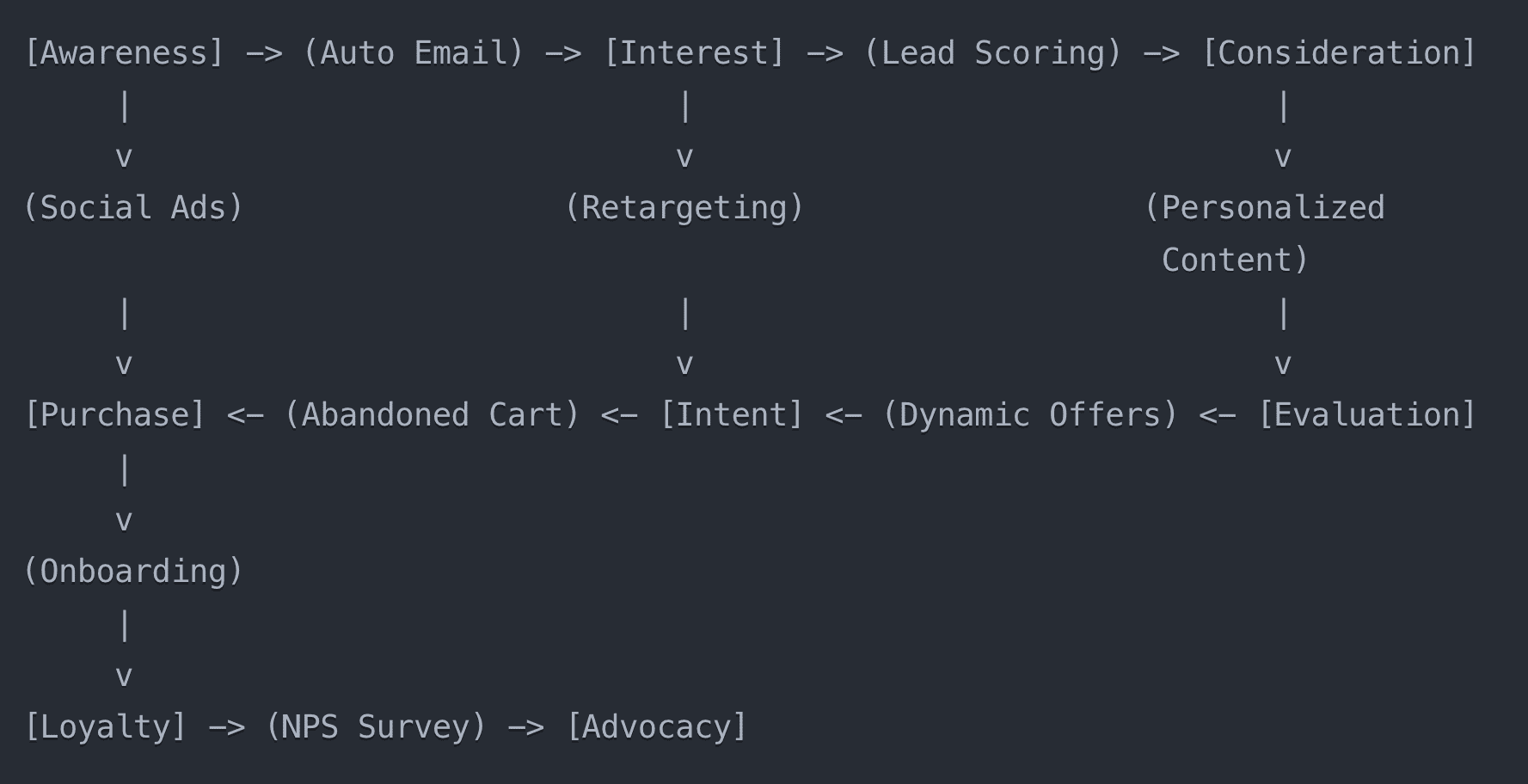
So, in this context, let's talk about the marketing flywheel.
Spin to win
When I hear the phrase "marketing flywheel," I picture overeager growth hackers wearing Allbirds and Patagonia vests—folks whose sole purpose in life is making sure that I see the same retargeting ad 47 times an hour. (Clearly, I've had great experiences with these wonderful people.)
What the marketing flywheel actually is, though, is a complex mix of critical tasks:
- Attract: Drawing in the right prospects through valuable content and experiences
- Engage: Nurturing leads and building relationships through personalized interactions
- Delight: Exceeding customer expectations to drive retention and advocacy
While the thought of manually managing this stuff personally fills me with the desire to be pelted with stale marshmallows, someone has to use software to accomplish these tasks. This is a lot of stuff! Frankly, no company can be great at all of this. Remember—the goal of marketing automation companies is to own the most important data or workflow because it means they will be the least likely to be replaced by a competitor. And, most importantly, everyone knows their competitors are also doing this.
So to win, companies have to come up with a distinct thesis on what the most important workflow is for their customer and how they are going to own it. To learn more, I chatted with a Hubspot certified marketing automation expert, with over a decade long experience under his belt. He argued that for small businesses, attracting leads through content marketing is what matters most. "Small companies are just hoping to get found online," he said. Here startups like Wordpress and Wix do really well. At big companies, the thing that matters most is, he told me, "owning the customer data"; Salesforce has nailed this to the tune of a $200B+ valuation.
When Dharmesh Shah started HubSpot, he aimed at small to medium-sized businesses. His point solution for these customers was inbound marketing. Shah explained why in an interview: "There was just like this revolt against interruption-based marketing...it was like a small early group of marketers who were championing this new format, which is what HubSpot was built for. And we served that, and there was some luck to it, but it just grew and that became the real default."
Later the company went multi-product, adding tools like CRM and service hubs.
It's helpful to think of marketing automation companies as something akin to religion. There is some core belief, some manner of work, that is at the heart of everything they do. Sometimes that belief is softer and more emotionally appealing, such as HubSpot's that it could do marketing more humanely through inbound methodologies.
At other times that belief is more pragmatic, as with marketing automation competitor Marketo. Its thesis is that lead management is at the center of everything for mid-sized to enterprise companies. Right or wrong, this is what it has based its entire product ethos around, and its content marketing product drives home this point.
Eventually the battle becomes religious. What underlying belief about marketing ends up being correct? In large enough markets, like marketing automation, there is usually room for multiple faiths. Sometimes what you are preaching lands, like HubSpot found with its higher ideal of inbound marketing. In other cases it's like the poor growth hackers who end up assigned to promote artisanal, hand-crafted pencils—there is no scalable interest.
Perhaps the strangest artifact is that because these systems are serving similar customers and have different strengths, they have no choice but to share the market.
What game are you playing?
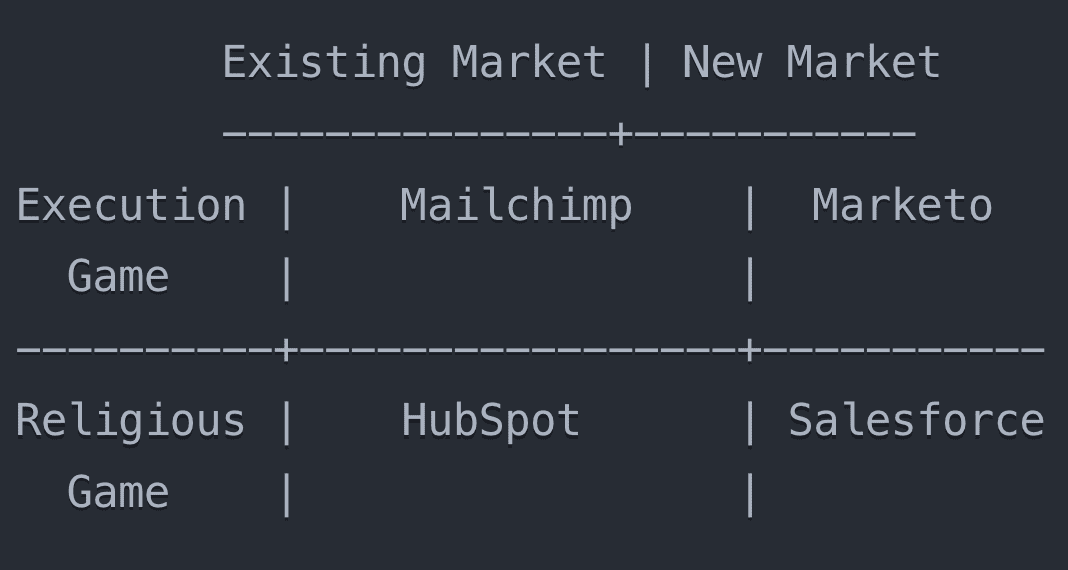
So how can you think about what marketing automation companies will win? It comes down to understanding what type of game the software companies are playing:
Execution game: Sometimes when the playbook is obvious, it comes down to who can run it better—so culture-market fit becomes important. Is the company properly constructed to reflect the needs of the market? Will it have a slight edge in recruiting product managers? In UX design? If you out-execute—even if you have a late start, worse technical talent, and less funding—you can still win, such as with the case of Mailchimp versus Constant Contact.
Religious game: Many of the largest bets in marketing automation come from taking a non-obvious perspective early. By building a product built around a forecast of how marketing will be done in the future, startups can capture value. It is best when this way of working may be counterintuitive or even appear to be dumb. In fact, looking wrong early is often a strong signal of winning later. For example, HubSpot was a counterintuitive bet that inbound marketing could replace traditional outbound tactics. In the beginning, no one believed in it, but now the company sits at a $17B+ valuation.
Market game: Dharmesh Shah describes the market game as searching for "zero billion-dollar markets." In a recent interview he described it as follows: "It's our way of saying there's no market yet, but we believe there will be one. Usually when you're positioned there, everybody's trying to figure out why are you here. When we first got into CRM, because we believe that in the future, the customer relationship is going to be largely software-driven. If it's going to be largely software-driven, a really incredible platform is necessary...I think 10 years later we're largely right." Great companies are those that are built with decades in mind—even a time period of five years is too short. In marketing automation, when the playbook is obvious, there is a big advantage that comes from running it before anyone else.
| Game Type | Key Characteristics | Example Companies | Success Factors |
|---|---|---|---|
| Execution | Strong culture-market fit, Operational excellence | Mailchimp vs. Constant Contact | Superior UX, Faster feature rollout |
| Religious | Non-obvious early perspective, Paradigm-shifting approach | HubSpot (Inbound Marketing) | Evangelist community, Thought leadership |
| Market | Long-term vision, "Zero billion-dollar markets" | Salesforce (Cloud CRM) | First-mover advantage, Platform ecosystem |
At its core, the marketing automation universe is paradoxical: common playbooks that should herald predictable commoditization instead yield unpredictable successes. This might be unsettling for the traditional marketer, but it's a fascinating phenomenon for the astute founder or CMO.
Where does this leave us? First, it's essential to recognize that the uniqueness of marketing automation strategy isn't rooted in what companies do but in how they do it. In a world where everyone has access to the same roadmap, the differentiator becomes the vision, culture, and adaptability of the company itself. It's not just about selling a marketing solution; it's about selling a belief, a future perspective that entices and resonates.
HubSpot and Marketo show that while companies might operate in the same space, their beliefs can diverge significantly. Sometimes it's a humane touch to a traditional process; other times it's a hard-hitting conviction about what truly matters. Companies that grasp and use their unique "why" are those that flourish in the ocean of copycat martech.
Lastly, for the keen marketer or business leader, the key to picking winners isn't just about knowing the playbook; it's about discerning which companies truly understand the game they're playing. As we at DataDab have seen through our consulting work, the most successful marketing automation implementations are those that align closely with a company's core beliefs about how marketing should work.
In the end, the marketing flywheel, much like the software playbook, is both universally known and uniquely executed. The winners will be those who can spin it the fastest, with the least friction, and in perfect harmony with their customers' needs. And that, dear reader, is a game worth playing.