
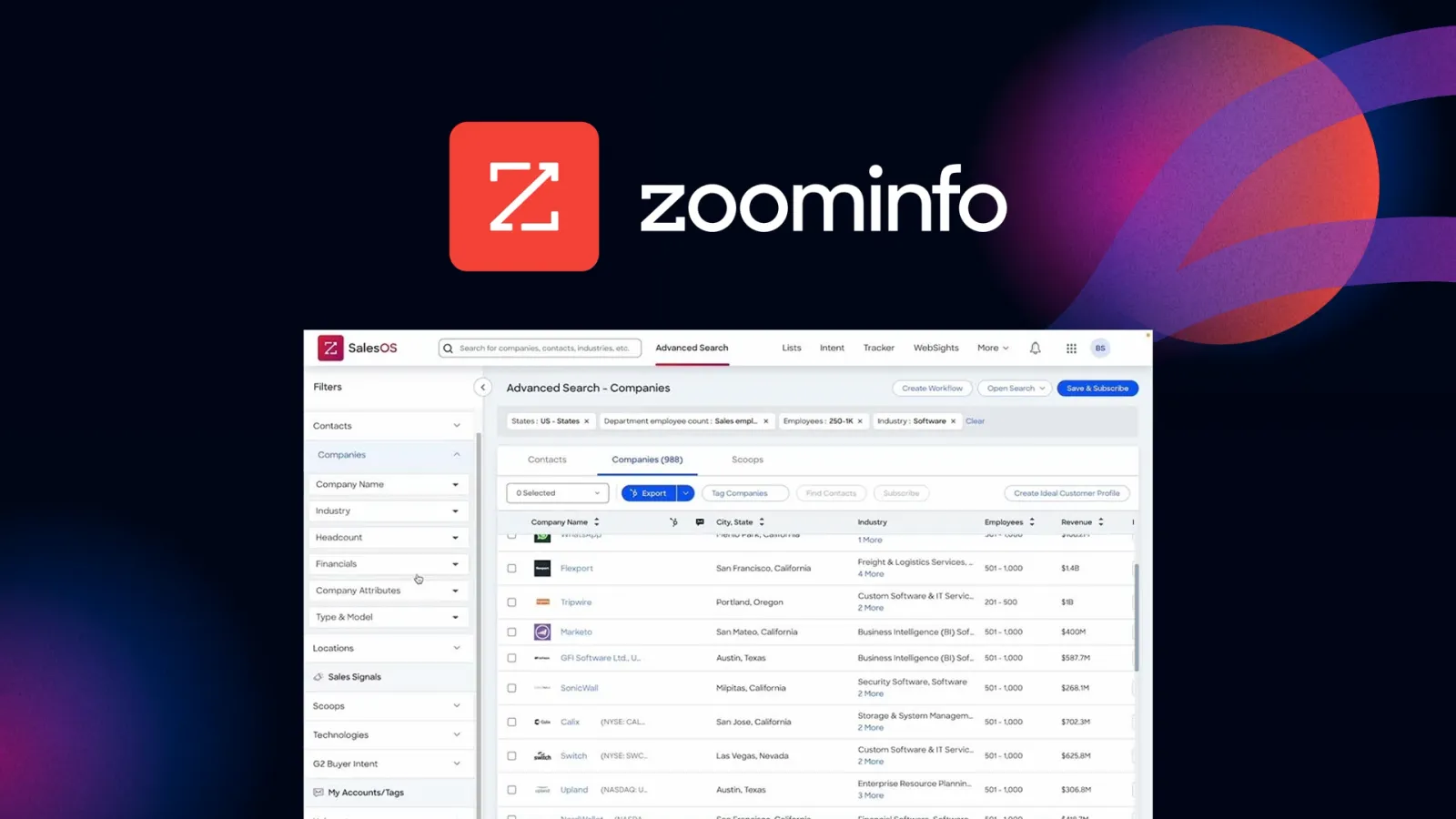
Why sales and marketing teams are quietly ditching the “king of data” for fresher, leaner, and dare we say, sassier alternatives
ZoomInfo. The name itself sounds like something a Bond villain would shout into a wristwatch. But for sales and marketing folks, it’s been more of a necessary evil than a cinematic sidekick.
Sure, ZoomInfo works. It’s the database equivalent of a massive, slightly bloated Swiss Army knife. Prospecting, enrichment, intent data, alerts, orchestration - it does a lot.
But does it do it well enough to justify the price tag, the clunky UX, or the yearly contracts that feel more binding than marriage vows?
We’ve been hearing murmurs (and full-blown rants) from growth teams across the B2B world. And the chorus is clear: ZoomInfo isn’t the only show in town anymore.
So let’s pull back the curtain and meet the contenders.

The Cracks in the ZoomInfo Facade
Let’s be honest. ZoomInfo’s been riding high for years, coasting on being “the default”. Like Internet Explorer in 2005. Or that one agency your boss refuses to fire.
But here’s what users are grumbling about:
- Outdated or inaccurate data. You open a promising prospect… only to discover they left the company in 2021. Classic.
- Opaque pricing. Want a quote? You’ll need to fill a form, sit through a demo, and pretend to be impressed first.
- Rigid contracts. ZoomInfo’s famous for locking you into 12-month deals. Missed a renewal date? Congrats, you’re stuck.
- Overbuilt, underloved features. Intent data that doesn’t convert. Enrichment that’s “meh”. Workflows that feel like an escape room puzzle.
It’s no surprise that leaner, sharper tools are gaining ground - especially for teams who value flexibility over bloat.

Who’s Taking on ZoomInfo?
Let’s break down the competition into three useful categories - because not all “alternatives” do the same job.
🧭 1. Prospecting Platforms (The Sales Hunters)
If you just need fresh contacts and accurate info - without the bells, whistles, and handcuffs - these are your people.
✅ Apollo.io
Why people love it: • Ridiculously good for the price. • Clean UX, Chrome extension that works like a dream. • Includes email + phone + LinkedIn + outreach tools.
Drawbacks: • Data isn’t as deep as ZoomInfo, but way fresher. • Intent data is more basic.
🧠 Verdict: A growth hacker’s dream. Ideal for startups, SDR teams, and cost-conscious closers.
✅ Cognism
Why people love it: • GDPR-compliant out of the box. • Big presence in EMEA and UK. • Strong mobile numbers (yes, really).
Drawbacks: • Smaller database than ZoomInfo. • Intent integrations not as slick.
🧠 Verdict: Perfect if you’re targeting Europe and want to stay on the good side of privacy laws.

🔍 2. Data Enrichment Tools (The Quiet Workhorses)
Sometimes, you don’t need a full-blown sales machine - you just want your CRM not to look like a ghost town.
✅ Clearbit
Why people love it: • Great API and real-time enrichment. • Plays well with HubSpot, Segment, and your growth stack. • Email and domain-based lookups are fast and clean.
Drawbacks: • Less outbound-focused. • Contact data can feel light if you’re sales-heavy.
🧠 Verdict: If you’re running PLG or inbound-first funnels, this is your wingman.
✅ Clay
Why people love it: • Enrichment meets automation, on steroids. • Pulls data from dozens of sources (including LinkedIn, Twitter, Crunchbase). • Great for building unique prospecting workflows.
Drawbacks: • Steep learning curve. • Not a "plug and play" solution.
🧠 Verdict: If Airtable and Zapier had a baby, and that baby was a B2B prospecting genius.

🕵️ 3. Intent + Intelligence Players (The Mind Readers)
Want to know who’s actually in-market? These tools try to give you that crystal ball.
✅ 6sense
Why people love it: • Serious predictive analytics chops. • Helps align sales and marketing on real buying signals. • Superb for ABM campaigns.
Drawbacks: • Enterprise pricing and complexity. • Requires buy-in across teams.
🧠 Verdict: Powerful, but not for the faint of budget.
✅ Leadfeeder (now Dealfront)
Why people love it: • Identifies anonymous site visitors and ties them to companies. • Great for small sales teams without fancy stacks. • Dead simple to use.
Drawbacks: • Data limited to website visitors. • Not a full CRM replacement.
🧠 Verdict: A smart way to catch low-hanging fruit from your own site traffic.
What Actually Matters?
Let’s zoom out (ahem). Here’s what actually matters when picking a ZoomInfo alternative:
| Feature | Worth Paying For? | Insight |
|---|---|---|
| Contact Accuracy | ✅ | Because nothing says “pro” like emailing someone who left in 2019. |
| CRM Integrations | ✅ | If it doesn’t sync, it stinks. |
| Intent Data | 🤔 | Only useful if you know how to use it - and have the volume. |
| Price Flexibility | ✅✅ | Year-long contracts are so 2008. |
| Platform Bloat | ❌ | Fancy dashboards won’t hit quota for you. |
If you’re a lean B2B team with clear outbound goals, don’t be seduced by the “one platform to rule them all” narrative. It’s often better to assemble your own Avengers - one that fits your needs, not some exec’s sales pitch.

The Takeaway: Bye-Bye, ZoomBot
ZoomInfo is still the big dog. But like MySpace, Blockbuster, or the guy still using Hotmail for work - it’s not the future for everyone.
The best ZoomInfo alternative? Depends on what you actually need. Some of you just want a snappy prospecting tool. Others need rock-solid enrichment. A few are diving into intent data to fuel ABM plays.
But you all have one thing in common: you’re no longer afraid to ask, “Wait, is this really worth what we’re paying?”
(Spoiler: In many cases, no.)
Want to test a leaner stack without sacrificing results? Start with Apollo or Clearbit, pair it with a smart outreach tool like Instantly or Smartlead, and thank us later.
Need help building your outbound engine? We’ve helped teams like yours build smart, cost-efficient prospecting workflows from scratch.
Drop us a line. We’ll even explain it in plain English.
FAQ
1. Is ZoomInfo still worth it in 2025?
It depends on your team's size, goals, and budget. If you're running a large sales org with complex workflows and deep ABM requirements, ZoomInfo still delivers a lot of value—especially with features like orchestration, Scoops, and multi-threading tools. But for leaner, more agile teams, there are now more cost-effective options with comparable data quality and better flexibility.
2. What makes Apollo.io a serious competitor to ZoomInfo?
Apollo combines a growing B2B database with built-in outreach tools, which means you can search, enrich, and email—all in one place. Its pricing is transparent (a rarity in this space), and the Chrome extension is lightweight and responsive. While it may lack ZoomInfo’s depth in some org charts or intent layers, it wins big on speed, usability, and cost-effectiveness.
3. Can I replace ZoomInfo entirely with Clearbit or Clay?
Not quite apples to apples. Clearbit is brilliant for enrichment and inbound-focused strategies (like identifying high-value traffic or routing leads faster). Clay is a workflow beast—ideal for building custom prospecting automations. Neither offers the same out-of-the-box depth in contact discovery as ZoomInfo. But together, they can outperform ZoomInfo in agility and customisation, especially if you're automating around your own stack.
4. Which tool is best for GDPR compliance in Europe?
Cognism has built its brand on GDPR compliance, and it shows. They’re one of the few data providers with an explicit GDPR-first approach, meaning they collect, store, and process data with European regulations in mind. If your go-to-market strategy includes the UK or EU, this gives you a much stronger legal footing than using US-centric tools like ZoomInfo.
5. How does intent data differ between ZoomInfo and its rivals?
ZoomInfo’s intent data is powered by its acquisition of Clickagy and network of cooperative data providers. It's decent, but sometimes noisy or broad. 6sense, on the other hand, focuses on predictive analytics—layering account-level buying signals, website behaviour, and engagement scoring. If you’re running targeted ABM or looking for high-signal intent triggers, 6sense is often more actionable (but also more expensive).
6. What if I only need email and phone numbers for cold outreach?
Go lean. Tools like Apollo, Uplead, and even Wiza (paired with LinkedIn) can get you verified emails and mobile numbers without bloated contracts. If outbound is your main motion, and you’re not fussed about orchestration or advanced intent, these tools will do the job at a fraction of the cost.
7. Are there open-source or free tools that compete with ZoomInfo?
Not directly. ZoomInfo’s moat is built on years of data aggregation, compliance layers, and proprietary enrichment. But for those on a budget, combining LinkedIn Sales Navigator, Hunter.io, and free credits from tools like Skrapp or Snov.io can get you surprisingly far—especially for small-batch prospecting.
8. What’s the best combo stack to replace ZoomInfo without losing functionality?
For prospecting: Apollo.io or Cognism. For enrichment: Clearbit or Clay. For outreach: Smartlead or Instantly. For web visitor intel: Leadfeeder. For ABM and intent: 6sense (if budget allows) or Factors.ai (for smaller teams). Mixing tools gives you modular control and helps avoid vendor lock-in, which is ZoomInfo’s Achilles' heel.
9. Why is ZoomInfo pricing so opaque?
Because they can. ZoomInfo operates with an old-school enterprise sales playbook—meaning you'll typically speak to an account rep, get quoted based on seat count, usage, and integrations, and then negotiate. This opacity lets them maximise revenue per customer, but it frustrates teams who are used to transparent SaaS pricing.
10. How do I transition away from ZoomInfo without disrupting my sales process?
Start with overlap. Pilot your alternative tool (e.g., Apollo) with one SDR team for a month. Benchmark performance: lead quality, bounce rate, connect rate, meeting booked. Document gaps—what ZoomInfo did better—and see if those are deal-breakers. Gradually phase ZoomInfo out while training your team on the new workflows. Most importantly, avoid last-minute transitions; ZoomInfo auto-renewal clauses are notoriously unforgiving.