The best A/B testing tools for B2B websites that actually move the needle (and not just the pixels)
Let’s get one thing straight: B2B website optimisation isn’t about fiddling with button colours or running “headline v/s subheadline” shootouts like you’re the judge of a beauty pageant. It’s about conversions that count - demos booked, forms filled, and pipeline that actually shows up in Salesforce.
But here’s the rub: most A/B testing tools are built for e-commerce or DTC. They’re obsessed with CTRs and “buy now” clicks, when what you really want is to see if version B gets that Head of Procurement to finally schedule a call.
So, we went digging. Past the hype, under the dashboards, through the integrations maze - to find A/B testing tools that get B2B. Tools that don’t blink when faced with a 4-month sales cycle, gated content funnels, or that one guy who still uses IE11 at his day job.
Not All Tests Are Created Equal
Let’s start with a truth bomb: B2B testing is often riddled with low traffic, high stakes, and stakeholders who think every change is a branding crisis. That’s why choosing the right testing tool is half the battle.
Take this classic scenario: You’re trying to test whether moving the ‘Book a Demo’ button above the fold increases conversions. With an average of 50 visits/day to that page (most of whom are your own sales team), your sample size won’t win any statistical prizes. But the impact of even a 0.5% lift? Potentially millions in ARR.
This is where tools with Bayesian modelling, multi-armed bandit tests, or audience segmentation superpowers shine. And no, Google Optimize is no longer an option. RIP, sweet prince.
VWO: The Swiss Army Knife for Serious B2Bers
You know how in spy films there’s always one gadget that can do everything - cut wires, hack doors, make coffee? VWO is a bit like that for testing.
You get A/B testing, split URLs, multivariate tests, session recordings, heatmaps, and funnel analysis all in one tab. Great for teams who want both experiments and evidence. Especially useful when your CMO asks, “But why did the conversion rate go up?”
Pros:
- Built-in statistical significance calculator (no more “is 17 conversions enough?”).
- Good integration with CRMs and analytics tools.
- Super clean visual editor - handy when your devs are too “agile” to help.
Cons:
- Can get pricey if you scale up usage.
- Some features (like heatmaps) feel a bit ‘last updated in 2018’.
Verdict: Best for B2B marketing teams with big ambitions and medium budgets.
Convert: The No-Nonsense Nerd Pick
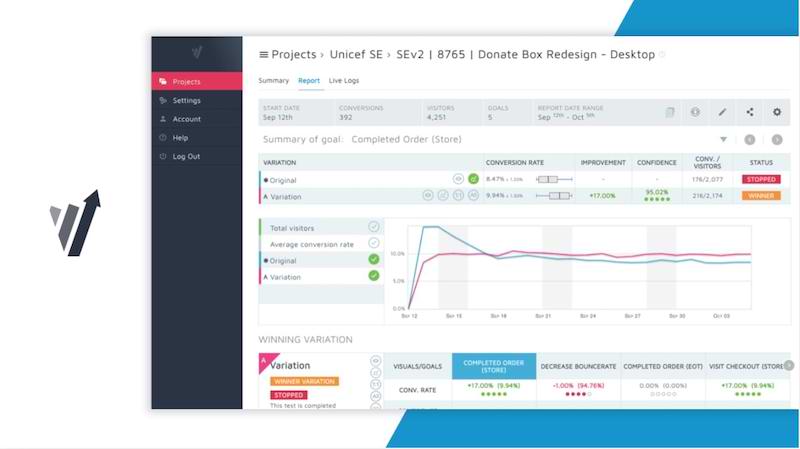
Convert is what happens when a group of data scientists says, “What if we made an A/B tool without the fluff?” It’s lean, privacy-conscious, and laser-focused on experimentation without making you learn Python.
Best part? It plays really well with custom data sets - think firmographic segmentation, lead quality scoring, or journey-stage specific testing. If you’re a B2B company obsessing over ICP-fit leads rather than just anyone who clicked, this one’s your jam.
Pros:
- Super fast. Like, “blink and it deployed” fast.
- GDPR/CCPA compliant, with servers in the EU - ideal if your legal team sleeps with one eye open.
- Deep segmentation features perfect for ABM (Account-Based Marketing) use cases.
Cons:
- Not very visually flashy. Think Honda Civic, not Tesla.
- Learning curve is steep if you’re coming from a tool like Unbounce.
Verdict: Ideal for performance marketers and data-minded folks who love tweaking knobs behind the scenes.
Optimizely: Enterprise Muscle, Enterprise Price Tag
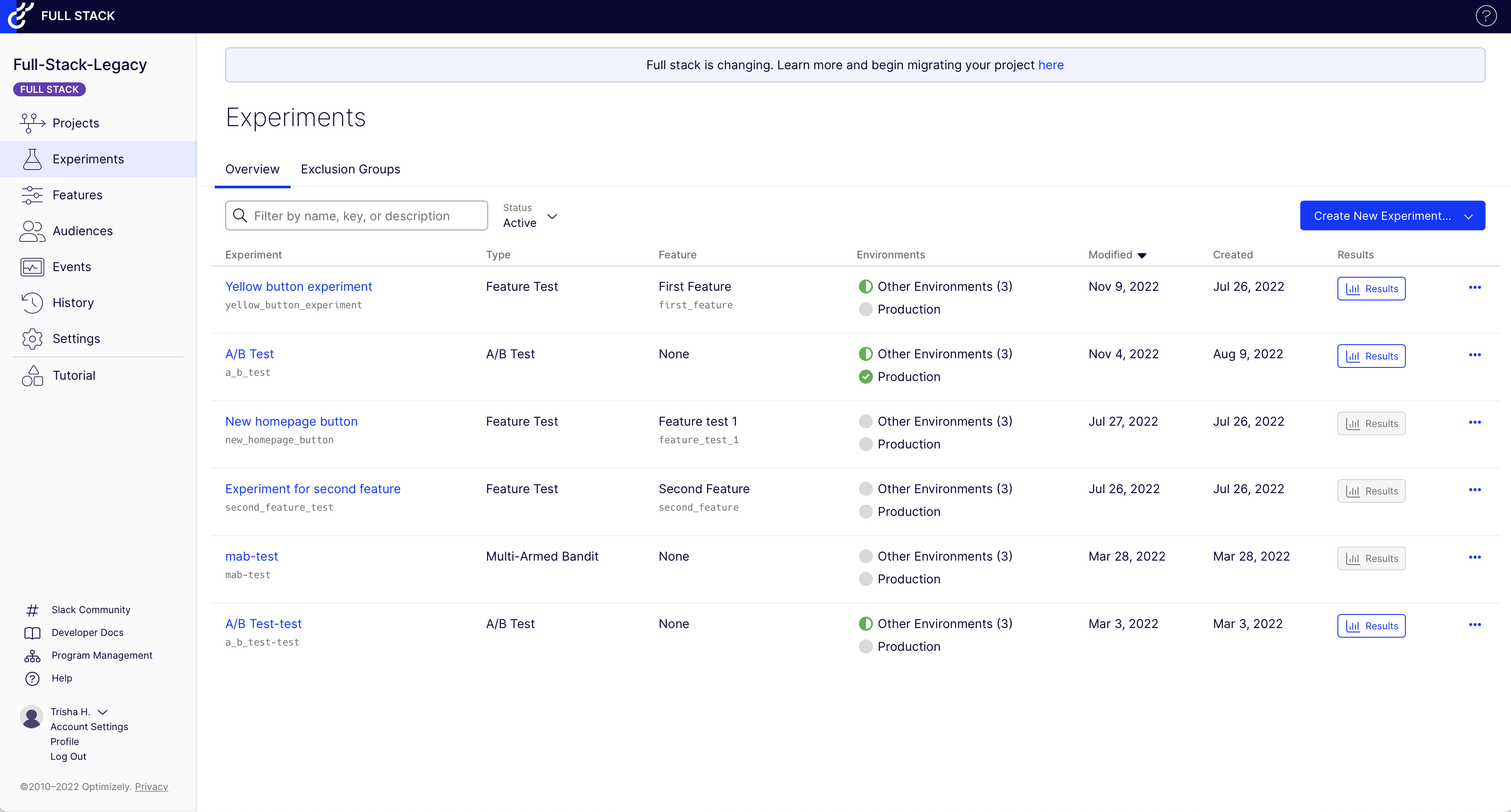
If Convert is the quiet genius, Optimizely is the power lifter in a tailored suit. It was practically built for enterprise B2B companies - those with internal analytics teams, $50k MRR pages, and a scary obsession with data governance.
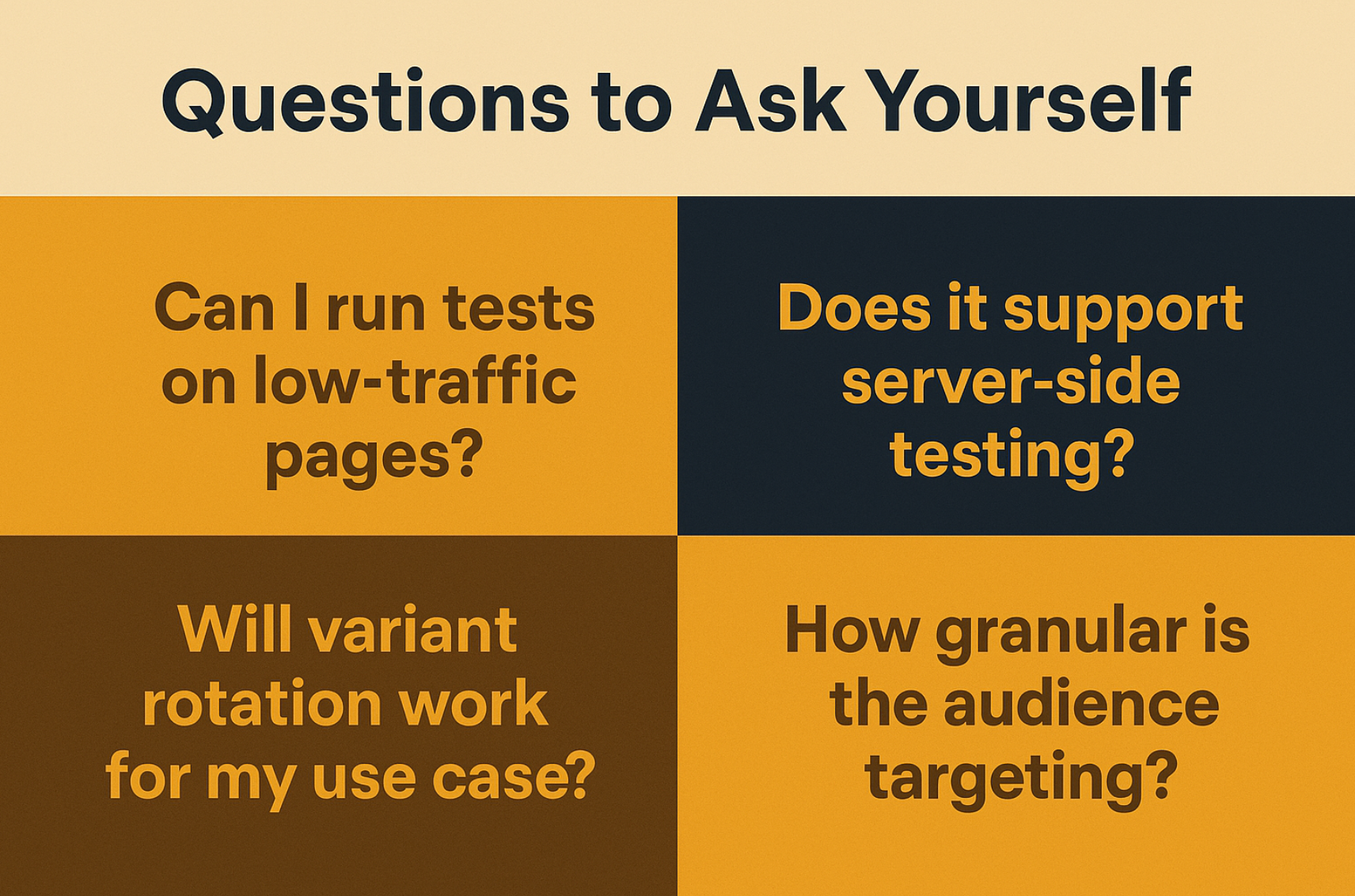
It supports server-side testing, full-stack experiments, feature flags, and even AI-powered personalization. If your CTO loves to get involved in marketing “just to be safe,” Optimizely will make them feel at home.
Pros:
- Phenomenal for complex experiments across web, app, and server.
- Feature rollouts + A/B testing = better product-market fit decisions.
- Integrates deeply with Adobe, Segment, Salesforce.
Cons:
- You need to sell a kidney to afford it.
- Steep implementation curve. Not for Friday-afternoon side projects.
Verdict: Brilliant for B2B enterprises who view testing as infrastructure, not a “nice-to-have”.
AB Tasty: The Fun One That Still Gets Results
AB Tasty sits comfortably between Convert and Optimizely. It’s more flexible than Optimizely and fancier than Convert, with a friendly UI and surprisingly deep experimentation features.
What makes it great for B2B? Its behavioural targeting. You can trigger tests based on scroll depth, time on site, exit intent - you name it. Perfect for trying out that sneaky pop-up asking prospects if they “need help convincing their boss.”
Pros:
- Super customisable test triggers.
- Decent WYSIWYG editor for non-technical marketers.
- Pricing is reasonable for mid-sized B2B orgs.
Cons:
- Analytics dashboard isn’t as deep as Convert.
- AI features feel more like marketing than substance (for now).
Verdict: Great for teams that want versatility without needing a degree in statistics.
Kameleoon: The Dark Horse (That Might Be Smarter Than You)
Here’s one you may not have heard of - but Kameleoon is quietly becoming a darling of data-driven B2B marketers. Why? Because it’s built around real-time decisioning and predictive targeting.
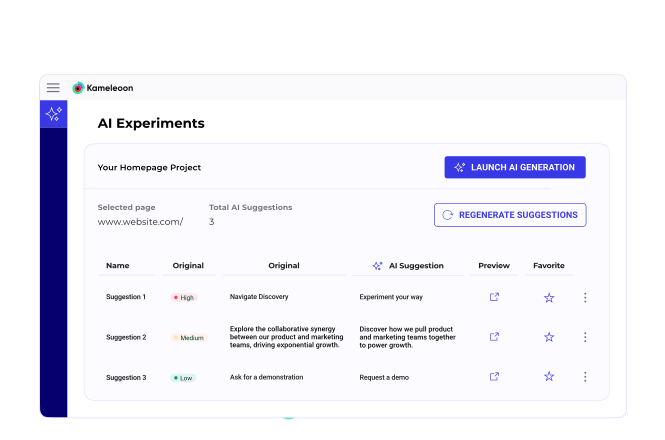
It doesn’t just tell you what did work. It helps predict what will work for each visitor based on AI-driven scoring. Yes, it sounds like buzzword salad, but this is genuinely clever stuff - especially when your sales cycles are glacial and every nudge counts.
Pros:
- Real-time AI-powered segments.
- Can be used across web and product teams.
- Surprisingly robust support and documentation.
Cons:
- Doesn’t have the name recognition of the big dogs.
- May be overkill for simple tests.
Verdict: Use it if your CRO strategy involves personalisation, behavioural predictions, and impressing your CFO.
Honourable Mentions (AKA the Bench Warmers)
- Unbounce – great for landing page variants and fast campaigns, not a pure testing tool.
- HubSpot A/B Testing – Basic but convenient if you’re already married to the ecosystem.
- Crazy Egg – Lovely for qualitative insights (heatmaps, scroll maps), but testing is an afterthought.
- Google Optimize – We miss you. We’re not crying, you’re crying.
Quickfire Scorecard
| Tool | Best For | Pricing | Standout Feature |
|---|---|---|---|
| VWO | All-round B2B marketers | Mid-high $$$ | Full-stack CRO in one tab |
| Convert | Data nerds and ABM lovers | Medium $$$ | Speed + segmentation |
| Optimizely | Enterprise B2B with deep tech stacks | High $$$$ | Server-side + feature flags |
| AB Tasty | Mid-sized teams with flair | Medium $$$ | Behavioural targeting |
| Kameleoon | Predictive CRO ninjas | Medium-high $$ | AI-driven visitor scoring |
Never Test Without a Hypothesis
It’s tempting to fire up a tool, clone your homepage, and run a test to see what “happens.” But without a proper hypothesis (and patience), you’re just rearranging digital furniture.
Ask:
- What exactly are we trying to improve?
- Who are we trying to influence?
- Can we realistically reach significance?
Because in B2B, the traffic is slow but the stakes are high. Your CRO strategy isn’t about running dozens of meaningless micro-tests. It’s about building confidence that your site is helping the right people take the right actions.
Bonus Bit: A/B Testing Red Flags
- Test Everything Syndrome – If it moves, they test it. Result: chaos and zero insight.
- Conversion Myopia – Only tracking form fills, ignoring MQL quality.
- Statistical Panic – Declaring victory after 48 hours and 30 visits.
- Design by Committee – Everyone wants their “winning” idea tested. (Just say no.)
Wrap-Up
The best A/B testing tool for your B2B website isn’t the one with the most features. It’s the one that matches your traffic reality, your sales journey, and your team’s actual skills.
You want fewer tests. Better hypotheses. Clear outcomes. And tools that don’t turn your next CRO sprint into a murder mystery.
Curious where to begin? Start with VWO or Convert, run one high-impact test, and watch what happens when your site starts working like your best SDR.
FAQ
1. What makes A/B testing different for B2B websites compared to B2C?
B2B websites typically have lower traffic volumes, longer sales cycles, and more complex buyer journeys. This means A/B tests need to be designed with smaller sample sizes, clearer hypotheses, and metrics that go beyond superficial clicks—think qualified leads, demo requests, or sales meetings.
2. How do I choose the right A/B testing tool for my B2B team?
Focus on tools that support low-traffic testing, offer deep segmentation (like account-based or firmographic filters), and integrate cleanly with your CRM or lead tracking system. Bonus points if the platform handles statistical significance calculations for you and supports qualitative insight overlays like heatmaps or session replays.
3. Is statistical significance even achievable on a low-traffic B2B site?
Yes, but you need patience and precision. Use Bayesian approaches or sequential testing to work with smaller datasets. Alternatively, focus on higher-impact pages (e.g., pricing or demo pages) where even a small change in conversion rate can justify the test’s run time.
4. Can I run A/B tests without developers?
Absolutely. Most visual editors in tools like VWO, AB Tasty, or Unbounce let marketers run tests without writing code. But for more robust server-side experiments or dynamic content changes, you’ll still need some dev involvement.
5. Should we always aim for 95% statistical confidence?
Not necessarily. In B2B, with longer buying cycles and fewer visits, a rigid 95% threshold might delay insights unnecessarily. Consider using a 90% threshold if the risk of a false positive is acceptable and the upside of a positive test is significant.
6. What kinds of tests are most effective on B2B sites?
Tests that impact user flow and clarity tend to outperform cosmetic ones. Try variations in CTAs, value proposition messaging, form layout or gating strategies, pricing page structure, or content offers tailored to specific buyer personas.
7. How do we measure success in B2B A/B tests?
Success metrics should map to your funnel. Early-stage pages might optimise for engagement or resource downloads, while decision-stage pages should focus on demo bookings, qualified leads, or pipeline velocity. Always tie tests back to revenue-impacting actions, not just clickthrough rates.
8. Can we use heatmaps and A/B tests together?
Yes, and you should. Heatmaps, scroll maps, and session recordings help generate smarter hypotheses before you test. Post-test, they help explain why a version won or lost. Many tools like VWO and Crazy Egg bundle both types of features for this reason.
9. How do I ensure my A/B tests don’t confuse returning visitors or leads?
Use cookie-based consistency or user-level targeting. Most advanced tools let you ensure that a visitor always sees the same version of a test and exclude existing leads from tests meant for first-time visitors. Just don’t forget to test across devices.
10. What’s the biggest mistake B2B teams make with A/B testing?
Chasing volume over value. Running lots of tests on trivial UI tweaks might feel productive, but rarely moves the needle. The best teams focus on fewer, high-impact tests grounded in customer behaviour, and always tie back results to business outcomes like pipeline and revenue.