
Why traffic alone won’t save you anymore and what actually will
There was a time when SaaS SEO felt reassuringly mechanical. You picked some keywords, produced a sensible number of blog posts, acquired a handful of links that may or may not have involved awkward emails, and waited for the graph to go up and to the right. When it did, everyone nodded solemnly and declared the strategy ‘working’.
That era hasn’t just ended. It’s been quietly dismantled while most SaaS teams were still refreshing Search Console and debating H1 tag placement.
In 2026, SaaS SEO isn’t broken, but it is deeply misunderstood. Google still sends traffic, yes. Rankings still matter, yes. But the idea that SEO is primarily about attracting anonymous visitors and converting a neat percentage of them into demos feels increasingly out of touch with how software is actually bought now.
Buyers are researching in AI tools before they ever search. Vendor shortlists are being assembled without clicks. Brand familiarity is forming in places your analytics can’t see. And the internet is drowning in content that technically answers questions while completely failing to influence decisions.
So if you’re here looking for another checklist of ‘2026 SEO hacks’, we should probably save each other some time. This guide is about how SaaS SEO actually works now. The messy bits. The uncomfortable trade-offs. The things that don’t show up nicely in dashboards but still determine whether your pipeline lives or dies.
Let’s get into it.
Presence Over Rankings
Buyers encounter your brand in fragments across AI, communities, and internal conversations—not just search results.
SEO is no longer about rankings, it’s about presence
The first thing we need to unlearn is the idea that SEO equals rankings.
Rankings are still useful. They just aren’t the main event anymore.
In 2026, your buyers don’t experience your brand through a linear journey that starts with Google, moves neatly through your blog, and ends with a demo request. They encounter you in fragments. A quote in an AI answer. A mention in a Slack community. A comparison table someone forwarded internally. A blog post they half-read three weeks ago and vaguely remember agreeing with.
SEO now lives across all of those moments.
This matters because the most influential interactions often leave no measurable trace. No click. No session. No tidy attribution model. Yet they shape buying decisions all the same.
When someone asks an AI assistant to compare tools in your category, you are either part of the answer or you don’t exist. There is no page-two consolation prize. When a decision-maker asks their network for recommendations, your name either comes up or it doesn’t. Again, no rankings report will warn you in advance.
So the real job of SaaS SEO in 2026 is building presence across the surfaces where research actually happens. Not just your website, but:
- Third-party reviews, comparison posts, and listicles that AI systems scrape and summarise.
- Long-form content that gets referenced without being linked.
- Clear explanations that machines can quote confidently, without hedging or caveats.
- Consistent messaging that reinforces what you’re known for, even when people encounter it out of context.
This is why obsessing over one keyword ranking can be actively misleading. You might be number one and still invisible where it matters most.
Traffic ≠ Pipeline Impact
Pageviews obscure what matters: high-intent readers who quietly shape deals. Optimize for influence, not impressions.
Why traffic is a vanity metric for most SaaS companies
This is where things get awkward in internal meetings.
Traffic is easy to report. It’s familiar. It looks impressive in decks. Which is exactly why it’s so often overvalued.
In 2026, raw organic traffic tells you surprisingly little about whether SEO is doing its job. A blog post can pull in thousands of visitors and still contribute nothing to revenue. Another can get read by fifty people and quietly influence five deals.
The difference isn’t volume. It’s intent and context.
Most SaaS buying decisions are shaped by a small number of highly relevant interactions, not mass awareness. The people who matter are often senior, time-poor, and allergic to fluff. They skim. They remember fragments. They talk internally.
SEO that works now is designed for those people, not for maximising sessions.
This means accepting a slightly uncomfortable truth. Some of your best content will look underwhelming in analytics tools. Lower traffic. Fewer keywords. Less obvious ROI. And yet it will punch far above its weight in pipeline influence.
If your SEO strategy is still optimised primarily for pageviews, you’re optimising for the wrong outcome.
Keyword research is dead, long live problem research
Let’s talk about keyword research, because it’s overdue for a reckoning.
Keyword tools are not useless. They’re just wildly over-relied upon. In 2026, treating keyword volume as a proxy for importance is a reliable way to miss what actually matters to buyers.
The most valuable questions your prospects ask are often poorly represented in keyword data. They’re too specific, too contextual, or too uncomfortable to show up neatly in a spreadsheet.
Questions like:
- ‘Why does our product analytics never match finance data, and who’s wrong?’
- ‘What actually breaks when you move from self-serve to sales-led, beyond what the blogs admit?’
- ‘Is this tool going to create more internal politics than value?’
These aren’t keyword opportunities. They’re problem statements.
The shift that winning SaaS teams have made is from keyword-first thinking to problem-first thinking. Instead of starting with a list of phrases to rank for, they start with the situations their buyers find themselves stuck in.
This requires doing research the unglamorous way. Listening to sales calls. Reading churn emails. Sitting in onboarding sessions. Paying attention to support tickets. Not just skimming for feature requests, but noticing patterns in confusion, frustration, and misaligned expectations.
Once you understand the problems clearly, keywords become secondary. Useful for distribution, yes. But not the source of truth.
In 2026, the best SEO content doesn’t just answer questions. It demonstrates that you understand the problem space better than anyone else. That’s what earns trust. That’s what gets cited. And that’s what quietly moves deals forward.
Topical authority now requires actual opinions
For years, SaaS content was trained to be polite to a fault.
Be comprehensive. Be neutral. Don’t offend. Cover all angles. The result was a vast quantity of content that technically addressed topics while leaving readers with no idea what the company behind it actually believed.
In 2026, that approach is a liability.
Topical authority is no longer about covering everything. It’s about taking a stance and defending it with clarity. Both humans and machines respond better to confidence than to hedging.
This doesn’t mean hot takes for the sake of it. It means being precise about where something works, where it doesn’t, and why.
Statements like:
- ‘This approach only makes sense once you cross $10M ARR.’
- ‘If you’re measuring this metric in isolation, you’re probably misreading your growth.’
- ‘Most teams adopt this tool too early and regret it later.’
These are the kinds of assertions that get remembered and repeated. They cut through generic advice. They signal experience rather than theory.
From an SEO perspective, opinionated content also performs better in the environments that now matter most. AI systems prefer sources that sound authoritative and internally consistent. Content that waffles endlessly or tries to please everyone is harder to quote with confidence.
If your content could be swapped with a competitor’s without anyone noticing, it’s not building authority. It’s background noise.
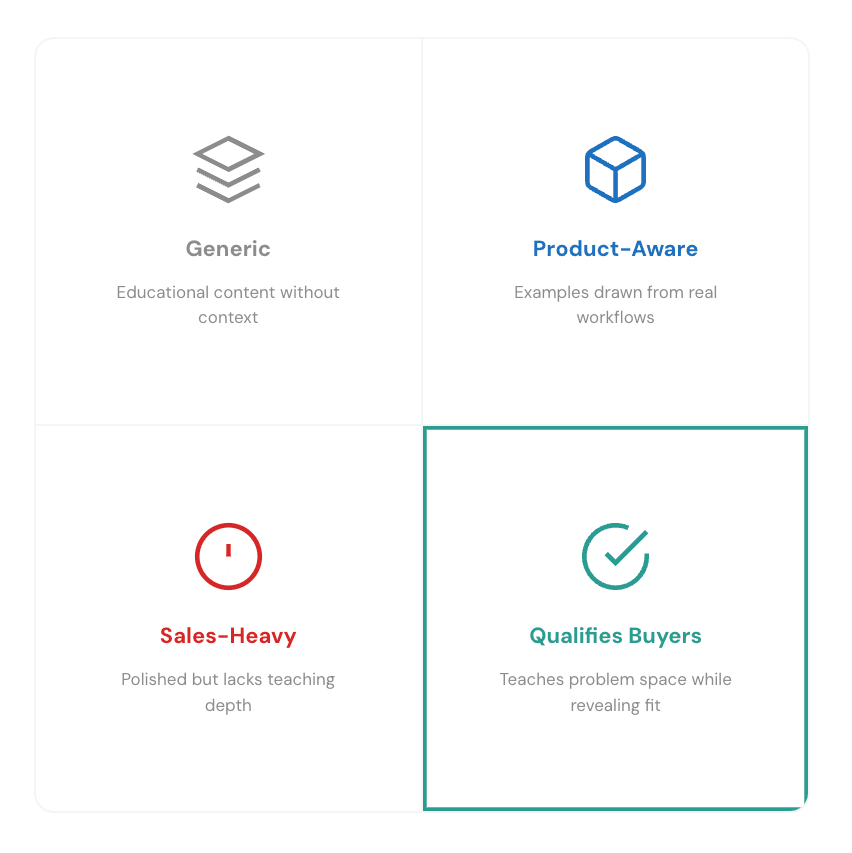
The rise of product-led content that actually qualifies buyers
One of the more interesting shifts in SaaS SEO over the past couple of years is the performance gap between generic educational content and product-led educational content.
The old playbook said to keep things high-level. Don’t talk about your product too much. Focus on education first, conversion later.
In 2026, that advice is starting to look outdated.
The content that consistently performs best now sits at the intersection of education and product reality. It teaches the reader about the problem space, but it also reveals how the product thinks about solving it.
This might include:
- Detailed breakdowns of how your category actually works under the hood, using examples drawn from real workflows.
- Honest discussions of trade-offs, including where your product is not the right fit.
- Implementation guides that show the messy middle, not just polished case studies.
This kind of content does something subtle but powerful. It qualifies the reader while educating them.
By the time someone finishes reading, they don’t just understand the topic better. They understand whether your approach aligns with how they think. That saves everyone time. Sales conversations become more productive. Churn goes down. Expectations are set earlier.
From an SEO standpoint, this content also tends to attract higher-quality engagement. Fewer visitors, perhaps, but far more relevant ones.
Why comparison content has become a strategic asset
Comparison content used to be treated with suspicion. Too salesy. Too competitive. Potentially awkward.
In 2026, it’s one of the most strategically important content types in SaaS SEO.
Buyers compare tools whether you like it or not. If you don’t participate in that conversation, someone else will do it for you. Often badly.
Well-executed comparison content does several things at once. It captures high-intent searches. It feeds AI systems structured information. It sets expectations. And it allows you to frame trade-offs honestly.
The key is not pretending to be objective while quietly stacking the deck. That kind of content is increasingly transparent and increasingly distrusted.
The comparison pages that work now are clear about perspective. They explain who each option is best for, where it shines, and where it falls down. They acknowledge weaknesses. They guide rather than manipulate.
When done well, these pages don’t just rank. They get referenced. They get shared internally. They show up in AI-generated summaries.
And yes, they convert. because they help buyers make sense of a confusing landscape, not because they push aggressively.
Links still matter, but the game has moved upstream
Backlinks haven’t disappeared. They’ve just become harder to game and easier to misunderstand.
In 2026, the links that matter most are rarely the result of direct outreach. They’re a side effect of being useful in public.
This is where many SaaS SEO strategies fall apart. Teams still ask ‘How do we get more links?’ when the better question is ‘Why would anyone want to reference us?’
The content that earns links naturally tends to have one thing in common. It saves someone effort. Time. Cognitive load. Embarrassment.
That might be:
- Original data that settles an argument.
- A framework that clarifies a messy topic.
- A clear explanation of something everyone pretends to understand but secretly doesn’t.
When content provides genuine relief, links follow. When it doesn’t, no amount of templated outreach will compensate.
It’s also worth noting that not all influence shows up as links anymore. Mentions without links still matter, particularly in AI-driven discovery. Being referenced repeatedly, even without a hyperlink, builds authority signals that traditional SEO tools struggle to capture.
Technical SEO is table stakes, not a growth lever
There’s a certain comfort in focusing on technical SEO. It feels precise. Actionable. Respectably nerdy.
Unfortunately, in 2026, it’s rarely where growth comes from.
Most SaaS sites now meet the basic technical requirements. They’re fast enough. Crawlable. Reasonably clean. The marginal gains from shaving another 100 milliseconds off load time are minimal for most companies.
The technical work that still matters is structural rather than tactical. Clear information architecture. Logical page hierarchies. Internal linking that reflects how your product and category actually work.
Machines need to understand your site. Humans need to enjoy navigating it. Anything beyond that is usually diminishing returns.
If your SEO roadmap is dominated by technical tasks while your content remains generic, you’re optimising the wrong layer.
Internal linking as a narrative tool, not just an SEO trick
Internal linking is often treated as a mechanical exercise. Add links. Use keywords. Improve crawlability.
In 2026, internal linking is better thought of as narrative design.
Every internal link is a suggestion. A nudge. A subtle statement about what matters and how ideas connect. When done thoughtfully, internal linking helps both humans and machines understand your worldview.
Instead of linking everything to everything, the most effective SaaS sites create clear thematic paths. Foundational ideas link out to supporting detail. Advanced content assumes familiarity and builds on earlier concepts.
This doesn’t just help with SEO. It reinforces positioning. It trains repeat readers. It makes your content ecosystem feel intentional rather than accidental.
SEO and brand are finally inseparable
Here’s the part many SEO guides still avoid because it’s harder to quantify.
Brand matters. in very practical, not in a vague, fluffy way, very measurable ways.
Branded searches convert better. Known names get shortlisted faster. Familiar voices are trusted more readily. AI systems are more likely to reference sources that appear consistently across contexts.
In 2026, SEO contributes to brand whether you acknowledge it or not. Every piece of content either reinforces what you’re known for or dilutes it.
This is why voice, consistency, and point of view matter so much more now. If your content sounds generic, it will be treated as such. If it sounds like it could only come from you, it builds cumulative advantage.
The strongest SaaS SEO strategies are brand strategies in disguise.
Measuring SaaS SEO without losing your sanity
Eventually, someone will ask for proof. A dashboard. A number.
This is where many teams go wrong by trying to force SaaS SEO into an e-commerce measurement model.
Attribution is messy. Buying cycles are long. Influence is often indirect. Trying to achieve perfect measurement usually leads to misleading conclusions.
The metrics that actually help in 2026 tend to be directional rather than definitive. Organic pipeline influenced, not just sourced. Growth in branded search. Increased mentions in AI-generated answers. Content-assisted conversions over time.
You will never capture every touchpoint. Accepting that frees you to focus on trends rather than false precision.
SEO success now is about confidence, not certainty.
Where AI fits, and where it absolutely doesn’t
AI has changed how content is produced, but it hasn’t changed what good content is.
Used well, AI accelerates research, drafting, updating, and repurposing. It reduces friction. It buys time.
Used badly, it floods your site with plausible-sounding content that adds nothing new and quietly erodes trust.
The SaaS teams winning with SEO in 2026 treat AI as an assistant, not a strategist. Humans decide what’s worth saying. Humans bring experience, judgment, and point of view. AI helps say it faster and more consistently.
If your strategy is ‘publish more because AI makes it cheap’, you’re already behind. If it’s ‘publish better because AI frees up thinking time’, you’re on the right track.
The organisational challenge nobody talks about
One of the least discussed aspects of SaaS SEO in 2026 is that it’s no longer an isolated function.
The best SEO strategies are deeply cross-functional. They require input from product, sales, support, and leadership. They reflect real decisions being made inside the company, not just marketing assumptions.
This is uncomfortable for organisations used to siloed execution. It’s also unavoidable.
SEO content that resonates now is grounded in reality. In trade-offs actually faced. In constraints actually felt. That information lives outside the marketing team.
If your SEO strategy doesn’t involve regular exposure to how customers actually use and struggle with your product, it will drift into abstraction. And abstraction doesn’t rank, convert, or influence.
The SaaS SEO playbook for 2026, distilled
If we strip all of this down, a few truths stand out.
SEO is no longer about gaming systems. It’s about earning trust in public. It’s less about keywords and more about clarity. Less about traffic spikes and more about sustained relevance.
The companies that win aren’t the ones publishing the most content. They’re the ones publishing the clearest thinking, consistently, in the places buyers actually pay attention to.
It’s harder work. Slower work. Less flashy work.
It’s also the only kind that still works.
Wrap-up or TL;DR
SaaS SEO in 2026 isn’t dead. It’s just grown up.
Traffic still matters, but influence matters more. Rankings still help, but recognition helps more. The old playbook of keywords, links, and volume hasn’t disappeared, but it’s no longer enough on its own.
The real opportunity is building content that machines trust, humans remember, and buyers actually use to make decisions. That requires fewer tricks and more honesty. Fewer posts and more perspective.
And yes, it’s more demanding than it used to be. But if you’re building a SaaS business for the long term, that’s probably a feature, not a bug.
Want to get ahead? Start by auditing not just what you rank for, but what you’re genuinely known for. That shift alone tends to change everything.