

The blog cadence was fire, but the brand voice slowly morphed into ‘tech bro meets motivational speaker’. Here’s what worked and where human editing saved the day.
We were promised content utopia, weren’t we?
Plug in an AI, set the tone to “Thought Leader with Empathy”, pick a topic like “How to Grow in a Recession Without Cutting Headcount” and boom - a blog post appears. Rinse, repeat, go viral, sip margaritas.
That was the dream.
So, we tried it. We attempted to build an all-AI content machine: briefs, outlines, headlines, body copy - the whole burrito, made by bots. And you know what? It worked. At least at first. The posts came out fast, SEO traffic ticked up, LinkedIn impressions doubled, and our Notion board looked like a productive person's fever dream.
But then the weirdness crept in. The tone got slippery. The metaphors got cheesier. And somewhere around post #17, we realized we’d created a Frankenstein with ChatGPT’s verbosity, Claude’s earnestness, and the soul of a TEDx bro.
Here’s the tale - equal parts marvel and cautionary - of what AI can do for your content, and where it absolutely needs a human with taste (and a red pen).
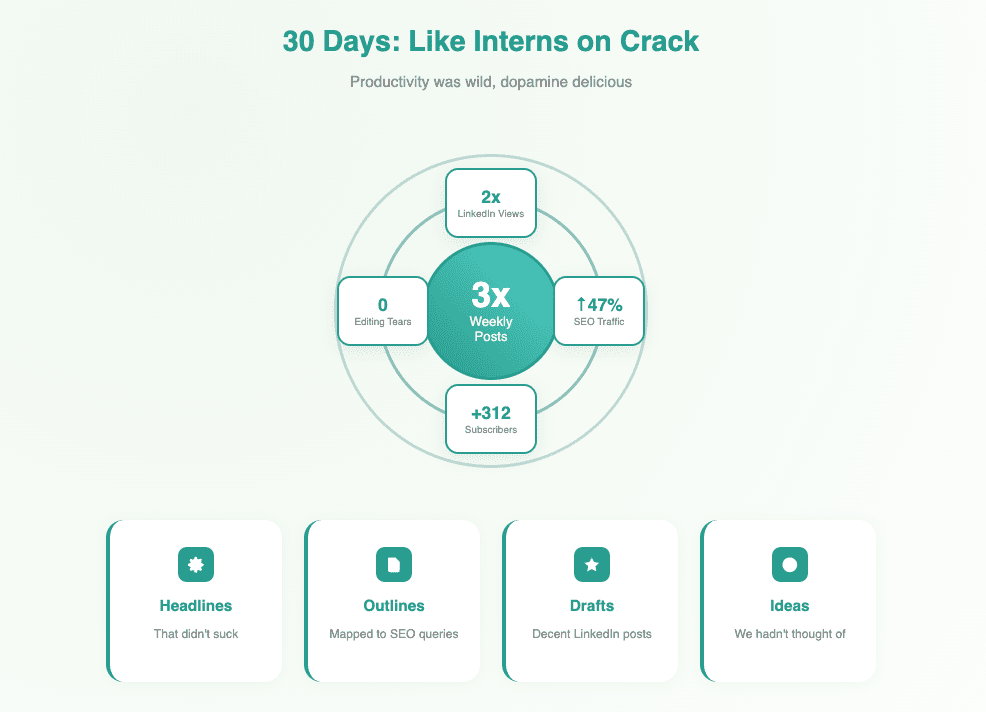
The First 30 Days: Like Having a Dozen Interns on Crack
Let’s start with the honeymoon phase.
We booted up our AI stack - mostly ChatGPT-4 and Claude 3 with a dash of Notion AI for organizational glue - and tasked them with building out our blog backlog. Target: three posts a week. Topics: B2B growth, SaaS strategy, AI in marketing. Tone: conversational, witty, helpful.
Within hours, we had:
- Headlines that didn’t suck
- Outlines that mapped nicely to SEO queries
- Drafts that read like… well, decent LinkedIn posts
- Ideas we hadn’t even thought of
The productivity? Wild. We’d normally need 3–4 freelancers and a content strategist to maintain this pace. But here we were, sipping lukewarm coffee while the machine spat out copy faster than a crypto bro drops hot takes on Twitter.
Traffic was up. So were newsletter signups. And let’s be honest - the dopamine of pressing publish three times a week without late-night editing tears? Delicious.
But.
Always a but.
The Creep of the Cringe
Somewhere around week five, something shifted.
The posts still looked right. Structure? Tight. H2s? Neat. Calls-to-action? Present and accounted for. But if you actually read them - and we mean really read them - they started to sound... odd.
One post opened with this gem:
“In today’s ever-evolving landscape, adaptability isn’t just a buzzword - it’s a survival mechanism.”
Another advised:
“Leaders must rise, not just to the occasion, but beyond it.”
We weren’t writing content anymore. We were giving keynotes at a WeWork.
The AI had overlearned its sources. Instead of sounding like us - curious, cheeky, skeptical - it started channeling the ghosts of Medium thought leaders past. Motivational soup, with a dash of ‘hustle harder’. You know the type.
Sure, each post had a kernel of truth. But kernels alone don’t make popcorn.
Where the Machine Shines (and You Should Let It)
Let’s not throw the Roomba out with the rug. AI content isn’t bad - not inherently.
In fact, here’s where it absolutely pulls its weight:
- Ideation on tap
Feeling stuck? Ask it for “15 spicy content ideas on SaaS churn,” and you’ll get stuff like:- "The Secret Churn Hiding in Your Customer Success Team"
- "Why ‘Freemium’ Is Killing Your Retention Rate"
enough for a strong sift, not all gold.
- Outlining and structuring
It’s a brilliant digital skeleton-maker. Logical flow? Tick. Headings that break up chunky thoughts? Double tick. Even SEO placements for keywords? Chef’s kiss. - Repurposing like a boss
Turn that webinar transcript into a newsletter. Convert that podcast riff into a carousel. AI excels at transforming content like it’s on a reality makeover show. Total efficiency flex. - Speed, obviously
First drafts arrive in seconds. That alone is reason to keep it in the toolkit.
But - and we can’t stress this enough - drafts are if you publish it without tweaking, not destiny. The raw output might be passable, you're signing off with someone else’s voice.
Enter: The Editor-as-Exorcist
So how did we claw our way back from ‘AI LinkedIn influencer’ hell?
We started doing what any decent publication’s done since forever: editing.
Like, properly editing.
Every AI-generated post now goes through what we lovingly call the ‘Cringe Filter’:
- Strip the fluff
Every “in today’s world” dies an honorable death. - Inject voice
Not ours? Not in. We rework sentences to sound like our team - irreverent, informed, allergic to clichés. - Fact-check everything
AI loves inventing sources and misquoting stats. We double-check every claim, quote, or data point. - Add a story or real-world example
Without that, AI content is just a collection of platitudes dressed up in H2s.
Yes, this adds a few hours back into the process. But it also makes the content… human. Memorable. Sharable. Less like a lecture, more like a pint with a mate who’s good at marketing.
The Scorecard: AI vs. Human
Let’s break it down for the skeptics.
| Task | AI-Only | Human-Only | AI + Human |
|---|---|---|---|
| Blog idea generation | ✅ Great | ⚠️ Slow | ✅ Best of both |
| First draft writing | ✅ Fast but bland | ⚠️ Slow but better voice | ✅ Fast and fixable |
| SEO structuring | ✅ Smart | ⚠️ Manual | ✅ Sweet combo |
| Brand tone and humor | ⚠️ Cringe-prone | ✅ Nailed it | ✅ When edited |
| Publishing cadence | ✅ Fire | ⚠️ Erratic | ✅ Consistent & quality |
| Reader feedback | ⚠️ Mixed | ✅ Strong | ✅ Even better |
So no, we’re we’re also never, not going back to an all-human workflow, ever letting the bots publish unchecked again.
Why AI Can’t Have the Final Say
Here’s the thing. AI can predict patterns. It can mimic tone (sort of). It can organize words into legible structures. But it doesn’t know your audience. It doesn’t know the little inside jokes. The stories you told at your last offsite. The personality quirks that make your brand yours.
And let’s not forget - the best content isn’t just useful. It’s memorable.
AI alone gives you correctness.
Humans give you texture.
You need both.
Yes, AI Will Improve. No, You Shouldn’t Wait.
We can already hear someone in the back going, “But GPT-5 will fix that, right?”
Maybe.
But even if the next model speaks like Oscar Wilde and fact-checks like a Harvard librarian, we’ll still want human eyes on it. Because brand voice isn’t just a sentence style. It’s a set of decisions. What to say. What not to say. How much sass to sprinkle in. Where to stop being clever and just be clear.
AI might get close. But close isn’t on-brand.
So What Now? (Besides Firing Your Ghostwriter Bot)
If you’re building a content engine with AI, don’t skip the human part. Treat AI like a well-meaning but overeager intern. It’s helpful, but it needs supervision. And snacks.
The best workflow we’ve landed on looks like this:
- Prompt AI for ideas and outlines
Give it clear context, tone rules, and examples from your existing blog. - Let it draft - but fast
Don’t nitpick too early. Let it pour. - Edit like your reputation depends on it
Because it does. Cut the fluff. Add the grit. - Use human judgment for publishing
No ‘in today’s world’ gets through. Ever. - Measure what matters
Engagement, not just SEO. Did it make someone snort coffee out their nose? That’s gold.
TL;DR: Your AI Content Stack Needs You
We tried to go full AI with our content. It was fast. It was shiny. It was efficient. But it also slowly turned our brand into a parody of itself. AI can do the heavy lifting - no doubt. But unless someone’s editing with a scalpel and a sense of humor, you’re gonna end up sounding like a ChatGPT bot doing a TED Talk in a Patagonia vest.
Want to scale content without losing your soul? Try pairing AI with a clever human. Or better yet, hire one who knows how to boss the bot around.
FAQ
1. Can AI completely replace human content writers?
No. AI can draft well, but humans ensure tone, nuance, originality, and emotional intelligence - all critical for brand trust.
2. What’s the best use of AI in content marketing?
Use AI for outlines, ideas, and repurposing - a terrible final editor, not final drafts. It’s a brilliant assistant.
3. Why does AI-generated content often sound generic?
AI mimics patterns from training data. Without human editing, it defaults to clichés and bland motivational filler.
4. How do I keep brand voice intact with AI?
Feed it examples, refine prompts, and always edit the final output to match your brand’s unique tone and personality.
5. Does AI help with SEO content?
Yes, especially for keyword structuring and topic clustering. But relevance and depth still depend on human judgment.
6. What are common mistakes with AI content workflows?
Over-reliance, publishing without edits, ignoring tone, and trusting hallucinated facts. Treat AI like a fast intern, not a strategist.
7. How fast can you produce blogs using AI?
You can draft a blog in minutes, but quality output still needs human refinement - expect hours, not seconds.
8. Is it risky to use AI-only content?
Yes. Risk includes off-brand messaging, misinformation, tone mismatch, and alienating your audience with robotic writing.
9. How do you fix AI-sounding blog posts?
Strip filler phrases, add personal stories or opinions, fact-check everything, and rewrite to sound like you - not a bot.
10. Will future AI models fix tone issues?
They’ll improve, but brand-specific voice still needs a human hand. AI can get close, but never exactly right.