
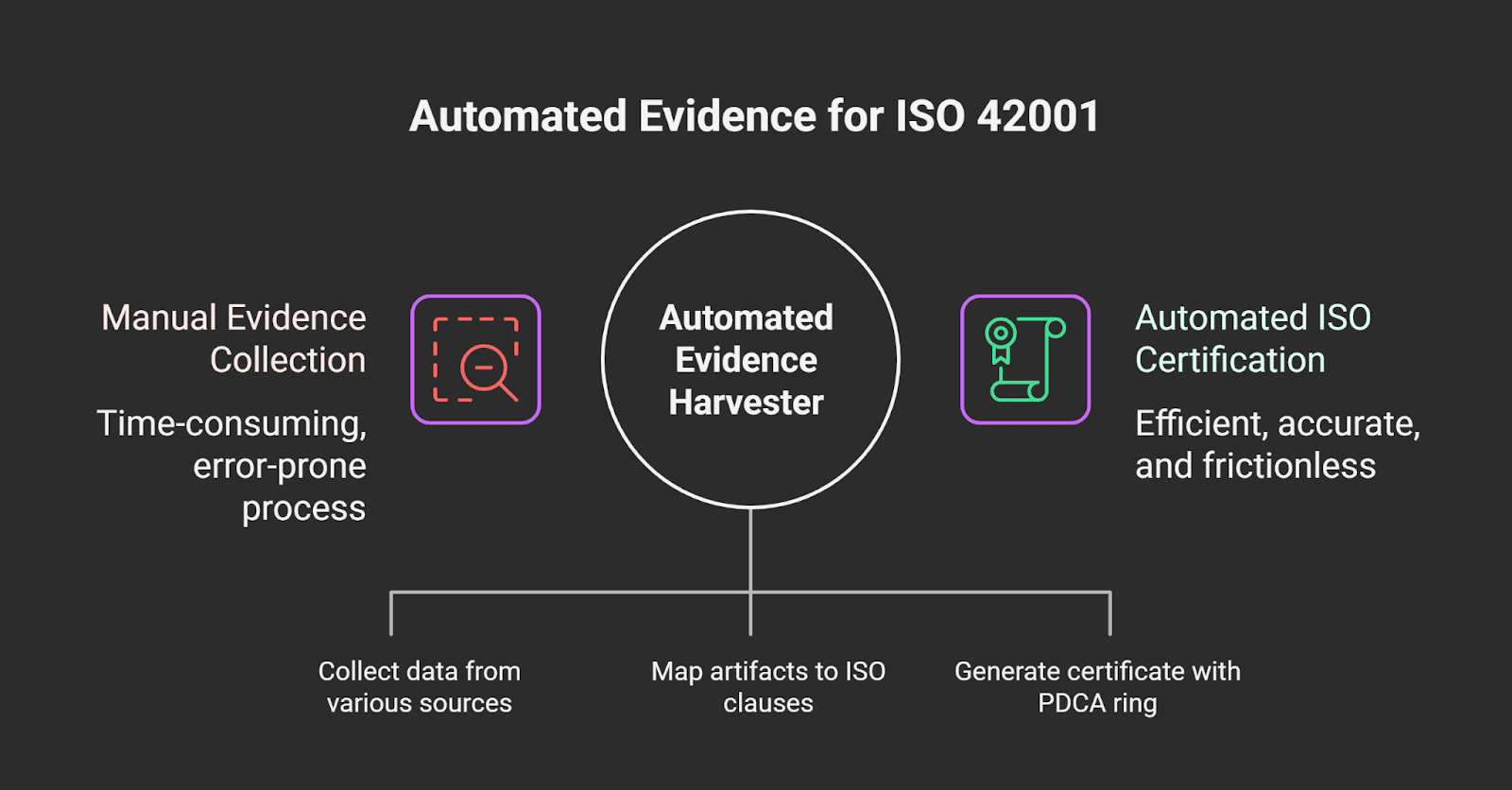
In December 2023, ISO/IEC 42001 became the first management-system standard written specifically for AI, requiring every team that builds, buys, or deploys models to document ethics, transparency, and risk controls across the entire lifecycle—not only security.
Manual evidence hunts can't keep pace with models that retrain overnight, but audit-automation platforms close the gap. By plugging into your cloud, code repo, and ticket queues, they collect proof continuously and map each artifact to ISO 42001 clauses. Teams using GRC platforms report major efficiency gains, with one Forrester study noting a 50% reduction in time spent on control testing and a 65% decrease in time spent on audit preparation.
In this guide, we'll walk you through how these platforms work, which features matter at different company sizes, and a 30-day sprint plan to earn your certificate. You'll also get a decision matrix and a list of common pitfalls—so you can swap spreadsheet marathons for one dashboard and hit "certified" sooner.
ISO 42001 in one page
ISO/IEC 42001 became the world's first AI management-system standard in December 2023. Built on the familiar Plan-Do-Check-Act cycle, it keeps the 10-clause structure but swaps infosec jargon for AI guardrails. The operative requirements live in Clauses 4–10:
- Context – define scope and stakeholders
- Leadership – publish an AI policy and assign accountability
- Planning – assess AI risks and set measurable objectives
- Support – provide people, data, and documentation
- Operation – govern the full AI lifecycle, from design to drift monitoring
- Performance evaluation – track KPIs, run internal audits, review results
- Improvement – correct issues and refine controls continuously
Annex A adds 39 AI-specific controls, ranging from data-quality checks to bias testing, to bring each clause to life (Sprinto).
An accredited body can certify your AI Management System for three years, with annual surveillance audits to confirm you still follow the rules. Teams implement ISO 42001 to structure an AI management system, signal trust to customers, and get ahead of tightening AI rules; the ISO 42001 guide covers these drivers in plain language. Because the standard is approach-agnostic, it fits a two-person fintech that buys models via API just as well as a global pharma that trains its own. To pass, you need to:
- identify and rank AI risks
- apply proportionate controls
- monitor outcomes continuously
- keep evidence organized so an auditor can retrace every decision
In short, ISO 42001 turns "trustworthy AI" from a slogan into an auditable management system, giving the market a single yardstick for proof.
Why manual compliance breaks down for AI
Manual compliance workflows were built for quarterly change, yet AI changes hourly. A model can retrain overnight, pick up new bias by breakfast, and reach production before lunch. By the time your risk committee meets next quarter, the evidence trail is already three versions out of date.
Spreadsheets can't keep pace. According to a 2023 survey by Compliance Week, 55 percent of compliance teams report still using manual processes like spreadsheets and email for key functions. This reliance on manual methods persists even after adopting GRC tools; a survey by AuditBoard revealed that 43% of audit teams spend 11-25% of their time on manual, administrative tasks, indicating that automation is often not fully leveraged. Chasing screenshots and email threads wastes time, frustrates engineers, and hides blind spots in model lineage and post-launch monitoring.
Fragmented evidence turns every audit into a scramble, but the bigger danger is silent failure: a model that drifts into unsafe or discriminatory output while the documents say everything is fine. To govern AI responsibly—and to stay sane—you need a system that watches, records, and alerts in real time, exactly as your models behave in real time.
Audit-automation software: what buyers want
Automated evidence harvesting
Top platforms connect to your cloud, code repo, ticket system, and HR suite, then pull logs, configs, and approvals every few minutes. Modern Health reports that it cut audit-collection time from months to under a week after moving to continuous evidence gathering with Vanta. No screen-caps, no late-night ZIP files, evidence lands in folders already mapped to the correct ISO 42001 clause.
Policy and control library pre-mapped to ISO 42001
Quality tools ship with an AI-ethics policy, risk-assessment template, and a control matrix for every clause. For ISO 42001, that library should include an AIMS Statement of Applicability and prebuilt policy scaffolding, which audit-automation platforms like Vanta provide, so you start from a working model rather than a blank page. You add a logo, adjust language, and publish. Because the wording mirrors ISO 42001, the dashboard flips a control to green as soon as evidence is attached, turning weeks of policy drafting into hours of configuration.
AI-specific risk register and scoring
Instead of generic firewall findings, an AI-focused platform surfaces risks such as bias, drift, privacy leakage, adversarial attack, or runaway autonomy. You rate likelihood and impact; the software calculates a composite score and links each risk to a control. Decision-makers see in one view which models carry the most heat and whether safeguards are working.
Built-in internal audits and time-stamped trails
ISO 42001 requires you to audit yourself before the certifier arrives. Good software schedules the cycle, pulls stored evidence automatically, and time-stamps every click. When auditors log in, they review a complete chain of who checked what and when, rather than piecing together emails.
Corrective actions and continuous improvement
Every failed control turns into a ticket with an owner and due date. Once the fix—for example, a new bias-test report—is uploaded, the dashboard flips from orange to green. The platform keeps a historical trend chart so you can prove year-over-year improvement, not just one-time compliance.
Vendor risk in the same workflow
AI pipelines rely on third-party APIs, cloud GPUs, and licensed datasets. The software imports your vendor list, tracks which products feed each model, and stores attestations such as SOC 2 or bias reports. Expired certificates trigger the same alerts as an internal control gap, keeping shared-responsibility lines clear.
Reporting and management reviews, zero PowerPoint
Executives want a summary, not a data dump. Click Export and the tool produces a PDF with compliance scorecards, open risks ranked by impact, incident counts, and a one-page Statement of Applicability. An IDC business value study found that Vanta customers saved 82% of time per framework and attestation-related audit. Auditors get a read-only portal, cut email back-and-forth to hours, and stay focused on substance, not scavenger hunts.
Evaluation approach: how to pick the right platform
1. Coverage of the full ISO 42001 playbook
Choose a tool that maps all 10 clauses—policy, risk, operations, and audit—to at least one control. During a demo, filter the dashboard by "ISO 42001" and confirm no clause shows "coming soon." Preview out-of-box assets (AI-ethics policy, risk-assessment SOP, change-management procedure) and make sure they cover Clause 8 (human oversight) and Clause 9 (management review). Insist on version tracking so your content library updates automatically when the standard evolves.
2. Breadth and depth of evidence automation
Integrations multiply your effort. Leading vendors average more than 100 first-party connectors across cloud, code, HR, and ticketing systems. Breadth cuts manual uploads, and depth matters, too. A strong connector cross-checks AWS user lists against HR termination data and triggers an alert within minutes. Ask the rep to toggle a setting in a sandbox and watch for a real-time alert. Verify you can build custom evidence fields as your stack changes without opening a support ticket.
3. Embedded in the AI lifecycle
ISO 42001 cares how you source data, train models, approve releases, and monitor drift. Look for hooks into MLflow, SageMaker, or your CI/CD. The platform should record every model version, attach bias-test results, and block deployment if a required review is missing. Confirm it can add new model types or risk lenses without professional-services work; otherwise, you will outgrow it quickly.
4. Closed-loop audits and corrective actions
A repository alone isn't enough. Open the internal-audit module, schedule controls, record findings, and watch the tool auto-create corrective-action tickets with owner, due date, and evidence fields. Top platforms cut follow-up email traffic by 70 percent during audits because everything lives in one workflow. Auditors want to see the trace → action → evidence → sign-off loop; automation should make that effortless.
5. Price transparency and three-year TCO
Sticker price is only the opener. Clarify how seats, integrations, storage, and extra frameworks affect cost. Request a three-year cost model that includes projected head-count growth and any planned frameworks. Compare that number to the internal hours the vendor claims to save; if the ROI depends on ambitious labor-hour assumptions, push back. Nail down renewal uplifts and export fees early, because a 12 percent annual increase or a $5k evidence-export charge can erase savings fast.
A platform passes this evaluation when it covers every clause, automates evidence end to end, embeds in your ML workflow, closes corrective-action loops, and publishes costs as clearly as its compliance scorecards.
The comparison: who's who in ISO 42001 automation
How to read the table
- Pick your primary constraint—speed, depth, or multi-approach overlap.
- Match it to the "Notable strength" column.
- Make sure the trade-off will not derail your timeline or budget.
Vanta — an agentic trust platform for fast-growing teams
Vanta, an agentic trust platform, aims to put a SOC 2-style "trust badge" within reach of startups that cannot hire a full compliance staff. Once you connect your stack, the platform runs a readiness scan and surfaces missing controls. Modern Health saw a baseline score within four hours of onboarding.
Strengths
- Wide integration library. Vanta's integration library is extensive, offering over 400 integrations across common cloud services, identity providers, and business applications, so most SaaS teams can automate evidence without custom scripting.
- Guided templates. Pre-written AI-policy, risk, and change-management documents map directly to ISO 42001 clauses; the dashboard turns a control green when evidence lands.
- Continuous alerts. If a control drifts—say, an S3 bucket loses encryption—Vanta sends an in-app or Slack alert within minutes.
Trade-offs
- Shallow AI hooks. Deep-learning pipelines, model registries, or automated bias tests still require manual uploads or custom controls.
- Limited enterprise flexibility. Custom workflows or on-prem deployment options trail heavier GRC suites.
OneTrust — the extensive GRC suite with AI extensions
If your privacy or vendor-risk teams already live in OneTrust, the Responsible AI module plugs ISO 42001 into the same control library.
Strengths
- Scale and reach. OneTrust offers 165 pre-built integrations and 200 data-discovery connectors, giving large enterprises the breadth they need to onboard every business unit.
- Process orchestration. Launch an AI-project intake form, route it through legal, data science, and security, and store each approval in a central record.
- Unified governance. Map AI assets, datasets, and vendors to evolving laws; the regulatory-intelligence feed updates mappings automatically.
Trade-offs
- Technical evidence light. You will still rely on specialized scanners for bias testing or cloud hardening and upload reports.
- Enterprise-scale implementation. Budget eight to twelve weeks for configuration and training.
StandardFusion — ISO-centric and budget-friendly
StandardFusion keeps things straightforward: the UI mirrors the ISO management-system cycle, so teams familiar with ISO 27001 can map ISO 42001 controls quickly.
Strengths
- Process automation at a modest cost. Starter plans begin around USD $8k–$12k per year for up to 25 users.
- Built-in reminders and audit logs. Overdue tasks trigger alerts; every edit is time-stamped for a clean trail.
- Open API. When you outgrow manual uploads, push evidence from scanners such as AWS Config into StandardFusion.
Trade-offs
- No live cloud scanning. External scanners must feed reports back into the tool.
- Limited enterprise features. On-prem deployment and granular RBAC are on the roadmap but not yet available.
Holistic AI — purpose-built for bias, fairness, and impact
Holistic AI moves beyond checklists by testing the models themselves. The platform inventories each algorithm, scans training data for bias, and runs fairness, robustness, and privacy tests, then exports an audit-grade scorecard for Clause 8 evidence.
Strengths
- Deep model analytics. A Bryq case study showed Holistic AI completed a NYC Local Law 144 bias audit in under two weeks, delivering a risk report and mitigation roadmap.
- Regulation mapping. The AI Rulebook supports ISO 42001, the EU AI Act, the NIST AI RMF, and state laws, updating controls as regulations evolve.
- Governance workflows. Built-in templates help convene an internal review board, assign actions, and track closure.
Trade-offs
- Narrow security scope. You will still need a GRC suite (or spreadsheets) for classic infosec and vendor controls.
- Specialist pricing. Subscriptions start in the high-five-figure range and scale with model count.
If your ISO 42001 audit depends on proving your models are fair and explainable, Holistic AI supplies quantitative evidence, turning "ethical intent" into measurable, auditable facts.
Fast path to ISO 42001 readiness
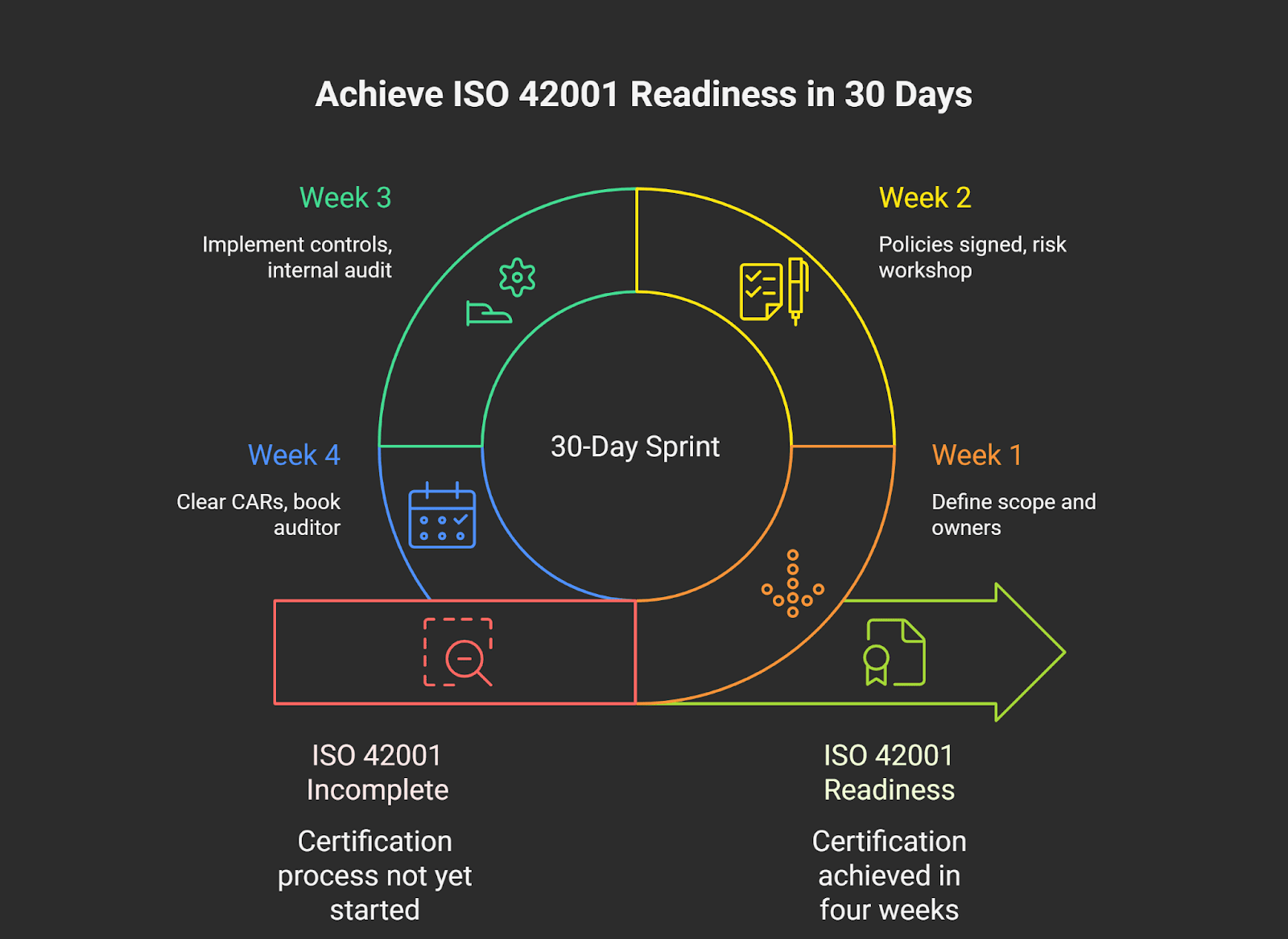
Early adopters show that automation can shrink an ISO rollout from six months to 30–45 days. Modern Health reached audit readiness in four weeks after wiring Vanta to its cloud stack. Use the sprint plan below as a template; expand the timeline if your environment is larger.
Week 1 – lock scope, assign owners, connect evidence feeds
- Define scope. List the AI systems, teams, and regions you will certify, then store the one-paragraph scope in the platform.
- Name owners. Map each clause to a person (for example, data governance → Bob, model release gates → Aisha).
- Integrate systems. Connect cloud, code repo, ticket queues, and HR. Close connector errors within 24 hours; without data flow, automation is only UI.
Outcome: scope approved, owners notified, and 90 percent or more of key integrations healthy.
Week 2 – publish core policies and seed the risk register
- Customize templates. Edit the AI policy, risk-assessment procedure, and model-lifecycle SOP from your platform, then secure executive signatures.
- Run a two-hour risk workshop. Brainstorm bias, drift, privacy, and safety hazards for each in-scope model; log likelihood and impact in the risk module.
- Link controls. Tie each critical risk to at least one draft control, such as a quarterly fairness test.
Outcome: living risk register started, critical risks linked to controls, policy set signed.
Week 3 – implement controls and rehearse an internal audit
- Close high-risk gaps. Enforce dataset versioning, add a mandatory reviewer to the deployment pipeline, and launch a 30-minute AI-ethics training in the LMS.
- Conduct a 30 percent sample internal audit. Use platform-stored evidence; failing controls create corrective-action tickets automatically.
Outcome: readiness score above 80 percent, all failed controls captured as open CARs.
Week 4 – clear CARs, hold management review, book the external audit
- Resolve CARs. Attach new evidence and mark tickets closed; the dashboard shows zero open findings.
- Management review. Use the platform's report—scope, objectives, top risks, internal-audit results, resource needs—and record decisions in signed minutes.
- Schedule auditor. Share a read-only portal; Stage 1 often shrinks to a desk review because evidence is pre-organized.
Outcome: scope, policies, risk register, controls, audit trail, management sign-off, and an audit date in place within 30 days.
Tip: if your company has more than 200 employees, or manages over five production models, add one extra week per 100 employees, or per additional model portfolio. Otherwise, the four-week sprint remains realistic with an automation platform.
Common mistakes and how to dodge them
Mistake 1: copy-pasting ISO 27001 controls
Security controls protect data, while ISO 42001 protects people. Reusing your ISMS word for word skips bias tests, human-in-the-loop checkpoints, and transparency logs. Reuse only the skeleton, such as policy structure and risk cadence, then add AI-specific controls like quarterly fairness reviews and drift monitors.
Mistake 2: scoping the whole company "just in case"
A 2024 BSI survey found that projects with oversized scope were 2.3 times likelier to miss their audit date. If you need a refresher on how enterprise risk management should drive scoping decisions, this overview of GRC vs. ERM—unified approach benefits clarifies how risk appetite and materiality determine what to include now vs. later. Certify the AI product lines that drive revenue or regulatory exposure first, and expand once processes mature.
Mistake 3: ignoring third-party models and data
A major portion of AI incidents involve external components. The 2024 Stanford AI Index report noted that the majority of reported AI model misuses since 2010 were deployed by industry, highlighting the risks in the application layer. Track every model, API, and dataset in your vendor register, collect attestations, and test them as thoroughly as internal assets. Shared responsibility is still responsibility.
Mistake 4: treating the internal audit as paperwork
Inadequate internal audits are a leading cause of certification failure. Analysis from certification bodies frequently shows that a failure to conduct thorough internal audits and subsequent management reviews is among the top reasons for non-conformance in management system certifications. Use platform sampling tools to surface real deficiencies early, then close them. A tough internal audit sets up a quiet external one.
Mistake 5: letting evidence rot between surveillance audits
Controls drift, and people forget. Continuous monitoring keeps dashboards green all year, turning the annual surveillance visit into a brief health check instead of a month-long scramble.
Platform, manual, or hybrid: which path fits your program?
*Timelines drawn from Vanta, OneTrust, and BSI consultant case studies, 2024.**Cost ranges reflect published SaaS pricing pages and average U.S. ISO-consultant day rates.
Rule of thumb: if you will certify more than one model or need the badge this quarter, a platform or hybrid route pays back fast. If you are piloting a single, low-impact model and have time, a consultant-led manual project can work; just budget for repeat effort at each surveillance cycle.
Next steps and further resources
- Short-list two platforms. Industry analysis suggests that a focused evaluation process is more efficient. For example, Gartner research indicates that creating a shortlist of two to four highly relevant vendors, rather than conducting a broad review, can significantly streamline the procurement process. Bring IT, data-science, and compliance leads to each call, and surface every integration or control gap in real time.
- Run a 14-day pilot. Connect at least five systems, import one policy, and schedule an internal-audit test. Use the result as a pass-or-fail yardstick.
- Reserve an auditor early. BSI and TÜV Süd quote six- to ten-week lead times for Stage 1 reviews. Share your target certification date, and confirm the auditor already works with your chosen platform; portal-familiar auditors save about twelve hours of evidence sampling.
- Download free starter kits. Most vendors publish ISO 42001 policy templates, risk catalogs, and management-review agendas. Even in a manual project, these assets cut drafting time by 30–40 percent.
- Join the community. LinkedIn's "ISO 42001 Implementers" group and the public Slack channel #responsible-ai-governance each host more than 1,000 members who trade lessons on bias metrics and auditor expectations. Crowd-sourcing answers beats solo trial-and-error.
Follow these steps, and you can move from research to a signed engagement letter in under 30 days, setting a smoother course to responsible-AI certification.